

“Has”, “have”, and “had” are three forms of one verb, and the subject and the time decide which one a sentence requires. “He has”, “we have”, “they had”. These three are harder than they look for one reason. The same forms fill two different positions: sometimes the verb is the main verb of the sentence, and sometimes it only builds a tense with the verb after it.
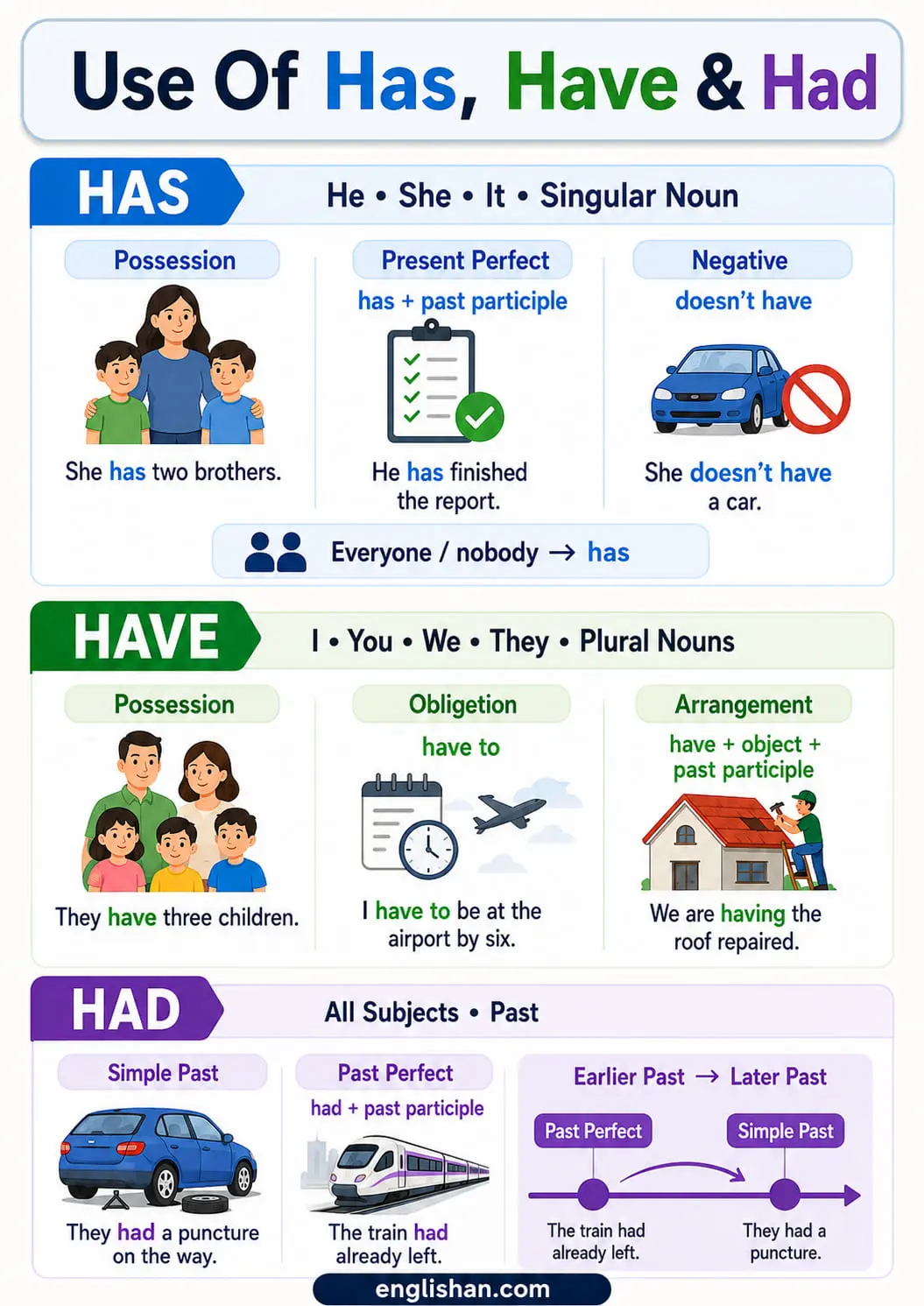
When To Use Has Have And Had
“Has”, “have”, and “had” are three forms of one verb, and what a sentence does with them depends on whether the form is the main verb or an auxiliary.
A main verb expresses the meaning of the sentence on its own. An auxiliary verb expresses no meaning of its own and builds a tense with the verb after it.
| Subject | Present | Past |
|---|---|---|
| I, you, we, they, a plural noun | have | had |
| He, she, it, a singular noun | has | had |
“Had” is used with every subject in the past, which is the one form of this verb that never varies by subject.
- She has two brothers.
- We have an appointment at four.
- They had a puncture on the way.
- He has finished the report.
- I have worked here since March.
- The train had already left.
- My colleagues have seen the figures.
- It has rained every day this week.
The first three sentences use the form as the main verb, and the last five use it as an auxiliary in front of a past participle.
The main verb uses: in the next four rules nothing follows the verb but an object, so the verb expresses the meaning itself.
Has And Have For Possession
As a main verb, “have” expresses possession, relationships, and physical characteristics.
- She has a flat in Bristol.
- They have three children.
- I have a headache.
- The house has a south-facing garden.
- We had a dog when I was small.
- He has dark hair and green eyes.
- The office has two entrances.
- My grandmother had a beautiful singing voice.
- Do you have a moment?
- The car had eighty thousand miles on it.
Where the alternative form applies: British English also uses “have got” for possession, so “She has got a flat in Bristol” expresses the same possession. The two forms differ in register and in how the question is built, never in meaning.
Have For Actions And Experiences
“Have” also precedes a noun that names an activity, and there the verb expresses almost no meaning of its own.
This use is called delexical have, meaning that the noun after the verb expresses the meaning rather than the verb itself. “Have a shower” means “shower”, and “have a look” means “look”.
- I have a shower every morning.
- We had lunch at the station.
- She had a look at the contract.
- They have a meeting every Monday.
- He had a nap after the flight.
- Let’s have a chat about it tomorrow.
- We had a lovely time in Kraków.
- I had a word with the manager.
- She has a swim before work.
- The children had a great time.
These sentences all describe activities rather than possession, which is why they occur in the continuous form freely: “I am having lunch” is correct, while “I am having a car” is not.
Have To And Had To For Obligation
“Have to” and “had to” express an obligation imposed from outside the speaker: a rule, a timetable, a law, or somebody else’s decision.
The negative changes the meaning rather than reversing it. “Don’t have to” means the obligation does not exist, which is different from a prohibition.
- I have to be at the airport by six.
- She has to wear a uniform at work.
- We had to queue for forty minutes.
- You don’t have to come if you are busy.
- He had to cancel the appointment.
- They have to submit the form by Friday.
- Do you have to work weekends?
- The children don’t have to wear a tie.
“Don’t have to come” means the choice is yours. “Mustn’t come” would forbid it, so the two negatives express opposite meanings.
Causative Have Something Done
In “I had my car repaired”, somebody else did the repairing, and the sentence never names them.
This is causative have, and its structure is “have” plus an object plus a past participle. It reports that you arranged for something to be done rather than doing it yourself.
- I had my car repaired last week.
- She has her hair cut every six weeks.
- We had the kitchen painted in June.
- They are having a new boiler fitted.
- He had his passport renewed.
- You should have that tooth looked at.
- We had the report translated into Portuguese.
- She had her bag stolen at the station.
The last sentence uses the same structure for something unpleasant that happened to her, which is the one reading where nobody arranged anything.
The auxiliary uses: in the next four rules a past participle follows the verb, so the verb expresses no meaning of its own.
Has And Have In The Present Perfect
In front of a past participle, “has” and “have” build the present perfect, which links a past action to the present moment.
The subject determines which one is used, exactly as before: “has” with a singular subject, “have” with a plural one. The past participle never changes.
- She has finished the report.
- They have moved to Aberdeen.
- I have never flown business class.
- The council has approved the plans.
- We have already eaten.
- He has lived here since 2019.
- Prices have risen twice this year.
- Have you spoken to her yet?
- The parcel has not arrived.
- My sisters have both applied.
The present perfect leaves the exact time unstated, which is why “I have seen her yesterday” fails and “I saw her yesterday” is correct.
Had In The Past Perfect
In front of a past participle, “had” builds the past perfect, which marks an action completed before another past action.
“Had” is used with every subject here, so the past perfect has no subject agreement at all.
- By the time we arrived, the play had started.
- She was angry, because someone had moved her files.
- He had never flown before that morning.
- They had already left when I called.
- I recognised the street, since I had lived there as a student.
- The pitch was unplayable, because it had rained all week.
- We had not been told about the change.
- Had you met him before the interview?
The word after “had” separates its two uses. A past participle means the past perfect, and anything else means “had” is the main verb: “I had a headache” is a past-simple sentence, and “I had taken an aspirin” is a past-perfect one.
Has Had Have Had And Had Had
Why does one sentence need two “hads” in a row?
The answer is that the two words are two different verbs. The first is the auxiliary, and the second is the past participle of the same verb. “Had had” is the past perfect of “have”, and “has had” and “have had” are the present perfect of “have”.
| Form | Tense | Example |
|---|---|---|
| Has had | Present perfect | She has had a cold all week. |
| Have had | Present perfect | We have had three offers already. |
| Had had | Past perfect | I had had a cold for days before I saw a doctor. |
- She has had the same car for twelve years.
- We have had no reply from the landlord.
- I had had enough by the second hour.
- He has had two operations this year.
- They had had a difficult journey.
- The company has had a strong quarter.
- She had had the flat inspected before she signed.
- Have you had breakfast?
- I have had this argument too many times.
- By March they had had four managers in a year.
The first word is the auxiliary and the second is the main verb, which is why the two are spelled alike. The same structure occurs with every other verb without drawing attention: “I had bought” is one auxiliary plus a different participle.
Has Been Have Been And Had Been
“Been” is the past participle of “be”, so “has been”, “have been”, and “had been” put “be” into a perfect tense.
Three constructions follow. In front of an adjective, a noun, or a place, the sentence describes a state. In front of an -ing form, it builds the present perfect continuous or the past perfect continuous. In front of a past participle, it builds the perfect passive, as in “The road has been closed”.
- She has been ill since Tuesday.
- We have been to Lisbon twice.
- He had been a teacher before he retrained.
- They have been waiting for an hour.
- I had been driving for six hours.
- The road has been closed all morning.
- Prices have been falling since spring.
- Had she been working there long?
“Have been to” and “have gone to” report different situations. “She has been to Lisbon” means she went and came back, and “She has gone to Lisbon” means she is still there.
The sentence forms and one restriction: the next four rules are the contracted forms, the negative, the question, and the one meaning that blocks the continuous.
Contractions With Has Have And Had
All three forms contract after a pronoun in speech and in informal writing, and each one reduces to a different ending.
| Full form | Contraction | Example |
|---|---|---|
| I have, you have, we have, they have | I’ve, you’ve, we’ve, they’ve | I’ve finished the report. |
| He has, she has, it has | He’s, she’s, it’s | She’s finished the report. |
| I had, she had, they had | I’d, she’d, they’d | She’d finished before we arrived. |
- I’ve worked here since March.
- We’ve had no reply from the landlord.
- They’ve moved to Aberdeen.
- She’s lived in Bristol since 2019.
- He’s already eaten.
- I’d never flown before that morning.
- They’d left by the time I called.
- You’ve met him before, haven’t you?
Two of these contractions stand for more than one word. “She’s” reduces both “she has” and “she is”, while “‘d” reduces both “had” and “would”. The word that follows resolves each one.
| Contraction | Followed by | Reads as |
|---|---|---|
| She’s | Past participle | She has finished |
| She’s | -ing form or adjective | She is finishing, she is ready |
| She’d | Past participle | She had finished |
| She’d | Base form | She would finish |
“She’d finished by six” is the past perfect, and “She’d finish by six” is a conditional.
Negative Forms Of Has Have And Had
The negative puts “not” directly after the auxiliary, and the main-verb use requires do-support instead: “do”, “does”, or “did” in front of “have”.
| Use | Negative | Example |
|---|---|---|
| Auxiliary | has not, have not, had not | She has not replied. |
| Auxiliary, contracted | hasn’t, haven’t, hadn’t | She hasn’t replied. |
| Main verb | do not have, does not have, did not have | She doesn’t have a car. |
| Main verb, British alternative | has not got, have not got | She hasn’t got a car. |
- She hasn’t replied to my email.
- We haven’t finished the accounts.
- They hadn’t told anyone.
- I don’t have any change.
- He doesn’t have a driving licence.
- We didn’t have time to check.
- The flat hasn’t got a lift.
- Haven’t you eaten yet?
Mixing the two rows is the common error. “She hasn’t a car” is old-fashioned but grammatical in British English, while “She hasn’t got a car” and “She doesn’t have a car” are what current speech uses.
Questions With Has Have And Had
How is a question built with these three forms?
The auxiliary use inverts: put “has”, “have”, or “had” in front of the subject. The main-verb use requires “do”, “does”, or “did” in front of the subject instead, and the main verb stays as “have”.
| Question | Short answer, yes | Short answer, no |
|---|---|---|
| Have you finished? | Yes, I have. | No, I haven’t. |
| Has she called? | Yes, she has. | No, she hasn’t. |
| Do you have a pen? | Yes, I do. | No, I don’t. |
| Had they left? | Yes, they had. | No, they hadn’t. |
- Has the delivery arrived?
- Have they signed the contract?
- Had you eaten before you left?
- Do you have her number?
- Does he have any allergies?
- Did they have a good journey?
- How long have you worked here?
- Why hadn’t anyone checked?
- “Have you seen the email?” “Yes, I have.”
- “Does she have a car?” “No, she doesn’t.”
The short answer repeats whichever word started the question. A question opening with “have” is answered with “have”, and a question opening with “do” is answered with “do”.
Stative Have And The Continuous Forms
“I am having a car” is impossible, and the reason is what the verb means rather than which tense the sentence needs.
A stative verb describes a state rather than an activity, and possessive “have” is stative. A state cannot be in progress, so it has no continuous form. Delexical “have” and causative “have” both describe activities, so both occur in the continuous freely.
- I am having a car. ❌
- I have a car. ✅
- She is having two brothers. ❌
- She has two brothers. ✅
- I am having lunch with Yusuf. ✅
- We are having the roof repaired. ✅
The last two sentences use the same verb and are correct, so the continuous form depends on the meaning rather than on the verb. A sentence describing something in progress uses the continuous form.
Subject Agreement With Has And Have
Which form follows a subject that is hard to count?
The rule is ordinary subject-verb agreement, the same one that governs every present-tense verb: a singular subject agrees with “has” and a plural subject agrees with “have”. What changes is how easy the subject is to identify.
- Everyone has signed in.
- Nobody has complained.
- Each of the rooms has its own thermostat.
- Neither of the applicants has replied.
- Either of those dates has worked before.
- The team has won every match. (both varieties)
- The team have all signed new contracts. (British)
- Several have already arrived.
- Both have been approved.
- The news has been good this week.
“Everyone”, “nobody”, “each”, “neither”, and “either” are indefinite pronouns, and every one of them is grammatically singular even though it refers to more than one, so “everyone has” and “neither has” agree in the singular. “Team” is a collective noun, and British English also accepts “the team have” where the members acted individually, while American English does not. “Several” and “both” are quantifiers standing in for a plural noun, so both agree with “have”.
Common Mistakes With Has Have And Had
Each error below is a correct rule applied in the wrong environment, so the correction depends on identifying the environment rather than on restating the rule.
- She have two brothers. ❌
- She has two brothers. ✅
- He has went home. ❌
- He has gone home. ✅
“Has” and “have” are followed by the past participle, not the past simple. “Go” is an irregular verb whose participle is “gone” rather than “went”, so “has went” is never possible.
- I have seen her yesterday. ❌
- I saw her yesterday. ✅
- I am having a headache. ❌
- I have a headache. ✅
- Do you has a pen? ❌
- Do you have a pen? ✅
- She hasn’t finished it, has she? ✅
- She hasn’t finished it, hasn’t she? ❌
A question tag reverses the polarity of the statement, so a negative statement is followed by a positive tag.
- I had had enough. ✅
- I have had had enough. ❌
- Everyone have arrived. ❌
- Everyone has arrived. ✅
- We had the car repair. ❌
- We had the car repaired. ✅
- By six o’clock, they have already left. ❌
- By six o’clock, they had already left. ✅
Has Have And Had Chart
| Structure | Form | What it expresses | Example |
|---|---|---|---|
| Has or have + object | Main verb | Possession, relationship, characteristic | She has two brothers. |
| Has or have + activity noun | Main verb, delexical | An activity | We have lunch at one. |
| Has or have to + base form | Obligation | An outside requirement | I have to leave now. |
| Has or have + object + past participle | Causative | Something arranged | She has her hair cut. |
| Has or have + past participle | Present perfect | A past action linked to now | He has finished. |
| Had + object | Main verb, past simple | Past possession or activity | I had a headache. |
| Had + past participle | Past perfect | An action before another past action | I had taken an aspirin. |
| Has or have had | Present perfect of have | A state or activity continuing to now | She has had a cold all week. |
| Had had | Past perfect of have | A state or activity before a past point | I had had enough by then. |
| Has, have, or had been + adjective | Perfect of be | A state across time | He has been ill. |
| Has, have, or had been + ing | Perfect continuous | A duration | They have been waiting. |
The word directly after the form identifies the use. An object indicates the main verb and a past participle indicates an auxiliary, and every row in the chart follows from that one word.
FAQs
Q1. Can “has” and “have” appear in the same sentence?
Yes, whenever two subjects with different numbers appear together. “My sister has replied but her colleagues have not” is correct, because each verb agrees with its own subject. A single subject can also agree with both across two clauses, as in “She has had the flat since 2020 and they have had theirs longer”.
Q2. Is it “she should have” or “she should has”?
It is “she should have”, and the same rule governs every modal verb. A modal is followed by the base form, and the base form of this verb is “have”, so “she must have”, “he could have”, and “they will have” are all correct. The structure “have” plus a past participle after a modal is the perfect infinitive, as in “she must have left”. “Should has” is never possible, whatever the subject.
Q3. How do “has”, “have”, and “had” differ from “do”, “does”, and “did”?
Both sets are auxiliary verbs, and they build different structures. “Has”, “have”, and “had” are followed by a past participle and build the perfect tenses, as in “She has finished”. “Do”, “does”, and “did” are followed by a base form and build negatives, questions, and emphasis in the simple tenses, as in “She didn’t finish”. The two never combine as auxiliaries in the same clause.
Q4. How can you remember when to use “had had”?
Use “had had” when the having itself ended before another past event. “I had had a cold for days before I saw a doctor” places the illness earlier than the visit, so the main verb “have” is in the past perfect. Where no earlier past point exists in the sentence, “I had a cold” is the correct form.
Q5. Is “I have had had” ever correct?
No, three forms of the same verb in a row is never grammatical. The present perfect of “have” is “have had”, and the past perfect is “had had”, and no tense adds a third. Where a sentence looks as though it needs a third, the tense is wrong rather than the number of words.
Q6. Are contractions with “has”, “have”, and “had” acceptable in formal writing?
Contractions are standard in emails, blog writing, and most business correspondence, and they are avoided in academic essays, legal documents, and formal reports. Write “she has not replied” rather than “she hasn’t replied” in those contexts. The full form is never wrong, so it is the safe choice when the register is uncertain.
Q7. Can “had” refer to present time?
Not on its own, since “had” is a past form. It refers to present time only inside a conditional or an unreal structure, as in “If I had more time, I would help” and “I wish I had a car”, where the past form marks unreality rather than past time. Everywhere else, “had” places the situation in the past.
Q8. Is “I have got” the same as “I have”?
For possession they are equivalent in meaning, and they differ in register and in form. “I have got a car” is common in British speech and informal writing, and “I have a car” is the neutral form used everywhere including American English. The negative and the question are built differently: “I haven’t got a car” against “I don’t have a car”.
Q9. What is the difference between the past perfect and the past simple?
The past simple reports an event in the past, and the past perfect reports an event that happened before it. “I ate at six” places one event, while “I had eaten by six” places it before a later past point. The past perfect is needed only when the order of events is not already obvious from the sentence.
Q10. What happens to “has” and “have” in reported speech?
Both become “had”, which is the backshift that reported speech applies to the present perfect. “She has finished” becomes “She said she had finished”, and “They have moved” becomes “He told me they had moved”. “Had” itself does not shift a second time, so “I had eaten” stays as “had eaten” inside the report.
Q11. What does “had better” mean?
“Had better” gives advice with a consequence attached, and it is followed by the base form, as in “You had better leave now”. The contracted “You’d better leave now” is the usual spoken form, and the negative is “had better not” rather than “hadn’t better”. The past form carries no past meaning here, since “had better” refers to the present and the future.