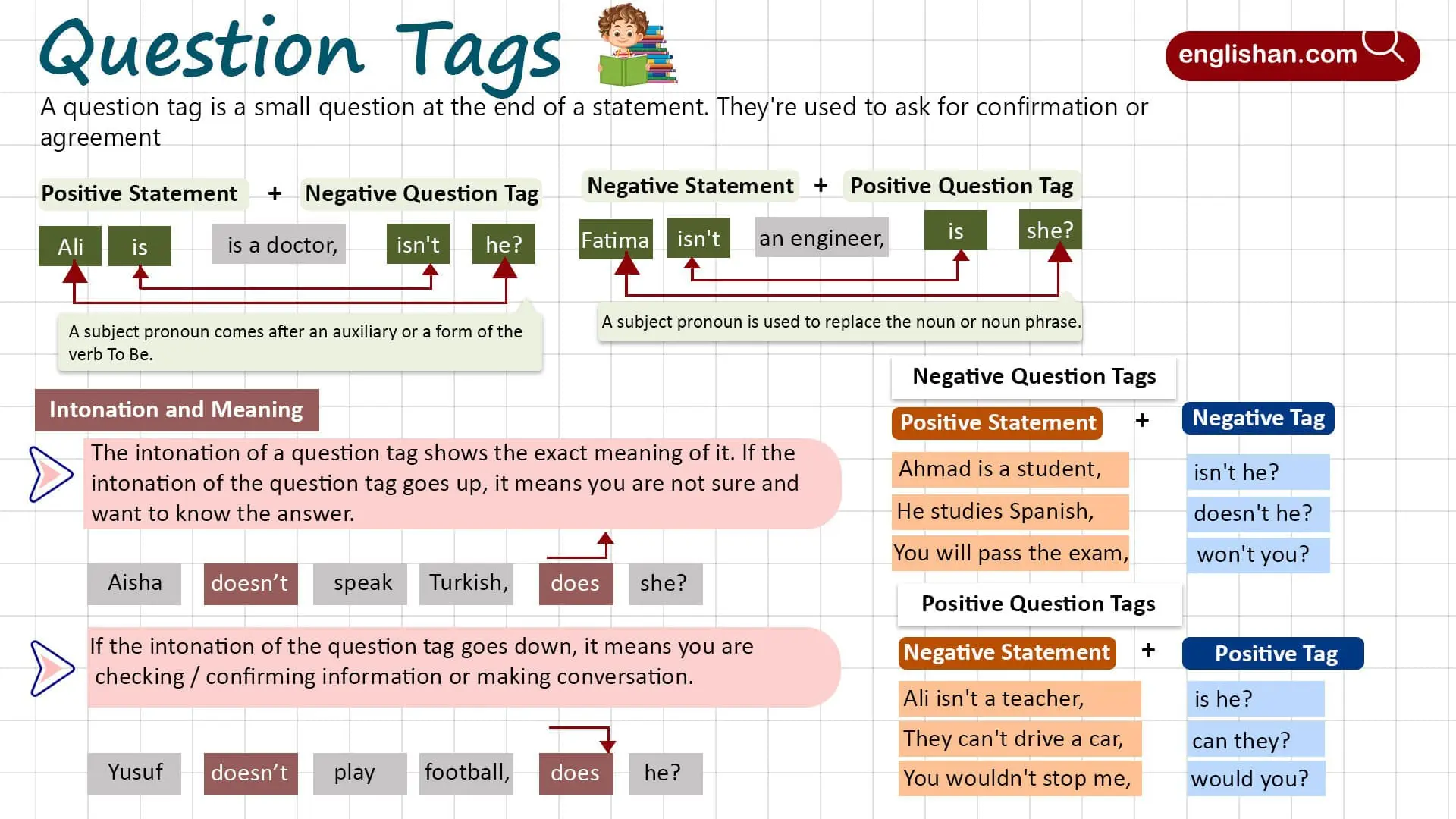
What Are Question Tags in English?
A question tag is a small question added to the end of a statement. It’s often used in conversations to check if something is true or to get a response. In English, question tags make statements more interesting or help check if the listener agrees. The structure usually repeats the auxiliary or modal verb from the main sentence and matches it to the subject.
Examples of Question Tags
Question tags can be added to different kinds of sentences:
- You’re coming to the party, aren’t you? ✅
- She doesn’t like coffee, does she? ✅
- Ahmed is at home, isn’t he? ✅
In these examples, the question tag repeats the auxiliary or modal verb to match the main statement.
How to Form a Question Tag
To form a question tag, start by identifying the verb in the main sentence. A question tag has the opposite meaning of the statement:
- For positive statements, use a negative question tag.
- For negative statements, use a positive question tag.
Example
Ahmed can help us, can’t he?
In this sentence, the main part is positive, so the question tag is negative.

Types of Question Tags
Positive Question Tags
These are used after negative statements to confirm or clarify information. They help make sure that the listener agrees or understands.
A positive question tag follows a negative statement. It uses the auxiliary or modal verb from the main sentence, and the subject is repeated.
- Example: You don’t like mangoes, do you?

Negative Question Tags
These are used after positive statements to seek agreement or to check if the listener feels the same way.
A negative question tag follows a positive statement. It uses the auxiliary or modal verb from the main sentence, and the subject is repeated with a negative form.
- Example: She loves reading, doesn’t she?

There are some exceptions to this rule, like with imperative sentences. Here are some examples:
- Let’s go to the park, shall we? ✅
- Close the door, won’t you? ✅
In these cases, the question tag is used to be polite or encouraging.
Common Mistakes
Learners often make mistakes when forming question tags, either by choosing the wrong verb or by mismatching the polarity. Here are some common errors:
- She can play piano, doesn’t she? ❌
- Correct: She can play piano, can’t she? ✅
- You aren’t ready, is you? ❌
- Correct: You aren’t ready, are you? ✅
Remember, the verb in the tag must always match the main verb, and the polarity must be opposite.
When to Use Question Tags in Conversations
Question tags are mostly used in informal spoken English to confirm or seek agreement. They help the speaker make sure the listener is following along or shares the same opinion. Here are some contexts where they are used:
- Expressing doubt: You’re not serious, are you?
- Seeking agreement: We had a great time, didn’t we?
- Politeness: Pass the salt, won’t you?
Question Tags Chart for Different Subjects
| Subject | Positive Question Tag Example | Negative Question Tag Example |
|---|---|---|
| I | I’m not late, am I? | I am on time, aren’t I? |
| You | You don’t like mangoes, do you? | You like mangoes, don’t you? |
| He | He didn’t go to school, did he? | He went to school, didn’t he? |
| She | She doesn’t know the answer, does she? | She knows the answer, doesn’t she? |
| They | They aren’t happy, are they? | They are happy, aren’t they? |
| It | It is raining, isn’t it? | It isn’t raining, is it? |
| Doctor | The doctor isn’t available, is he? | The doctor is available, isn’t he? |
| Father | Your father isn’t coming, is he? | Your father is coming, isn’t he? |
Question Tags Chart for Helping Verbs
| Helping Verb | Positive Question Tag Example | Negative Question Tag Example |
| Is | The cat isn’t hungry, is it? | The cat is hungry, isn’t it? |
| Are | We aren’t late, are we? | We are late, aren’t we? |
| Was | She wasn’t here, was she? | She was here, wasn’t she? |
| Were | They weren’t wrong, were they? | They were wrong, weren’t they? |
| Has | Ahmed hasn’t arrived, has he? | Ahmed has arrived, hasn’t he? |
| Have | They haven’t left, have they? | They have left, haven’t they? |
| Had | He hadn’t had breakfast, had he? | He had breakfast, hadn’t he? |
| Will | They won’t succeed, will they? | They will succeed, won’t they? |
| Shall | We shan’t meet, shall we? | We shall meet, shan’t we? |
| Must | He mustn’t forget, must he? | He must remember, mustn’t he? |
| Need | She needn’t worry, need she? | She needs to go, doesn’t she? |
Question Tags Chart for Modal Verbs
| Modal Verb | Positive Question Tag Example | Negative Question Tag Example |
| Can | She can’t sing, can she? | She can sing, can’t she? |
| Could | You couldn’t help, could you? | You could help, couldn’t you? |
| Will | He won’t join us, will he? | He will join us, won’t he? |
| Would | They wouldn’t leave, would they? | They would leave, wouldn’t they? |
| Should | We shouldn’t go, should we? | We should go, shouldn’t we? |
| Might | He might not come, might he? | He might come, mightn’t he? |
| Must | She mustn’t stay, must she? | She must leave, mustn’t she? |
| Ought to | You ought not to wait, ought you? | You ought to go, oughtn’t you? |
| Need to | He needn’t stay, need he? | He needs to go, doesn’t he? |
Summary
Question tags are a helpful part of English grammar that can make statements clearer or more interesting, especially in conversations. Understanding the types, rules, and differences between positive and negative tags is important for using them correctly. Practicing with different verbs can help you get better at this, and avoiding common mistakes will make communication easier.
FAQs
A tag in English is a short question at the end of a sentence to check if something is true or to get confirmation.
Example:
You’re coming, aren’t you?
(The tag is “aren’t you?” asking if it’s true.)
Another example:
She likes ice cream, doesn’t she?
(The tag is “doesn’t she?” asking for confirmation.)
Tags are used to check if something is correct or to ask someone to agree.
Here are 10 simple examples of question tags:
1. You’re coming, aren’t you?
2. She’s done, hasn’t she?
3. They like pizza, don’t they?
4. It’s a nice day, isn’t it?
5. You don’t mind, do you?
6. He can swim, can’t he?
7. We’ve met, haven’t we?
8. She’s not well, is she?
9. They’re outside, aren’t they?
10. This is your book, isn’t it?
Question tags help check if something is true or ask for confirmation.
Tags in English are short questions added at the end of statements to ask for confirmation or agreement.
Examples of tags:
1. You’re going to the store, aren’t you?
2. She’s your friend, isn’t she?
3. We’re meeting at 5, aren’t we?
4. It’s a beautiful day, isn’t it?
5. You like chocolate, don’t you?
The tags are aren’t you, isn’t she, aren’t we, isn’t it, and don’t you in these examples. Tags make sure the listener agrees or confirms what was said.
A name tag is a label that shows a person’s name, usually worn on clothing. It helps others identify them easily.
A tag set in English is a list of labels used to classify words in a sentence. These labels show what type of word it is, like a noun, verb, or adjective.
For example:
NN = noun
VB = verb
JJ = adjective
Tag sets are used to analyze and understand how sentences are built.
Read More
Question Tags Quiz
Question Tags
Complete the tag.
You are coming, ___?
A positive statement takes a negative tag with a matching pronoun.
positive statement -> negative tag
You are coming, aren't you?
Complete the tag.
She isn't here, ___?
A negative statement takes a positive tag with a matching pronoun.
negative statement -> positive tag
She isn't here, is she?
Complete the tag.
He can swim, ___?
The modal 'can' returns as 'can't' in a negative tag.
the tag repeats the auxiliary or modal
He can swim, can't he?
Complete the tag.
They don't know, ___?
A negative statement takes a positive tag with the matching auxiliary.
negative statement -> positive tag
They don't know, do they?
Complete the special tag.
I am late, ___?
'I am' takes the fixed tag 'aren't I'.
'I am' -> 'aren't I'
I am late, aren't I?
Complete the tag.
You like tea, ___?
A present-simple statement takes 'don't you' as the negative tag.
present simple -> do/does tag
You like tea, don't you?
Complete the tag for an imperative.
Open the window, ___?
An imperative commonly takes the tag 'will you'.
imperative -> 'will you'
Open the window, will you?
Complete the tag.
She has finished, ___?
The auxiliary 'has' returns as 'hasn't' in the negative tag.
the tag repeats the auxiliary
She has finished, hasn't she?
True or false?
A positive statement usually takes a negative question tag.
A positive statement pairs with a negative tag, as in 'You are ready, aren't you?'
positive -> negative tag
It is warm, isn't it?
Complete the tag.
We should leave, ___?
The modal 'should' returns as 'shouldn't' in the negative tag.
the tag repeats the modal
We should leave, shouldn't we?
Complete the tag for 'let's'.
Let's start, ___?
A 'let's' suggestion takes the tag 'shall we'.
'let's' -> 'shall we'
Let's start, shall we?
Complete the tag.
He didn't call, ___?
A negative statement takes a positive tag with the matching auxiliary.
negative statement -> positive tag
He didn't call, did he?
Complete the tag.
You have seen it, ___ you?
The auxiliary 'have' returns as 'haven't' in the negative tag.
the tag repeats the auxiliary
You have seen it, haven't you?
Complete the tag with 'there'.
There is a problem, ___?
With 'there is', the tag keeps 'there': 'isn't there'.
'there is' -> 'isn't there'
There is a problem, isn't there?
Complete the tag.
You were tired, ___?
The past 'were' returns as 'weren't' in the negative tag.
the tag repeats the auxiliary
You were tired, weren't you?
Complete the tag.
Nobody called, ___?
'Nobody' takes the plural 'they' and a positive tag after a negative sense.
'nobody' -> 'they' with a positive tag
Nobody called, did they?
Complete the tag.
It will rain, ___?
The modal 'will' returns as 'won't' in the negative tag.
the tag repeats the modal
It will rain, won't it?
True or false?
A question tag repeats the auxiliary or modal from the main clause.
The tag echoes the auxiliary or modal, as 'can' returns in 'can't he'.
tag repeats the auxiliary/modal
She has left, hasn't she?
Complete the tag.
You won't forget, ___?
A negative statement takes a positive tag with the matching modal.
negative statement -> positive tag
You won't forget, will you?
Complete the tag.
Everyone enjoyed it, ___?
'Everyone' takes the plural 'they' and a negative tag after a positive statement.
'everyone' -> 'they' with a matching tag
Everyone enjoyed it, didn't they?
Turn on JavaScript for the interactive quiz. The full practice set is shown above.