Delexical verbs are common verbs, such as “have”, “take”, “make”, “give”, “go”, and “do”, that add no meaning of their own when they combine with a noun. In “I had a drink”, the lexical content, the meaning of the action, is in the noun “drink”, and “had” marks only the past tense. Each of the six verbs goes with its own set of nouns. That pairing is fixed by collocation rather than by the verb’s ordinary meaning, which is why “have a shower” is right and “have a phone call” is not. That pairing is what there is to learn, one verb at a time.
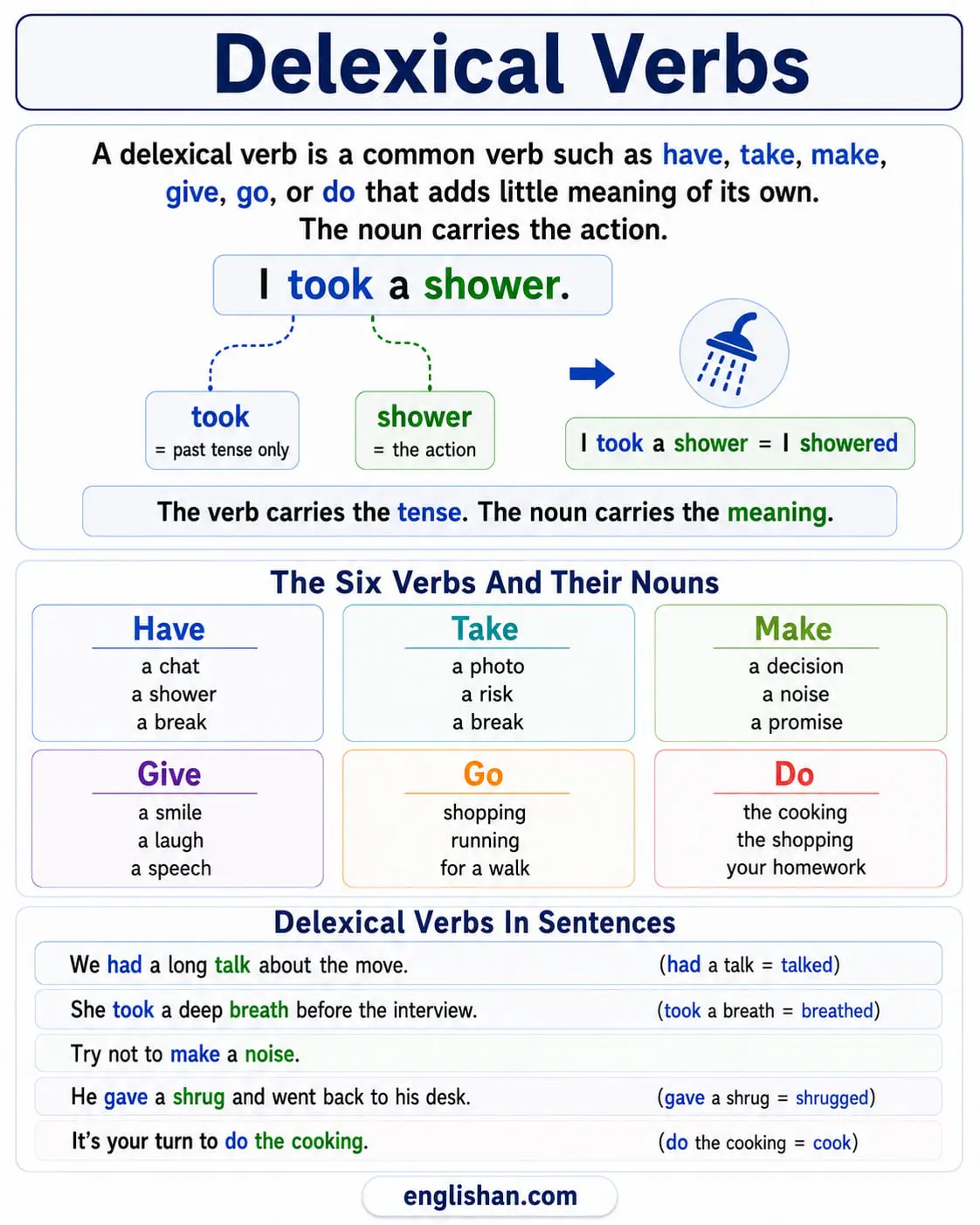
Delexical verbs are common verbs that lose their own meaning when they combine with a noun, so the lexical content passes to the noun after them. “She had a drink” means “she drank”, and “he took a photograph” means “he photographed”. The six delexical verbs of learner grammar are “have”, “take”, “make”, “give”, “go”, and “do”.
To remember:
- “Go” is the one verb of the six that takes no article: “go shopping”, “go for a walk”.
- “Make” goes with result nouns and “do” with activity nouns, and the exceptions are learned one by one.
- Each verb goes with its own set of nouns, and the pairing is fixed by collocation.
- The noun takes an article and accepts an adjective, so “have a quick chat” is more natural than “chat quickly”.
- “Have a shower” and “take a shower” are both correct; British English prefers “have” and American English prefers “take”.
What A Delexical Verb Is
In “I took a shower”, the verb “took” adds no meaning of its own, and the noun “shower” carries the lexical content. The whole phrase means the same as the single verb “showered”. A delexical verb phrase is therefore a verb plus a noun in which the verb is semantically bleached, emptied of its own meaning, and marks only the tense and the agreement. In linguistics the same verbs are called light verbs, and both names refer to one construction.
The lexical content is in the noun, and the verb marks tense and agreement. The pairing of verb and noun is fixed by collocation, the established co-occurrence of two words, rather than by the verb’s ordinary sense. That is why each of the six verbs goes with its own set of nouns and not with the others. They are not weak verbs in the grammatical sense; that term names verbs with a regular past tense, which is a different classification.
- She had a chat with the neighbour over the fence.
Here “had” is semantically bleached, and “chat” carries the lexical content; the single verb “chatted” says the same.
- She took a photograph of the harbour at dusk.
- We made a decision about the flat that evening.
- He gave a shrug and went back to his desk.
- They went shopping on the first day of the sale.
A substitution test identifies a delexical verb. Replace the verb and its noun with the single verb formed from that noun: “had a drink” becomes “drank”, and “took a photograph” becomes “photographed”. If the sentence keeps the same meaning after the substitution, the verb is delexical.
Issue 1: The ordinary meaning of “have” read into the delexical use
- I have hungry. ❌ “Hungry” is an adjective, not a noun, so there is no delexical phrase here; states such as hunger, age, and fear take “be” in English.
- I am hungry. ✅
Read the noun, not the verb: in “have a drink”, “take a look”, and “make a promise”, the lexical content is drinking, looking, and promising.
The Noun Phrase After The Verb
A delexical verb takes a noun phrase as its object, and that noun phrase opens with a determiner, most often the indefinite article “a” or “an”. The article is required: “have a rest”, never “have rest”. An adjective, where the speaker adds one, is placed between the article and the noun as an attributive adjective, so “have a long rest” keeps the same structure with one word added.
- I had a long talk with my sister about the move.
The adjective “long” is the reason for the phrase: “I talked at length” is marked, and “I talked long” is ungrammatical.
- She took a deep breath before the interview.
- He made a quiet suggestion at the end of the meeting.
- The dog gave a low growl when the gate opened.
- We had a wonderful, lazy holiday in Crete.
The adjective is the advantage of the delexical phrase over the single verb. An adjective before the noun is easier to add than an adverb after the verb, so “have a quick chat” is preferred to “chat quickly”, and “give a loud laugh” to “laugh loudly”.
Issue 1: The determiner left out
- I had rest after lunch. ❌ The noun in a delexical phrase takes a determiner, so “a” goes in front of “rest”.
- I had a rest after lunch. ✅
Write the determiner every time: “have a rest”, “take a break”, “make a comment”, and put the adjective after it: “have a short rest”.
The Six Delexical Verbs And Their Collocates
Each of the six verbs takes its own families of collocates, the nouns that regularly occur with it, and the families overlap in two places only. Washing and resting nouns take “have” or “take”, and the nouns for plans and work are divided between “make” and “do”. Every other family belongs to one verb.
Have With Meals, Talks, And Showers
“Have” goes with meals, talking, washing, resting, disagreeing, and with nouns formed from verbs. It is the verb with the largest range of collocates, and the most frequent of the six in British English.
| Noun family | Nouns after have |
|---|---|
| Food and drink | A meal, breakfast, lunch, dinner, a snack, a coffee, a cup of tea |
| Talking | A chat, a talk, a conversation, a discussion, a word |
| Washing | A bath, a shower, a wash |
| Resting | A break, a rest, a holiday, a lie-down |
| Disagreeing | An argument, a fight, a quarrel, a row |
| Nouns from verbs | A look, a bite, a drink, a swim, a listen, a try |
- We had lunch at the little place by the station.
Meal nouns are uncountable and take no article: “have lunch”, “have breakfast”. They become countable once an adjective is added: “have a big lunch”.
- Can I have a word with you before you go?
- The kids had a bath and were asleep by eight.
- I had a quick look at the report on the train.
- They had a row about whose turn it was to cook.
- She had a swim before breakfast every day of the trip.
- Have a rest; the rest of the boxes will wait.
Watch for the noun: “have a drink” is the delexical use, and “have a car” is the ordinary verb meaning own.
Take With Care, Risks, And Photos
“Take” goes with washing and resting, with a fixed set of nouns such as care, a risk, a chance, a decision, and a photograph, and with nouns formed from verbs of movement.
| Noun family | Nouns after take |
|---|---|
| Washing and resting | A shower, a bath, a break, a rest, a nap, a holiday |
| Fixed nouns | Care, care of, a turn, trouble, a chance, a risk, a decision, a photograph, a seat, a call |
| Nouns from verbs | A look, a walk, a swim, a sip, a step |
- I take a shower before work and a bath at the weekend.
- You look exhausted; take a break and come back after lunch.
- We took hundreds of photos on the first day and none after that.
- He took a chance on the smaller company, and it paid off.
- Take a seat; the doctor will be with you in a moment.
- Let’s take a walk along the river before dinner.
“Take” and “make” split one noun by meaning: “make a call” is to ring somebody, and “take a call” is to answer. “Decision” goes with both verbs as well: “make a decision” is the commoner form, and “take a decision” is British and formal.
Make With A Noise, A Promise, And A Decision
“Make” goes with talking and sounds, and with plans and arrangements. The ordinary sense of “make”, to create, is still faintly present, which is why the nouns after it are result nouns, nouns for what the action produces: a noise, a promise, a plan.
| Noun family | Nouns after make |
|---|---|
| Talking and sounds | A comment, an enquiry, a noise, a point, a promise, a sound, a speech, a suggestion, a call, a complaint |
| Plans | Arrangements, a choice, a decision, a plan, an appointment, a date |
| Other fixed nouns | A mistake, an effort, an excuse, progress, money, friends |
- Try not to make a noise; the baby has only just gone down.
- I made an appointment for Thursday at ten.
- She made a good point about the delivery costs.
- We made arrangements to meet outside the cinema.
- He made a mistake on the form and had to start again.
Issue 1: “Do” used where the noun takes “make”
- I did a mistake on the form. ❌ A mistake, a decision, and a promise are result nouns, so they take “make”; “do” takes activity nouns, nouns for work and tasks.
- I made a mistake on the form. ✅
Write “make” before a mistake, a decision, a promise, a noise, and an appointment.
Give With Laughs, Looks, And Speeches
“Give” goes with noises, facial expressions, hitting, affectionate actions, and speech, and it takes an indirect object where the action is directed at somebody: “give her a hug”.
| Noun family | Nouns after give |
|---|---|
| Noises | A cry, a laugh, a scream, a shout, a sigh, a whistle |
| Facial expressions | A smile, a grin, a look, a glance, a frown |
| Hitting | A kick, a punch, a slap, a push, a knock |
| Affectionate actions | A hug, a kiss, a wave, a pat |
| Speech | Advice, an answer, information, an interview, a lecture, a speech, a talk, a warning |
- She gave a loud laugh at the end of the story.
- He gave me a strange look and said nothing.
- The referee gave the defender a warning for the tackle.
- I have to give a speech at my brother’s wedding.
- The toddler gave the door a kick and burst into tears.
- She gave everyone a wave from the train window.
Issue 1: “Give” used where the noun takes “have” or “take”
- Give a look at this report. ❌ “Look” goes with “have” or “take”; “give a look” is unidiomatic, and only the informal “give it a look” is attested.
- Have a look at this report. ✅
Write “give” before a laugh, a smile, a kick, a hug, and a speech, and “have” or “take” before a look.
Go Shopping And Go For A Walk
“Go” goes with “-ing” nouns that name activities and, in the form “go for a”, with nouns that name movement. Unlike the other five, it takes no article before the “-ing” noun.
| Structure | Nouns after go |
|---|---|
| Go plus -ing | Shopping, swimming, running, walking, dancing, skiing, fishing, camping |
| Go for a | A walk, a run, a jog, a swim, a ride, a stroll, a drive |
- We usually go walking in the hills at the weekend.
“Go walking” names the activity in general; “go for a walk” is a countable noun phrase naming a single event, and both are correct.
- Mum’s out; she’s gone shopping.
- Shall we go for a swim before the pool gets busy?
- He goes running every evening after supper.
- Let’s go for a drive while the roads are quiet.
Write “go” plus the “-ing” noun for the activity in general, and “go for a” plus the countable noun for a single event.
Do With The Cooking, The Shopping, And Homework
“Do” goes with work, especially work in the house, and with nouns whose associated action is predictable from the noun itself. Most of its nouns take “the” or a possessive rather than “a”.
| Noun family | Nouns after do |
|---|---|
| Work in the house | The cooking, the washing up, the shopping, the ironing, the cleaning, the dishes |
| Work and tasks | Homework, a job, some work, business, an exercise, a course |
| Obvious actions | Your hair, your teeth, your nails, the car, the garden |
- It’s your turn to do the cooking tonight.
- I can’t come out; I have a lot of work to do.
- Have you done your teeth?
“Done your teeth” means cleaned them, because the action is recoverable from the noun.
- She did a course in bookkeeping last winter.
- Who’s going to do the dishes after all that?
Where the noun names a task or a chore, write “do”: “do the shopping”, “do your homework”, “do the garden”.
Make Or Do
“Make” goes with result nouns, and “do” goes with activity nouns, the nouns for work, tasks, and general activity. That is a tendency, not a rule, and a short set of nouns goes the other way. So “make a plan” and “make a decision” take result nouns, while “do the shopping” and “do your homework” take activity nouns. The exceptions are learned one by one: “make the bed” is housework but takes “make”, “do a favour” and “do harm” take “do”, and “do business” takes “do”.
| Noun | Verb | Why |
|---|---|---|
| A mistake, a decision, a promise, a noise, an effort | Make | Result noun |
| The shopping, the cooking, homework, a job, an exercise | Do | Activity noun |
| The bed, money, friends, progress | Make | Fixed exceptions |
| A favour, harm, business, your best | Do | Fixed exceptions |
- I made a promise and I intend to keep it.
- We did the shopping on the way home.
- She made progress with the report before the deadline.
- He did me a favour and picked up the parcel.
- They made the bed and opened the window.
- Do your best; nobody will ask for more.
Ask whether the noun is a result noun or an activity noun. A result noun takes “make”, an activity noun takes “do”, and the fixed exceptions in the table are learned one by one.
Have Or Take
“Have” and “take” both go with washing and resting nouns, and the choice between them is a matter of variety. British English writes “have a shower”, “have a bath”, and “have a break”; American English writes “take a shower”, “take a bath”, and “take a break”. Both are correct in both varieties, so the choice is one of collocation frequency rather than grammar.
- I’ll have a quick shower and be down in five minutes.
- She took a long bath after the hike.
- We had a break at eleven and went back to it.
- Take a break; you’ve been at that screen since eight.
Where the noun names a meal or a drink, “have” is the usual verb in both varieties: “have lunch”, “have a coffee”. “Take a coffee” is heard in American English and in speech influenced by other languages, and it is marked in British English.
Write “have” in British English and “take” in American English for a shower, a bath, and a break, and “have” for meals and drinks everywhere.
Delexical Phrase Or Single Verb
A delexical phrase and its single verb mean the same, and the choice between them is one of register and of what you want to add. The phrase belongs to informal spoken register, takes an attributive adjective without effort, and names one complete act. The single verb is more concise and belongs to formal written register, the form for a report or an instruction.
- We had a chat about the schedule. / We chatted about the schedule.
The phrase is the spoken form; the single verb is the form for the minutes of the meeting.
- She gave a sigh and closed the laptop. / She sighed and closed the laptop.
- I took a look at the figures. / I looked at the figures.
- He made a complaint to the manager. / He complained to the manager.
- They had an argument about money. / They argued about money.
- Can I have a word with you? / Can I speak to you?
Issue 1: The adjective turned into an adverb that does not exist
- He likes to look longly before he tries anything. ❌ “Long” forms no adverb of manner, so the adjective stays inside the delexical phrase.
- He likes to have a long look before he tries anything. ✅
Use the phrase in informal speech and where you want an attributive adjective, and the single verb in formal writing and where concision matters.
Delexical Do And Auxiliary Do
Delexical “do” is followed by a noun and means the work named by that noun: “do the cooking”. Auxiliary “do” is followed by a bare verb and adds no meaning at all; it forms a question, a negative, or an emphatic statement, which is do-support. The two appear together in one clause, and the first is always the auxiliary.
- Did you do the shopping on the way home?
The first “did” is the auxiliary of the question; “do the shopping” is the delexical phrase.
- She doesn’t do the ironing on a Sunday.
- What does your brother do for a living?
- I did do my homework; it’s in my bag.
To tell them apart, look at what follows. A noun after “do” means the delexical use; a bare verb after “do” means the auxiliary.
The Substitution Test For Delexical Verbs
Two checks decide any sentence. First, apply the substitution test: replace the verb and its noun with the single verb formed from that noun, and if the meaning is unchanged, the verb is delexical. Second, read the noun; where it is an action noun, an event noun, or a sound noun rather than a concrete noun, the verb before it is delexical. Where neither check works, the verb is a main verb with its ordinary meaning.
She had a coffee in the square: “had a coffee” becomes “drank a coffee”, and “coffee” names something drunk, so “had” is delexical.
She has a coffee shop in the square: no single verb fits, and “shop” is a concrete noun, so “has” means owns.
He made a comment on the design: “made a comment” becomes “commented”, so “made” is delexical.
He made a table for the kitchen: no single verb fits, and “table” is a concrete noun, so “made” means built.
Apply the substitution test to your own sentence before you choose the verb. Where the test succeeds, choose the verb that collocates with that noun rather than the verb suggested by its ordinary lexical meaning.
Related: 20 Types of Verbs in English with Examples and Rules
FAQs
Q1. Are delexical verbs the same as light verbs?
Yes, they are one construction under two names. Delexical verb is the name to use when you are learning or teaching English, and light verb is the same thing described in linguistics. Whichever name your course uses, the rule is identical: the noun carries the lexical content and the verb marks the tense.
Q2. How many delexical verbs are there in English?
There are six delexical verbs to learn: “have”, “take”, “make”, “give”, “go”, and “do”. Three more behave the same way in a handful of fixed phrases, “get a grip”, “keep a record”, and “set an example”, so count them as delexical when you meet them, and learn the six first.
Q3. Is “take a decision” correct?
Yes, “take a decision” is correct, and it is the British and formal form. “Make a decision” is the form to write in ordinary English, in both British and American usage, because it is the commoner of the two. Read “take a decision” as correct when you meet it, and write “make a decision” yourself.
Q4. Is “I’m having a tea” correct?
Yes, and it means something different from “I’m having tea”. Without the article, “tea” is an uncountable noun naming the meal or the occasion; with it, “a tea” is a countable unit noun naming one serving. The countable form is the one for ordering at a counter. “Coffee” works in the same two ways; every other drink takes the article: “a beer”, “a juice”.
Q5. What is the difference between delexical verbs and phrasal verbs?
The difference is what follows the verb. A delexical verb is followed by a noun that carries the lexical content: “take a photo” means photograph. A phrasal verb is followed by a particle that changes the verb’s meaning: “take off” means leave or remove. If the word after “take” is a noun, the verb is delexical; if it is a particle such as “off”, “up”, or “in”, the verb is phrasal.