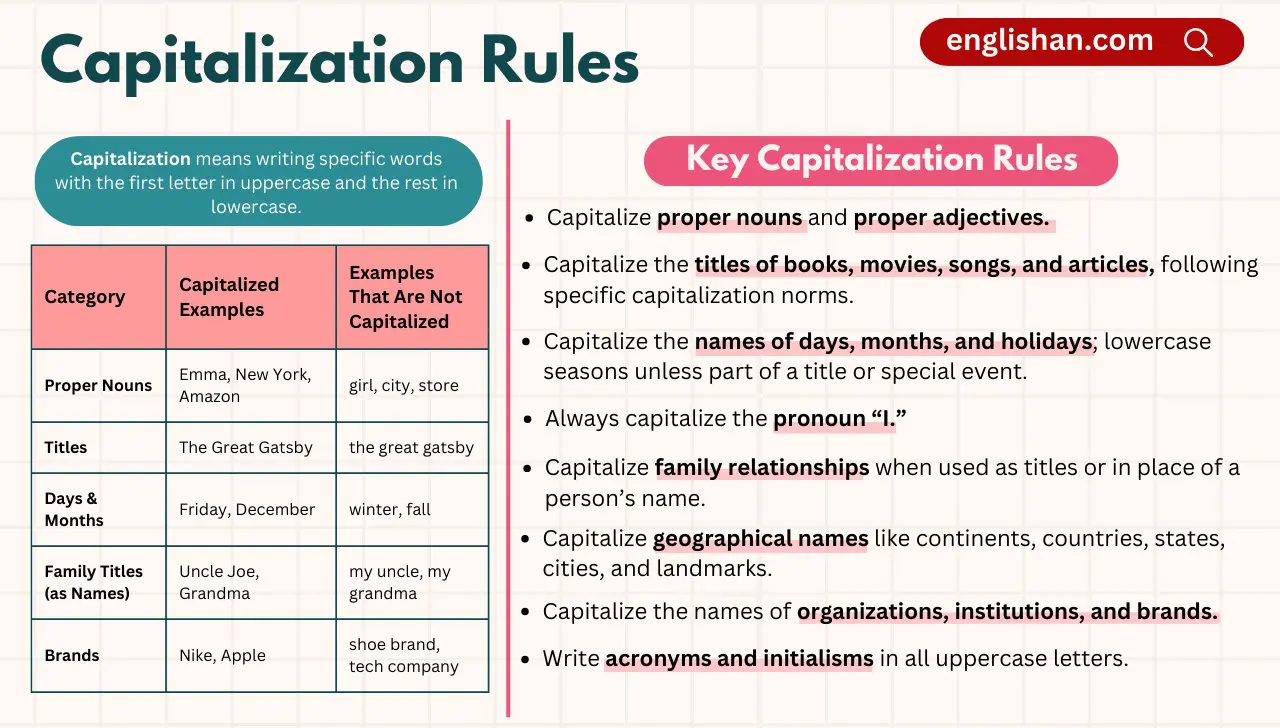
Capitalization is the practice of writing the first letter of a word in uppercase while the rest of the word stays lowercase. Three groups of words take a capital in every well-edited English sentence: the first word of a sentence, the pronoun I, and every proper noun. Every other capitalization decision resolves to three questions: is this word starting a sentence, is it a name, or is it a title?
Those three questions cover almost every capitalization choice you make in school papers, workplace emails, and web copy. The 17 capitalization rules that follow group into sentence-level rules, proper-noun rules, and title-level rules, with paired ✅ and ❌ examples on the confusable ones and a reference table for fast lookup. Where AP, Chicago, MLA, and APA disagree, both readings appear so you know which style you are writing in.
Sentence-Level Capitalization Rules
Five rules cover every capitalization decision at the level of one sentence. Learn these five and you handle the fastest 40 percent of the work.
First Word of Every Sentence
Every complete sentence takes a capital on its first letter, no matter what part of speech the word is.
- The train left at seven. ✅
- the train left at seven. ❌
- Are you sure? ✅
- What a night. ✅
One edge case complicates the rule: brand names designed to look lowercase in running text. Companies write iPhone, eBay, and macOS with a lowercase first letter, but at the start of a sentence the Associated Press Stylebook and Chicago Manual of Style recommend capitalizing the opening letter to protect the sentence rule.
- EBay opened strong in trading today. ✅
- iPhone sales grew last quarter. (mid-sentence) ✅
The Pronoun I Is Always Capitalized
The single letter I, used as the first-person pronoun, stays capitalized in every position: start of sentence, middle of sentence, inside a contraction, or on its own.
- I read the report. ✅
- Yesterday I read the report. ✅
- I’m not sure. I’ve never seen it before. ✅
- It was Sarah and i at the table. ❌
Every other pronoun stays lowercase in the middle of a sentence. Only I takes the capital.
- She said i was late. ❌ (both “She” and “I” need capitals)
- She said I was late. ✅
First Word of a Direct Quotation
A direct quotation that forms a complete sentence takes a capital on its first word, even when the quotation sits inside your own sentence.
- Lamarr said, “The case is far from over.” ✅
- The report opened with, “the case is far from over.” ❌
A partial quotation, meaning a fragment lifted out of a longer statement, keeps the lowercase letter it had inside the original sentence.
- She objected “to the phraseology, not to the ideas.” ✅
- She objected “To the phraseology, not to the ideas.” ❌
When a quotation is interrupted by attribution and then resumes as the same sentence, the second half stays lowercase.
- “The court,” she said, “will decide next week.” ✅
Capitalization After a Colon
When a colon introduces a list, the first word after it stays lowercase unless the first word is a proper noun.
- She packed three items: sunscreen, a book, and water. ✅
- She packed three items: Sunscreen, a book, and water. ❌
When a colon introduces a full independent clause, the two style camps split. APA (7th edition) capitalizes the first word of a full sentence after a colon. Chicago Manual of Style keeps the first word lowercase unless two or more complete sentences follow, at which point Chicago capitalizes.
- APA style: The finding is worth repeating: The colon introduces the answer. ✅
- Chicago style: The finding is worth repeating: the colon introduces the answer. ✅
Pick one style at the start of a document and hold to it throughout.
Capitalization After a Semicolon
A semicolon joins two independent clauses without ending the first sentence. The word after a semicolon stays lowercase unless the word is a proper noun or the pronoun I.
- The meeting ran late; we skipped lunch. ✅
- The meeting ran late; We skipped lunch. ❌
- The meeting ran late; I skipped lunch. ✅
The mistake to watch for is treating a semicolon like a period. If the next word starts a fully separate thought that deserves a full stop, replace the semicolon with a period and capitalize as normal.
Proper Nouns That Are Always Capitalized
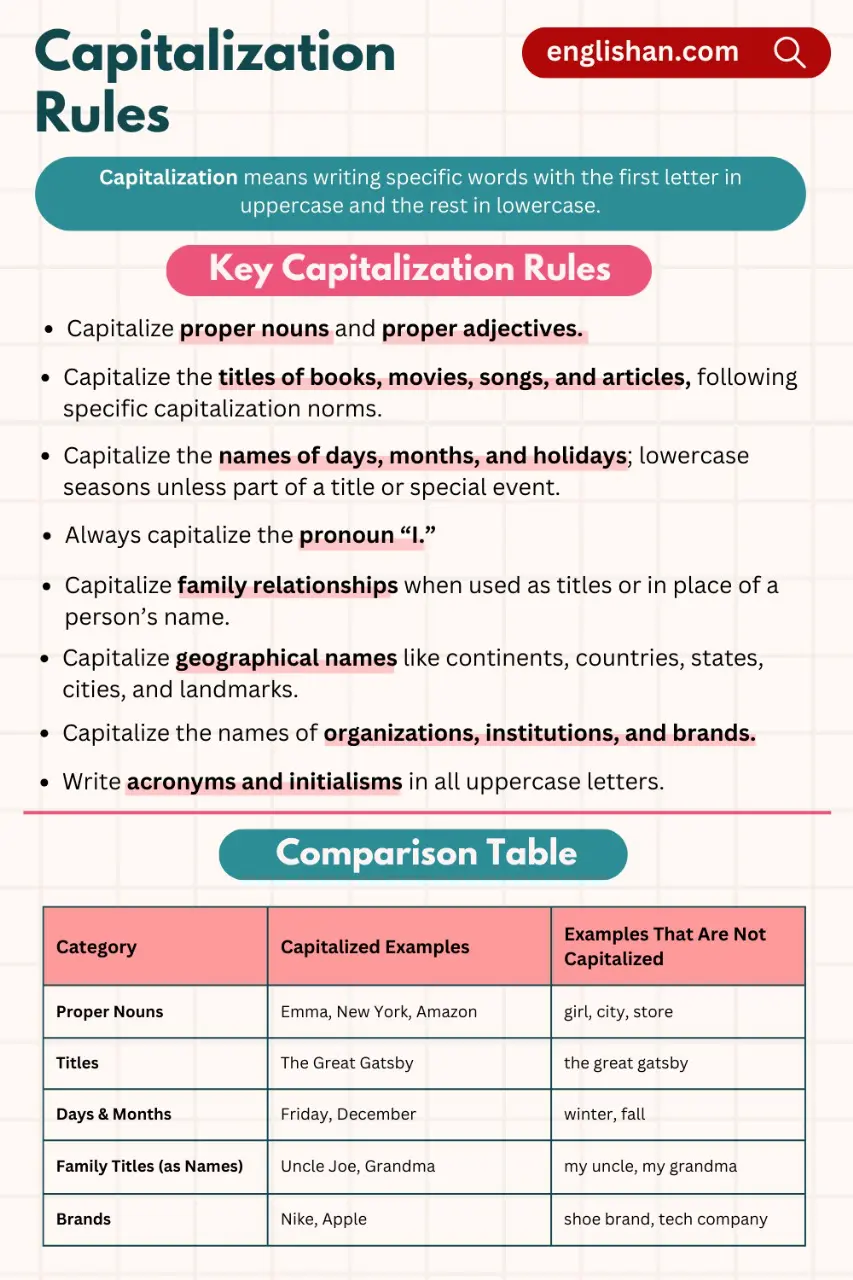
A proper noun is the specific name of one person, place, organization, brand, work, or event. Where a common noun names a category (city, dog, holiday), a proper noun names one member of that category (Nairobi, Buddy, Diwali). A proper noun takes a capital every time it appears, no matter where it falls in the sentence.
Seven categories cover almost every proper noun in daily writing.
Names of People and Personal Titles
Every part of a person’s name takes a capital: first name, middle name, last name, suffixes like Jr. and Sr., and nicknames set in quotation marks.
- Martin Luther King Jr. led the march. ✅
- Dwayne “The Rock” Johnson signed on to the film. ✅
Personal titles like Mr., Mrs., Ms., Dr., and Prof. stay capitalized when they attach to a name. Alone, they revert to lowercase, with Dr. as the medical-writing exception.
- I have an appointment with Dr. Chen. ✅
- I have an appointment with the doctor. ✅
Places, Countries, and Landmarks
Cities, countries, states, continents, oceans, rivers, mountains, and named landmarks all take a capital.
- Cairo, Egypt, Africa, the Nile, Mount Kilimanjaro, the Eiffel Tower ✅
- cairo, egypt, africa ❌
Generic descriptors stay lowercase until they attach to a specific name.
- We hiked a mountain last summer. ✅
- We hiked Mount Rainier last summer. ✅
The article the stays lowercase in front of most place names, with narrow exceptions such as The Hague and The Bronx, where the article is part of the official name.
Days, Months, and Holidays (Not Seasons)
The seven weekday names, the twelve month names, and the names of holidays all take a capital as proper nouns.
- Monday, February, Thanksgiving, Diwali, Ramadan, Yom Kippur ✅
Words like day and eve take a capital when they are part of a holiday name.
- Christmas Eve, New Year’s Day, Independence Day ✅
- The party is on Christmas eve. ❌
Seasons (spring, summer, fall or autumn, winter) do not take a capital in ordinary use. They are common nouns.
- She hates winter and loves spring. ✅
- She hates Winter and loves Spring. ❌
Four exceptions require a capital on a season, covered in the Seasons section further down.
Nationalities, Languages, and Religions
Nationalities, national adjectives, the names of languages, and the names of religions and their adherents all take a capital.
- She speaks French, Mandarin, and Swahili. ✅
- The panel welcomed Buddhist, Christian, Jewish, and Muslim leaders. ✅
- He is Brazilian; his wife is Vietnamese. ✅
Merriam-Webster lists each of these as always uppercase because the name identifies a specific group.
Historical Events, Eras, and Periods
Named events and named eras take a capital. Generic time frames stay lowercase.
- World War II, the Renaissance, the Middle Ages, the Roaring Twenties, the Cold War ✅
- the seventeenth century, the nineties, the war ❌ (unless “the war” refers to a specific named war already introduced)
The test: if the period has a proper name that historians and reference works agree on, capitalize it. Describing a decade or century in the abstract keeps the phrase lowercase.
Organizations, Schools, and Brand Names
Companies, schools, government bodies, and brand names take a capital as proper nouns.
- Google, the University of Cambridge, the World Health Organization, Coca-Cola ✅
Where a brand begins with a lowercase letter by design (iPhone, eBay, macOS, iPad), the lowercase form holds inside a sentence. At the start of a sentence, the opening letter takes a capital per AP Stylebook guidance.
- I bought an iPhone last week. ✅
- IPhone sales rose this quarter. ✅ (AP style, sentence start)
A common noun turns proper the moment it attaches to a specific name.
- She works for a bank. ✅ (common noun)
- She works for the Bank of England. ✅ (proper noun)
Acronyms and Initialisms
Acronyms formed from the initial letters of a name take all capitals: NASA, FBI, UNESCO, WHO, ATM. Initialisms follow the same rule: USA, UK, EU.
A handful of acronyms have entered ordinary English as common nouns and stay lowercase, because they now name a general object rather than the phrase behind them. Merriam-Webster lists them all in lowercase:
- scuba (self-contained underwater breathing apparatus)
- laser (light amplification by stimulated emission of radiation)
- radar (radio detection and ranging)
Example:
- The diver adjusted his scuba tank. ✅
- The diver adjusted his SCUBA tank. ❌
Proper Adjectives and Derived Words
A proper adjective is an adjective formed from a proper noun. Since the noun takes a capital, the adjective inherits it.
- Russian literature, Shakespearean sonnet, Freudian slip, Kenyan runners ✅
Over time, some adjectives break their connection to the original proper noun and take on a general meaning of their own. Merriam-Webster lists these in lowercase because the tie to the source has faded:
- french fries, herculean effort, quixotic mission, draconian penalty, pasteurized milk ✅
- French fries, Herculean effort ❌ (US style guides remain split on French fries; the modern trend is lowercase)
If you are unsure, check the current Merriam-Webster entry. The dictionary is the tiebreaker when the adjective fits neither category outright.
Family Titles: When to Capitalize Mom, Dad, and Grandma
Family relationship words work either as common nouns (my mother, his uncle) or as proper nouns (Mom, Uncle Ravi). The test is a name swap: if you can replace the word with a first name and the sentence still reads correctly, capitalize it.
- Ask Mom if she wants coffee. ✅ (swap in: Ask Anna if she wants coffee)
- Ask my mom if she wants coffee. ✅ (mom is a common noun here, because of “my”)
- I called Grandma yesterday. ✅ (swap in: I called Lucia yesterday)
- I called my grandma yesterday. ✅
- Dad, will you drive me to school? ✅ (direct address)
- My dad drove me to school. ✅ (common noun)
The trap is stacking a possessive in front of a capitalized family word. If a possessive (my, your, his, her, our, their) comes before the word, the word stays lowercase because the possessive has already turned it into a common noun.
- I called my Mom yesterday. ❌
- I called my mom yesterday. ✅
Job Titles: When to Capitalize Them
Job titles take a capital in three positions: directly before a person’s name, on a signature line, and in direct address. Everywhere else, they stay lowercase.
Before a name.
- President Lincoln addressed Congress. ✅
- Senator Warren voted against the bill. ✅
After a name or standing alone.
- Abraham Lincoln, the president, addressed Congress. ✅
- The senator voted against the bill. ✅
- She was elected chair of the board. ✅
The appositive rule. A title set off by commas is an appositive, and appositives take lowercase.
- At the meeting, Elizabeth Devi, the chair of the board, spoke first. ✅
- At the meeting, Chair of the Board Elizabeth Devi spoke first. ✅
Signature line. Titles listed under a name on a signed letter or email take a capital.
Sincerely,
Elizabeth Devi
Chair of the Board
Direct address. When you speak to a person by their title alone, the title takes a capital.
- Thank you, Doctor, for the referral. ✅
- Pass the report, Senator. ✅
Occupations differ from titles. Words that describe what a person does for a living, such as actor, pianist, accountant, author, and professor (in AP style), stay lowercase even before a name.
- attorney Jane Doe ✅
- author Toni Morrison ✅
The Blue Book of Grammar and Punctuation notes an “ego rule” for offices that insist on capitalizing internal titles. Follow the internal style where required, and follow the rules above for public-facing writing.
Capitalizing Directions vs Regions
Compass directions (north, south, east, west) stay lowercase when they describe direction of travel. They take a capital when they name a specific region.
Direction of travel (lowercase).
- Drive west for three miles. ✅
- The office is north of the river. ✅
Named region (capitalized).
- She grew up on the West Coast. ✅
- The economy of the South differs from the Northeast. ✅
- Southern Hemisphere tourism peaks in December. ✅
The same rule extends to the adjective forms. Northern, southern, eastern, and western stay lowercase for direction and take a capital when part of a region’s proper name.
- The southern side of the building gets more sun. ✅
- Southern California grew fastest in the last decade. ✅
Do You Capitalize Seasons?
Seasons stay lowercase in almost every use. They are common nouns.
- Last winter felt endless. ✅
- I love spring in Kyoto. ✅
Four exceptions require a capital on a season name:
1. At the start of a sentence.
- Winter arrived early this year. ✅
2. As part of a proper noun.
- The Winter Olympics returns in 2030. ✅
- Prada’s Spring 2021 collection sold out. ✅
3. Inside a title of a work.
- The essay collection is titled Summer Reading. ✅
4. In personification (literary or poetic use).
- Fall’s whisper woke the town. ✅
If none of the four exceptions applies, the season stays lowercase.
Title Capitalization Rules for Books, Movies, and Articles
Titles use title case: the first, the last, and every principal word takes a capital, and short function words stay lowercase. The four major style guides agree on the shape of this rule and split on the fine print.
Words That Are Always Capitalized in a Title
- The first word of the title, no matter what it is.
- The last word of the title, no matter what it is.
- All nouns, pronouns, verbs (including linking verbs like is, are, was), adjectives, and adverbs.
- The first word of a subtitle after a colon.
Sample titles applying the rule: The Sun Also Rises, Gone with the Wind, One Hundred Years of Solitude.
Words That Stay Lowercase in a Title
- Articles: a, an, the (unless first or last).
- Coordinating conjunctions: and, but, or, nor, for, so, yet (unless first or last).
- Short prepositions (definition of “short” varies by guide).
- The infinitive marker to.
Sample application: The Old Man and the Sea keeps “and” and “the” lowercase inside the title.
AP vs Chicago vs MLA vs APA: Where They Disagree
| Style guide | Prepositions | Linking verbs (is, be) | Second half of a hyphenated word |
|---|---|---|---|
| AP Stylebook | Lowercase 3 letters or fewer; capitalize 4+ letters | Capitalize | Capitalize both halves |
| Chicago Manual of Style | Lowercase all prepositions regardless of length | Capitalize | Capitalize both halves (narrow exceptions) |
| MLA Handbook | Lowercase all prepositions regardless of length | Capitalize | Capitalize both halves |
| APA (7th ed.) | Lowercase 3 letters or fewer; capitalize 4+ letters | Capitalize | Capitalize both halves |
Pick one style at the start of a document and follow it to the end. Academic papers follow the style your instructor names. Journalism and trade books lean AP or Chicago. Peer-reviewed research follows APA.
Capitalization Quick Reference Table
| Category | Capitalize | Do Not Capitalize |
|---|---|---|
| First word | Every sentence, every quoted full sentence | Partial quotation, word after a semicolon |
| Pronouns | The pronoun I always | Every other pronoun mid-sentence |
| People | Names, titles before a name, direct address | Descriptive titles after a name, occupations before a name |
| Places | Countries, cities, states, landmarks, named regions | Compass directions of travel, generic terms alone |
| Time | Days, months, holidays, named eras | Seasons, decades, centuries in the abstract |
| Nationalities | Nationalities, languages, religions | Foods derived from proper nouns (french fries) |
| Organizations | Full official names, brand names | Generic descriptors (a bank, a hotel) |
| Titles of works | First word, last word, all principal words | Articles, coordinating conjunctions, short prepositions |
| Family words | Direct address or replacing a name | After a possessive (my mom, his dad) |
| Directions | Named regions (the South, the West Coast) | Direction of travel (drive north) |
Common Capitalization Mistakes to Avoid
Six errors show up repeatedly in student, business, and web writing. Each one has a fast fix.
1. Capitalizing after a semicolon.
- The rain kept falling; The road flooded. ❌
- The rain kept falling; the road flooded. ✅
2. Capitalizing a job title after the name.
- The visit was hosted by Anna Chen, Chief Executive Officer. ❌
- The visit was hosted by Anna Chen, chief executive officer. ✅
3. Capitalizing a season without a reason.
- The Winter of 2023 was mild. ❌
- The winter of 2023 was mild. ✅ (the Winter Olympics is a proper noun; a plain season is not)
4. Capitalizing a family word after a possessive.
- I asked my Uncle for advice. ❌
- I asked my uncle for advice. ✅
- I asked Uncle Ravi for advice. ✅
5. Capitalizing a direction of travel.
- Drive North for two hours. ❌
- Drive north for two hours. ✅
6. Capitalizing common nouns for emphasis.
- The Company will Hire ten new Engineers. ❌
- The company will hire ten new engineers. ✅
The line Blue Book editors quote is worth learning: experienced writers are stingy with capitals. If you are unsure, keep the letter lowercase and check a current dictionary.
FAQs
Seasons stay lowercase in ordinary use. Capitalize a season at the start of a sentence, inside a proper noun (Winter Olympics), inside a title, or in literary personification.
When a colon introduces a list or a phrase, the first word after it stays lowercase unless the word is a proper noun. When a colon introduces a full sentence, APA capitalizes the first word and Chicago does not. Pick one style and hold to it across the document.
Capitalize a job title in three positions: directly before a name (President Lincoln), on a signature line, and in direct address (Thank you, Doctor). After a name, standing alone, or used as an occupation before a name, the title stays lowercase.
Three rules cover the foundation of English capitalization: capitalize the first word of every sentence, capitalize the pronoun I, and capitalize every proper noun. Nearly every other rule extends one of these three to a specific case.
Keep compass directions lowercase when they describe travel (drive south, head west). Capitalize them when they name a specific region (the South, the West Coast, Southern California).
Yes. Monday, Tuesday, January, February, and every other day and month take a capital as proper nouns. Seasons do not.
Always. The pronoun I takes a capital in every position: start of a sentence, middle of a sentence, and inside every contraction (I’m, I’ve, I’ll).
Yes. English, Spanish, Japanese, Kenyan, and Brazilian all take a capital, because each name identifies a specific group. Merriam-Webster lists them as always uppercase.
Conclusion
Learning capitalization rules takes practice, but it’s a useful skill that improves your writing. By sticking to these simple guidelines and studying the examples, you can compose texts that are clear, professional, and confident. Proper capitalization clarifies meaning and shows you pay attention to details, which helps present you as a careful writer.
Try these principles in your everyday writing, whether it’s a text message, a formal email, or a short story, and they will quickly become a habit. Enjoy learning!
You May Also Like
- Punctuation Rules with Examples
- Action Verbs in English Grammar
- 500 New Good Morning Images
- Connectors in English with Examples
- Acronym Examples In Sentences
Capitalization Rules Quiz
Capitalization Rules
Which sentence is capitalized correctly?
Place names and months are proper nouns.
capitalize proper nouns and months
We visited Paris in April.
Choose the correct sentence.
The pronoun 'I' is always capitalized.
capitalize the first word and the pronoun 'I'
My friend and I went home.
Which title is capitalized correctly?
Major words take capitals; short articles and prepositions stay lowercase.
in titles, capitalize major words only
The Lord of the Rings
Which sentence capitalizes correctly?
'North' names a region here, so it takes a capital.
capitalize regions, lowercase compass directions
Winters are harsh in the North.
Choose the correct sentence.
A title joined to a name is capitalized.
capitalize a title joined to a name
I spoke to Professor Bennett.
Which sentence is correct?
Languages are capitalized; seasons are not.
capitalize languages; lowercase seasons
She studies English and French in winter.
Choose the correctly capitalized sentence.
Capitalize sentence starts and proper nouns.
The sentence start, the place name, and the month all take capitals.
capitalize sentence starts, proper nouns, and months
We visited Paris in July.
True or false?
Days of the week are capitalized in English.
Days such as Monday and Friday are proper nouns and take capitals.
capitalize days and months
We meet every Monday.
Fix the capitalization.
i think english is a beautiful language.
The pronoun 'I' and the language name 'English' both take capitals, plus the sentence start.
capitalize 'I', languages, and sentence starts
I think English is a beautiful language.
Which sentence follows the season rule?
Seasons stay lowercase unless they start a sentence.
Seasons are common nouns and stay lowercase mid-sentence.
seasons stay lowercase; capitalize the sentence start
I love the crisp air of winter.
Rewrite with correct capitals.
my friend from canada speaks french.
The sentence start, the country 'Canada', and the language 'French' all take capitals.
capitalize sentence starts, countries, and languages
My friend from Canada speaks French.
True or false?
The pronoun 'I' is always written with a capital letter.
'I' is capitalized wherever it appears in a sentence.
always capitalize the pronoun 'I'
Tom and I went shopping.
Choose the correctly capitalized name.
A mountain's proper name.
'Mount Everest' is a proper noun and takes capitals.
capitalize proper place names
We climbed Mount Everest.
True or false?
The names of months take a capital letter.
Months such as March and October are proper nouns and take capitals.
capitalize months
Her birthday is in March.
Fix the capitalization.
i met dr. smith on friday.
The pronoun 'I', the title and name, and the day all take capitals.
capitalize 'I', titles with names, and days
I met Dr. Smith on Friday.
Choose the correct sentence.
Languages and nationalities.
Names of languages are proper adjectives and take capitals.
capitalize languages and nationalities
She speaks Spanish and English.
Capitalize the direct quote.
Punctuating a spoken line.
The first word inside a direct quote takes a capital.
capitalize the first word of a direct quote
She said, "Come in."
True or false?
Specific place names such as Paris and the Nile take capitals.
Proper place names carry capitals.
capitalize specific place names
We sailed down the Nile.
Choose the correct sentence.
Brand and day.
The brand name and the day are proper nouns and take capitals.
capitalize brand names and days
We shopped at Target on Sunday.
Choose the correct title use.
A title before a name.
A title joined to a name takes a capital.
capitalize a title used with a name
We saw President Lincoln's desk.
Turn on JavaScript for the interactive quiz. The full practice set is shown above.