A misplaced comma can shift the meaning of a sentence, and a missing period can merge two thoughts into one confusing line. Punctuation controls how readers move through your writing, where they pause, what they emphasize, and how they separate one idea from the next. These marks are not decoration. They are the structure that holds written English together.
English has fourteen punctuation marks, and each one follows specific placement rules. Commas handle pauses, lists, and clause separation. Semicolons join related sentences without a conjunction. Colons set up explanations or lists. Apostrophes show possession and contraction. Quotation marks frame direct speech. Mixing up these roles creates grammar errors that change what a sentence actually says.
Below, you’ll work through every punctuation mark with real sentence examples, correct and incorrect usage, and the common mistakes that writers repeat most often. By the end, you’ll know which mark belongs where and how to use it with confidence in your own writing.
What Is Punctuation?
Punctuation is a set of special marks used in writing to make meaning clear and easy to understand. It helps organize ideas, shows where to pause or stop, and guides the reader on how a sentence should be read. Without punctuation, writing can become confusing or even completely change meaning.
For Example:
- With punctuation: Let’s eat, Grandma.
- This means you are inviting Grandma to eat.
- Without punctuation: Let’s eat Grandma.
- This sounds like you want to eat Grandma!
A single comma completely changes the meaning of the sentence. That is why punctuation is so important.
Punctuation is very important in writing because it helps make sentences clear and meaningful. It guides the reader to understand the exact message without confusion and ensures that ideas are properly expressed. It also plays a key role in improving the overall quality of writing by making it easier to read and understand.
- Makes sentences clear and meaningful
- Prevents confusion in reading
- Shows pauses, stops, and tone
- Improves readability
In simple terms, punctuation is what gives writing clarity and structure. It helps readers understand meaning correctly, avoid confusion, and read sentences smoothly. In short, good punctuation makes writing clear, effective, and easy to understand.
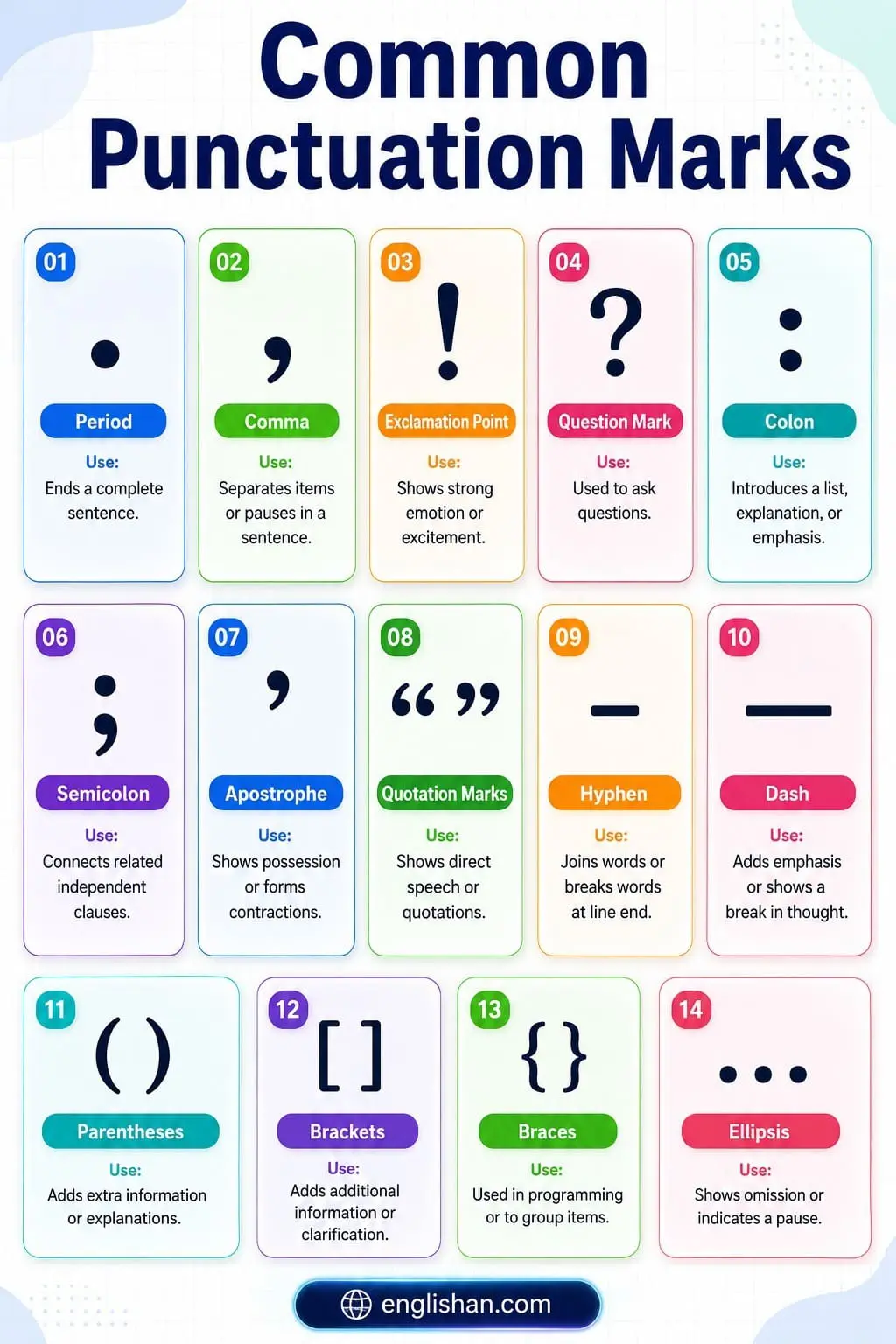
Common Punctuation Marks
Punctuation marks are small symbols, but they completely change how writing is understood. Each mark has a specific job, and using them correctly makes your writing clearer, more natural, and easier to read.
Full Stop / Period (.)
A full stop is used to end a complete sentence. It shows that one thought or idea has finished and a new one may begin. It is one of the most basic punctuation marks and is used in almost every sentence.
Example 1: She is reading a book.
Example 2: We went to the market yesterday.
In simple terms, a full stop is used to end statements and complete ideas. It helps separate one sentence from another and keeps writing clear and organized.
Comma (,)
A comma is used to give a short pause within a sentence. It helps separate items in a list, divide ideas, and make sentences easier to read and understand.
Example 1: I bought apples, bananas, oranges, and grapes.
Example 2: After finishing homework, he went outside to play.
A comma plays a crucial role in structuring sentences by adding clarity and rhythm. It prevents confusion and ensures that ideas are separated in a logical and readable way.
Question Mark (?)
A question mark is used at the end of a sentence that asks something. It shows that the sentence is a question and requires an answer.
Example 1: Where are you going?
Example 2: Did you complete your homework?:
A question mark is important because it distinguishes questions from statements. It helps readers immediately recognize that a response or answer is needed.
Exclamation Mark (!)
An exclamation mark is used to express strong feelings such as excitement, surprise, anger, or urgency. It makes the sentence more emotional and expressive.
Example 1: What a beautiful view!
Example 2: Help! There is a fire!
An exclamation mark adds emotional strength and intensity to writing. It helps convey feelings clearly, making sentences more impactful and expressive.
Colon (: )
A colon is used to introduce information such as lists, explanations, or examples. It signals that further details are about to be provided.
Example 1: You need three things: pen, paper, and notebook.
Example 2: There is one rule: never give up.
A colon is a powerful punctuation mark that prepares the reader for important information. It improves clarity by clearly introducing explanations or lists that follow.
Semicolon (;)
A semicolon connects two closely related independent sentences. It shows a strong relationship between ideas without using a full stop.
Example 1: I was tired; I still finished my work.
Example 2: She loves tea; he prefers coffee.
A semicolon is valuable for linking related ideas smoothly. It strengthens sentence flow while maintaining a clear connection between closely related thoughts.
Apostrophe (’)
An apostrophe shows possession or forms contractions. It indicates ownership or replaces missing letters in shortened words.
Example 1: Ali’s car is new.
Example 2: Don’t worry about it.
An apostrophe is important for showing possession and forming contractions. It makes writing more natural, precise, and grammatically correct.
Quotation Marks (“ ”)
Quotation marks are used to show exact spoken or written words. They clearly separate speech from narration in writing.
Example 1: She said, “I am ready.”
Example 2: “What are you doing?” he asked.
Quotation marks are essential for representing direct speech accurately. They ensure clarity by clearly distinguishing spoken words from the rest of the text.
Hyphen (-)
A hyphen joins words together to form compound meanings. It is also used in writing numbers and certain combined terms.
Example 1: She is a well-known writer.
Example 2: He is twenty-one years old.
A hyphen improves clarity by combining words into meaningful units. It helps avoid confusion and ensures proper structure in compound expressions.
Dash (—)
Dashes are punctuation marks used to create emphasis, show interruptions, or connect ideas. There are two main types: the em dash (—) and the en dash (–), and both have slightly different purposes.
An em dash is a longer dash used to add emphasis, insert extra information, or show a sudden break in thought. It makes writing more expressive and dramatic.
Example 1: I need only one thing—your support.
Example 2: She was about to speak—then suddenly stopped.
An em dash is used to make writing more powerful and expressive. It highlights important information or sudden changes in thought, giving sentences a strong and natural flow.
On the other hand, an en dash is shorter than an em dash and is mainly used to show ranges or connections between numbers, dates, or places. It shows a link between two values.
Example 1: The meeting is scheduled for 10–12 June.
Example 2: Read pages 50–75 for homework.
An en dash is used to show ranges or connections in a clear and compact way. It improves precision in writing, especially when showing numbers, time, or distance.
Parentheses ( )
Parentheses are used to include extra information that is not essential to the main idea. The sentence still makes sense without it.
Example 1: He finally arrived (after a long delay).
Example 2: My brother (who lives abroad) is visiting us.
Parentheses are useful for adding additional details without disturbing the main sentence. They help include extra information in a clear and organized way.
Ellipsis (…)
An ellipsis shows that some words are missing or creates a pause for dramatic effect. It often suggests unfinished thoughts or suspense.
Example 1: I was thinking… maybe we should go.
Example 2: And then suddenly…
An ellipsis adds depth and emotion by creating suspense or showing unfinished thoughts. It makes writing more engaging and leaves room for interpretation.
Brackets [ ] / ( )
Rackets are used to add extra information, clarification, or explanation inside a sentence. This extra detail is not part of the main sentence but helps the reader understand it better. In formal writing, parentheses ( ) are more common, while square brackets [ ] are often used inside quotations or academic writing for added clarification.
Example 1: He finally arrived (after a long delay).
Example 2: The researcher stated, “The results were unexpected [based on initial data].”
In short, Brackets are used to include additional or explanatory information without disturbing the main sentence. They improve clarity by separating extra details from the core idea, making writing more precise and reader-friendly.
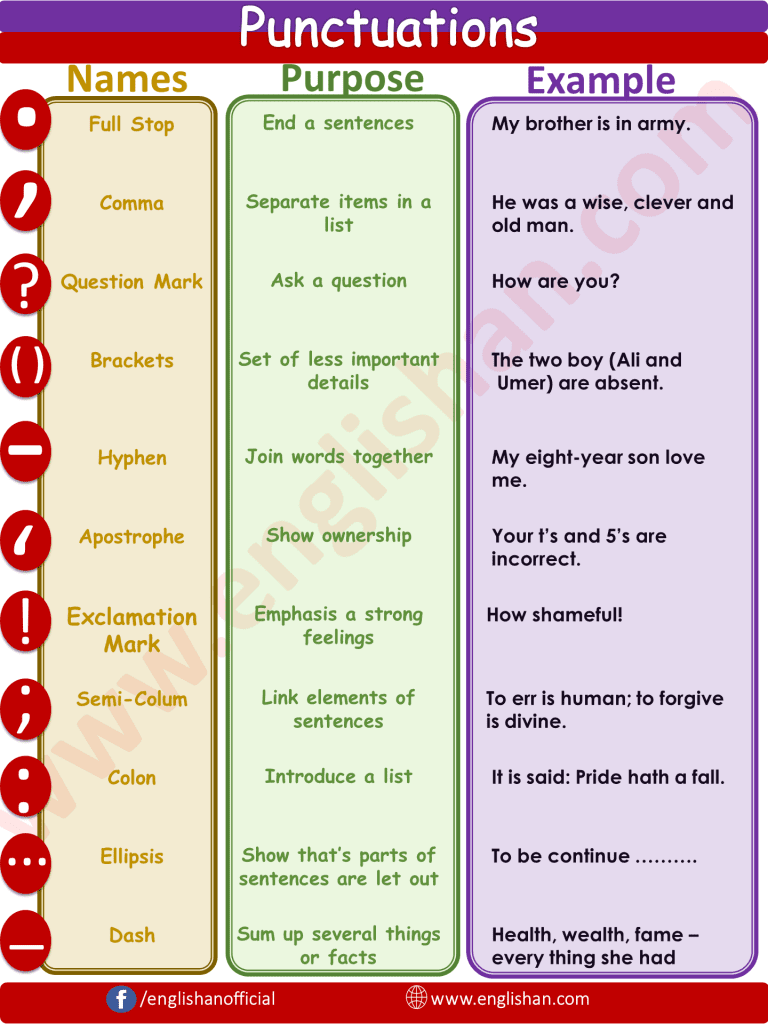
Capitalization and Punctuation
Capitalization and punctuation are two basic but very important parts of English writing. They work together to make sentences clear, readable, and meaningful. Without them, writing can look messy and confusing.
Capitalization
Capitalization means starting certain words with a capital (big) letter. It is used mainly at the beginning of sentences and for proper nouns (specific names of people, places, days, etc.).
When we use capitalization:
- At the beginning of a sentence
- Names of people (Ali, Sara)
- Names of places (Pakistan, Lahore)
- Days and months (Monday, January)
- The word “I” always
Example 1: Ali is my friend.
Example 2: We live in Pakistan.
Example 3: I will go on Monday.
In simple terms, capitalization helps highlight important words and shows where a sentence starts. It makes writing clear, organized, and easy to read.
Punctuation
Punctuation refers to the use of special marks in writing that help explain meaning, show pauses, and structure sentences properly. These marks guide the reader on how to read and understand the sentence correctly.
Common punctuation marks:
- Full stop (.)
- Comma (,)
- Question mark (?)
- Exclamation mark (!)
Example 1: I am going to school.
Example 2: I like apples, bananas, and oranges.
Example 3: Where are you going?
In simple terms, punctuation gives writing its flow and meaning. It helps readers understand ideas clearly by showing stops, pauses, and emotions in sentences.
Punctuation Rules in Lists
Lists are a common part of writing used to present multiple ideas in a clear and organized way. Punctuation in lists helps separate items properly so the reader can easily understand each point without confusion.
Using Commas in Lists
When we list three or more items in a sentence, we usually separate them with commas. This helps each item stand out clearly and avoids confusion.
Example 1: I bought apples, bananas, and oranges.
Example 2: She packed a pen, notebook, eraser, and ruler.
Example 3: We visited Lahore, Karachi, and Islamabad.
When commas are used correctly, the sentence becomes smooth and easy to read because each item is clearly separated.
In simple terms, commas in lists help separate items so the meaning stays clear and the sentence does not become confusing.
Using Oxford Comma
The Oxford comma is the comma placed before the last item in a list (before “and” or “or”). Some writers use it for extra clarity, while others skip it, but it can sometimes change the meaning of a sentence.
Example 1: I like reading, writing, and traveling.
Example 2: We invited my parents, Ali, and Sara.
Without the Oxford comma, meaning can sometimes become unclear or confusing depending on the sentence.
In simple terms, the Oxford comma is used to make lists clearer and avoid misunderstanding, especially in complex sentences.
In Bulleted Lists
Bulleted lists are used when we want to present information in a clean and easy-to-read format. Instead of writing everything in a sentence, we place each item on a separate line.
For Example:
Things I need for school:
- Books
- Pen
- Notebook
- Bag
Bulleted lists make information more organized and easier to scan quickly.
In simple terms, bulleted lists help present information in a simple and organized way so the reader can understand it quickly and clearly.
Punctuation in Dialogue
When we write conversations between people, we use punctuation to show who is speaking and how the words are being said. This is called dialogue punctuation. It helps the reader clearly understand the conversation without confusion.
In dialogue, quotation marks are used to show the exact words spoken by a person, and punctuation marks like commas, full stops, question marks, and exclamation marks are placed carefully inside or outside the quotation marks depending on the sentence.
Quotation Marks in Dialogue
Quotation marks (“ ”) are used to enclose the exact words spoken by a person. They act like a boundary between speech and explanation.
Example 1: Ali said, “I am going to school.”
Example 2: She replied, “I will help you.”
Example 3: He shouted, “Don’t move!”
In these examples, everything inside the quotation marks is the actual spoken words.
Commas in Dialogue
Commas are used when we introduce the speaker before the dialogue or when dialogue is followed by explanation. They create a smooth connection between narration and speech.
Example 1: He said, “I am tired.”
Example 2: She asked, “Are you ready?”
Example 3: My teacher said, “Focus on your work.”
Without the comma, the sentence can feel broken or unclear, so it helps maintain flow.
Question Marks and Exclamation Marks in Dialogue
When someone is asking a question or showing strong emotion, the punctuation stays inside the quotation marks because it belongs to the spoken sentence.
Example 1: He asked, “Where are you going?”
Example 2: She said, “What are you doing here?”
Example 3: Ali shouted, “Be careful!”
These marks help show tone—whether the speaker is curious, surprised, or emotional.
In simple terms, punctuation in dialogue is what makes written conversation feel real. It separates speech from narration, shows tone and emotion, and helps the reader understand exactly how something is being said. Without it, conversations in writing would become confusing and flat.
Punctuation in Dates, Numbers, and Abbreviations
Punctuation is not limited to sentences only. We also use it in dates, numbers, and abbreviations to make information clearer, more organized, and easier to read. It helps the reader understand details quickly without any confusion.
Punctuation in Date
Punctuation in dates is used to separate different parts like day, month, and year so that the information is easy to read and not mixed up. A comma is often used when writing dates in a sentence, and slashes are also used in short formats.
Example 1: 7 May, 2026
Example 2: Monday, 7 May 2026
Example 3: 07/05/2026
When punctuation is used properly in dates, it becomes much easier to understand the exact time or day being referred to.
In simple terms, punctuation in dates helps separate day, month, and year so the date is clear, organized, and easy to read.
Punctuation in Numbers
Punctuation in numbers is mainly used to make large numbers easier to read. Commas are placed in large numbers to break them into groups, so the reader can understand the value quickly without counting every digit.
Example 1: 1,000
Example 2: 25,000
Example 3: 1,000,000
Without commas, large numbers can feel confusing, but punctuation makes them clean and readable at a glance.
In simple terms, punctuation in numbers helps break large figures into readable parts, making them easier to understand quickly and correctly.
Punctuation in Abbreviations
Punctuation in abbreviations is used when words are shortened. Full stops are often used after each shortened part, although in modern English, some abbreviations are written without punctuation for simplicity.
Example 1: Dr. (Doctor)
Example 2: e.g. (for example)
Example 3: USA, NASA (no punctuation used in some modern forms)
This helps readers recognize that the word is shortened and still understand its full meaning.
In simple terms, punctuation in abbreviations shows that a word has been shortened, making writing quicker while still keeping the meaning clear.
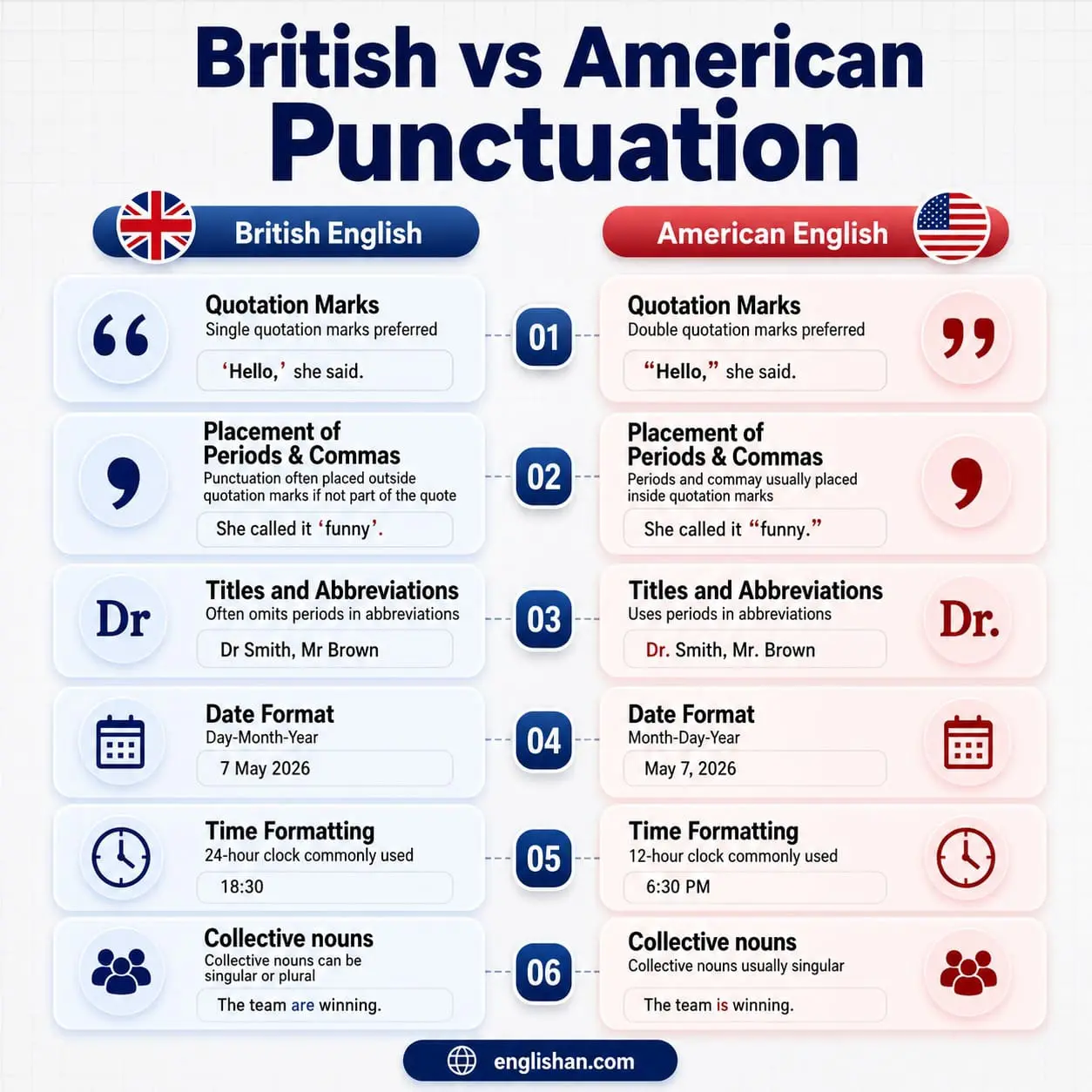
British vs American Punctuation
British and American English both follow the same basic punctuation rules, but they differ in a few stylistic details. These small differences do not change the meaning of sentences, but they do affect how writing is presented in each form of English.
| Feature | British English | American English | Example |
|---|---|---|---|
| Quotation Marks | Uses single quotation marks more often | Uses double quotation marks | British: ‘I am coming.’ / American: “I am coming.” |
| Full Stop with Quotes | Outside quotation marks (when not part of quote) | Inside quotation marks | British: ‘I am busy’. / American: “I am busy.” |
| Oxford Comma | Often optional or not used | Commonly used for clarity | British: I bought apples, bananas and oranges. / American: I bought apples, bananas, and oranges. |
In simple terms, British and American punctuation are almost the same, but they differ in small writing conventions like quotation marks, comma usage, and punctuation placement. Both are correct, and the choice depends on which style of English you are following.
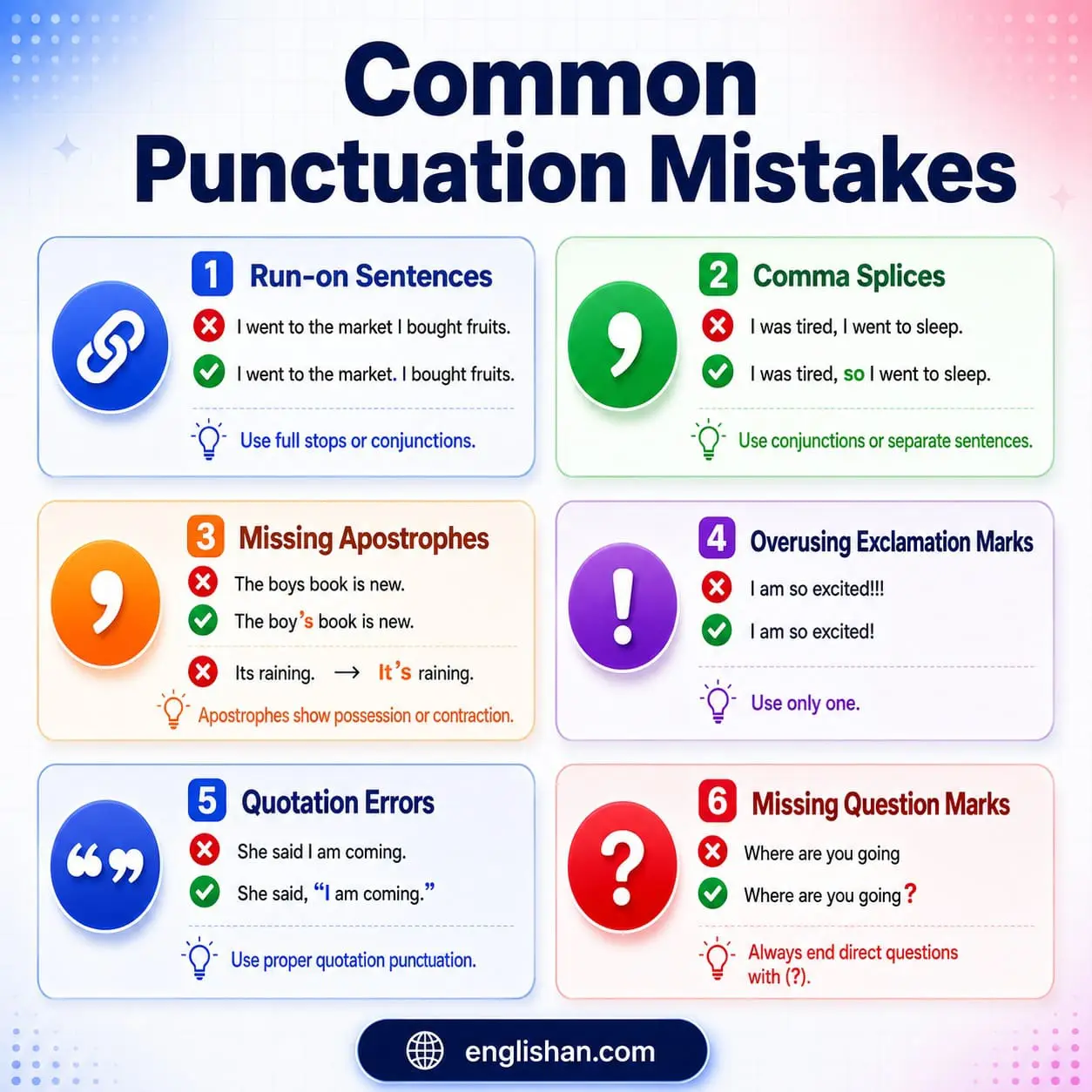
Common Punctuation Mistakes
Punctuation mistakes are very common in writing. They can change meaning, create confusion, or make sentences difficult to read. Understanding these mistakes helps improve clarity and accuracy in writing.
Run-on Sentences
Run-on sentences happen when two complete ideas are written together without proper punctuation or connectors. This makes the sentence long and confusing.
- Incorrect: I went to the market I bought fruits.
- Correct: I went to the market. I bought fruits.
So, run-on sentences join ideas without proper punctuation, which makes writing unclear and hard to read.
Comma Splices
A comma splice happens when two complete sentences are joined only with a comma instead of proper punctuation or a conjunction.
- Incorrect: I was tired, I went to sleep.
- Correct: I was tired, so I went to sleep.
In simple terms, comma splices incorrectly join two complete sentences with just a comma, which should be avoided.
Missing Apostrophes
This mistake happens when apostrophes are not used to show possession or contractions correctly, which can change the meaning.
- Incorrect: The boys book is new.
- Correct: The boy’s book is new.
- Incorrect: Its raining today.
- Correct: It’s raining today.
In simple terms, missing apostrophes make sentences incorrect and can confuse possession with simple statements.
Overusing Exclamation Marks
Using too many exclamation marks makes writing look unnatural and less professional. One is usually enough to show strong emotion.
- Incorrect: I am so happy!!!
- Correct: I am so happy!
In this case, overusing exclamation marks reduces writing quality and makes it look exaggerated.
Incorrect Quotation Usage
This mistake happens when quotation marks or punctuation inside them are used incorrectly, making speech unclear.
- Incorrect: She said I am coming.
- Correct: She said, “I am coming.”
- Incorrect: He asked “Where are you going?”
- Correct: He asked, “Where are you going?”
In short, incorrect quotation usage makes it unclear what someone is actually saying, so proper punctuation is important.
Practice Exercises: Punctuation
To improve your punctuation skills, practice is very important. These exercises will help you understand how to use full stops, commas, question marks, quotation marks, and other punctuation marks correctly in sentences. Try solving them first, then check the answers below.
Exercise 1: Add the correct punctuation (full stop, comma, or question mark)
She is going to school ___
Where are you going ___
I like apples bananas and oranges ___
Exercise 2: Fix the sentence by adding correct punctuation
i am very happy today
Exercise 3: Correct the punctuation in the list
I bought pen notebook eraser and ruler
Exercise 4: Fix the dialogue punctuation
he said I will come tomorrow
Exercise 5: Choose the correct sentence
a) lets eat grandma
b) let’s eat grandma
Answer Key:
- She is going to school.
Where are you going?
I like apples, bananas, and oranges. - I am very happy today.
- I bought pen, notebook, eraser, and ruler.
- He said, “I will come tomorrow.”
- b) let’s eat grandma
Final Thought
As we learned, good writing is not just about choosing the right words, it is about presenting them clearly. Punctuation acts as the structure that holds your sentences together and guides the reader smoothly from one idea to the next. When used correctly, it removes confusion, strengthens meaning, and makes your writing more professional and effective.
Mastering punctuation is a small effort with a big impact. The more you practice it, the more natural and confident your writing will become, and in this article, we’ll learn how to use it correctly in real writing situations.
FAQs
Here are 14 punctuation marks with short examples:
1. Period (.) – I like dogs.
2. Comma (,) – I bought apples, bananas, and grapes.
3. Question Mark (?) – What is your name?
4. Exclamation Mark (!) – That’s amazing!
5. Colon (:) – I need two things: shoes and a bag.
6. Semicolon (;) – I’m tired; I’ll rest now.
7. Quotation Marks (” “) – He said, “Hello!”
8. Apostrophe (‘) – It’s raining.
9. Parentheses (()) – I went to the store (it was fun).
10. Hyphen (-) – This is a well-known fact.
11. Dash (–) – She’s so talented – it’s incredible.
12. Ellipsis (…) – I don’t know what happened…
13. Brackets [ ] – He said, “I love [this book].”
14. Slash (/) – Do you want tea/coffee?
Here are 12 punctuation marks:
1. Period
2. Comma
3. Question Mark
4. Exclamation Mark
5. Quotation Marks
6. Apostrophe
7. Colon
8. Semicolon
9. Dash
10. Parentheses
11. Ellipsis
12. Slash
A semicolon (;) is used for two main reasons:
1. To connect two related sentences without using “and” or “but.”
Example: I like pizza; I don’t like pasta.
2. To separate items in a list when the items are long or have commas in them.
Example: We traveled to New York, USA; London, England; and Tokyo, Japan.
It helps link ideas more closely than a period.
You can improve punctuation by reading regularly, practicing writing sentences, and paying attention to how punctuation is used in books or articles. Writing short paragraphs and checking your mistakes also helps a lot.
The Oxford comma is the comma placed before the last item in a list (before “and”). It is used to make lists clearer and avoid confusion.
Example:
I bought apples, bananas, and oranges.
- Present Indefinite Tense Worksheets and Exercises
- Punctuation Worksheets with Answers in English
- Present Continuous Tense Worksheets
- Modals Verbs Exercises with Answers in English
- Road Signs and Traffic Signs with Meanings