“Was” and “were” are the two past-tense forms of the verb “be”. A singular subject agrees with “was”, and a plural subject agrees with “were”. The subjunctive overrides that agreement: where a sentence describes something unreal, “were” is used with every subject, so “If I were you” is correct and “If I was you” reports a real past possibility.
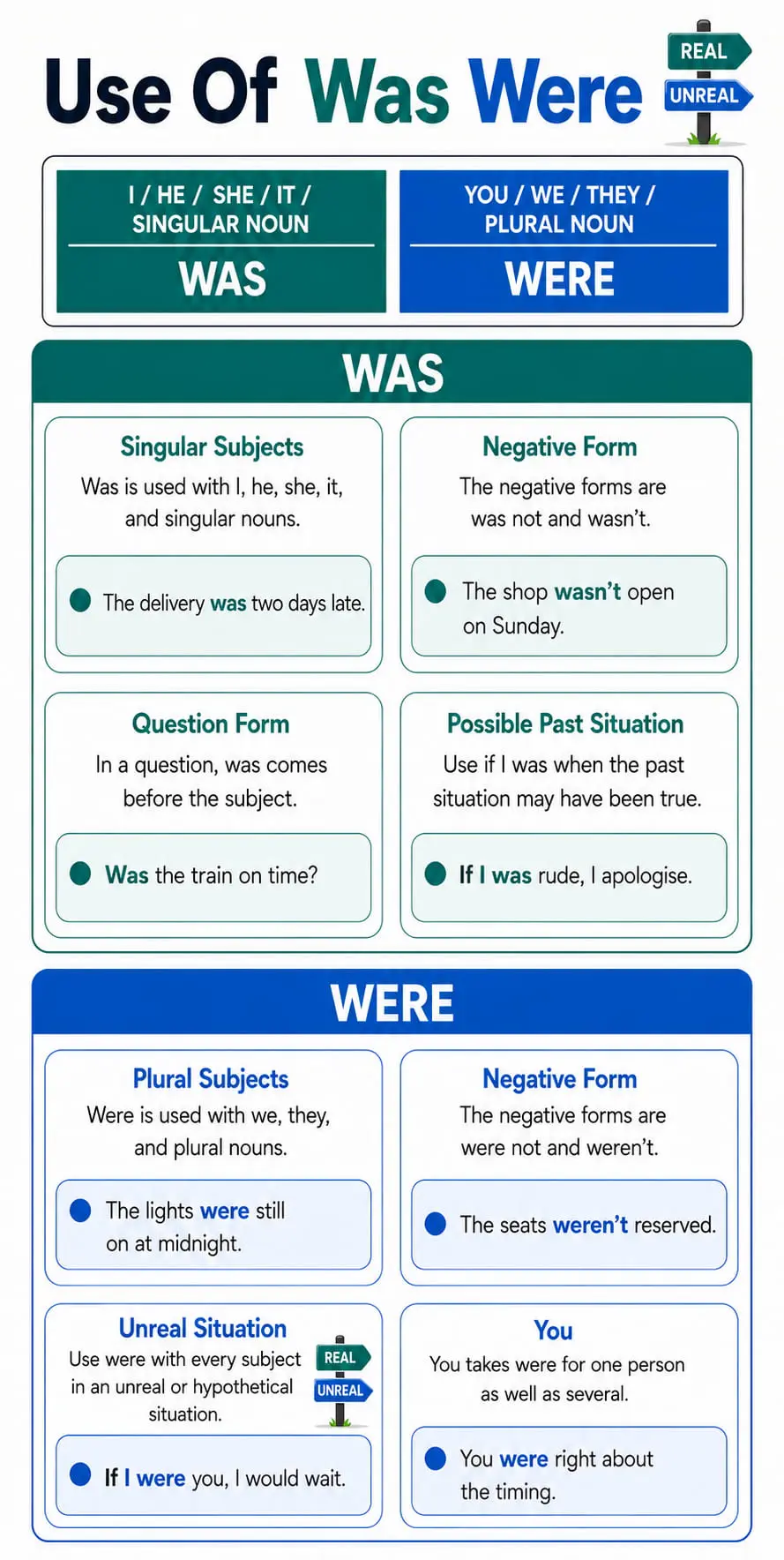
When To Use Was And Were
“Was” is used with a singular subject and “were” with a plural one, and the one structure that overrides that agreement is the subjunctive, where “were” is used for every subject.
| Subject | Form | Example |
|---|---|---|
| I, he, she, it, a singular noun | was | The meeting was short. |
| You, we, they, a plural noun | were | The seats were taken. |
“You” agrees with “were” whether it refers to one person or to several, exactly as it agrees with “are” in the present.
- I was at the dentist all morning.
- She was the last one to leave.
- The delivery was two days late.
- We were halfway through dinner.
- They were waiting by the entrance.
- The lights were still on at midnight.
- You were right about the timing.
- My cousins were born in Lahore.
The last sentence uses “were born”, which is a passive form with no active counterpart, so “my cousins bore in Lahore” is impossible.
What was and were do in a sentence: the next five rules are the linking use, the past continuous, the passive, the negative, and the question with its short answer.
Was And Were For Past States
As a main verb, “was” and “were” join the subject to a word that describes or renames it, which makes them linking verbs.
What follows is one of three forms: a noun that renames the subject, an adjective that describes it, or a phrase of time or place.
- My grandfather was a signalman.
- The interview was shorter than expected.
- The kitchen was freezing.
- Those figures were wrong.
- The keys were on the windowsill.
- We were in the waiting room for an hour.
- She was nineteen at the time.
- The tickets were cheaper online.
- The children were at their grandmother’s.
- It was a Tuesday.
In every one of these, “was” or “were” is the main verb of the sentence. No other verb is present, so it is the main verb rather than a helper.
What Was And Were State About A Subject
The complement after “was” and “were” states one of six kinds of information about the subject: identity, job, age, nationality, feeling, or appearance.
Two of the six have a restriction on their form that the other four do not.
- She was my form tutor. (identity)
- He was a signalman on the branch line. (job)
- My grandmother was ninety-one. (age)
- They were Hungarian. (nationality)
- We were relieved by the verdict. (feeling)
- His hair was grey by then. (appearance)
- I was born in Karachi. (birth)
- Were you nervous before the interview? (feeling)
Age is stated as a bare number, so “My grandmother was ninety-one” is complete and “was ninety-one years” is not. “Born” occurs only in the passive, so “I was born in Karachi” is standard and “I bore in Karachi” is impossible.
It Was With Time Weather And Price
“Was” and “were” also state the time, the day, the weather, the price, and the distance, and the subject in every one of these is “it”.
“It” names nothing here. It occupies the subject position because an English clause requires a subject, and the words after the verb state the information.
- It was nearly midnight. (time)
- It was a Thursday. (day)
- It was freezing on the platform. (weather)
- It was eleven pounds a head. (price)
- It was six miles to the nearest station. (distance)
- What time was the last train? (time)
- How much was the deposit? (price)
- What was the weather like in March? (weather)
The question forms invert “was” with “it” exactly as any other question inverts the verb with its subject.
Was And Were In The Past Continuous
Before an -ing form, “was” and “were” build the past continuous, which reports an action already in progress at a past moment.
The past continuous is used for the background, and the past simple for the event that interrupts it.
- I was cooking when the power went off.
- She was driving back from Leeds.
- The children were playing in the garden.
- We were discussing the budget at the time.
- Traffic was building on the ring road.
- They were arguing about the bill when the waiter arrived.
- He was not listening.
- Were you waiting long?
“Was cooking” started before the power cut and continued after it, which is what the continuous form expresses.
Was And Were In The Past Passive
Before a past participle, “was” and “were” build the past passive voice, which puts the affected noun into the subject position and leaves the doer unnamed.
- The road was closed for resurfacing.
- These forms were checked twice.
- The parcel was delivered on Thursday.
- She was interviewed by two directors.
- The results were published in April.
- Our flight was cancelled without warning.
- The building was designed in 1908.
- The papers were signed the same morning.
The word after the form is what separates the two constructions. An -ing form builds the past continuous, and a past participle builds the passive.
Negative Forms Of Was And Were
The negative puts “not” directly after the form, as in “The shop wasn’t open”, and both the full and the contracted version are correct.
| Full | Contraction |
|---|---|
| I was not | I wasn’t |
| He was not | He wasn’t |
| They were not | They weren’t |
- The shop wasn’t open on Sunday.
- I was not aware of the change.
- She wasn’t at the meeting.
- We weren’t told about the delay.
- The instructions weren’t clear.
- It wasn’t raining when we left.
- The seats weren’t reserved.
- He was not invited.
Unlike “am”, both past forms have a full negative contraction, so “wasn’t” and “weren’t” are available in every position including a question.
Questions With Was And Were
How is a question formed with these two forms?
Put “was” or “were” in front of the subject for a yes-or-no question, and put the question word first for a wh-question. A short answer repeats the subject and the form rather than the whole sentence.
| Question | Short answer, yes | Short answer, no |
|---|---|---|
| Was it busy? | Yes, it was. | No, it wasn’t. |
| Were they late? | Yes, they were. | No, they weren’t. |
| Weren’t you there? | Yes, I was. | No, I wasn’t. |
- Was the train on time?
- Were you at the briefing?
- Was she the one who called?
- Were the results any good?
- Where were you last night?
- Why was the door unlocked?
- How many people were there?
- What was the final figure?
- “Was the doctor in?” “Yes, she was.”
- “Were you two at school together?” “No, we weren’t.”
The positive short answer never contracts. “Yes, she was” is correct and “Yes, she’s” is not, because a contraction cannot end a clause.
Were for what is not real: in the next three rules the subjunctive overrides the singular and plural split.
If I Was Or If I Were
Both forms are correct, and they report different situations.
“If I were” is the subjunctive mood, which marks a situation contrary to fact. Some grammars call the same form the unreal past. “If I was” is the ordinary past indicative, and it is correct wherever the condition is a real past possibility.
- If I were you, I would take the earlier train. (I am not you)
- If I were taller, I could reach the top shelf. (I am not taller)
- If she were here, she would explain it herself. (she is not here)
- If I was rude yesterday, I apologise. (I may well have been)
- If he was at the office, nobody saw him. (he may have been)
- If the parcel was delivered, it went to the wrong door. (it may have been)
An “if” clause that could not be true requires “were”, and one that might genuinely have been true requires “was”. “If I was you” fails on that condition alone, since nobody can be somebody else, and not because “if I was” is ungrammatical.
Were After Wish And As If
“Wish”, “if only”, “as if”, and “as though” all occur with “were” rather than “was” when the situation is unreal.
- I wish I were better at this.
- I wish she were here.
- If only the flat were a little bigger.
- He talks as if he were in charge.
- She looked as though she were about to cry.
- I wish it were Friday.
Where the wider rule applies: the same unreal past follows “it is time” and “would rather”, and it becomes a past perfect when the unreality is in the past, as in “I wish I had known”.
“Was” is used in all six of those structures in speech and in informal writing, and it is accepted there. “Were” is what formal writing and examinations use, so it is the safer form on paper.
Fixed Expressions With Were
In “Were it not for the rain, we would have walked”, the subject and the verb have swapped places and no “if” is present.
Three fixed structures use “were” outside the ordinary rules. Inversion puts “were” in front of the subject and replaces “if” entirely. “As it were” is a set phrase meaning “so to speak”. “Were it not for” introduces the single condition that changed an outcome.
- Were it not for the rain, we would have walked.
- Were I to resign, the department would collapse.
- Were she younger, she would apply herself.
- He is the head of the family, as it were.
- Were the decision mine, I would postpone it.
- Were they to refuse, we would have no alternative.
All six are restricted to formal or literary writing. In speech, “If it weren’t for the rain” and “If I resigned” are equivalent in meaning and sound natural.
Subjects that are hard to count: in the next three rules the noun standing in front of the verb is not the subject, so the form has to be worked out.
Agreement After There Was And There Were
“There” can occupy the subject position without naming anything, and the form of “be” then agrees with the noun that follows it.
Singular and uncountable nouns agree with “there was”. Plural nouns agree with “there were”.
- There was a message on the answering machine.
- There was ice on the windscreen.
- There were four of us in the car.
- There were no seats left.
- Was there a reason for the delay?
- Were there any complaints?
- There wasn’t time to check.
- There weren’t enough copies.
A list changes the agreement. When a list follows “there”, the verb agrees with the first noun, so “There was a table and two chairs” and “There were two chairs and a table” are both correct.
Either Or And Neither Nor Agree With The Nearer Noun
Which form follows “either … or” and “neither … nor”?
The verb agrees with the noun closest to it rather than with both. “Either” and “neither” standing alone as the subject are singular, so they agree with “was”.
- Either the manager or her deputy was on duty.
- Either the deputy or the assistants were on duty.
- Neither the file nor the backups were where they should be.
- Neither the backups nor the file was where it should be.
- Neither of the applicants was suitable.
- Either of those dates was fine with us.
- Neither answer was correct.
- Either option was acceptable.
In “Neither of the applicants was suitable”, a plural noun stands directly before the verb and the verb stays singular. The subject is “neither”, which is singular, and “of the applicants” only modifies it.
Was Or Were With Team And Family
A collective noun names a group as a single unit: team, family, staff, committee, government, jury, audience, class, band.
American English treats it as singular and writes “was”. British English writes “was” when the group acted as one body and “were” when the members acted individually, which is called notional agreement.
- The team was unbeaten that season. (both varieties)
- The team were arguing among themselves. (British)
- The committee was unanimous.
- The committee were divided on the proposal. (British)
- Our staff was fully trained. (American)
- Our staff were fully trained. (British)
- The jury was out for six hours.
- The audience were on their feet. (British)
Pick one variety and use it across a document. Mixing “the team was” and “the team were” in the same report is what a reader notices.
Was And Were In Reported Speech
“I am tired” becomes “she said she was tired”, and the shift is automatic once the reporting verb is past.
Reported after a past verb, “am”, “is”, and “are” all become “was” or “were”, which is called backshift. The past continuous becomes the past perfect continuous.
- “I am exhausted.” → She said she was exhausted.
- “We are on our way.” → They said they were on their way.
- “The shop is closed.” → He told me the shop was closed.
- “You are next.” → The receptionist said I was next.
- “They were waiting outside.” → She said they had been waiting outside.
- “Are you free?” → He asked whether I was free.
- “I was at home.” → She insisted she had been at home.
- “There are three left.” → The email said there were three left.
Common Mistakes With Was And Were
Each error below is a correct rule applied in the wrong environment, so the correction depends on identifying the environment rather than on restating the rule.
- They was late again. ❌
- They were late again. ✅
- You was supposed to call. ❌
- You were supposed to call. ✅
“You was” is a real form in several regional dialects of English. It is not standard written English, and it is treated as an error in exams and in edited prose.
- If I was you, I would say nothing. ❌
- If I were you, I would say nothing. ✅
- Neither of the reports were finished. ❌
- Neither of the reports was finished. ✅
- There were a table and two chairs. ❌
- There was a table and two chairs. ✅
- The news were worse than expected. ❌
- The news was worse than expected. ✅
- She was went home early. ❌
- She went home early. ✅
- I was born in 1994, wasn’t I? ✅
- I were born in 1994. ❌
- Yes, they were’nt. ❌
- No, they weren’t. ✅
Was And Were Agreement Chart
| Subject or structure | Form | Example |
|---|---|---|
| I, he, she, it, a singular noun | was | The room was empty. |
| You, singular or plural | were | You were early. |
| We, they, a plural noun | were | The doors were locked. |
| Any subject in the subjunctive | were | If she were here… |
| Wish, if only, as if, as though, unreal | were | I wish it were simpler. |
| Inverted, replacing “if” | were | Were it not for the fog… |
| There + singular or uncountable noun | was | There was traffic. |
| There + plural noun | were | There were delays. |
| There + a list | Agrees with the first noun | There was a desk and two chairs. |
| Either or, neither nor | Agrees with the nearest noun | Neither the keys nor the card was there. |
| Either, neither, each, everyone, nobody | was | Neither was available. |
| Both, few, several, many | were | Several were missing. |
| A collective noun acting as one body | was | The band was on tour. |
| A collective noun acting individually, British English | were | The band were all vegetarians. |
| An uncountable noun ending in -s | was | The news was good. |
| A quantity treated as one amount | was | Twenty miles was too far. |
Every row agrees with the subject, and the subjunctive overrides every row above it.
FAQs
Q1. Why is “you were” correct and not “you was”?
“You” agrees with “were” because it is grammatically plural, even where it names one person. That plural agreement survives from the older split between singular “thou” and plural “you”. “You was” occurs in several regional dialects and is not standard in written English.
Q2. What tense are “was” and “were”?
Both are past-simple forms of the verb “be”. As a main verb they express the past simple on their own, as in “She was a nurse”. As an auxiliary they build the past continuous, as in “She was working”, and the past passive, as in “She was promoted”. “Were” also marks the past subjunctive, which is a mood rather than a tense.
Q3. Can “was” and “were” appear in the same sentence?
Yes, and it happens whenever two subjects with different numbers appear together. “The manager was late and the assistants were already waiting” is correct, because each verb agrees with its own subject. A single sentence can also mix a real past and an unreal one, as in “She was here yesterday, and I wish she were here now”.
Q4. What is the difference between “was”, “were”, and “been”?
“Was” and “were” are the past-simple forms, and “been” is the past participle. “Been” is never used alone: it requires “have”, “has”, or “had” in front of it, as in “I have been”, “she has been”, and “they had been”. So “I was tired” reports a finished past state, while “I have been tired” links it to the present.
Q5. Are “was” and “were” pronouns?
No, both are verbs. They are the past-tense forms of “be”, and a pronoun replaces a noun rather than showing tense. Both stand directly after a pronoun, as in “I was” and “they were”, where the pronoun is the subject and the verb agrees with it.