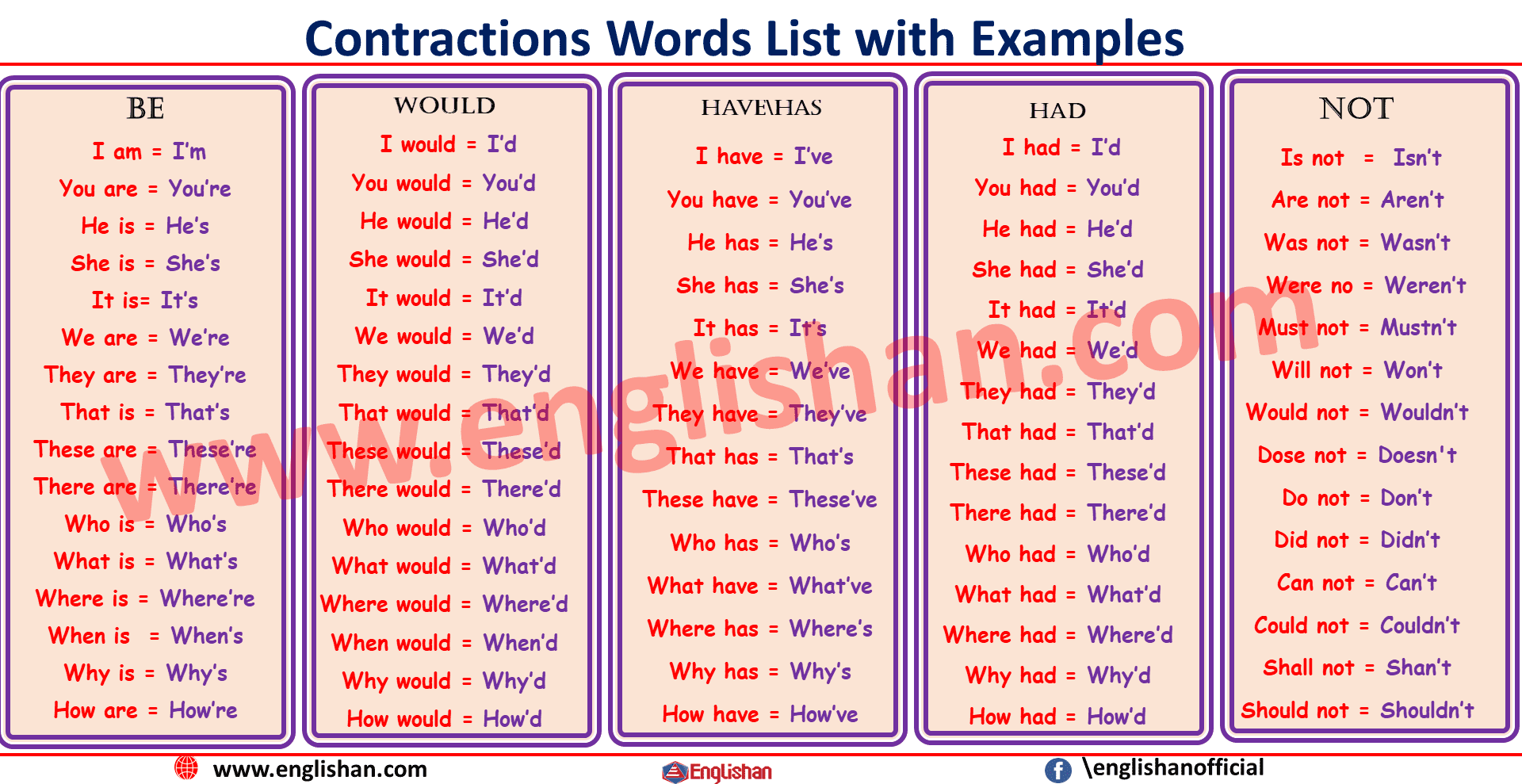
Contractions are shortened forms of words that are commonly used in English. They are created by combining two words and removing some letters and replacing them with an apostrophe. Contractions are widely used in spoken English, informal writing, and messaging. They make communication more natural and fluent, and they help speakers and writers to convey their messages more effectively. In this article, we will explore the usage of contractions in English and how they affect communication.
Contractions
We also use an apostrophe to shorten or contract two words together.
|
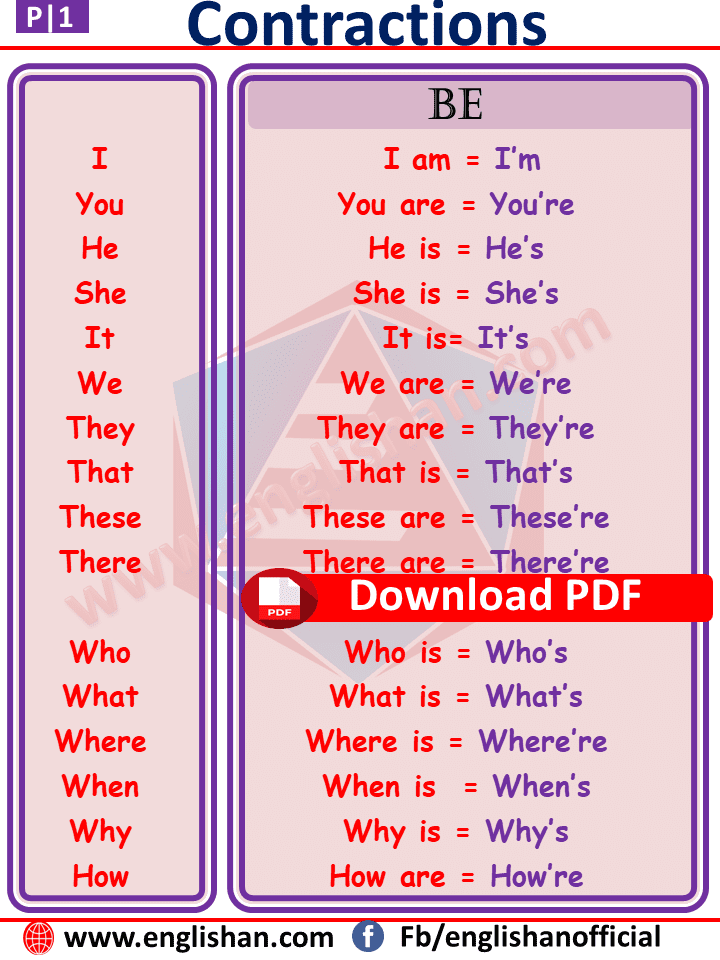
Be |
|
|
I |
I am = I’m |
|
You |
You are = You’re |
|
He |
He is = He’s |
|
She |
She is = She’s |
|
It |
It is= It’s |
|
We |
We are = We’re |
|
They |
They are = They’re |
|
That |
That is = That’s |
|
These |
These are = These’re |
|
There |
There are = There’re |
|
Who |
Who is = Who’s |
|
What |
What is = What’s |
|
Where |
Where is = Where’re |
|
When |
When is = When’s |
|
Why |
Why is = Why’s |
|
How |
How are = How’re |
would contractions list
|
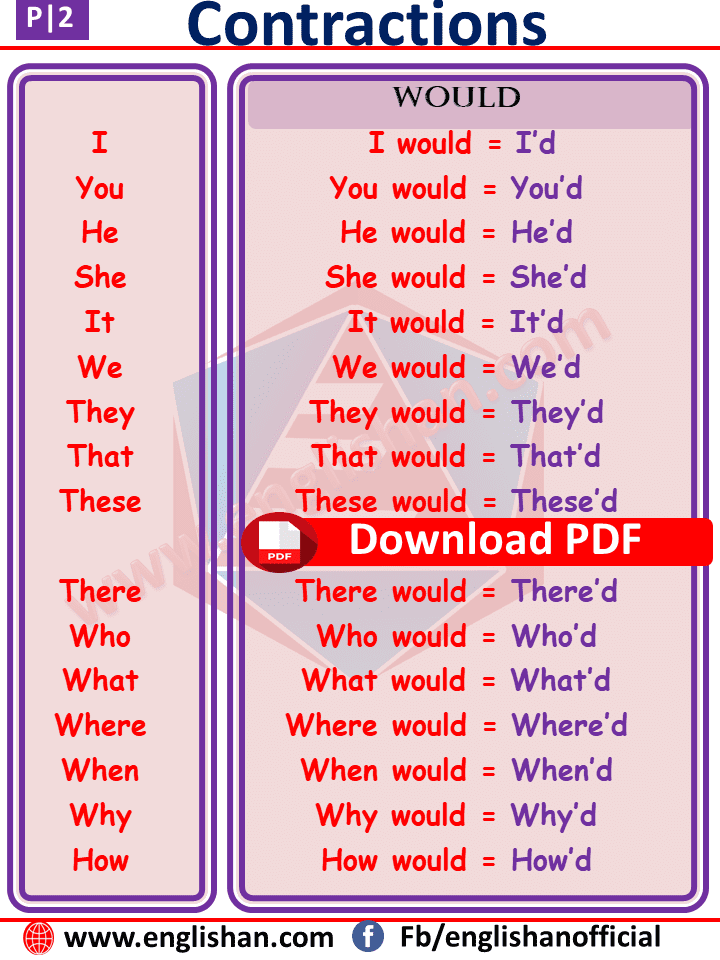
Would |
|
|
I |
I would = I’d |
|
You |
You would = You’d |
|
He |
He would = He’d |
|
She |
She would = She’d |
|
It |
It would = It’d |
|
We |
We would = We’d |
|
They |
They would = They’d |
|
That |
That would = That’d |
|
These |
These would = These’d |
|
There |
There would = There’d |
|
Who |
Who would = Who’d |
|
What |
What would = What’d |
|
Where |
Where would = Where’d |
|
When |
When would = When’d |
|
Why |
Why would = Why’d |
|
How |
How would = How’d |
Had contractions list
|
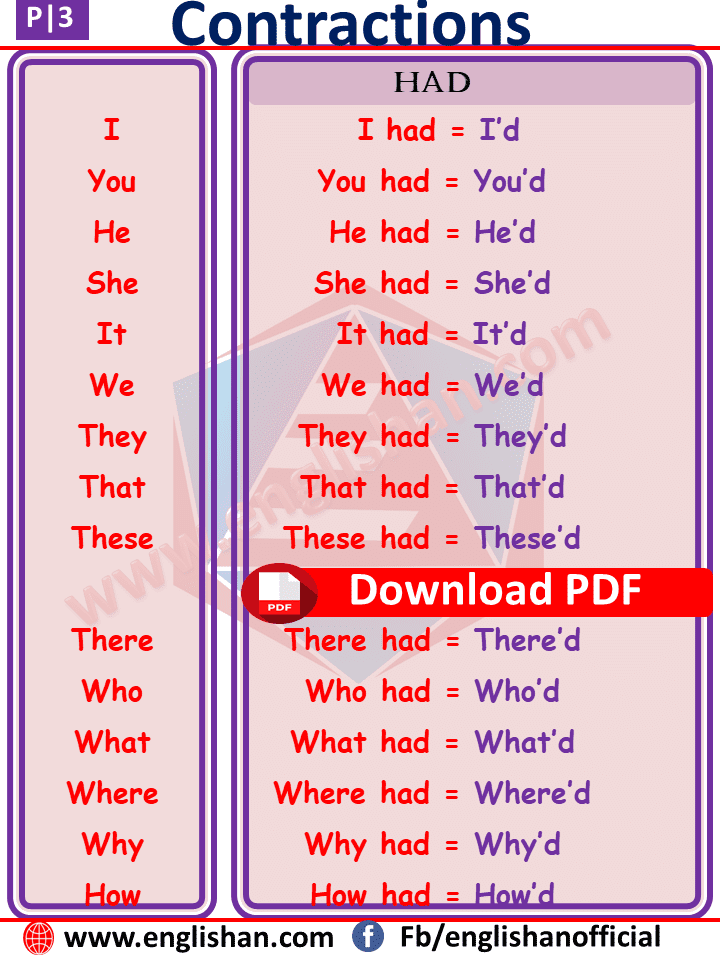
had |
|
|
I |
I had = I’d |
|
You |
You had = You’d |
|
He |
He had = He’d |
|
She |
She had = She’d |
|
It |
It had = It’d |
|
We |
We had = We’d |
|
They |
They had = They’d |
|
That |
That had = That’d |
|
These |
These had = These’d |
|
There |
There had = There’d |
|
Who |
Who had = Who’d |
|
What |
What had = What’d |
|
Where |
Where had = Where’d |
|
Why |
Why had = Why’d |
|
How |
How had = How’d |
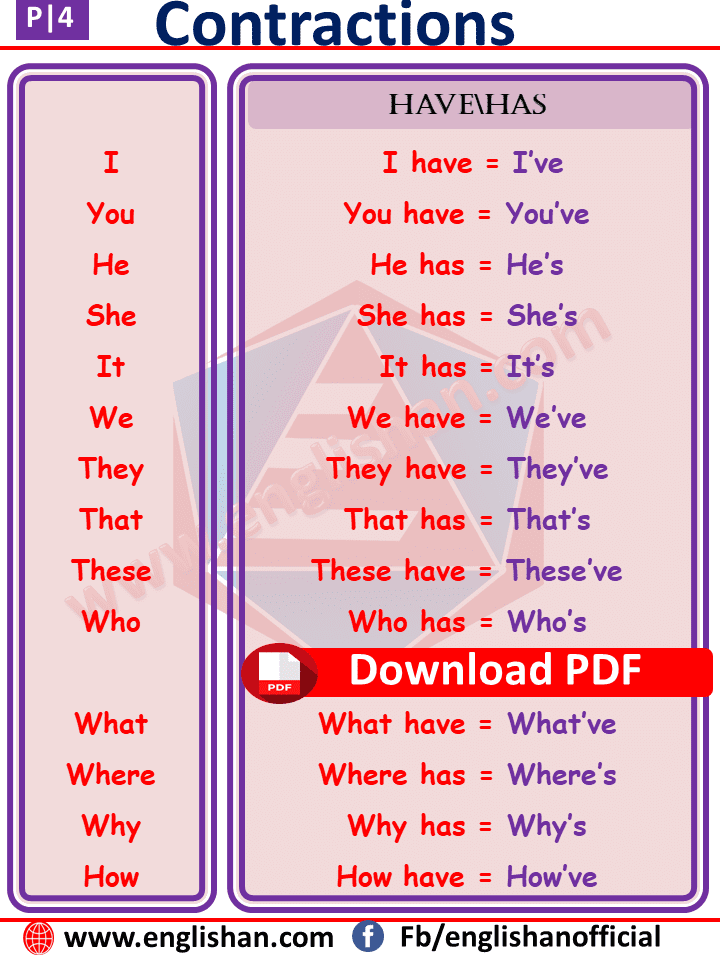
Have / Has contractions list
|
Have\has |
|
|
I |
I have = I’ve |
|
You |
You have = You’ve |
|
He |
He has = He’s |
|
She |
She has = She’s |
|
It |
It has = It’s |
|
We |
We have = We’ve |
|
They |
They have = They’ve |
|
That |
That has = That’s |
|
These |
These have = These’ve |
|
There |
There has = There’s |
|
Who |
Who has = Who’s |
|
What |
What have = What’ve |
|
Where |
Where has = Where’s |
|
Why |
Why has = Why’s |
|
How |
How have = How’ve |
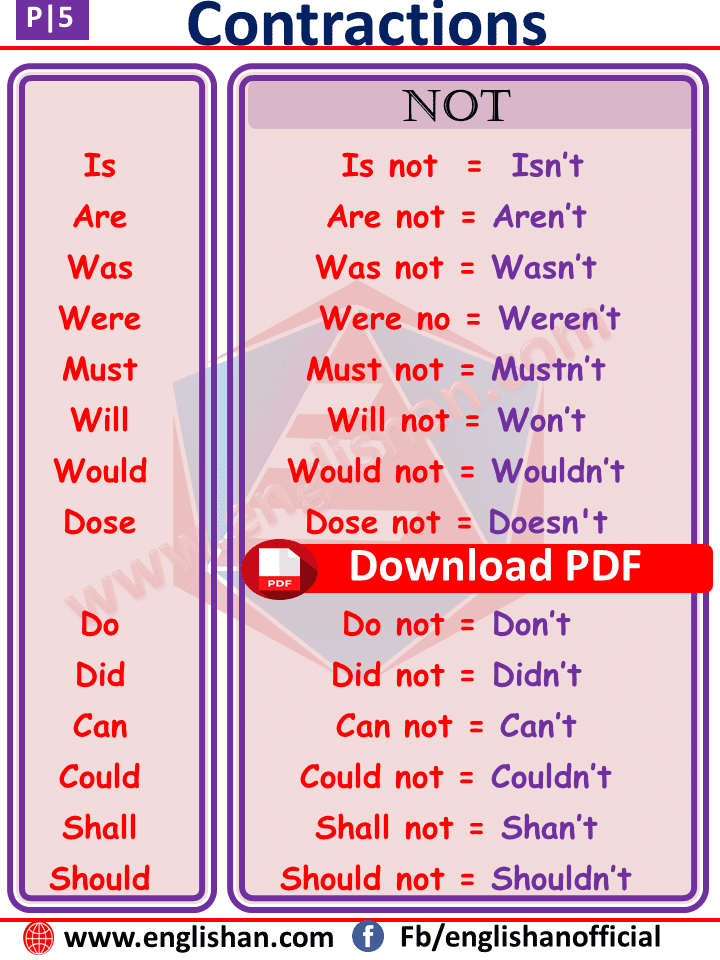
Not contractions list
|
Not |
|
|
Is |
Is not = Isn’t |
|
Are |
Are not = Aren’t |
|
Was |
Was not = Wasn’t |
|
Were |
Were no = Weren’t |
|
Must |
Must not = Mustn’t |
|
Will |
Will not = Won’t |
|
Would |
Would not = Wouldn’t |
|
Dose |
Dose not = Doesn’t |
|
Do |
Do not = Don’t |
|
Did |
Did not = Didn’t |
|
Can |
Can not = Can’t |
|
Could |
Could not = Couldn’t |
|
Shall |
Shall not = Shan’t |
FAQs:
Here are 12 common contractions:
1. I’m (I am)
2. You’re (You are)
3. He’s (He is)
4. She’s (She is)
5. It’s (It is)
6. We’re (We are)
7. They’re (They are)
8. Can’t (Cannot)
9. Won’t (Will not)
10. Don’t (Do not)
11. Haven’t (Have not)
12. Isn’t (Is not)
The 6 most common contractions are:
1. I’m (I am)
2. You’re (You are)
3. He’s (He is)
4. It’s (It is)
5. Can’t (Cannot)
6. Don’t (Do not)
These are used frequently in everyday conversation.
Contracting words are shortened forms of two words combined with an apostrophe. For example:
1. I’m = I am
2. You’re = You are
3. He’s = He is
4. Can’t = Cannot
5. Won’t = Will not
6. Don’t = Do not
These are common in casual speech and writing.
Here are 6 examples of sentences with contractions:
1. I’m studying for the test.
2. You’re always so helpful.
3. He’s working on his project.
4. They’ve already left the party.
5. We can’t wait for the weekend.
6. It’s a beautiful day outside.
These contractions make the sentences sound more casual and conversational.
Contractions PDF

You May Also Like
Contractions Quiz
Contractions
Choose the correct contraction.
The contraction of 'do not' is ___.
The apostrophe replaces the missing 'o'.
the apostrophe replaces the missing letters
do not -> don't
Complete the expansion.
'I'm' is short for ___.
'I'm' joins 'I' and 'am'.
'I'm' = I am
I'm ready.
Complete the expansion.
'They're' is the contraction of ___.
'They're' joins 'they' and 'are'.
they're = they are
They're here.
Which contraction is written correctly?
The apostrophe marks the missing 'o' in 'not'.
the apostrophe goes where letters are removed
would not -> wouldn't
What does the '-'s mean here?
In 'She's gone', 's stands for ___.
'Gone' is a past participle, so 's is 'has'.
's can mean 'is' or 'has'; the verb form tells which
She's gone = She has gone
Complete the expansion.
'Let's' means ___.
'Let's' joins 'let' and 'us'.
'let's' = let us
Let's begin.
Choose the contraction.
The short form of 'do not' is ___.
'Don't' joins 'do' and 'not', with the apostrophe marking the missing o.
the apostrophe stands for the missing letter
I don't agree.
Choose the contraction.
The short form of 'I am' is ___.
'I'm' joins 'I' and 'am', with the apostrophe marking the missing a.
contractions mark dropped letters with an apostrophe
I'm ready.
Choose the contraction.
The short form of 'will not' is ___.
'Will not' contracts to the irregular 'won't'.
will not -> won't (irregular)
She won't be late.
Type the contraction of 'they are'.
___ meeting us at noon.
'They're' joins 'they' and 'are', with the apostrophe marking the missing a.
they are -> they're
They're meeting us at noon.
True or false?
The apostrophe in a contraction marks the missing letters.
The apostrophe stands in for the letters removed when two words join.
apostrophe = dropped letters
Can't means cannot.
What does 'it's' stand for?
Choose the meaning of 'it's'.
'It's' is the contraction of 'it is' or 'it has'.
it's = it is / it has; its = possessive
It's raining, and its roof leaks.
Choose the contraction.
The short form of 'cannot' is ___.
'Can't' joins 'can' and 'not', with the apostrophe marking the missing letters.
the apostrophe stands for the missing letters
I can't reach the shelf.
Choose the contraction.
The short form of 'is not' is ___.
'Isn't' joins 'is' and 'not', with the apostrophe marking the missing o.
apostrophe marks the dropped letter
She isn't ready yet.
Choose the contraction.
The short form of 'we are' is ___.
'We're' joins 'we' and 'are', with the apostrophe marking the missing a.
we are -> we're
We're leaving at six.
Choose the contraction.
The short form of 'she is' is ___.
'She's' joins 'she' and 'is', with the apostrophe marking the missing i.
she is -> she's
She's on her way.
Type the contraction of 'have not'.
They ___ finished the work.
'Haven't' joins 'have' and 'not', with the apostrophe marking the missing o.
have not -> haven't
They haven't finished the work.
True or false?
'Let's' is the contraction of 'let us'.
'Let's' joins 'let' and 'us', with the apostrophe marking the missing u.
let us -> let's
Let's start now.
Choose the contraction.
The short form of 'would not' is ___.
'Wouldn't' joins 'would' and 'not', with the apostrophe marking the missing o.
would not -> wouldn't
He wouldn't agree.
What does 'you've' stand for?
Choose the meaning of 'you've'.
'You've' joins 'you' and 'have', with the apostrophe marking the missing 'ha'.
you have -> you've
You've done well.
Turn on JavaScript for the interactive quiz. The full practice set is shown above.