A noun names a person, place, thing, animal, idea, quality, material, or group. Words such as teacher, London, book, dog, honesty, gold, and team are nouns because they name something we can talk about in a sentence. Nouns do more than label things. They also work as subjects, objects, complements, modifiers, and parts of longer noun phrases.
What Is a Noun?
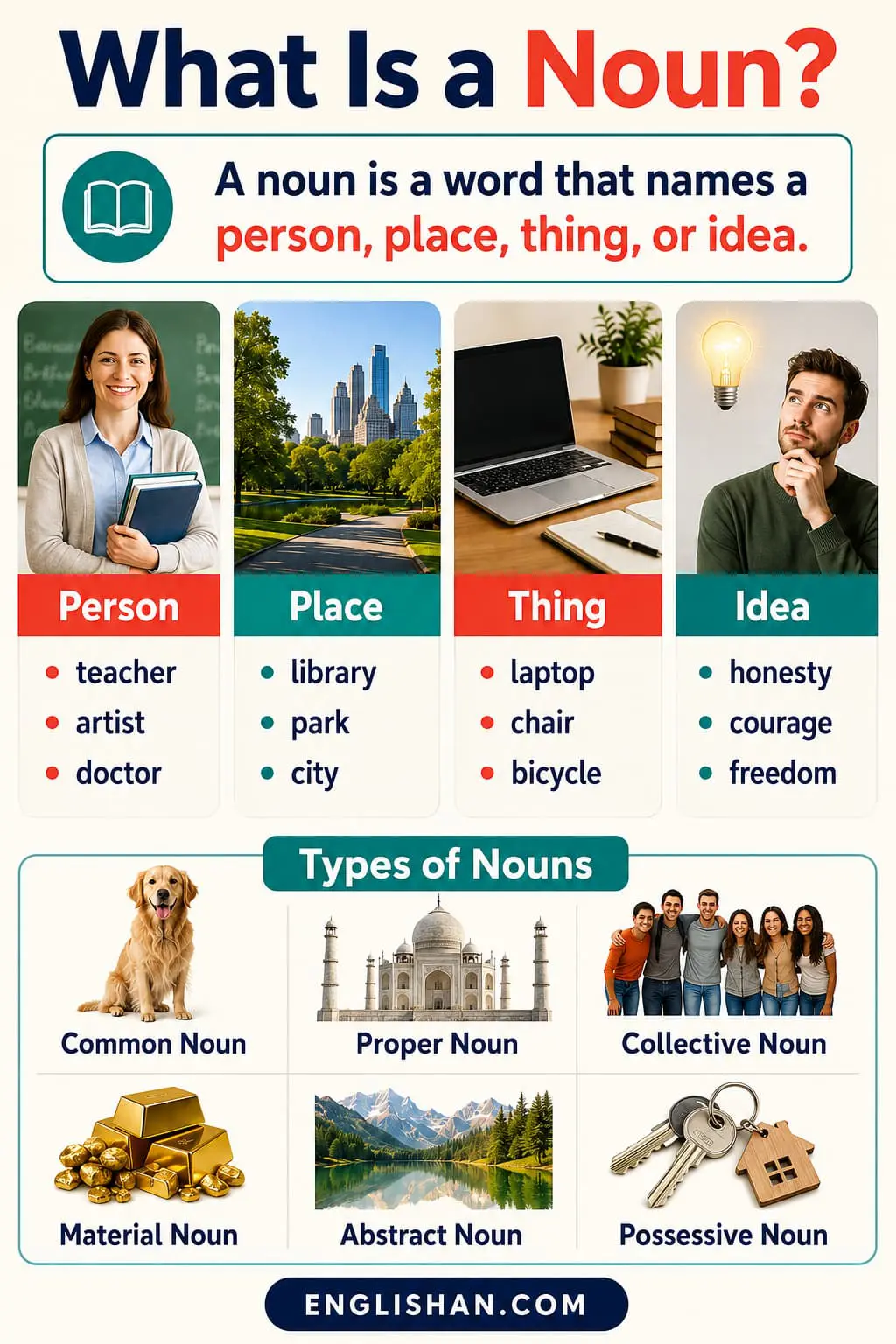
A noun is a naming word, but mature grammar needs a fuller explanation than that. A noun gives language a name for something real, imagined, specific, general, physical, emotional, or abstract. It may name a person like doctor, a place like museum, a thing like phone, an animal like horse, a quality like bravery, or a material like cotton.
Nouns can be one word, such as book, or more than one word, such as swimming pool, New York, or the old stone bridge. They can be general, such as city, or specific, such as Toronto. They can be countable, such as apple, or uncountable, such as rice. They can also work with articles, adjectives, prepositions, and possessive forms to build larger noun phrases.
A noun is not defined only by what it names. Its grammar role also matters. In a sentence, a noun can perform the action, receive the action, complete the meaning after a linking verb, or sit after a preposition.
Noun Examples
Noun examples are easier to understand when they are grouped by what they name.
| Category | Noun Examples |
|---|---|
| People | Teacher, doctor, writer, Emma, Mr. Wilson |
| Places | City, school, London, museum, Canada |
| Things | Book, phone, table, car, laptop |
| Animals | Dog, horse, lion, bird, whale |
| Ideas | Freedom, honesty, justice, courage, knowledge |
| Feelings | Happiness, fear, anger, pride, sadness |
| Qualities | Beauty, kindness, strength, patience, wisdom |
| Materials | Gold, wood, cotton, glass, water |
| Groups | Team, family, class, committee, crowd |
| Events | Meeting, wedding, concert, festival, election |
These examples show why nouns cover such a wide range of English vocabulary. A noun may name something you can touch, such as chair, or something you can only understand as an idea, such as loyalty.
How Nouns Work in Sentences
Nouns as Subjects
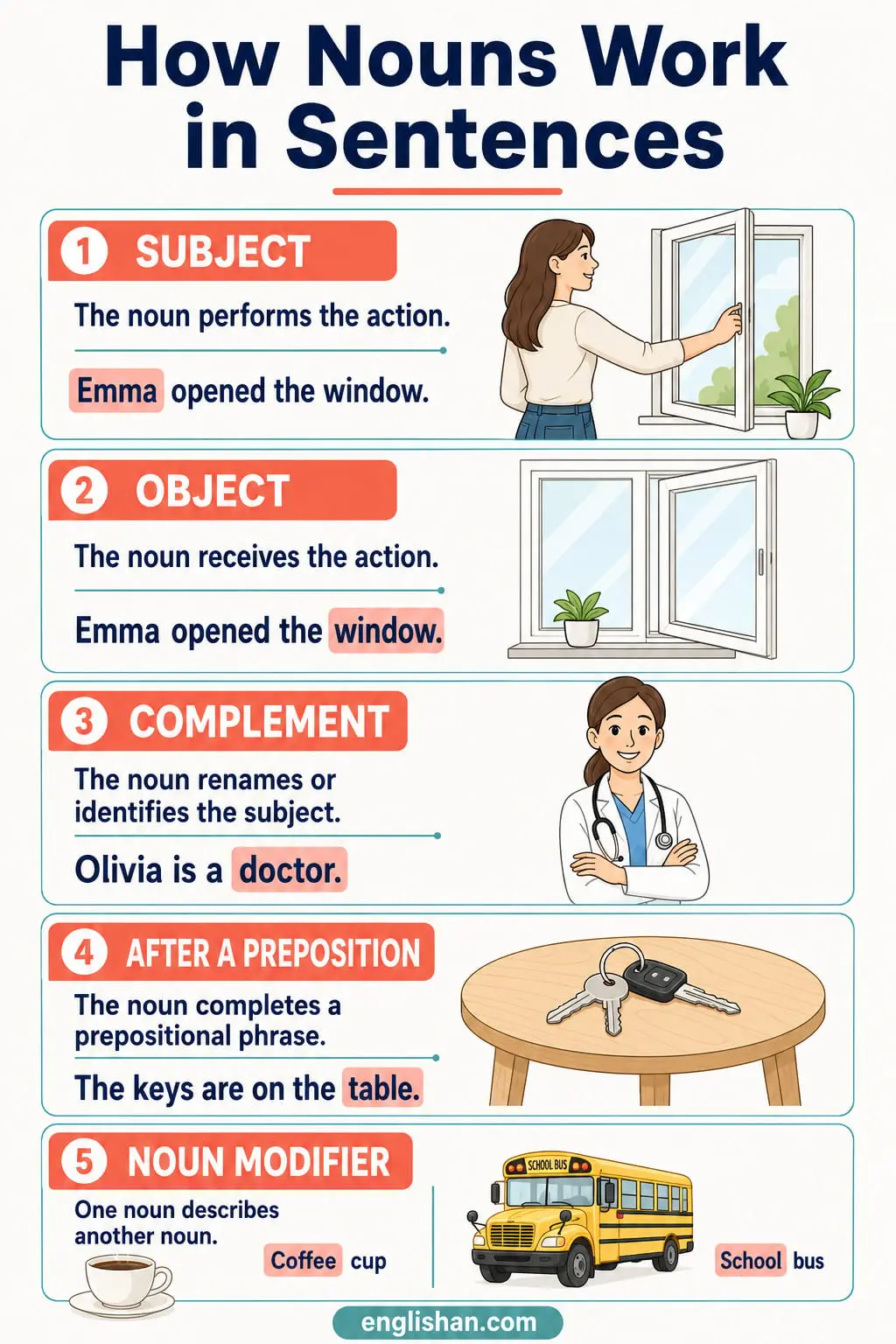
A noun works as the subject when it names the person, place, thing, or idea that the sentence is mainly about. The subject often performs the action.
- Olivia opened the window.
- The teacher explained the assignment.
- The river flows through the valley.
- Confidence improves with practice.
In these sentences, the nouns tell us who or what performs the action or carries the main idea.
Nouns as Objects
A noun works as an object when it receives the action of a verb.
- Emma opened the window.
- The students watched the film.
- Daniel bought a laptop.
- The chef prepared dinner.
The object answers questions such as what did she open?, what did they watch?, or what did he buy?
A noun can also be an indirect object when it names the person who receives something.
- Grace gave Oliver a book.
- The manager sent the team an email.
Here, Oliver and the team receive something.
Nouns as Complements
A noun works as a complement when it completes the meaning after a linking verb such as be, become, or seem. It identifies or renames the subject.
- Olivia is a doctor.
- That building became a museum.
- London remains a major financial center.
- The winner was Charlotte.
The complement does not receive an action. It gives another name or identity for the subject.
Nouns After Prepositions
A noun often appears after a preposition such as in, on, under, near, with, from, or through. In that position, it works as the object of the preposition.
- The keys are on the table.
- We walked through the park.
- The letter came from Canada.
- The children sat near the window.
Prepositions create relationships of place, time, direction, cause, or connection. The noun after the preposition completes that relationship.
Nouns as Modifiers
A noun can describe another noun. In this role, the first noun acts like a modifier.
- School bus
- Coffee cup
- Chicken soup
- London airport
- History teacher
- Office chair
In coffee cup, the word coffee tells what kind of cup it is. In school bus, school tells what kind of bus it is. The first noun modifies the second noun, but it is still a noun.
Types of Nouns
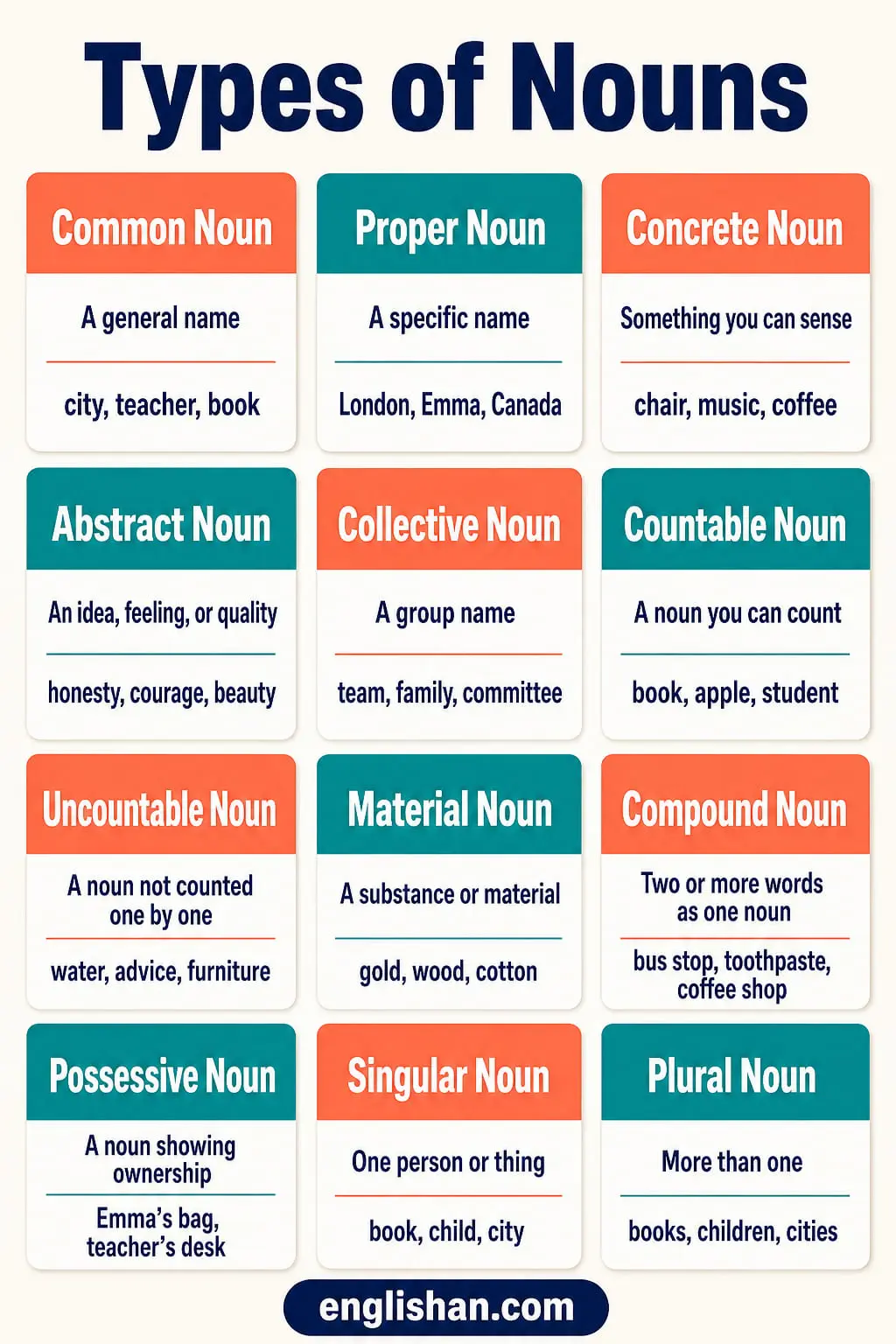
The main Types of Nouns explain what a noun names, how specific it is, whether it can be counted, and what form it takes. A single noun can belong to more than one type, so these categories should not be treated as separate boxes.
Common Nouns
A common noun names a general person, place, thing, animal, idea, or group. It does not name one specific person, place, or thing.
Examples:
- Teacher
- City
- Book
- Country
- River
- Company
- Student
- Restaurant
Common nouns are usually lowercase unless they begin a sentence.
- The teacher gave a lecture.
- The city is famous for its museums.
Proper Nouns
A proper noun names a specific person, place, organization, brand, day, month, title, or event. Proper nouns begin with capital letters.
Examples:
- Emma
- London
- Canada
- Monday
- Oxford University
- Apple
- The Guardian
- Christmas
Proper nouns identify exact names.
- Emma lives in Toronto.
- We visited Oxford University in July.
Concrete Nouns
A concrete noun names something physical, something you can see, hear, touch, smell, or taste.
Examples:
- Chair
- Music
- Coffee
- Flower
- Dog
- River
- Bread
- Perfume
Concrete nouns are not limited to things you can touch. Music is concrete because you can hear it. Perfume is concrete because you can smell it.
Abstract Nouns
An abstract noun names an idea, feeling, quality, state, or condition. It does not name a physical object.
Examples:
- Honesty
- Courage
- Beauty
- Freedom
- Wisdom
- Happiness
- Anger
- Patience
Abstract nouns are common in mature writing because they allow you to discuss ideas and qualities rather than only physical things.
- Honesty builds trust.
- Patience is valuable in difficult conversations.
Collective Nouns
A collective noun names a group of people, animals, or things as one unit.
Examples:
- Team
- Family
- Class
- Committee
- Crowd
- Audience
- Flock
- Herd
A collective noun can refer to several members, but the word itself treats them as one group.
- The team is ready.
- The audience enjoyed the performance.
- A flock of birds crossed the sky.
In American English, collective nouns often take singular verbs when the group acts as one unit. British English may use singular or plural verbs depending on whether the group is viewed as one unit or as individual members.
Countable Nouns
A countable noun names something you can count as separate items. Countable nouns have singular and plural forms.
Examples:
- One book, two books
- One student, three students
- One apple, six apples
- One city, many cities
Countable nouns can use a or an in the singular.
- A book
- An apple
- A university
- An idea
They also work with numbers and plural forms.
- Two books
- Five students
- Several cities
Uncountable Nouns
An uncountable noun names something not usually counted as separate individual items. It may name a substance, material, quality, field of knowledge, or mass idea.
Examples:
- Water
- Rice
- Advice
- Furniture
- Information
- Music
- Knowledge
- Sugar
Uncountable nouns usually do not take a or an directly.
An advice ❌
A piece of advice ✅
A furniture ❌
A piece of furniture ✅
A rice ❌
A bowl of rice ✅
Many uncountable nouns are counted through measurement words, containers, or units.
- A glass of water
- A bag of rice
- A piece of advice
- A cup of coffee
- A slice of bread
Material Nouns
A material noun names a substance or material from which things are made.
Examples:
- Gold
- Wood
- Cotton
- Glass
- Iron
- Plastic
- Water
- Leather
- Silver
- Wool
Material nouns often behave like uncountable nouns when they refer to the substance itself.
- The ring is made of gold.
- The table is made from wood.
- The shirt is made of cotton.
Some material nouns become countable when they refer to types, containers, or objects. Glass can name a material, but a glass can also mean a drinking container.
Compound Nouns
A compound noun is made from two or more words that work together as one noun.
Examples:
- Toothpaste
- Bus stop
- Swimming pool
- Coffee shop
- Firefighter
- Bedroom
- High school
- Mother-in-law
Compound nouns appear in three main forms: closed, open, and hyphenated.
| Form | Examples |
|---|---|
| Closed compound | Toothpaste, bedroom, notebook |
| Open compound | Bus stop, coffee shop, swimming pool |
| Hyphenated compound | Mother-in-law, editor-in-chief |
The spelling of compound nouns is not always predictable, so dictionary checking is useful when accuracy matters.
Possessive Nouns
A possessive noun shows ownership, relationship, or connection. It usually uses an apostrophe.
Examples:
- Emma’s book
- The teacher’s desk
- The students’ notebooks
- The children’s toys
- The company’s office
A singular noun usually adds ’s.
- The doctor’s office
- The dog’s collar
- Grace’s laptop
A regular plural noun ending in s usually adds only an apostrophe.
- The students’ books
- The teachers’ meeting
- The players’ uniforms
Irregular plural nouns that do not end in s usually add ’s.
- The children’s room
- The women’s team
- The men’s jackets
Singular and Plural Nouns
A singular noun names one person, place, thing, animal, idea, or group. A plural noun names more than one.
Examples:
- Book, books
- Student, students
- City, cities
- Box, boxes
- Child, children
- Tooth, teeth
Most nouns form the plural by adding s, but many follow spelling changes or irregular patterns.
| Singular | Plural |
|---|---|
| Book | Books |
| Class | Classes |
| City | Cities |
| Child | Children |
| Man | Men |
| Tooth | Teeth |
| Mouse | Mice |
| Sheep | Sheep |
Plural forms are part of noun grammar because they affect verbs, determiners, and sentence meaning.
Common Noun vs Proper Noun
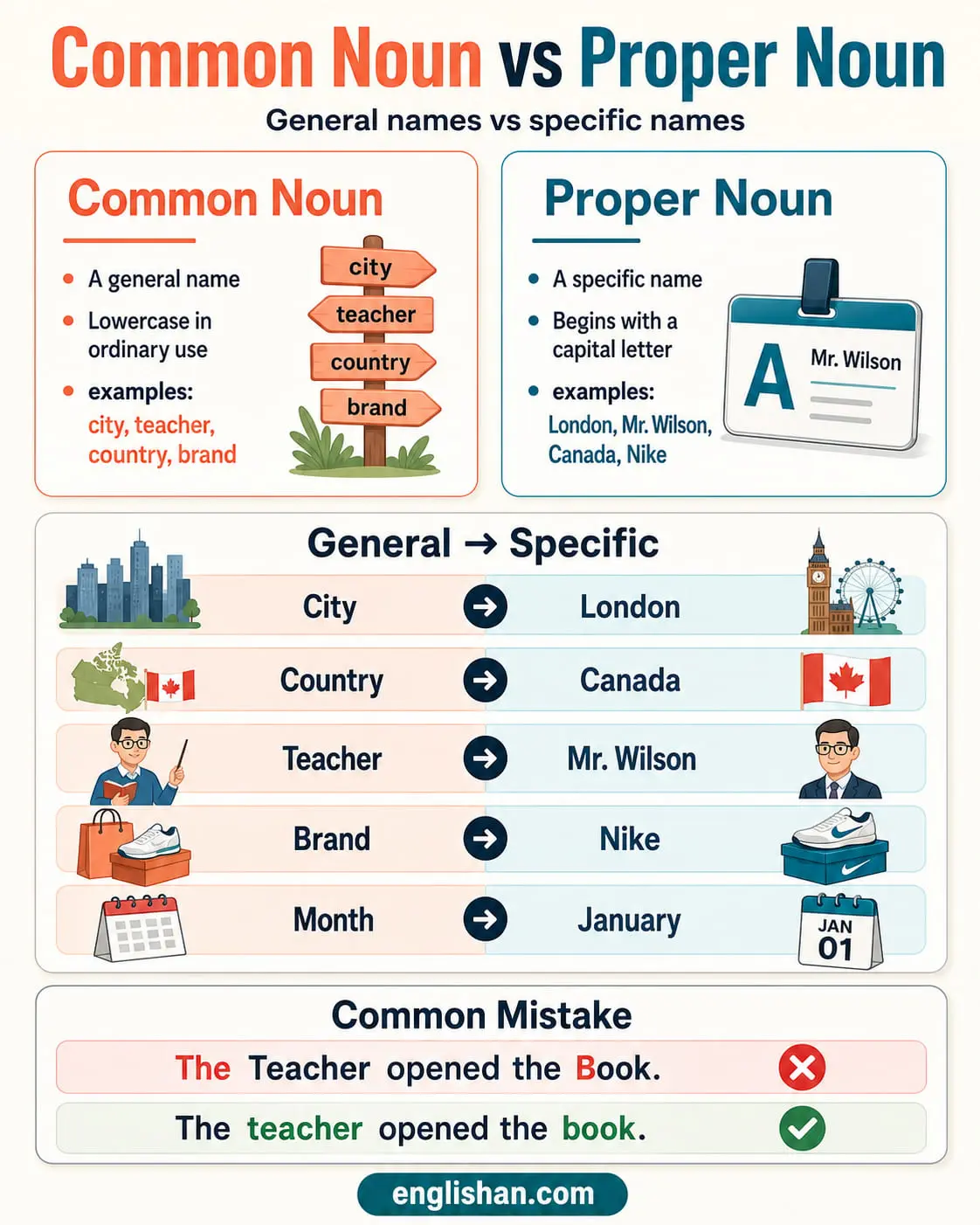
The difference between a common noun and a proper noun is specificity. A common noun gives a general name. A proper noun gives an exact name.
| Common Noun | Proper Noun |
|---|---|
| City | London |
| Country | Canada |
| Teacher | Mr. Wilson |
| Brand | Nike |
| Month | January |
| River | River Thames |
| University | Harvard University |
| Newspaper | The Guardian |
A common noun usually stays lowercase. A proper noun begins with a capital letter.
- The city is busy.
- London is busy.
- The teacher explained the lesson.
- Mr. Wilson explained the lesson.
Do not capitalize a common noun just because it feels meaningful.
The Teacher opened the Book. ❌
The teacher opened the book. ✅
Concrete Noun vs Abstract Noun
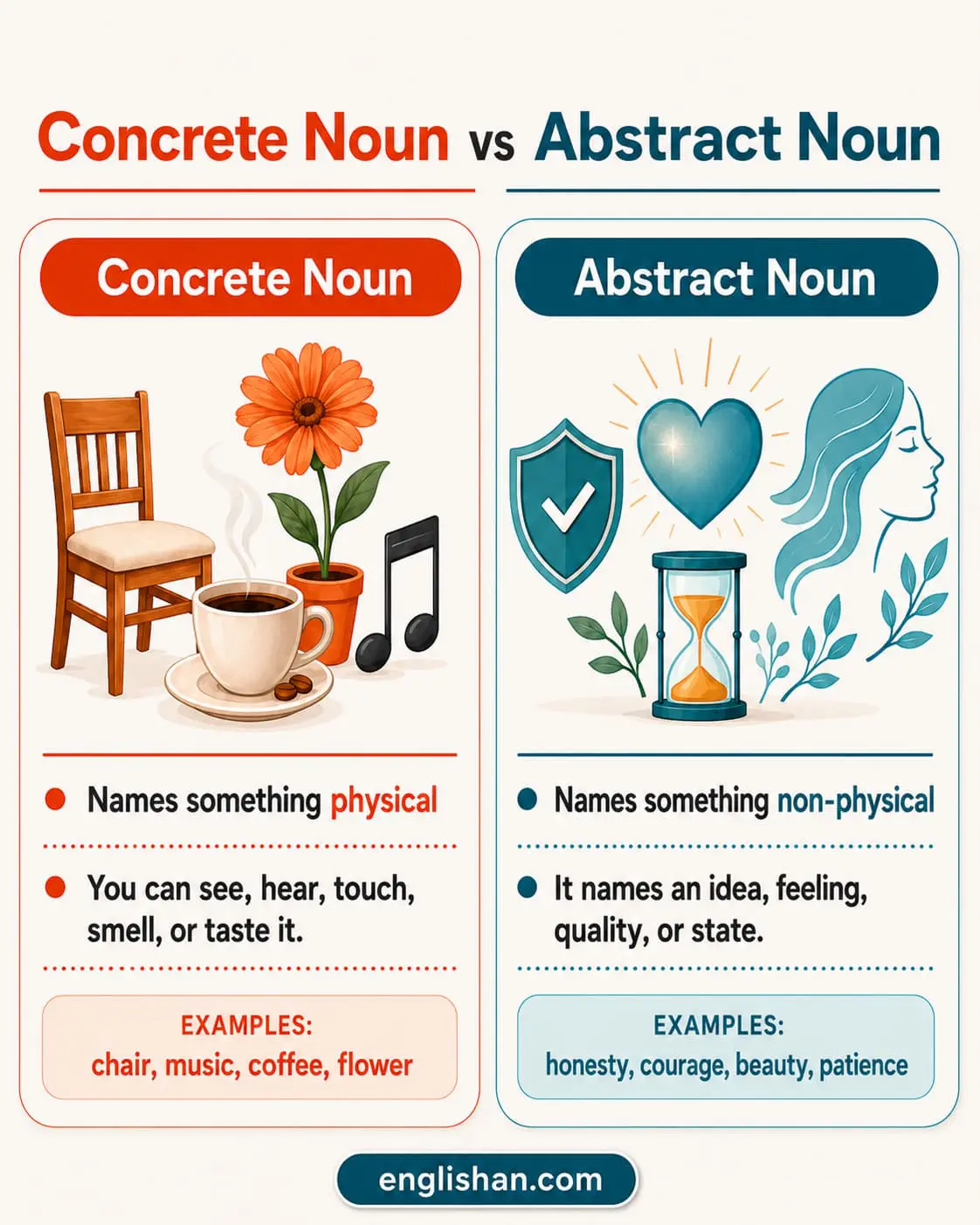
Concrete and abstract nouns differ by whether the noun names something physical or non-physical.
A concrete noun names something you can sense physically. An abstract noun names an idea, quality, feeling, or condition.
| Concrete Noun | Abstract Noun |
|---|---|
| Chair | Kindness |
| Flower | Beauty |
| Music | Happiness |
| Book | Knowledge |
| Coffee | Patience |
| Rain | Sadness |
| House | Safety |
The sentence “The book gave her knowledge” contains both types. Book is concrete because it is a physical object. Knowledge is abstract because it names understanding, not a physical thing.
Countable Noun vs Uncountable Noun
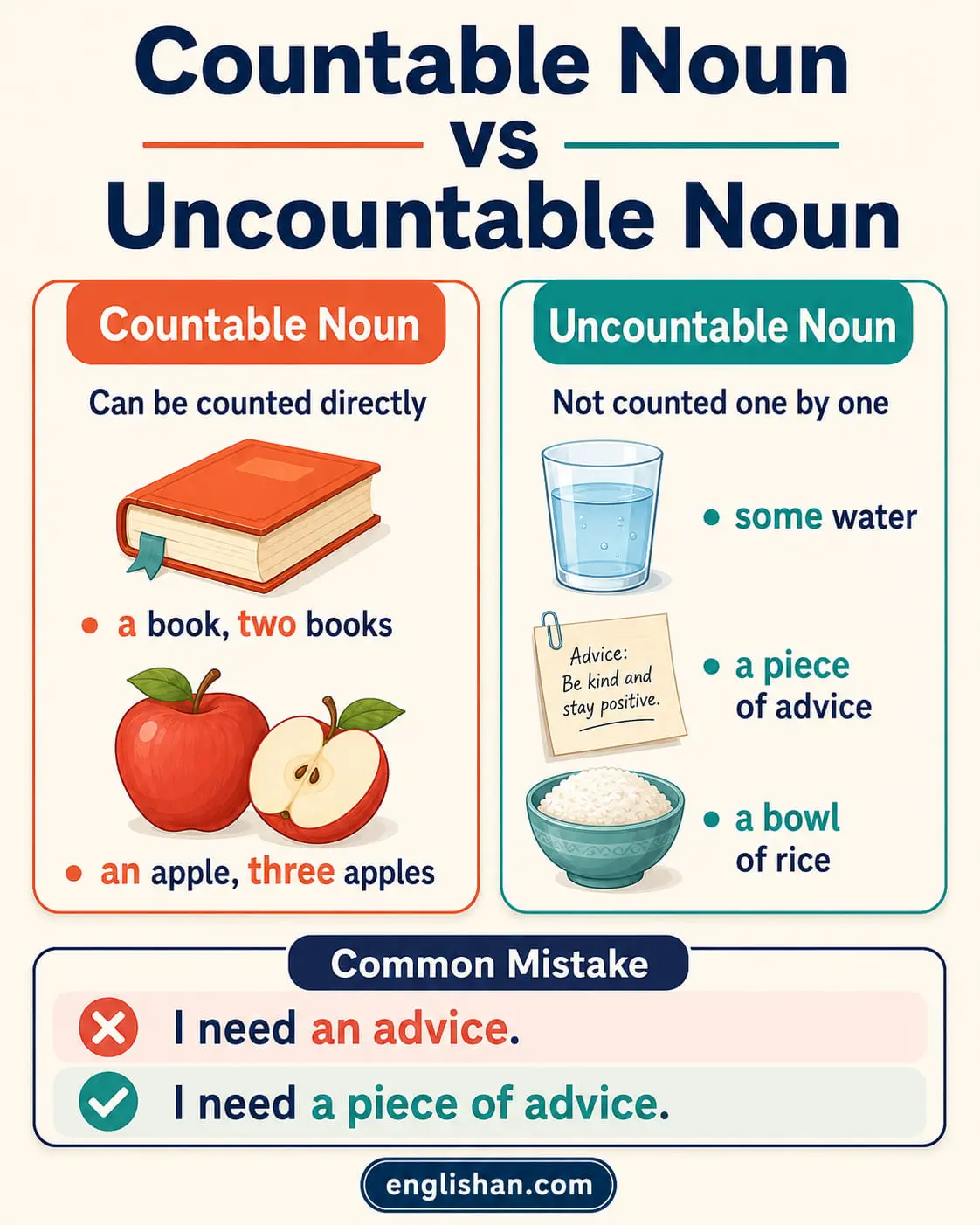
Countable and uncountable nouns affect articles, plural forms, and measurement.
A countable noun can be counted directly.
- A chair
- Two chairs
- Several chairs
An uncountable noun is not normally counted as separate items.
- Some furniture
- A piece of furniture
- Several pieces of furniture
| Countable Noun | Uncountable Noun |
|---|---|
| A book | Some information |
| Two chairs | Some furniture |
| Three apples | Some fruit |
| Several ideas | Some advice |
| Many songs | Some music |
The mistake usually happens when learners use a/an with an uncountable noun.
I need an information. ❌
I need some information. ✅
She gave me an advice. ❌
She gave me a piece of advice. ✅
Singular Nouns and Plural Nouns
Singular and plural nouns show number. A singular noun names one. A plural noun names more than one.
Most regular nouns add s:
- Car, cars
- Book, books
- Chair, chairs
Nouns ending in s, x, z, ch, or sh often add es:
- Class, classes
- Box, boxes
- Watch, watches
- Dish, dishes
Nouns ending in a consonant plus y usually change y to ies:
- City, cities
- Baby, babies
- Story, stories
Some nouns have irregular plural forms:
- Child, children
- Person, people
- Man, men
- Woman, women
- Foot, feet
- Tooth, teeth
A few nouns have the same singular and plural form:
- Sheep
- Deer
- Species
- Series
Plural nouns also affect verb agreement.
The student is ready.
The students are ready.
The child is playing.
The children are playing.
Possessive Nouns
Possessive nouns show ownership, relationship, authorship, or association. The apostrophe changes the meaning.
- Emma’s phone means the phone belongs to Emma.
- The teacher’s desk means the desk belongs to the teacher.
- The company’s policy means the policy belongs to or is connected with the company.
Possessive nouns are often confused with plural nouns.
| Meaning | Correct Form |
|---|---|
| One student owns a book. | The student’s book |
| Several students own books. | The students’ books |
| Several children own toys. | The children’s toys |
| One teacher has a desk. | The teacher’s desk |
Possessive mistakes change meaning and weaken sentence accuracy.
The students book is on the desk. ❌
The student’s book is on the desk. ✅
The childrens toys are outside. ❌
The children’s toys are outside. ✅
Noun Phrases
A noun phrase is a noun together with the words that describe, limit, or complete it. The noun is the head of the phrase.
Examples:
- A book
- The old book
- The old history book
- The old history book on the shelf
- A talented young artist from Toronto
In each example, the main noun controls the phrase. In the old history book on the shelf, the head noun is book. The other words give more information about it.
Noun phrases can work anywhere a noun can work.
Subject:
The old history book on the shelf belongs to Grace.
Object:
Grace bought the old history book on the shelf.
Complement:
That gift was a rare history book.
A noun phrase allows English to add detail without changing the basic grammar role.
Can One Noun Have More Than One Type?
A noun can belong to more than one category at the same time. This is one of the most misunderstood points in noun grammar.
| Noun | Possible Types |
|---|---|
| London | Proper noun, concrete noun, place noun |
| Team | Common noun, collective noun, countable noun |
| Gold | Material noun, concrete noun, usually uncountable noun |
| Happiness | Common noun, abstract noun, usually uncountable noun |
| Swimming | Gerund, noun form when used as a subject or object |
| Oxford University | Proper noun, compound name, institution name |
The categories describe different features. A noun may be proper or common, concrete or abstract, countable or uncountable, singular or plural, possessive or not possessive. These labels can overlap because they answer different grammar questions.
For example, team is a common noun because it is not a specific name. It is a collective noun because it names a group. It is countable because you can say one team or three teams.
Rules for Using Nouns
Noun rules affect capitalization, articles, plural forms, verb agreement, and possession.
Capitalize Proper Nouns
Proper nouns begin with capital letters.
- London
- Canada
- Monday
- Oxford University
- Apple
- The Guardian
Common nouns stay lowercase unless they begin a sentence.
I visited a Museum in London. ❌
I visited a museum in London. ✅
Use A or An With Singular Countable Nouns
A singular countable noun usually needs a determiner such as a, an, the, this, my, or one.
- A teacher
- An apple
- The book
- My phone
- One chair
Use a before a consonant sound and an before a vowel sound.
- A university
- An hour
- A European city
- An honest answer
The sound matters more than the first letter.
Use Measurement Words With Uncountable Nouns
Uncountable nouns usually need units, containers, or measurement words when you want to count them.
- A glass of water
- A piece of advice
- A bowl of rice
- A slice of bread
- A cup of coffee
- A piece of furniture
This rule is central to natural English because many common learner errors come from treating uncountable nouns like countable nouns.
Match Singular and Plural Nouns With Verbs
The verb must agree with the noun when the noun is the subject.
- The student is ready.
- The students are ready.
- The child plays outside.
- The children play outside.
- The team is meeting today.
With collective nouns, the verb may depend on variety of English and meaning. In American English, a collective noun such as team or committee usually takes a singular verb when the group acts as one unit.
Add Apostrophes Correctly for Possession
Use apostrophes to show possession, not ordinary plural forms.
- The teacher’s desk
- The teachers’ meeting
- The child’s toy
- The children’s toys
Never add an apostrophe just because a noun is plural.
The student’s are waiting outside. ❌
The students are waiting outside. ✅
The teachers meeting starts at nine. ❌
The teachers’ meeting starts at nine. ✅
Common Mistakes With Nouns
Noun mistakes often come from capitalization, plural forms, possessive apostrophes, and countability.
Capitalizing Common Nouns
Common nouns do not need capital letters unless they begin a sentence.
My School is near the Park. ❌
My school is near the park. ✅
Using A or An With Uncountable Nouns
Some nouns do not take a or an in their usual meaning.
I need an advice. ❌
I need some advice. ✅
She bought a furniture. ❌
She bought a piece of furniture. ✅
Using the Wrong Plural Form
Irregular plural nouns do not follow the regular s pattern.
The childs are playing. ❌
The children are playing. ✅
Three womans joined the meeting. ❌
Three women joined the meeting. ✅
Confusing Plural and Possessive Forms
A plural noun names more than one. A possessive noun shows ownership or connection.
The teachers are in the room.
The teacher’s book is on the desk.
The teachers’ books are on the desk.
Each sentence has a different meaning.
Treating Every Noun as Only One Type
Learners sometimes think a noun has only one label. In real grammar, one noun can carry several labels.
- Canada is a proper noun and a concrete noun.
- Gold is a material noun and an uncountable noun.
- Team is a collective noun and a countable noun.
The correct label depends on the grammar question being asked.
Nouns in Sentences
These sentences show nouns in different meanings and grammar roles.
- Emma teaches English in London.
- The students opened their books.
- Honesty builds trust.
- The team won the match.
- The chair is made of wood.
- Canada has many beautiful cities.
- The doctor gave Olivia clear instructions.
- The museum stands near the river.
- Music filled the room.
- The children played in the garden.
- The committee approved the plan.
- Grace’s laptop is on the desk.
- The coffee shop opened in Toronto.
- Patience makes difficult work easier.
- The teacher’s notes were useful.
- A flock of birds crossed the sky.
- The book on the shelf belongs to Oliver.
- The company hired three new designers.
- The glass broke during the storm.
- Knowledge grows through reading and experience.
These examples include proper nouns, common nouns, abstract nouns, collective nouns, material nouns, compound nouns, possessive nouns, singular nouns, and plural nouns.
FAQs
A noun is a word that names a person, place, thing, animal, idea, quality, material, event, or group. Examples include teacher, London, book, dog, honesty, gold, and team.
The main types of nouns include common nouns, proper nouns, concrete nouns, abstract nouns, collective nouns, countable nouns, uncountable nouns, material nouns, compound nouns, possessive nouns, singular nouns, and plural nouns.
Ten examples of nouns are teacher, city, London, book, dog, water, gold, team, honesty, and happiness.
Yes. A name is a proper noun. Names of people, places, organizations, days, months, brands, and titles are proper nouns, such as Emma, Canada, Monday, Apple, and Oxford University.
Yes. A noun can belong to more than one type. Gold is a material noun, a concrete noun, and usually an uncountable noun. Team is a common noun, a collective noun, and a countable noun.
A noun names a person, place, thing, or idea. A pronoun replaces a noun to avoid repetition. In “Emma lost her phone,” Emma and phone are nouns, while her is a pronoun.
A noun phrase is a noun with the words that describe, limit, or complete it. In the old history book on the shelf, the head noun is book, and the other words add detail.
A gerund is a verb form ending in -ing that works as a noun. In “Swimming is good exercise,” swimming acts as the subject of the sentence, so it works as a noun.
You May Also Like