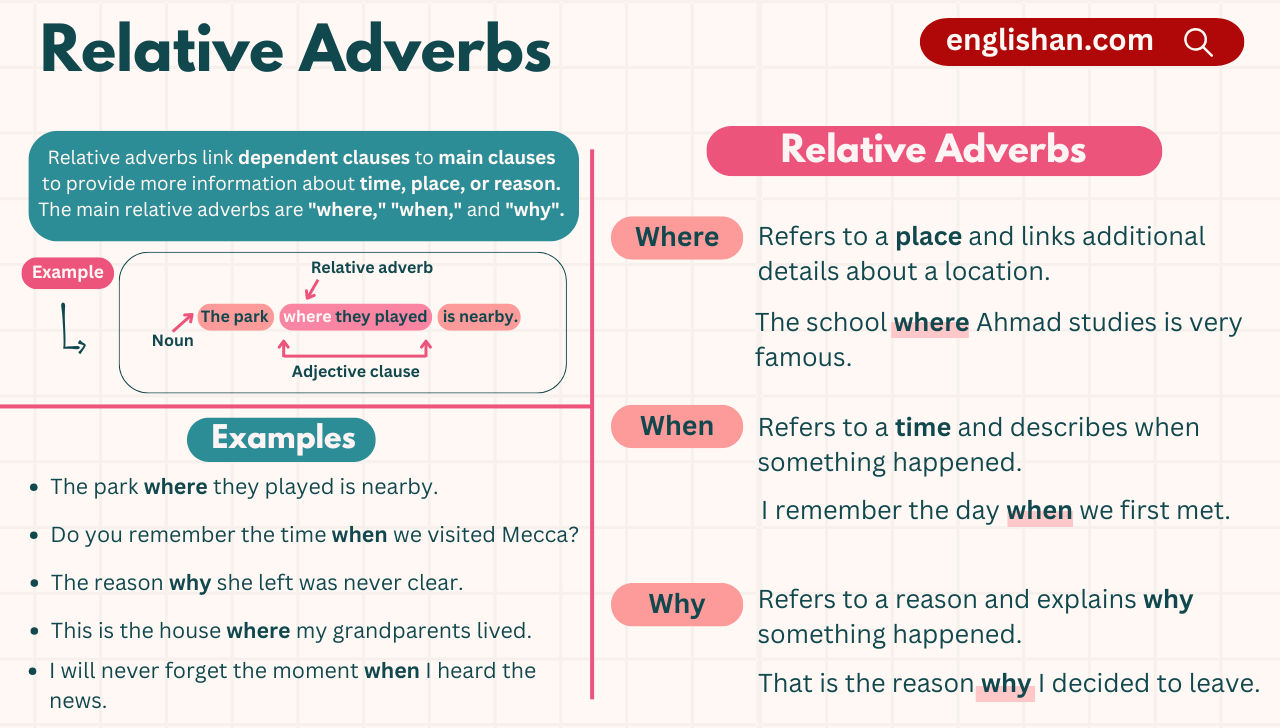
A relative adverb is an adverb that introduces an adjective clause and links it to a noun in the main sentence. The three relative adverbs in English are where (place), when (time), and why (reason). Each attaches a whole clause to a noun and answers a question about that noun: which place, which time, or for what reason.
Writers choose a relative adverb to compress two sentences into one. “Cairo is a city. I grew up there.” becomes “Cairo is the city where I grew up.” One noun, one clause of description, no repetition of the same word.
What Is a Relative Adverb?
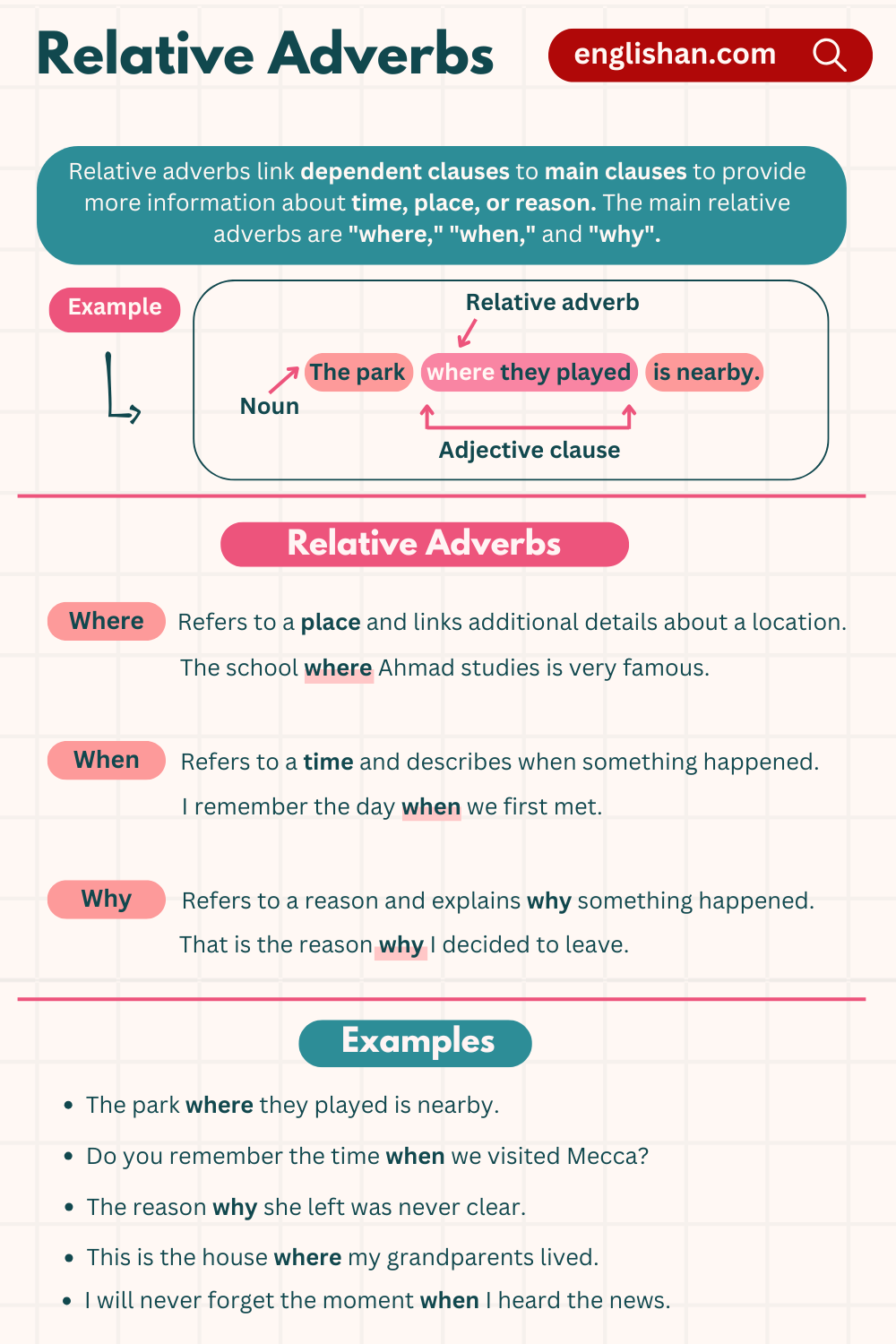
A relative adverb is an adverb that introduces an adjective clause and connects it to a noun in the main sentence. The adjective clause describes the noun by naming one specific fact about place, time, or reason.
- The café where we first met has closed. (which café? the one where we first met)
- I still remember the day when we moved in. (which day? the day we moved in)
- Tell me the reason why you left. (which reason? the one behind leaving)
The noun that the clause modifies is called the antecedent. In each of the three sentences, the antecedent (café, day, reason) comes directly before the relative adverb, followed by the rest of the clause. That word order almost never changes.
A relative adverb performs two jobs at once. It is an adverb modifying the verb inside its own clause, and it is a connector joining that clause to the main sentence. This double role distinguishes it from a plain adverb like quickly or quietly.
The Three Relative Adverbs
Each of the three replaces a different preposition-plus-pronoun structure. Where replaces in which or at which. When replaces on which, in which, or at which for time. Why replaces for which.
Where: Refers to Place
Use where after a noun that names a location. The location is a country, a city, a room, a shop, or any physical space.
- Cairo is the city where I grew up.
- The office where she works overlooks the river.
- This is the restaurant where the negotiations began.
- The park where we first met has been redesigned.
- I need to find the drawer where I put the passport.
In each sentence, where modifies the verb inside its clause (grew up, works, began, met, put) and connects that clause to a place-noun in the main sentence.
When: Refers to Time
Use when after a noun that names a period, moment, or point in time: a day, a year, a moment, an era, a summer.
- I still remember the day when we moved in.
- 1969 was the year when the first moon landing took place.
- She misses the summer when everything felt possible.
- That was the moment when he changed his mind.
- The decade when jazz reshaped America began in the 1920s.
Grammar Monster cites Sophocles for the line “There is a time when even justice brings harm,” a strong model of how when connects a full clause to a time-noun in real writing.
Why: Refers to Reason
Use why after the noun reason. That is the one antecedent standard English accepts.
- Tell me the reason why you left.
- No one explained the reason why the meeting was canceled.
- The reason why she took the job surprised everyone.
- I still do not know the reason why he waited so long.
Two constraints govern why. First, the antecedent is almost always reason; other nouns of explanation (motive, purpose, cause) prefer a different structure. Second, non-restrictive clauses do not accept why, as covered further down in the restrictive-versus-non-restrictive discussion.
Preposition + Which: The Formal Alternative
Every relative adverb has a formal equivalent that uses a preposition plus the relative pronoun which. Formal writing (academic papers, legal drafting, institutional prose) prefers these; modern editorial prose prefers the relative adverb. Both are correct English.
| Relative adverb | Formal equivalent | Sample rewrite |
|---|---|---|
| Where | in which, at which, on which | The office where she works → The office in which she works |
| When | on which, in which | The day when we moved in → The day on which we moved in |
| Why | for which | The reason why he left → The reason for which he left |
Grammar Monster and the University of Nevada Reno Writing Center both note that the preposition-plus-which version reads as more formal. Modern editors treat the plain relative adverb as natural rather than incorrect. Choose the formal version for a legal brief or a research paper; use the relative adverb almost everywhere else.
Lemon Grad documents a five-level formality gradient for where alone: at which (most formal), where, which…at, that…at, and full omission (least formal). Adult writers pick the level that fits the register they are writing in.
Relative Adverbs vs Relative Pronouns
The biggest confusion learners face is the difference between a relative adverb and a relative pronoun. Both introduce a relative clause. Both attach that clause to a noun. Their grammatical job inside the clause is not the same.
A relative pronoun replaces a noun. Who, whom, whose, which, and that stand in for the noun they refer to. Inside the clause, they are the subject or the object of the verb.
A relative adverb modifies a verb. Where, when, and why modify the verb inside the clause and stand in for an adverbial phrase (in that place, at that time, for that reason).
| Feature | Relative pronoun | Relative adverb |
|---|---|---|
| The words | who, whom, whose, which, that | where, when, why |
| Grammatical job inside the clause | Subject or object | Adverb modifying the verb |
| What it replaces | A noun or pronoun | An adverbial phrase (preposition + noun) |
| Antecedent | A person, thing, or animal | A place-noun, time-noun, or reason |
| Formal equivalent | Preposition + which (object relatives) | Preposition + which |
| Restrictive vs non-restrictive | All five work in both | Where and when work in both; why only in restrictive |
Three paired sentences show the contrast:
- The person who called was Adnan. (relative pronoun; who is the subject of called)
- The room where we spoke was quiet. (relative adverb; where modifies spoke)
- The report that she wrote won an award. (relative pronoun; that is the object of wrote)
If the word replaces a noun, it is a relative pronoun. If it modifies a verb by naming a place, a time, or a reason, it is a relative adverb.
Restrictive vs Non-Restrictive Relative Clauses
A relative clause is restrictive when the noun it modifies needs that clause to make sense. Restrictive clauses take no commas.
- The café where we first met has closed. ✅
Remove where we first met and the sentence loses the specific café. The clause is defining.
A relative clause is non-restrictive when the noun already stands on its own and the clause adds extra description. Non-restrictive clauses take a pair of commas (or one comma if the sentence ends with the clause).
- Café Rouge, where we first met, has closed. ✅
- Let us sit on this seat, where we will get splashed. ✅
One carve-out applies here. Why does not appear in a non-restrictive clause. English rejects The reasons, why he wanted the money, are unclear. ELT Concourse and Grammar Monster both note this asymmetry: where and when accept both restrictive and non-restrictive use, but why accepts only restrictive.
Are “Whenever” and “Wherever” Relative Adverbs?
Whenever and wherever are relative adverbs when they introduce a free relative clause with no fixed antecedent. In this use, they mean at any time that and in any place that.
- Sit wherever you like.
- Call whenever you get a moment.
- She takes her notebook wherever she goes.
- I will read the report whenever the meeting ends.
Both words also intensify time and place adverbs in emphatic use (Why ever did he say that?), but that is a separate use from the relative one. The one-word form whyever is rare and mostly restricted to emphatic questions.
Is “How” a Relative Adverb?
No. Standard English does not treat how as a relative adverb. Writing the way how he answered is not correct English.
- I disliked the way how he answered the question. ❌
To express manner, English offers three natural alternatives:
- Formal: the way in which → I disliked the way in which he answered the question.
- Informal: the way that → I disliked the way that he answered the question.
- Concise: how as a noun clause → I disliked how he answered the question.
Lemon Grad and ELT Concourse both confirm the ruling: manner needs the way in which or the way that in relative use, or how as a nominal clause after verbs like know, see, remember, and understand. The construction the way how is a translation error common in learner writing.
When to Omit a Relative Adverb
Not every relative adverb has to stay in the sentence. English drops each of the three at a different rate.
| Adverb | Omission rule | Result after omission |
|---|---|---|
| Why | Almost always droppable | The reason he left is complete without why. |
| When | Freely droppable in informal register | The day we moved in reads as natural as The day when we moved in. |
| Where | Rarely droppable; works only after generalized place-nouns (place, spot, city) | This is the place I grew up works; the office I work does not. |
Lemon Grad documents this asymmetry in depth: why almost always disappears in modern prose, when disappears freely, and where stays because it stands in for a preposition the sentence still needs (at, in, on). When you drop where, you have to add a preposition back at the end of the clause (This is the office I work in).
Common Mistakes with Relative Adverbs
Five errors show up repeatedly in learner writing. Each one has a fast fix.
1. Using how as a relative adverb.
- I remember the way how she smiled. ❌
- I remember the way she smiled. ✅
- I remember how she smiled. ✅
2. The “reason why for which” stack.
- The reason why for which he left is unclear. ❌
- The reason why he left is unclear. ✅
- The reason for which he left is unclear. ✅ (formal)
Grammar Monster and Lemon Grad both flag this stacking as one of the more common mistakes among learners moving between formal and informal registers.
3. Adding a comma before a restrictive relative adverb.
- The park, where we first met, has been redesigned. ❌ (if the park needs identification)
- The park where we first met has been redesigned. ✅
Add commas only when the noun already stands on its own without the clause.
4. Mixing the relative use with the interrogative use.
- Where did you park? (interrogative: a question, not a relative adverb)
- The lot where I parked is full. (relative adverb: modifies lot)
The relative use follows a noun; the interrogative use starts a question.
5. Using where for time or when for place.
- The year where I was born ❌
- The year when I was born ✅
- The house when I lived ❌
- The house where I lived ✅
Match the adverb to the antecedent: place-noun → where; time-noun → when; reason → why.
FAQs
The three relative adverbs are where (place), when (time), and why (reason). Whenever and wherever work as extended relative adverbs in free relative clauses with no fixed antecedent.
No. Standard English does not treat how as a relative adverb. Use the way that for informal register, the way in which for formal register, or how as a nominal clause after verbs like know, see, or remember.
A relative pronoun (who, whom, whose, which, that) replaces a noun and is the subject or object inside the relative clause. A relative adverb (where, when, why) modifies the verb inside the relative clause and stands in for an adverbial phrase like in that place or at that time.
Yes. The office where she works is equivalent to the office in which she works. The preposition shifts with the noun: on which for a day, at which for a moment, for which for a reason. Formal writing prefers the preposition-plus-which form; modern editorial prose prefers the relative adverb.
Add a comma when the clause is non-restrictive, meaning the noun already stands on its own and the clause adds extra description. Café Rouge, where we first met, has closed. Do not add a comma when the clause identifies the noun. The café where we first met has closed.
Yes. Both introduce free relative clauses with no fixed antecedent. They mean at any time that and in any place that. Sit wherever you like. Call whenever you get a moment.
Yes, at different rates. Why almost always drops (The reason he left is unclear). When drops freely in informal register (The day we moved in). Where stays, because it stands in for a preposition the sentence still needs; drop it only after generalized place-nouns like place or spot.
Some editors call the reason why a tautology, since why already means for which. Grammar Monster and Lemon Grad both note that modern usage accepts the reason why as standard, and that only the stacked form the reason why for which counts as an actual error.
You May Also Like
- Relative Adverbs Worksheets
- 100 Opposite Adjectives in English
- Relative Pronouns in English
- Relative Clauses
- Dependent Clauses
Relative Adverbs Quiz
Relative Adverbs
Which is a relative adverb?
'Where' opens a clause about place.
relative adverbs are where, when, and why
the place where we met
Choose the relative adverb.
This is the day ___ we met.
'When' introduces a clause about time.
'when' introduces a clause about time
the day when we met
Choose the relative adverb.
That's the house ___ she was born.
'Where' introduces a clause about place.
'where' introduces a clause about place
the house where she was born
Choose the relative adverb.
Tell me the reason ___ you left.
'Why' introduces a clause about reason.
'why' introduces a clause about reason
the reason why you left
What does 'where' replace here?
the town where I grew up
'Where' stands in for 'in which'.
a relative adverb can replace preposition + which
the town in which I grew up = the town where I grew up
Choose the relative adverb.
I remember the summer ___ we travelled.
A summer is a time, so 'when' fits.
match the relative adverb to time, place, or reason
the summer when we travelled
Choose the relative adverb.
This is the café ___ we first met.
'Where' introduces a clause about a place.
where introduces a clause about a place
This is the café where we first met.
Choose the relative adverb.
I remember the day ___ we moved in.
'When' introduces a clause about a time.
when introduces a clause about a time
I remember the day when we moved in.
Choose the relative adverb.
Tell me the reason ___ you left.
'Why' introduces a clause about a reason.
why introduces a clause about a reason
Tell me the reason why you left.
True or false?
The relative adverbs are 'where', 'when', and 'why'.
These three adverbs introduce relative clauses about place, time, and reason.
relative adverbs: where, when, why
The town where I grew up has changed.
Which relative adverb marks a place?
Pick the one that refers to a place.
'Where' points to a location.
where refers to place
The shelf where I keep books is full.
Type the relative adverb.
This is the house ___ I grew up.
'Where' introduces the clause describing the place.
where introduces a place clause
This is the house where I grew up.
Choose the relative adverb.
This is the town ___ I was born.
'Where' introduces a clause about a place.
where introduces a clause about a place
This is the town where I was born.
Choose the relative adverb.
I recall the moment ___ he arrived.
'When' introduces a clause about a time.
when introduces a clause about a time
I recall the moment when he arrived.
Choose the relative adverb.
Nobody knew the reason ___ she stayed.
'Why' introduces a clause about a reason.
why introduces a clause about a reason
Nobody knew the reason why she stayed.
Which relative adverb marks a time?
Pick the one that refers to a time.
'When' points to a time.
when refers to time
The day when we met stays with me.
True or false?
'Where' introduces a clause about a place.
'Where' opens a relative clause that describes a location.
where refers to place
The field where we camped flooded.
Type the relative adverb.
That's the park ___ we played as children.
'Where' introduces the clause describing the place.
where introduces a place clause
That's the park where we played as children.
Choose the relative adverb.
2020 was the year ___ everything changed.
'When' introduces a clause about a time.
when introduces a clause about a time
2020 was the year when everything changed.
Which relative adverb marks a reason?
Pick the one that refers to a reason.
'Why' points to a reason.
why refers to reason
The reason why he left stays unclear.
Turn on JavaScript for the interactive quiz. The full practice set is shown above.