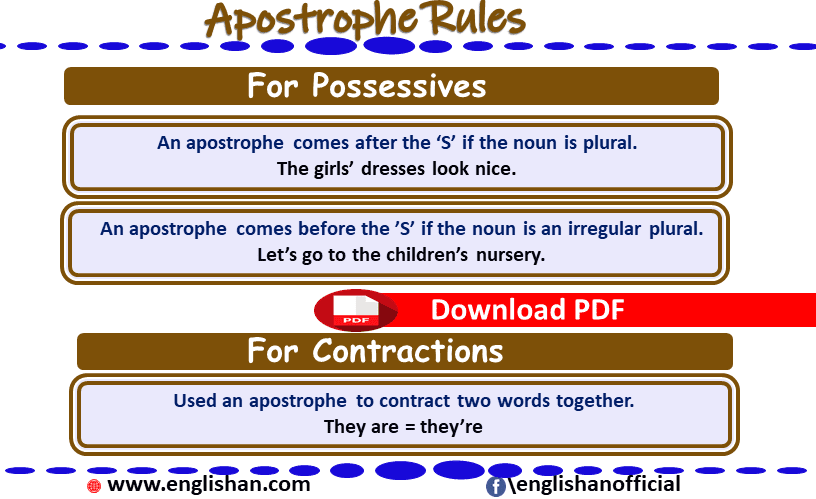
Apostrophes might seem like a small detail in English grammar, but they can make a big difference in how your writing is understood. They are mainly used to show possession and to indicate missing letters, yet many people still get confused about where and how to use them correctly. You’ve probably seen common mistakes like mixing up its and it’s or adding apostrophes where they’re not needed at all.
The good news is that apostrophes follow simple and clear rules. Once you understand them, using apostrophes becomes much more natural and effortless. In this article, we’ll go through these rules step by step with easy explanations and everyday examples, so you can write more clearly and confidently.
What Are Apostrophes? Definition and Meaning
Apostrophes are small punctuation marks ( ’ ) that we use in English writing. They may look tiny, but they are very important. We mainly use apostrophes to show possession (who owns something) and to form contractions (short forms of words). Once you understand them, they become very easy to use in daily writing.
Apostrophe Rules: Contractions and Omissions
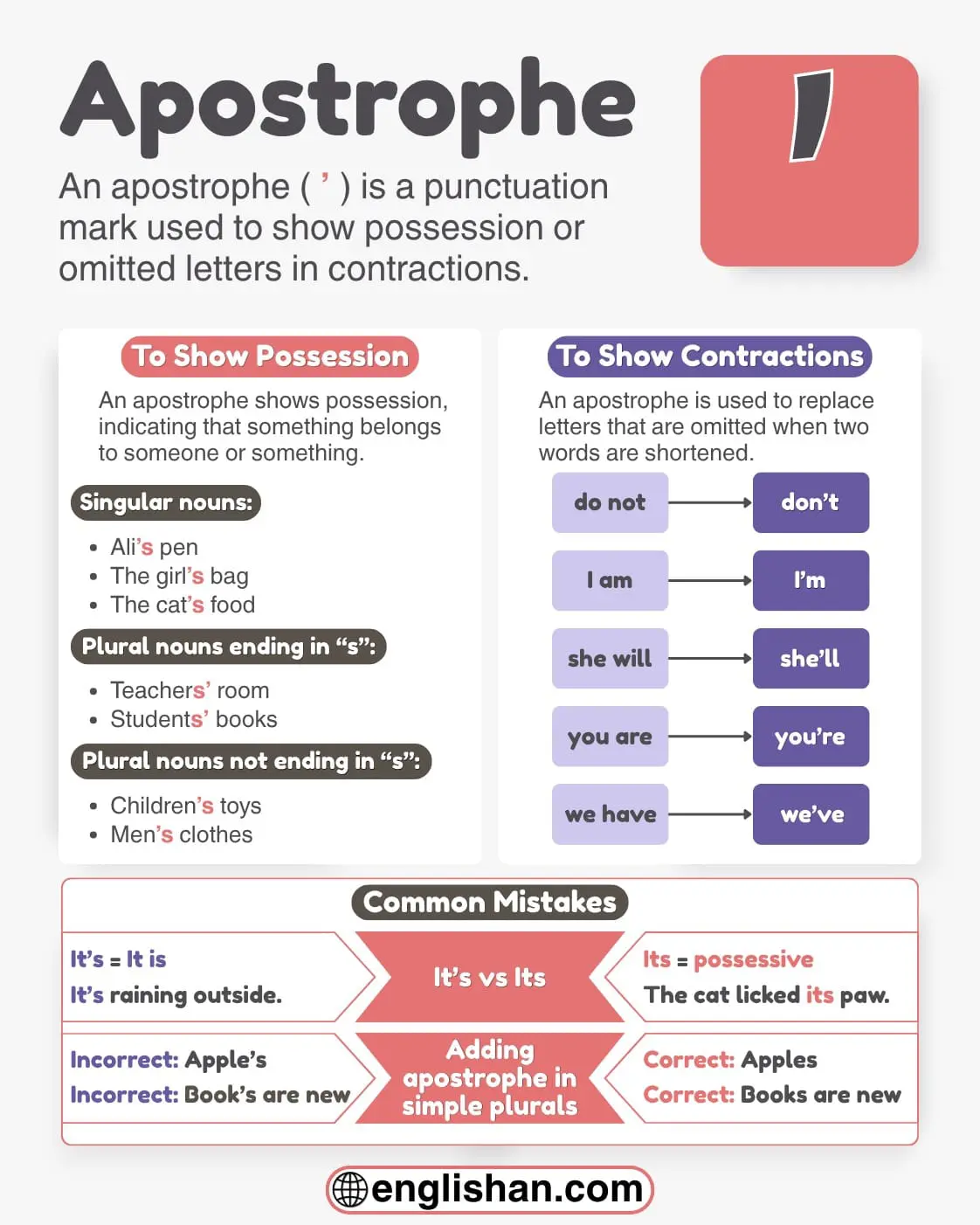
Apostrophes are often used when letters are left out of a word. This usually happens in contractions. For example, instead of writing do not, we write don’t. Here, the apostrophe shows that a letter is missing. So, whenever letters are omitted, we use an apostrophe to make the word shorter and easier to say.
What Are Contractions? Definition and Examples
Contractions are simply short forms of two words joined together. We use an apostrophe to replace the missing letters.
For example:
- I am → I’m
- She is → She’s
- They are → They’re
Common Contractions List (With Examples)
Here are some common contractions we use in everyday English:
| Contraction | Without Contraction | Example Sentence |
|---|---|---|
| I’m | I am | I’m going to school. |
| You’re | You are | You’re my best friend. |
| He’s | He is | He’s very happy today. |
| She’s | She is | She’s reading a book. |
| It’s | It is | It’s raining outside. |
| We’re | We are | We’re ready for the test. |
| They’re | They are | They’re playing football. |
| Don’t | Do not | I don’t like coffee. |
| Can’t | Cannot | I can’t swim. |
| Won’t | Will not | I won’t come tomorrow. |
| Didn’t | Did not | She didn’t finish her work. |
| Isn’t | Is not | He isn’t at home. |
| Aren’t | Are not | We aren’t late. |
| I’ve | I have | I’ve completed my homework. |
| You’ve | You have | You’ve done a great job. |
| We’ve | We have | We’ve seen that movie. |
| They’ve | They have | They’ve arrived early. |
| I’ll | I will | I’ll call you later. |
| You’ll | You will | You’ll understand it soon. |
| We’ll | We will | We’ll meet tomorrow. |
You’ll see these a lot in conversations, messages, and informal writing.
Using Contractions in Formal vs Informal Writing
Contractions are mostly used in informal writing, where the tone is friendly and relaxed. For example, when you are chatting with friends, sending messages, or writing casual emails, using words like don’t, I’m, and you’re feels natural and comfortable. It also makes your writing sound more like real conversation.
On the other hand, in formal writing, contractions are usually avoided. This includes things like exams, assignments, official letters, or professional emails. In these situations, it is better to write the full forms, such as do not, I am, and you are. This makes your writing look more clear, serious, and professional.
Apostrophes with Possessive Nouns
We use apostrophes with nouns to show ownership or possession. This means we are telling that something belongs to someone or something. It helps make our sentences clearer and more meaningful.
For example:
- Ali’s book is on the table. (The book belongs to Ali)
- The dog’s collar is red. (The collar belongs to the dog)
So whenever you want to show “who owns what,” you use an apostrophe.
Apostrophe Rules for Singular Nouns
When we are talking about just one person or thing, we add ’s at the end of the noun. This is the most common and easiest rule.
For example:
- The girl’s bag is very красив.
- The teacher’s office is closed.
- The cat’s tail is long.
In all these sentences, one person or thing owns something, so we simply add ’s.
Apostrophe Rules for Plural Nouns
When a noun is plural and already ends in s, we don’t add another s. We only add an apostrophe after the s.
For example:
- The students’ classroom is large.
- The teachers’ meeting is today.
- The players’ uniforms are new.
Here, we are talking about more than one person, so the apostrophe comes after the s.
Apostrophes with Irregular Plural Nouns
Some plural nouns are different because they do not end in “s”, like children, men, women, and people. These are called irregular plurals.
For these, we add ’s, just like singular nouns.
For example:
- The children’s toys are on the floor.
- The men’s room is on the right.
- The women’s dresses are beautiful.
Even though these are plural, we still use ’s because they don’t end in s.
Apostrophes with Names Ending in “S”
Sometimes names end with the letter s, like James or Harris. To show possession, we usually add ’s at the end.
For example:
- James’s car is parked outside.
- Harris’s phone is ringing.
Some people write James’ car, but adding ’s (James’s) is more clear and commonly used in modern writing.
Apostrophes with Plural Proper Nouns
When we talk about a whole family or group (like the Ahmeds or the Khans), we first make the name plural. Then we add an apostrophe to show possession.
For example:
- The Ahmeds’ house is very big.
- The Khans’ car is new.
- The Maliks’ garden is beautiful.
So the rule is simple:
First make the name plural → then add the apostrophe at the end.
Apostrophes and Possessive Pronouns
Possessive pronouns are words that show ownership, like mine, yours, his, hers, ours, and theirs. The important thing to remember is that these words already show possession, so we do not use apostrophes with them.
For example:
- This book is mine.
- That bag is hers.
- The house is ours.
Many learners get confused and try to write her’s or your’s, but that is incorrect. Possessive pronouns are already complete, so they don’t need an apostrophe at all. Just use them as they are.
List of Possessive Pronouns (With Examples)
Here are the most common possessive pronouns and how we use them in sentences:
| Possessive Pronoun | Example Sentence |
|---|---|
| Mine | This phone is mine. |
| Yours | Is this pen yours? |
| His | That bike is his. |
| Hers | The dress is hers. |
| Ours | This classroom is ours. |
| Theirs | The house on the corner is theirs. |
These words make sentences shorter and smoother because we don’t have to repeat the noun again and again. Instead of saying “This is my book,” we can simply say “This book is mine.”
Apostrophes in Joint Possession (Shared Ownership)
Joint possession means two or more people own something together. In this case, we use an apostrophe to show shared ownership, but the placement of the apostrophe depends on the sentence structure.
For example:
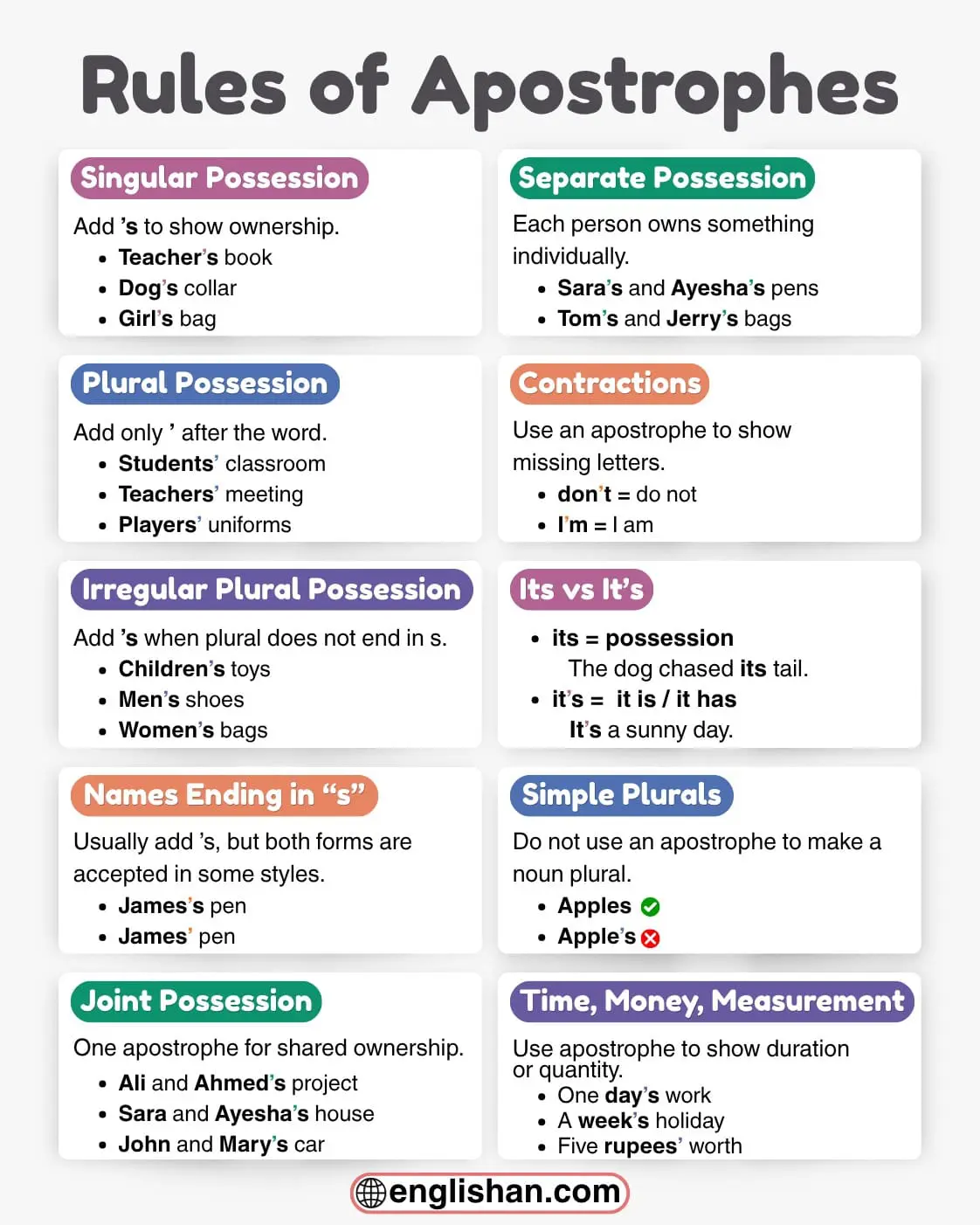
- Ali and Sara’s car is new. (They share one car)
- Tom and Jerry’s house is small.
Here, only the second name gets the apostrophe because they both own the same thing together.
Joint Ownership of One Thing (Apostrophe Rule)
When two people share one item, we place the apostrophe only once, usually after the second name. This shows that the ownership is combined.
For example:
- Ayesha and Maria’s project was selected.
- John and Peter’s business is successful.
- Me and Ali’s plan worked well.
This means both people are equally responsible or owners of one shared thing.
Separate Ownership of Different Things
Sometimes two people may own different things, even if we mention them in the same sentence. In this case, we use apostrophes with each name separately.
For example:
- Ali’s and Sara’s books are on the table.
- Tom’s and Jerry’s cars are parked outside.
- The teacher’s and students’ bags are missing.
This shows that each person owns their own item. So we treat them separately and add apostrophes to both nouns.
Apostrophes vs Plurals (Key Differences)
A very common confusion is between plurals and apostrophes. Plurals simply mean more than one thing, and we usually do not use an apostrophe for that.
For example:
- I have two apples.
- (correct plural, no apostrophe)
- She bought three books.
- (no apostrophe needed)
We only use apostrophes for possession (ownership) or contractions, not just to make a word plural. A mistake like apple’s instead of apples is very common, but incorrect unless you are showing ownership.
Apostrophes in Plurals of Letters and Symbols
Sometimes we use apostrophes when talking about single letters or symbols to make them clear in writing. This is just to avoid confusion.
For example:
- Mind your p’s and q’s.
- She got all A’s in the exam.
Here, the apostrophe is not showing possession—it is just helping us read the sentence clearly. Without it, the sentence might look confusing. So in this case, apostrophes are used for clarity only, not ownership.
Apostrophes with Other Punctuation Marks
Apostrophes can also appear near other punctuation marks like commas, periods, or quotation marks. The main rule is simple: the apostrophe should stay connected to the word it belongs to.
For example:
- Sara’s book is here.
- Is that Ali’s?
- “That’s mine,” she said.
Even if there is a comma or quotation mark, the apostrophe should always stay in the correct position inside the word. It should never break away or change its place.
Common Apostrophe Mistakes to Avoid
Many learners make small mistakes with apostrophes, but they are easy to fix once you know them.
Here are the most common ones:
- ❌ Apple’s are red
- ✔ Apples are red
- ❌ Its a nice day
- ✔ It’s a nice day (contraction)
- ❌ The boys book
- ✔ The boy’s book
Another mistake is using apostrophes in plurals, which is usually wrong. Also, people often confuse its (possessive) and it’s (it is).
Key Takeaway
As we learned, apostrophes are small punctuation marks in English, but they are very useful in writing. We mainly use them for two purposes: to show possession, meaning something belongs to someone (for example, Ali’s book), and to form contractions, where we shorten words by removing letters (for example, don’t for do not). In some special cases, they can also be used for clarity, like in plurals of letters, but they are not used for making regular plurals. The most important thing to remember is that apostrophes should only be used for ownership or missing letters, not just to make a word plural, because that is a very common mistake.
FAQs about Apostrophe
An apostrophe is a punctuation mark used for two main purposes: to show possession (ownership) and to indicate missing letters in shortened words. For example, in Sara’s book, the apostrophe shows that the book belongs to Sara. In contractions like don’t (do not), the apostrophe replaces the missing letter “o.” Using apostrophes correctly helps make your writing clearer and more accurate.
We use an apostrophe to show that something belongs to someone or something. For most singular nouns, you simply add ’s at the end, such as the boy’s bag or the teacher’s desk. This tells the reader who owns the object. Possessive apostrophes are very common in everyday writing and are essential for showing relationships between nouns.
When a plural noun already ends in s, you only add an apostrophe after the s.
For example, the students’ books means the books belong to multiple students. However, if the plural noun does not end in s, you add ’s, such as children’s toys or men’s clothes. This rule helps avoid confusion and keeps your writing grammatically correct.
No, possessive pronouns do not use apostrophes. Words like my, your, his, her, its, our, and their already show possession, so adding an apostrophe is incorrect.
For example, This is her book is correct, while her’s book is wrong. This rule is important because many learners mistakenly add apostrophes to these words.
Apostrophes are used in contractions to show that certain letters have been left out.
For example, can’t (cannot), I’m (I am), and they’re (they are). Contractions are commonly used in informal writing and speech to make language sound more natural and conversational.
You May Also Like
- Direct and Indirect Speech in English
- Punctuation Rules with Examples
- Punctuation Worksheets and Exercises with Answers
- Common Grammar Mistakes In Argumentative Writing