A pronoun is a word used in place of a noun that has already been mentioned, such as he, she, it, or they. They help connect ideas, avoid repetition, and show who or what is involved in the action. They work as subjects, objects, or possessives in a sentence. This grammar topic includes types of pronouns, usage rules, and examples to help you understand how they work in sentence structure.
What Is a Pronoun in Grammar?
A pronoun is a word that replaces a noun to avoid repeating it.
Examples:
- Maria is my friend. → She is very kind.
- The book is on the table. → It belongs to me.
- Ali and I are going to the market. → We need some fruits.
What Is an Antecedent in a Sentence?
An antecedent is the word (usually a noun) that a pronoun refers to or replaces. The antecedent must match the pronoun in number and gender to make the meaning clear. Understanding the connection between a pronoun and its antecedent helps avoid confusion in sentences.
Examples:
- John loves football. He plays every weekend.
- The dogs barked loudly. They were hungry.
- Sara and Tom arrived late. They missed the beginning.
When Do We Use Pronouns in Sentences?
We use pronouns in the following situations:
- To avoid repetition: Instead of saying “Ahmed is tall. Ahmed is smart,” we say, “Ahmed is tall. He is smart.”
- To make the sentence smoother: “The pencil is broken. The pencil was expensive” becomes “The pencil is broken. It was expensive.”
- To match formality and tone: “This is for you” is more natural than repeating a name each time.
Different Types of Pronouns in English
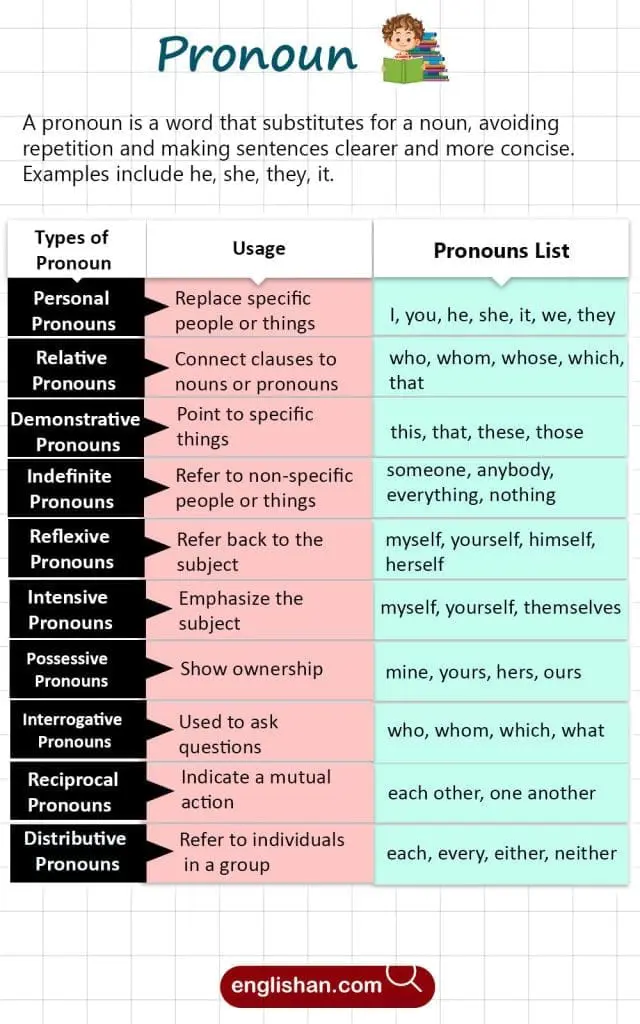
Each type of pronoun has a specific role in grammar. Below is a complete list with definitions and examples for every category.
Personal Pronouns in English
Personal pronouns refer to specific people or things. They change form depending on whether they are the subject or the object of the sentence.
- Subject: I, you, he, she, it, we, they
- Object: me, you, him, her, it, us, them
Examples:
- She is playing in the park.
- The teacher saw him in the hallway.
- We are going to the museum.

Reflexive Pronouns Definition and List
Reflexive pronouns are used when the subject and object of the sentence are the same person or thing. They end in -self or -selves.
- myself, yourself, himself, herself, itself, ourselves, yourselves, themselves
Examples:
- He hurt himself while playing.
- We taught ourselves how to draw.
- The dog cleaned itself.
Possessive Pronouns List
Possessive pronouns show ownership or belonging. They replace nouns that show possession.
- mine, yours, his, hers, its, ours, theirs
Examples:
- That bicycle is mine.
- Is this phone yours?
- The keys are theirs.
Demonstrative Pronouns in Grammar
Demonstrative pronouns point to specific things or people. They show whether something is near or far in distance or time.
- this, that, these, those
Examples:
- This is my pencil.
- Those are my shoes.
- That was an exciting story.
Interrogative Pronouns List and Definition
Interrogative pronouns are used to ask questions. They refer to something that is not yet known.
- who, whom, whose, which, what
Examples:
- Who is knocking at the door?
- What are you doing now?
- Whose book is this?
Relative Pronouns
Relative pronouns connect a dependent clause to a noun or pronoun. They help provide more information about a noun.
- who, whom, whose, which, that
Examples:
- The girl who won the prize is my cousin.
- This is the car that I want to buy.
- The man whose phone rang left quickly.
Indefinite Pronouns
Indefinite pronouns refer to nonspecific people or things. They do not name anyone or anything in particular.
- someone, anyone, everyone, no one
- something, anything, everything, nothing
Examples:
- Someone is calling you.
- Nothing seems right today.
- Everybody enjoyed the party.
Intensive Pronouns in English
They have the same form as reflexive pronouns but are used only to add emphasis to the subject.
- myself, yourself, himself, herself, itself, ourselves, yourselves, themselves
Examples:
- I myself cleaned the whole room.
- She herself baked the cake.
- They themselves fixed the car.
Reciprocal Pronouns
Reciprocal pronouns are used when two or more people are performing an action toward one another.
- each other, one another
Examples:
- They smiled at each other.
- The friends helped one another.
Distributive Pronouns in English
Distributive pronouns refer to members of a group separately, rather than collectively.
- each, either, neither
Examples:
- Each student must bring a pencil.
- You can choose either of the options.
- Neither answer is correct.
What Are Gender-Neutral Pronouns in English?
Gender-neutral pronouns are used when a person’s gender is unknown or when the speaker wants to avoid gendered language. They are respectful and inclusive of all gender identities.
- they, them, their (singular usage)
Examples:
- Someone left their jacket.
- If anyone calls, tell them I’m not home.
- A student should do their best.
Can a Word Function as More Than One Type of Pronoun?
Yes. Some pronouns can serve different roles depending on how they are used in a sentence. The meaning and function are based on context.
Examples:
- Who is that? (Interrogative)
- The boy who sang won a prize. (Relative)
- That is expensive. (Demonstrative)
- The dress that she wore was red. (Relative)
Common Pronoun Mistakes to Avoid
- Wrong case: Me went to school → I went to school
- Confusing subject and object: Her gave it to me → She gave it to me
- Missing antecedent: He was late → Who is “he”? (Always make the subject clear)
Example Sentences for Each Type of Pronoun
| Type | Example Sentence |
|---|---|
| Personal | He is my best friend. |
| Reflexive | She blamed herself for the mistake. |
| Possessive | This phone is mine. |
| Demonstrative | That is my house. |
| Interrogative | Who is at the door? |
| Relative | The boy who ran fast won the prize. |
| Indefinite | Someone is at the gate. |
| Intensive | I myself did the cooking. |
| Reciprocal | They helped each other. |
| Distributive | Each player had a ball. |
FAQs:
A pronoun is a word that replaces a noun in a sentence to avoid repetition.
Examples:
1. I
2. you
3. he
4. she
5. it
6. we
7. they
Example sentences:
1. Sarah is kind. She helps everyone.
2. John and I are friends. We play together.
3. This is my dog. It loves to run.
Pronouns make sentences shorter and clearer.
Here are 12 common pronouns:
1. I
2. you
3. he
4. she
5. it
6. we
7. they
8. me
9. him
10. her
11. us
12. them
Here are the 7 types of pronouns:
1. Personal Pronouns: I, you, he, she, it, we, they
Example: She is my friend.
2. Possessive Pronouns: mine, yours, his, hers, ours, theirs
Example: This is mine.
3. Reflexive Pronouns: myself, yourself, himself, herself
Example: He hurt himself.
4. Demonstrative Pronouns: this, that, these, those
Example: These are my shoes.
5. Interrogative Pronouns: who, what, which
Example: What is your name?
6. Relative Pronouns: who, which, that
Example: The boy who won is happy.
7. Indefinite Pronouns: everyone, anyone, something
Example: Everyone is here.
Here are 6 example sentences with pronouns:
1. I am going to the store.
2. She loves to play soccer.
3. They are my best friends.
4. We are having dinner now.
5. This book is mine.
6. The gift is hers.
These sentences show how pronouns replace nouns.
Read More
Pronouns Quiz
Pronouns
Choose the correct pair.
___ gave the book to ___.
'She' is the subject; 'him' is the object of the preposition.
subject pronoun before the verb, object pronoun after
She gave the book to him.
Choose the correct word.
This bag is ___.
'Mine' is a possessive pronoun that stands alone.
possessive pronouns stand alone
This bag is mine.
Choose the correct word.
He hurt ___ while cooking.
Subject and object are the same person, so the reflexive fits.
reflexive pronoun when subject and object match
He hurt himself while cooking.
Choose the formal, correct word.
___ did you invite?
'Whom' is the object of 'invite'.
whom as the object; who as the subject
Whom did you invite?
Choose the agreeing word.
Everyone must bring ___ own pen.
'Everyone' pairs with singular 'their' in current usage.
everyone pairs with singular 'their'
Everyone must bring their own pen.
Choose the correct word.
The gift is from Sara and ___.
After the preposition 'from', the object pronoun 'me' is correct.
use 'me' after a preposition, even in a pair
The gift is from Sara and me.
Choose the subject pronoun.
___ and Emma left early.
The subject position takes the subject pronoun 'he'.
subject pronouns: I, you, he, she, we, they
He and Emma left early.
Choose the object pronoun.
Please hand the keys to ___.
After the preposition 'to', the object pronoun 'him' fits.
object pronouns follow verbs and prepositions
Please hand the keys to him.
Choose the possessive pronoun.
That coat is ___.
'Mine' stands alone as a possessive pronoun.
possessive pronouns stand alone: mine, yours, hers, ours
That coat is mine.
Choose the reflexive pronoun.
She taught ___ to paint.
The action turns back on the subject, so the reflexive 'herself' fits.
reflexive pronouns end in -self / -selves
She taught herself to paint.
True or false?
The possessive 'its' is written without an apostrophe.
'Its' shows possession and carries no apostrophe.
its = possessive; it's = it is
The bird built its nest.
Type the reflexive pronoun.
The children dried ___ after the swim.
A plural subject acting on itself takes the reflexive 'themselves'.
plural reflexive: themselves
The children dried themselves after the swim.
Choose the subject pronoun.
___ are meeting at noon.
The subject position takes the subject pronoun 'we'.
subject pronouns: I, you, he, she, we, they
We are meeting at noon.
Choose the object pronoun.
The coach praised ___ after the match.
After the verb 'praised', the object pronoun 'them' fits.
object pronouns receive the action
The coach praised them after the match.
Choose the possessive form.
Is this ___ pen or mine?
'Your' sits before a noun to show ownership.
your + noun; yours stands alone
Is this your pen or mine?
Choose the possessive pronoun.
The final choice is ___ .
'Yours' stands alone as a possessive pronoun.
possessive pronouns stand alone
The final choice is yours.
Choose the reflexive pronoun.
He built the shed ___ .
The action turns back on the subject, so the reflexive 'himself' fits.
reflexive pronouns end in -self / -selves
He built the shed himself.
Choose the relative pronoun.
The girl ___ won the prize is my cousin.
'Who' refers to a person in a relative clause.
who refers to people in relative clauses
The girl who won the prize is my cousin.
Type the reflexive pronoun.
I taught ___ to cook last year.
A first-person subject acting on itself takes the reflexive 'myself'.
first-person reflexive: myself
I taught myself to cook last year.
True or false?
'Us' is a subject pronoun.
'Us' is an object pronoun; the matching subject pronoun is 'we'.
we = subject; us = object
We waved, and they waved back at us.
Turn on JavaScript for the interactive quiz. The full practice set is shown above.