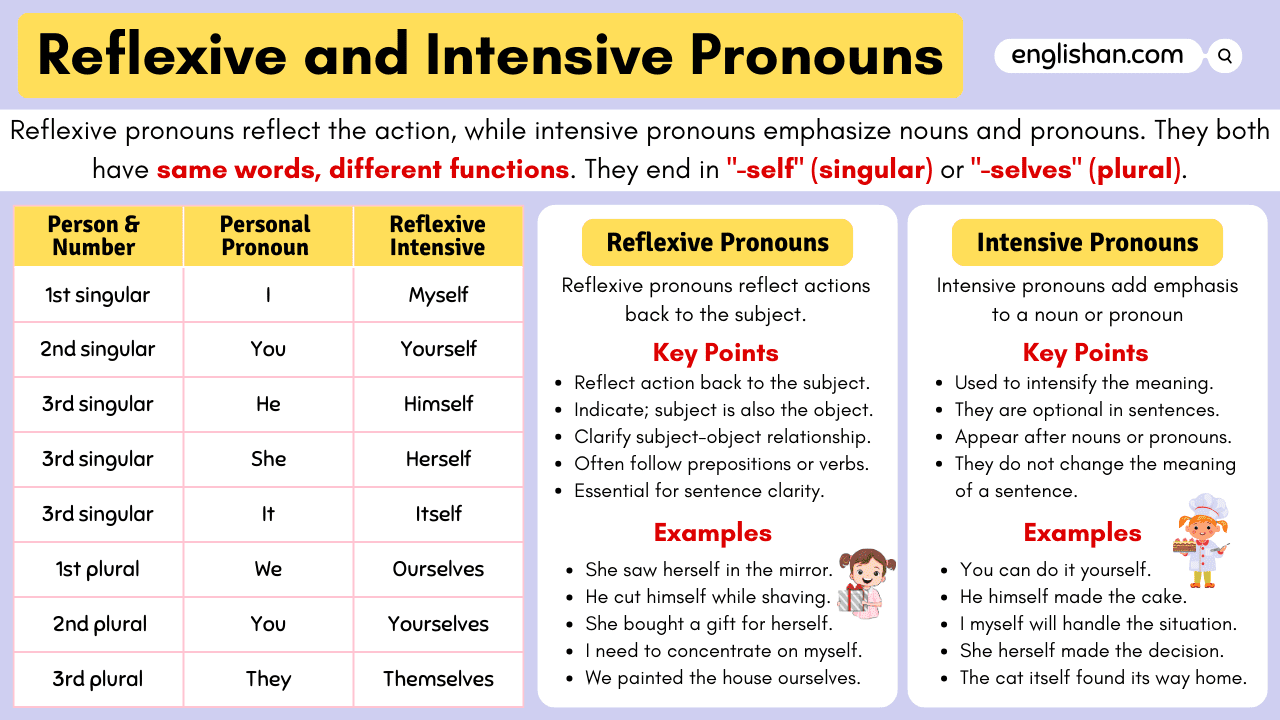
Reflexive and intensive pronouns are special types of pronouns used to refer back to the subject or add emphasis. Reflexive pronouns like myself, yourself, and themselves are used when the subject and object are the same. Intensive pronouns, also called emphatic pronouns, use the same forms but are used only for emphasis. Both types help you avoid repetition and improve sentence clarity. We’ll learn their definitions, usage, and examples in detail below.
What Are Reflexive Pronouns?
Reflexive pronouns are words that we use when the subject and the object of a sentence are the same person or thing. They show that the action is being done to oneself. For example, in the sentence “She dressed herself,” “herself” is the reflexive pronoun because it refers back to the subject “she” doing the action of dressing. Here “she” is both the doer of the action (dressing) and the receiver (she dressed herself). There are eight common reflexive pronouns in English:
- myself
- yourself
- himself
- herself
- itself
- ourselves
- yourselves
- themselves
These pronouns help us avoid repetition in sentences and emphasize that the subject is performing the action on themselves. They are formed by adding “-self” (singular) or “-selves” (plural) to the appropriate pronoun and change depending on the person and number of the subject:
| Person & Number | Personal Pronoun | Reflexive Pronoun |
|---|---|---|
| 1st person singular | I | Myself |
| 2nd person singular | You | Yourself |
| 3rd person singular (masculine) | He | Himself |
| 3rd person singular (feminine) | She | Herself |
| 3rd person singular (neutral) | It | Itself |
| 1st person plural | We | Ourselves |
| 2nd person plural | You | Yourselves |
| 3rd person plural | They | Themselves |
| Impersonal | One | Oneself |
What Are Intensive Pronouns?
Intensive pronouns are words that we use to give extra emphasis to a noun or pronoun in a sentence. They don’t change the meaning of the sentence but make it stronger by highlighting a particular person or thing. They are always preceded by a noun or pronoun that they emphasize. Intensive pronouns often end in “-self” or “-selves” just like reflexive pronouns do.
For example, in the sentence “I myself saw the accident,” “myself” is an intensive pronoun. It’s not necessary for the meaning of the sentence; “I saw the accident” would be enough. But by adding “myself,” it emphasizes that it was me who saw the accident, not someone else.
Intensive pronouns are the same words as reflexive pronouns but used differently in a sentence. They emphasize or intensify the subject rather than reflect the action back to it. Common intensive pronouns include:
| Personal Pronoun | Intensive Pronoun |
|---|---|
| I | Myself |
| You | Yourself |
| He | Himself |
| She | Herself |
| It | Itself |
| We | Ourselves |
| You | Yourselves |
| They | Themselves |
| One | Oneself |
Reflexive and Intensive Pronouns Difference
Here are the key differences between reflexive and intensive pronouns:
| Feature | Reflexive Pronouns | Intensive Pronouns |
|---|---|---|
| Function | Show the subject acts on itself | Add emphasis to a noun or pronoun |
| Purpose | Make it clear the subject and object are the same | Highlight or stress a specific noun or pronoun |
| Usage | Needed to complete the meaning | Not needed, sentence makes sense without it |
| Placement | Usually after the verb | Right after the noun or pronoun being emphasized |
| Forms | myself, yourself, himself, herself, etc. | Same forms as reflexive, used for emphasis |
| Effect on Meaning | Changes sentence meaning if removed | No change in meaning if removed |
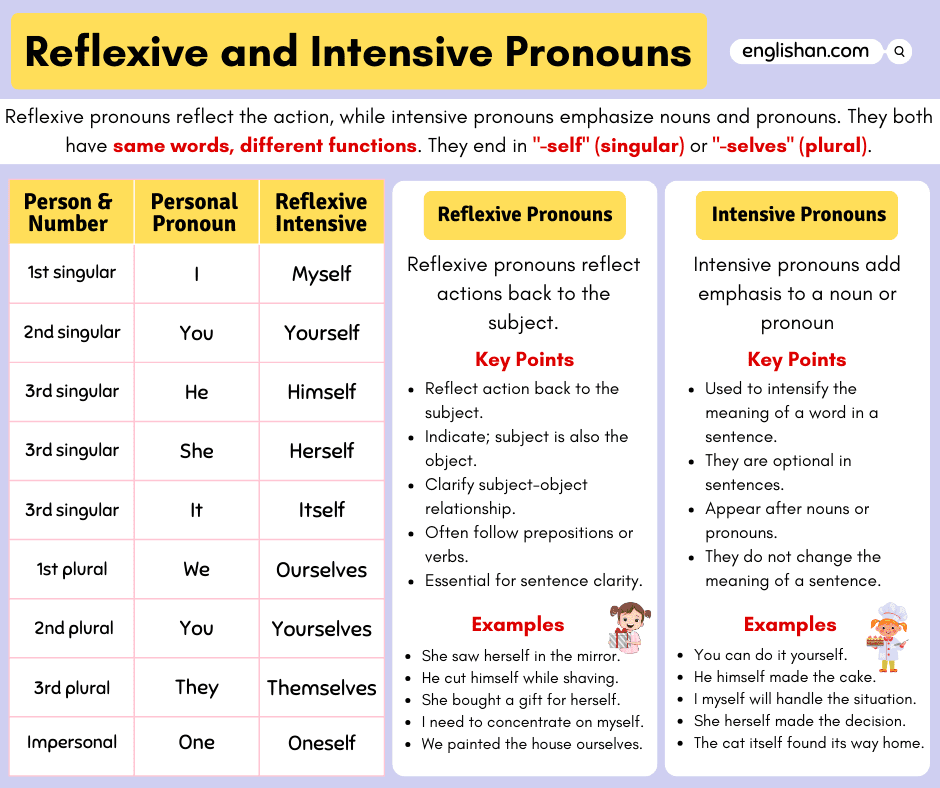
Reflexive and Intensive Pronouns Uses
Here are the uses of reflexive and intensive pronouns:
Reflexive Pronouns:
- Reflexive pronouns are used when the subject and the object in a sentence refer to the same person or thing.
- They show that the action of the verb reflects back on the subject.
- They often replace the noun or pronoun to avoid repetition in a sentence.
- Follows certain verbs like “enjoy,” “hurt,” “clean,” “find,” etc., where the subject and object are the same.
- For example: “She hurt herself,” “He made himself a sandwich,” “They found themselves lost.”
Intensive Pronouns:
- Intensive pronouns look the same as reflexive pronouns but are used differently.
- They are used to add emphasis or intensify a noun or pronoun in a sentence.
- Intensive pronouns are not essential to the sentence’s meaning and can be removed without changing the sentence’s structure.
- They often follow verbs like “am,” “is,” “are,” “was,” “were,” etc., to emphasize the subject.
- For example: “I myself will do it,” “She herself made the decision,” “They themselves organized the event.”
Reflexive and Intensive Pronouns Examples
- She burned herself while cooking. (reflexive)
- He himself made the cake. (intensive)
- She found herself lost in the forest. (reflexive)
- She herself cooked dinner for the party. (intensive)
- He cut himself while shaving. (reflexive)
- They themselves organized the event. (intensive)
- She bought herself a new dress. (reflexive)
- We ourselves will handle the situation. (intensive)
- He talked to himself while walking. (reflexive)
- I myself will finish the book tonight. (intensive)
- He cut himself while shaving. (reflexive)
- The child himself solved the puzzle. (intensive)
- He himself cut the cake. (intensive)
- We painted the house ourselves. (reflexive)
- She herself prepared the presentation. (intensive)
- They blamed themselves for the mistake. (reflexive)
- The cat itself opened the door. (intensive)
- She corrected herself after the error. (reflexive)
- They themselves managed the company. (intensive)
- He prides himself on his achievements. (reflexive)
- He reminded himself to call his mom. (reflexive)
- I need to concentrate on myself. (reflexive)
- She herself designed the website. (intensive)
- I myself completed the entire project. (intensive)
- The child dressed himself for school. (reflexive)
- They themselves planted the garden. (intensive)
- She bought herself a new dress. (reflexive)
- They themselves organized the event. (intensive)
Reflexive and Intensive Pronouns Exercises
Identify whether the underlined pronouns in the sentences below are reflexive or intensive.
- She herself designed the website.
- He cut himself while shaving.
- They themselves organized the event.
- We painted the house ourselves.
- I myself completed the entire project.
- She found herself lost in the forest.
- He prides himself on his achievements.
- They blamed themselves for the mistake.
- The cat itself opened the door.
- She burned herself while cooking.
- She cooked dinner for herself.
- They enjoyed themselves at the party.
- She bought herself a new dress.
- The child dressed himself for school.
- He talked to himself while walking.
Answers:
- Intensive
- Reflexive
- Intensive
- Reflexive
- Intensive
- Reflexive
- Reflexive
- Reflexive
- Intensive
- Reflexive
- Reflexive
- Reflexive
- Reflexive
- Reflexive
- Reflexive
FAQs:
A reflexive pronoun is used when the subject and the object of the sentence are the same person or thing.
Example:
1. I hurt myself.
An intensive pronoun is used to emphasize a person or thing in the sentence.
Example:
1. I did it myself.
In the first example, “myself” shows that I hurt me. In the second, “myself” emphasizes that I did it.
A reflexive pronoun is used when the subject of the sentence does something to itself.
Here are the reflexive pronouns:
1. myself
2. yourself
3. himself
4. herself
5. itself
6. ourselves
7. yourselves
8. themselves
Examples:
1. I hurt myself.
2. She looked at herself in the mirror.
3. We enjoyed ourselves at the park.
In these examples, the action is done by the subject to itself.
A reflexive pronoun is used when the subject does something to itself.
Example: I saw myself in the mirror.
An emphatic pronoun is used to emphasize or highlight someone or something in the sentence.
Example: The boss himself will talk to you.
In the first example, “myself” shows I saw me. In the second, “himself” emphasizes that it’s the boss who will talk to you.
Read More