

An adverb formed from an adjective is usually the adjective with the suffix “-ly” added to it, so “quick” becomes “quickly” and “careful” becomes “carefully”. Most adverbs of manner are formed this way, and they tell us how something happens, as in “She closed the door quietly“.
The spelling rules for how to form adverbs from adjectives depend on the last letters of the adjective. Adjectives ending in “-y”, “-le”, “-ic”, “-e”, and “-ll” change their spelling a little when the suffix is added. A short list of adjectives, among them “good”, “fast”, and “friendly”, does not take the suffix at all. Those irregular words are few, so for nearly every adjective the change from adjective to adverb starts with “-ly”.
To form an adverb from an adjective, add “-ly”: “slow” becomes “slowly”. Change “-y” to “-ily” (happy, happily), “-le” to “-ly” (gentle, gently), and “-ic” to “-ically” (basic, basically). Keep a final “-e” (nice, nicely), except in “truly”, “duly”, and “wholly”. The adverb of “good” is “well”, and “fast”, “hard”, and “late” keep the adjective form.
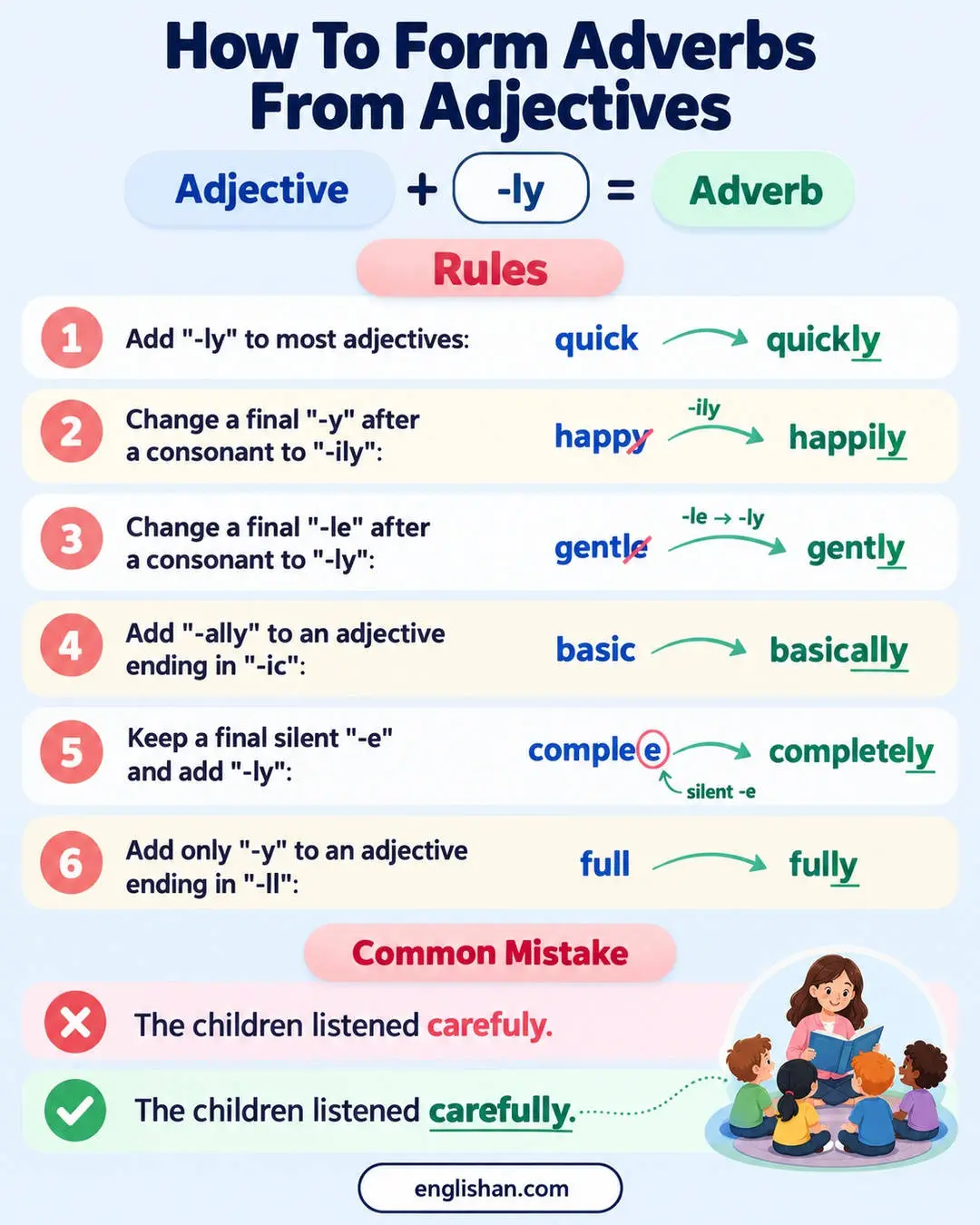
Adjective To Adverb By Adding -ly
There are six spelling rules for adding “-ly” to an adjective, and the right one depends on how the adjective ends:
- Add “-ly” to most adjectives: quick, quickly.
- Change a final “-y” after a consonant to “-ily”: happy, happily.
- Change a final “-le” after a consonant to “-ly”: gentle, gently.
- Add “-ally” to an adjective ending in “-ic”: basic, basically.
- Keep a final silent “-e” and add “-ly”: complete, completely.
- Add only “-y” to an adjective ending in “-ll”: full, fully.
The first rule is the regular one, and adjectives ending in “-ful”, “-ous”, “-al”, “-ent”, and most other endings follow it. An adjective ending in “-ful” keeps its own ‘l’ and adds the ‘l’ of the suffix, so “careful” becomes “carefully” and “beautiful” becomes “beautifully”.
- The nurse measured the dose carefully.
- Could you speak a little more slowly?
- Our team handled the complaint professionally.
- Prices rose dangerously fast last winter.
Adjectives that already end in “-ll” add only “-y”, so “full” becomes “fully” and “dull” becomes “dully”. The adverb has two letters ‘l’, the same number as the adjective.
The children listened carefuly. ❌
The children listened carefully. ✅
An adjective ending in “-ful” keeps its ‘l’ before the suffix “-ly”, so the adverb is spelled with two.
Adjectives Ending In -y
An adjective that ends in a consonant plus “-y” changes the “-y” to “-i” before “-ly”, so “happy” becomes “happily” and “easy” becomes “easily”. Most adjectives of two or more syllables follow the rule, as “angry”, “busy”, “lucky”, “noisy”, and “heavy” do.
- The twins played happily in the garden.
- Mia passed her driving test easily.
- The neighbor’s dog barked angrily at the mail carrier.
- Luckily, we found two seats on the last train.
Some one-syllable adjectives keep the “-y” and add “-ly”: “shy” becomes “shyly”, “sly” becomes “slyly”, and “wry” becomes “wryly”. The adjective “dry” has two standard adverbs, “dryly” and “drily”, and “dryly” is the usual American spelling. After a vowel, the “-y” stays as well, as in “coy” and “coyly”.
She smiled happyly at the baby. ❌
She smiled happily at the baby. ✅
After a consonant, the final “-y” of the adjective changes to “-i” before “-ly”.
Adjectives Ending In -le
An adjective that ends in a consonant plus “-le” drops the final “-e” and adds only “-y”, so “gentle” becomes “gently” and “simple” becomes “simply”. The same change happens in adjectives ending in “-able” and “-ible”, as in “comfortable, comfortably” and “terrible, terribly”.
- Ravi lifted the sleeping baby gently.
- The hotel room was comfortably warm.
- Our teacher explained the rule simply.
- The band played terribly at the wedding.
The rule is for adjectives with a consonant before “-le”. An adjective with a vowel before “-le” keeps its “-e” and adds the full suffix, so “sole” becomes “solely” and “vile” becomes “vilely”, with “whole, wholly” as the exception. The adverb “simply” has a second meaning, ‘just’ or ‘only’, as in “I simply forgot”, beside the meaning ‘in a simple way’.
The guide explained the route simplely. ❌
The guide explained the route simply. ✅
After a consonant, “-le” changes to “-ly”, so the adverb has no ‘e’ and no second ‘l’.
Adjectives Ending In -ic
An adjective that ends in “-ic” adds “-ally”, so “basic” becomes “basically” and “tragic” becomes “tragically”. The ending is spelled “-ically” even though the letters ‘al’ are silent in normal speech, which is why “basicly” and “automaticly” are frequent spelling errors.
- The two phones are basically the same.
- The printer switches off automatically at night.
- Your answer is scientifically correct.
- The story ended tragically for the hero.
The main exception is “public”, whose adverb is “publicly”, with “-ly” alone. Adjectives that already end in “-ical”, like “logical” and “practical”, add plain “-ly” and end in the same letters: “logically” and “practically”.
The company apologized publically. ❌
The company apologized publicly. ✅
The adjective “public” takes “-ly” alone, so “publicly” is the standard spelling.
Adjectives Ending In -e
An adjective that ends in a silent “-e” keeps the “-e” and adds “-ly”, so “complete” becomes “completely” and “nice” becomes “nicely”. Most adjectives with a final “-e” follow the rule: “safe”, “polite”, “rare”, “extreme”, and “sincere” all keep it.
- The road was completely empty at dawn.
- Ask the receptionist politely for a late checkout.
- We rarely eat out on weekdays.
- Please drive safely in the snow.
The main exceptions are “true”, “due”, and “whole”, which drop the “-e”: “truly”, “duly”, and “wholly”. Other adjectives ending in “-ue” keep the “-e”, as in “vague, vaguely” and “unique, uniquely”, so the exception belongs to “true” and “due” alone.
I am truely sorry for the delay. ❌
I am truly sorry for the delay. ✅
The adjective “true” drops its “-e” before “-ly”. The opposite slip is “sincerly” at the end of an email, but “sincere” keeps its “-e”, so the correct form is “sincerely”.
Adjective To Adverb Exceptions
Not every adjective follows the steps for how to form adverbs from adjectives. Some adverbs are a different word from the adjective, some have the same form as the adjective, some have a second form with a new meaning, and some adjectives have no adverb at all. Choosing between the two word classes in a sentence is a separate lesson, taught under adverb vs adjective. Many frequent adverbs, such as “soon” and “very”, come from no adjective, and they are listed with the adverbs without ly.
Adverb Of Good
The adverb of “good” is “well”, an irregular form with no “-ly”. The word “goodly” is a separate adjective meaning ‘large’, as in “a goodly sum”, and it is not the adverb of “good”.
- Nadia speaks Portuguese well.
- The interview went well.
- Did you sleep well last night?
In casual American speech, “You did good” is common, but “did well” is the standard form in writing. After a linking verb like “feel”, “look”, or “smell”, the adjective “good” is correct, as in “The soup smells good“.
Our team played good on Saturday. ❌
Our team played well on Saturday. ✅
After an action verb, the adverb “well” tells us how the action happened.
Adverbs With The Same Form As The Adjective
Some adverbs have the same form as their adjective and take no “-ly”: “fast”, “hard”, “late”, “early”, “straight”, “high”, “low”, “long”, and “daily”. The position of the word shows its word class, because before a noun it is an adjective, and after an action verb it is an adverb.
- Liam caught the early train. (adjective)
- Liam arrived early. (adverb)
- We took a daily walk by the river. (adjective)
- The pharmacy updates its prices daily. (adverb)
- Don’t drive so fast on wet roads. (adverb)
The time words “daily”, “weekly”, and “yearly” are both adjectives and adverbs of frequency, even though they end in “-ly”. The same-form adverbs “fast” and “hard” add “-er” and “-est”, as in “faster” and “hardest”, which are comparative and superlative adverbs without “more” or “most”.
He drives fastly. ❌
He drives fast. ✅
The adjective “fast” has no “-ly” form, so the adverb is the same word.
Adverbs With Two Forms
Some adjectives have two adverbs, one with the same form as the adjective and one with “-ly”, and the two adverbs have different meanings. The “-ly” form is not the regular adverb of the adjective, so it cannot replace the same-form adverb.
| Adjective | Same-Form Adverb | Adverb With -ly |
|---|---|---|
| Hard | Hard (‘with effort’) | Hardly (‘almost not’) |
| Late | Late (‘after the expected time’) | Lately (‘recently’) |
| High | High (‘far up’) | Highly (‘very’, ‘very much’) |
| Near | Near (‘close’) | Nearly (‘almost’) |
| Short | Short (‘suddenly’) | Shortly (‘soon’) |
| Wide | Wide (‘fully’) | Widely (‘in many places’) |
- Sami worked hard all weekend.
- Sami hardly slept all weekend.
- Have you seen Jo lately?
- The manager will call you back shortly.
- The new café is highly recommended.
The adverbs “hardly”, “nearly”, and “highly” are adverbs of degree, so they tell us how much, not how. A sentence about effort or position takes the same-form adverb.
She has worked hardly to pass the exam. ❌
She has worked hard to pass the exam. ✅
The error comes from adding “-ly” by rule to an adjective whose adverb has no suffix, and “hardly” means ‘almost not’.
Adjectives With No Adverb Form
Some adjectives have no adverb form. Adjectives that already end in “-ly”, such as “friendly”, “lovely”, “lonely”, “silly”, “ugly”, and “costly”, do not take a second “-ly”, so the manner of an action takes a phrase with “way” or “manner”.
- The guide spoke to us in a friendly way.
- Max laughed in a silly way at the joke.
- The garden was decorated in a lovely manner.
The adjective “likely” is an exception within the exception, because it is also an adverb meaning ‘probably’. As an adverb, it usually comes after “most”, “very”, or “more than”, as in “She will most likely call tonight”. Short adjectives of size and age, such as “big”, “small”, “tall”, “old”, and “young”, have no adverb in standard English either, so a sentence about how an action happened uses another word.
The hotel staff treated us friendly. ❌
The hotel staff treated us in a friendly way. ✅
The adjective “friendly” has no adverb form, so a phrase with “way” describes the action.
Adverb Forms Of Common Words
Adverbs in “-ly” are usually formed from adjectives, not from nouns or verbs. The adverb related to a noun or a verb is formed from its adjective by the same rules for how to form adverbs from adjectives, so “happiness” leads to “happy” and then to “happily”. Words such as “walk”, “eat”, “sing”, “run”, and “write” have no adjective with an everyday adverb, so they have no single-word adverb. The full word families of noun, verb, adjective, and adverb belong to the parts of speech, and the table gives the adverb form only.
| Word | Word Class | Adverb Form |
|---|---|---|
| Angry | Adjective | Angrily |
| Bad | Adjective | Badly |
| Basic | Adjective | Basically |
| Beautiful | Adjective | Beautifully |
| Brave | Adjective | Bravely |
| Bright | Adjective | Brightly |
| Busy | Adjective | Busily |
| Calm | Adjective | Calmly |
| Careful | Adjective | Carefully |
| Careless | Adjective | Carelessly |
| Clear | Adjective | Clearly |
| Clever | Adjective | Cleverly |
| Comfortable | Adjective | Comfortably |
| Comparable | Adjective | Comparably |
| Compare | Verb | Comparably, comparatively (from comparable, comparative) |
| Dangerous | Adjective | Dangerously |
| Different | Adjective | Differently |
| Difference | Noun | Differently (from different) |
| Easy | Adjective | Easily |
| Eat | Verb | None |
| Happy | Adjective | Happily |
| Happiness | Noun | Happily (from happy) |
| Identifiable | Adjective | Identifiably |
| Identify | Verb | Identifiably (from identifiable) |
| Mean | Adjective | Meanly |
| Practical | Adjective | Practically |
| Practice | Noun or verb | Practically (from practical) |
| Quick | Adjective | Quickly |
| Run | Verb | None (runningly is not standard) |
| Simple | Adjective | Simply |
| Sing | Verb | None |
| Slow | Adjective | Slowly |
| Soft | Adjective | Softly |
| Walk | Verb | None |
| Write | Verb | None (nearest form: in writing) |
The adverb “practically” usually means ‘almost’, as in “The fridge is practically empty”, and it also means ‘in a practical way’. The two adverbs related to “compare” differ in meaning: “comparably” means ‘to a similar degree’, and “comparatively” means ‘when compared with others’, as in “a comparatively cheap flight”. The adverb “meanly” comes from “mean” in the sense ‘unkind’, and it is rare in everyday speech. For “write”, the phrase “in writing” expresses the idea, as in “Please confirm the booking in writing“.
FAQs
The suffix "-ly" forms most adverbs from adjectives, as in "slowly" and "happily". A few adverbs end in "-wise" or "-ward" instead, like "clockwise", "lengthwise", and "upward", and these are formed from nouns and adverbs, not adjectives.
Many adverbs of manner are formed from adjectives, as "quietly" is from "quiet", but a large number of adverbs have no adjective behind them. Words like "soon", "here", "often", and "never" are adverbs from the start, and they appear across all the types of adverbs.
Yes, an adverb can modify an adjective, as in "very cold" and "surprisingly cheap". Adverbs of degree are the usual adverbs before an adjective, and they show how strong the quality is.
No, adverbs are a normal part of standard English, and the meaning of many sentences depends on one: "I hardly slept" states something no verb alone expresses. In formal writing, an adverb that repeats the meaning of its verb, as in "shouted loudly", adds nothing and is usually cut.
Related:
- Adjective
- What Do Adverbs Modify
- List of Adverbs
- Adverb Chart
- Prefixes and Suffixes
- Words Ending With LY