

An adverb adds a quality to a verb the way an adjective adds one to a noun. The adverbs that start with S range from quiet words to sudden ones: softly, smoothly, soothingly and serenely fit a quiet voice, while suddenly, sharply and swiftly fit a quick change. So, soon and still are short time and degree words, and slow is both an adjective and an adverb in one spelling, a point settled under slow and slowly.
Choose the first letter:
A · B · C · D · I · K · L · M · N · R · S · T · V
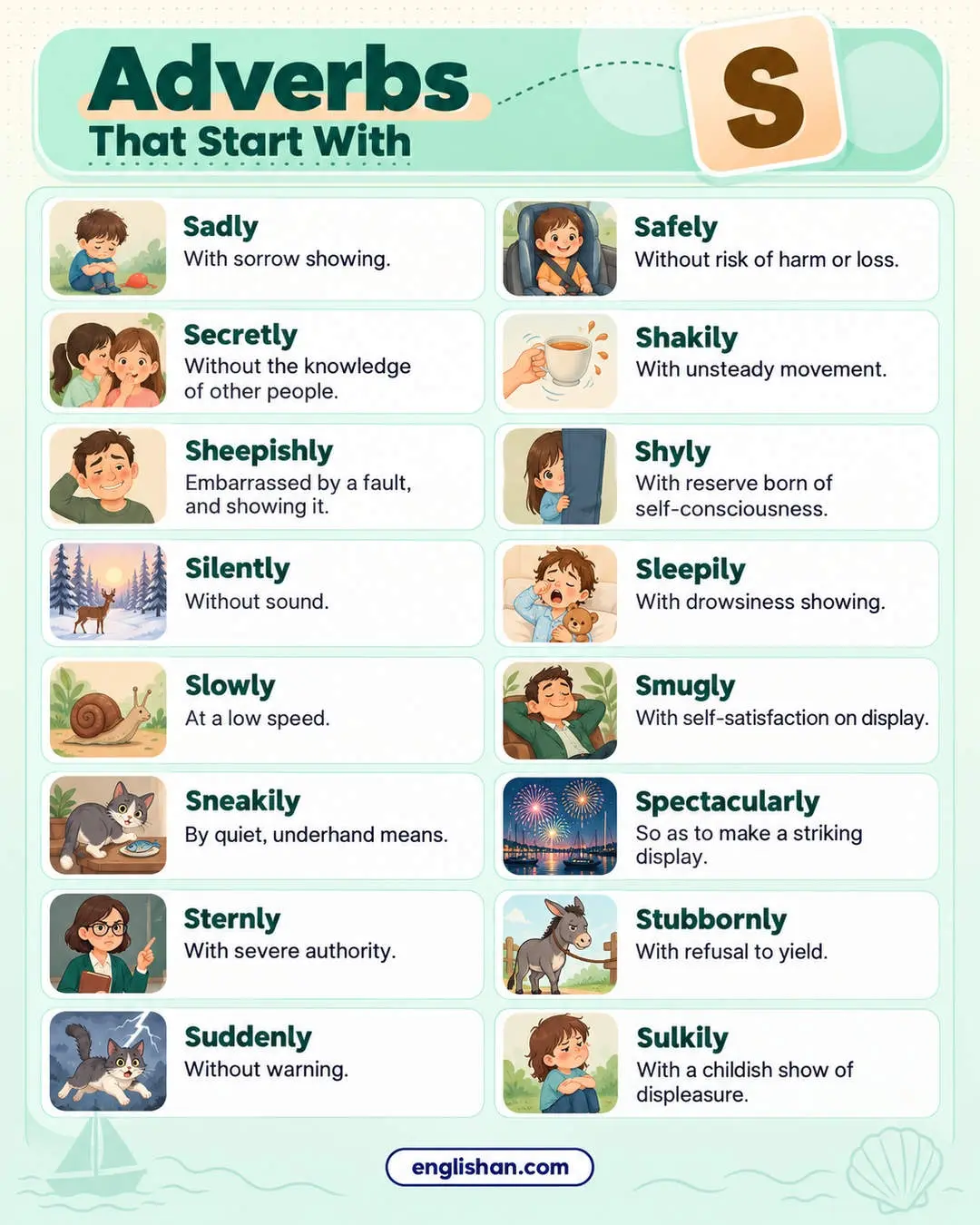
Adverbs That Start With S
The adverbs that start with S run alphabetically from sadly to suggestively, with the meaning beside the word and a sentence showing where the adverb belongs. Position changes the meaning for several of them, since sharply in front of a figure reads differently from sharply after a verb. Manner accounts for most of the adverbs that start with S, and the letter splits into five parts so that near-neighbours stay close enough to weigh against one another.
Adverbs That Start With Sa to Se
| Adverb | Meaning | In a sentence |
|---|---|---|
| Sadly | With sorrow showing in the voice or manner. | She folded the letter sadly and put it back in the drawer. |
| Safely | Without risk of harm or loss. | The climbers reached the ledge safely before the light went. |
| Sagely | With the calm judgement of someone experienced. | He nodded sagely at the question but offered no answer. |
| Sanely | Within the bounds of sound reason. | She argued sanely for a delay while the room shouted. |
| Sarcastically | With mockery dressed up as praise. | “Lovely weather,” she said sarcastically, shaking out her umbrella. |
| Sardonically | With dry, scornful amusement. | He smiled sardonically at the promise of a quick fix. |
| Satisfactorily | Well enough to meet the requirement. | The engine ran satisfactorily for the full three hours. |
| Saucily | Pertly, with open disrespect. | The child answered saucily and was sent back to her seat. |
| Savagely | With violent force. | The storm tore savagely at the roof tiles. |
| Scathingly | With harsh criticism that wounds. | The review dismissed the production scathingly in its opening line. |
| Scientifically | By the methods of science. | The claim has never been tested scientifically. |
| Scornfully | With open contempt. | She looked scornfully at the trophy on his desk. |
| Scrupulously | To the letter of what is right. | The accounts were kept scrupulously for twenty years. |
| Searchingly | With a look that probes for the truth. | He gazed searchingly at her face before replying. |
| Secretly | Without the knowledge of other people. | They secretly funded the repair themselves. |
| Sedately | At a calm, unhurried pace. | The old barge moved sedately along the canal. |
| Seductively | In a way built to attract. | The window display was lit seductively in warm amber. |
| Selectively | Choosing what to take and what to leave out. | He quoted the report selectively to support his case. |
| Selfishly | With regard only for one’s own interest. | She selfishly kept the better room. |
| Selflessly | Putting others ahead of oneself. | The nurses worked selflessly through the night shift. |
| Sensibly | With practical good sense. | They sensibly booked the earlier train. |
| Sensitively | Carefully, with the feelings involved in mind. | The redundancies were handled sensitively throughout the meeting. |
| Sentimentally | With feeling that leans on memory. | He spoke sentimentally about the old workshop. |
| Separately | Apart from the rest. | The two cases were heard separately. |
| Serenely | With untroubled calm. | She answered serenely while the room argued around her. |
| Seriously | Without joking, and with full weight. | Take the warning seriously this time. |
| Severely | With great harshness or intensity. | The frost damaged the vines severely. |
Adverbs That Start With Sh to Si
| Adverb | Meaning | In a sentence |
|---|---|---|
| Shabbily | In a worn or unworthy way. | The staff were treated shabbily after the merger. |
| Shakily | With unsteady movement. | He signed the form shakily and handed it back. |
| Shallowly | To a small depth. | The patient was breathing shallowly by morning. |
| Shamefully | So badly as to bring disgrace. | The records had been shamefully neglected. |
| Shamelessly | Without a trace of embarrassment. | The sequel borrows shamelessly from the original. |
| Sharply | With sudden force or a cutting edge. | Prices rose sharply in the second quarter. |
| Sheepishly | Embarrassed by one’s own fault, and showing it. | He returned the borrowed tools sheepishly. |
| Shiftily | Evasively, in the manner of someone with something to hide. | The witness glanced shiftily towards the door. |
| Shockingly | To a degree that startles. | The road was shockingly narrow for two lanes of traffic. |
| Shoddily | With poor workmanship. | The extension had been built shoddily and leaked within a year. |
| Shrewdly | With sharp practical judgement. | She invested shrewdly while the market was quiet. |
| Shrilly | In a high, piercing tone. | The whistle sounded shrilly across the yard. |
| Shyly | With reserve born of self-consciousness. | He offered the drawing shyly. |
| Sickeningly | To a degree that turns the stomach. | The bridge swayed sickeningly in the crosswind. |
| Significantly | To an extent large enough to notice. | Waiting times fell significantly after the second clinic opened. |
| Silently | Without sound. | The cat crossed the room silently. |
| Similarly | In the same manner as what came before. | The second trial was designed similarly. |
| Simplistically | With necessary complication stripped out. | The policy was explained simplistically to the press. |
| Simply | Without elaboration or difficulty. | Say simply what you want. |
| Simultaneously | At the same moment. | Both alarms rang simultaneously. |
| Sincerely | With honest feeling behind the words. | He apologised sincerely and paid for the damage. |
| Singly | One at a time. | The ballots were counted singly. |
| Singularly | To a remarkable and unusual degree. | The second act is singularly dull. |
| Sinuously | Winding and snaking along the way. | The path climbed sinuously between the rocks. |
Adverbs That Start With Sk to Sn
| Adverb | Meaning | In a sentence |
|---|---|---|
| Sketchily | With detail left out. | The plan was described sketchily at the first meeting. |
| Skittishly | Nervously, with jumpy movement. | The mare moved skittishly near the gate. |
| Slavishly | In unthinking obedience to a model. | The remake follows the original slavishly. |
| Sleepily | With drowsiness showing. | She answered the phone sleepily. |
| Slickly | Smoothly, with practised polish. | The campaign was run slickly from a single office. |
| Slightly | To a small degree. | The floor slopes slightly towards the door. |
| Slowly | At a low speed. | Read the clause slowly and then sign it. |
| Sluggishly | With a dull lack of energy. | The engine turned over sluggishly in the cold. |
| Slyly | Cunningly, without drawing attention. | He slyly moved the deadline back a week. |
| Smartly | With brisk, neat precision. | The guard turned smartly on his heel. |
| Smoothly | Without friction or interruption. | The handover went smoothly. |
| Smugly | With self-satisfaction on display. | She smiled smugly at the final score. |
| Snappily | With quick, short sharpness. | He answered snappily and returned to his screen. |
| Sneakily | By quiet, underhand means. | The clause was added sneakily at the final draft. |
| Sneeringly | With contemptuous mockery in the voice. | The letter referred sneeringly to amateurs. |
| Snidely | With a sly, belittling edge. | He referred snidely to her promotion. |
| Snugly | Close-fitting and comfortable. | The lid sits snugly on the jar. |
Adverbs That Start With So to Sq
| Adverb | Meaning | In a sentence |
|---|---|---|
| Soberly | Seriously and without excess. | The findings were presented soberly. |
| Sociably | In a friendly, mixing way. | The new tenant greeted everyone sociably. |
| Softly | With a gentle, low sound or touch. | She closed the door softly. |
| Solely | To the exclusion of everything else. | The decision rests solely with the committee. |
| Solemnly | With grave seriousness. | The oath was read solemnly. |
| Solidly | Firmly and without weakness. | The team performed solidly all season. |
| Soothingly | In a way that calms. | He spoke soothingly to the frightened dog. |
| Sordidly | Squalid and morally dirty in nature. | The affair ended sordidly in a public hearing. |
| Sorely | Badly, and with real need or pain. | The department is sorely understaffed. |
| Sorrowfully | With deep sadness. | She looked sorrowfully at the empty stall. |
| Soundlessly | Making no sound at all. | The owl dropped soundlessly onto the field. |
| Soundly | Thoroughly and without weakness. | The motion was soundly defeated. |
| Sourly | With bitter displeasure. | He commented sourly on the new rota. |
| Sparingly | In small amounts, with restraint. | Add the salt sparingly. |
| Sparsely | Thinly spread, with wide gaps. | The hills are sparsely populated. |
| Spasmodically | In sudden irregular bursts. | The pump worked spasmodically for an hour. |
| Specially | For one particular purpose. | The frame was made specially for the window. |
| Specifically | In exact terms, with the thing meant stated. | The contract specifically excludes weather delays. |
| Spectacularly | So as to make a striking display. | The plan failed spectacularly. |
| Speculatively | On guesswork rather than evidence. | The figures were quoted speculatively. |
| Speedily | Quickly, with little delay. | The claim was settled speedily. |
| Spiritedly | With lively energy. | She defended the proposal spiritedly. |
| Spitefully | With the intent to wound. | The review was written spitefully. |
| Splendidly | Very well indeed. | The roses did splendidly in the dry summer. |
| Spontaneously | Without planning or prompting. | The crowd applauded spontaneously. |
| Sporadically | At scattered, irregular intervals. | Rain fell sporadically through the afternoon. |
| Spotlessly | So as to leave no mark. | The workshop floor was swept spotlessly. |
| Squarely | Directly and without evasion. | The blame falls squarely on the contractor. |
| Squeamishly | With an easily turned stomach. | He looked squeamishly at the needle. |
Adverbs That Start With St to Su
| Adverb | Meaning | In a sentence |
|---|---|---|
| Starkly | In plain, severe contrast. | The two totals sit starkly apart. |
| Startlingly | To a degree that gives a sudden shock. | The copy was startlingly similar. |
| Statistically | By the measures of statistics. | The difference is statistically meaningless. |
| Staunchly | With firm, loyal support. | She staunchly defended the old method. |
| Steadfastly | Without wavering from a position. | He steadfastly refused the payment. |
| Steadily | At an even, unbroken rate. | Numbers climbed steadily from March. |
| Stealthily | Quietly, so as to avoid notice. | The fox moved stealthily along the hedge. |
| Steeply | At a sharp angle or rate. | The track rises steeply after the bridge. |
| Sternly | With severe authority. | The referee spoke sternly to both captains. |
| Stiffly | Hardly bending, with little ease of movement. | He rose stiffly from the chair. |
| Stingily | With grudging meanness over small amounts. | The butter was spread stingily. |
| Stirringly | So as to rouse feeling. | The anthem was played stirringly. |
| Stoically | Enduring hardship without complaint. | She bore the delay stoically. |
| Stoutly | Firmly and with determination. | He stoutly denied the charge. |
| Straightforwardly | Plainly and without evasion. | The terms were explained straightforwardly. |
| Strangely | In a way that departs from the expected. | The room felt strangely cold. |
| Strategically | With a plan for advantage. | The depots were placed strategically along the route. |
| Strenuously | Through great effort. | The union objected strenuously. |
| Strictly | With no allowance for exception. | Admission is strictly by ticket. |
| Stridently | In a loud, insistent tone. | The campaign argued stridently for a ban. |
| Strikingly | So as to draw immediate notice. | The two drafts are strikingly different. |
| Stringently | Under tight, demanding conditions. | The samples were tested stringently. |
| Stubbornly | With refusal to yield. | The stain held stubbornly to the cloth. |
| Studiously | With deliberate, careful attention. | He studiously avoided the question. |
| Stunningly | To an astonishing degree. | The restoration is stunningly exact. |
| Stupidly | With poor judgement. | I stupidly left the keys inside. |
| Sturdily | Strongly, with resistance to strain. | The shelves were sturdily made. |
| Stylishly | With attractive flair. | The lobby was stylishly refitted. |
| Suavely | With smooth social polish. | He deflected the question suavely. |
| Subconsciously | Beneath the level of awareness. | Drivers subconsciously slow down on narrow lanes. |
| Subjectively | From a personal point of view. | The panel scored the three designs subjectively. |
| Sublimely | To a degree of lofty excellence. | The second movement is sublimely quiet. |
| Succinctly | In few words, with nothing wasted. | State the objection succinctly. |
| Suddenly | Without warning. | The line went dead suddenly. |
| Suggestively | So as to hint at more. | The title was chosen suggestively. |
Positive Adverbs That Start With S
Approval is built into the positive adverbs that start with S, so they belong in praise and in references. Superbly and supremely top the scale and lose force through repetition.
| Adverb | Meaning | In a sentence |
|---|---|---|
| Superbly | To an excellent standard. | The quartet played superbly in the second half. |
| Sweetly | With pleasant gentleness. | The violin came in sweetly under the melody. |
| Swiftly | At great speed. | The council acted swiftly on the flood warning. |
| Sympathetically | With shared feeling for another’s trouble. | The manager listened sympathetically to the complaint. |
| Supportively | In a way that holds someone up. | Her family spoke supportively at the hearing. |
| Successfully | With the intended result achieved. | The valve was replaced successfully overnight. |
| Suitably | In a way proper to the occasion. | He dressed suitably for the interview. |
| Sumptuously | With rich, costly abundance. | The dining room was sumptuously furnished. |
| Sustainably | Without using up what cannot be replaced. | The timber is harvested sustainably. |
| Skilfully | With practised skill. | The violin was repaired skilfully by a local maker. |
| Securely | Fixed firmly, beyond risk of slipping. | Fasten the hatch securely before the crossing. |
| Satisfyingly | So as to leave a sense of completion. | The lid closed satisfyingly on the first try. |
| Sensationally | With startling brilliance. | The outsider finished sensationally in second place. |
| Serendipitously | By a lucky accident. | The letters turned up serendipitously during the move. |
| Sportingly | With fair and generous spirit. | He sportingly conceded the point. |
| Scrumptiously | Deliciously rich on the tongue. | The pears were scrumptiously ripe. |
| Soulfully | With deep, heartfelt feeling. | She sang the last verse soulfully. |
Superbly and sensationally belong to performance, while supportively and sympathetically belong to conduct, so the positive adverbs that start with S split by what the praise is for.
Adverbs of Manner That Start With S
Among the adverbs that start with S, the manner group is the largest, and a manner adverb answers the question how. The standard position is after the verb, or after the object when the verb takes one. Front position is available for stress, and it moves the weight onto the manner rather than the action.
- She closed the door softly.
- He stealthily crossed the yard.
- Softly, she closed the door.
- The motion was soundly defeated.
- Both captains were spoken to sternly.
The position to rule out is between the verb and its object, where the adverb separates a pair that belongs together.
- He closed softly the door ❌
- He closed the door softly ✅
Nothing about placement changes across the rest of the S class, as set out under adverbs of manner and across the types of adverbs.
Negative Adverbs That Start With S
Disapproval runs through the negative adverbs that start with S, and the strength varies more than the surface suggests. Sloppily faults the work and shiftlessly faults the worker.
| Adverb | Meaning | In a sentence |
|---|---|---|
| Sloppily | Carelessly, with little attention to neatness. | The forms had been filled in sloppily. |
| Sullenly | In silent, resentful bad temper. | He took the keys sullenly and left. |
| Sulkily | With a childish show of displeasure. | She pushed the plate away sulkily. |
| Superficially | Only at the surface, without depth. | The damage was examined superficially. |
| Superfluously | Beyond what is needed. | The clause repeats the warning superfluously. |
| Suspiciously | With distrust, or so as to invite distrust. | The second signature looked suspiciously fresh. |
| Surreptitiously | By stealth, to escape notice. | He surreptitiously checked his phone under the table. |
| Sanctimoniously | With a show of moral superiority. | The column lectured readers sanctimoniously. |
| Slanderously | By false statements that damage a reputation. | The pamphlet attacked the mayor slanderously. |
| Scantily | With barely enough to cover the need. | The shelves were scantily stocked. |
| Scurrilously | Coarsely, with abusive insult. | The letter attacked the family scurrilously. |
| Shiftlessly | Without effort or ambition. | The afternoon was spent shiftlessly on the sofa. |
| Stiflingly | So as to smother or suffocate. | The attic was stiflingly hot by noon. |
| Snobbishly | With disdain for those judged beneath one. | The club treated newcomers snobbishly. |
| Spinelessly | Without the courage to stand firm. | The board spinelessly withdrew the report. |
| Submissively | With complete yielding to another’s will. | He nodded submissively and said nothing. |
Sanctimoniously goes further again and faults the tone of someone else’s criticism, which makes it the sharpest of the negative adverbs that start with S.
Adverbs That Start With S to Describe a Person
Manner adverbs take the weight when a person heads the sentence, and the adverbs that start with S hold both halves of most matched pairs. She answered sunnily and she answered sniffily report one action and two different people.
| Adverb | Meaning | In a sentence |
|---|---|---|
| Self-assuredly | With quiet confidence in one’s own ability. | She presented the figures self-assuredly. |
| Single-mindedly | Fixed on one purpose, to the exclusion of others. | He pursued the qualification single-mindedly for four years. |
| Smilingly | With a smile on the face. | The host greeted every guest smilingly. |
| Sniffily | Faintly disdainful in manner. | The critic referred sniffily to the catering. |
| Sonorously | In a deep, full, resonant voice. | The chaplain read the roll sonorously. |
| Sportively | Playfully, in a teasing spirit. | The pups tumbled sportively on the grass. |
| Spryly | With brisk agility despite age. | At eighty he still climbed the stairs spryly. |
| Stuffily | Primly, with airless formality. | The notice was worded stuffily. |
| Sunnily | With bright cheerfulness. | She answered the complaint sunnily. |
| Swaggeringly | In a boastful strut. | He crossed the room swaggeringly. |
| Sweepingly | In broad terms that admit no exception. | The reply dismissed all four objections sweepingly. |
| Silkily | With smooth, almost oily softness. | The salesman explained the terms silkily. |
| Soppily | Over-sentimentally, past the point of taste. | He talked soppily about the dog all evening. |
| Sensuously | In a way that pleases the senses. | The cellist drew the bow sensuously across the strings. |
Self-assuredly and swaggeringly both attach to confidence, and matched pairs like that run right through the adverbs that start with S.
Adverbs of Time and Frequency That Start With S
Time and frequency words answer when and how many times, and most of the adverbs that start with S in this group have no -ly ending. A frequency word such as seldom belongs in front of the main verb, while soon and shortly stand at either end of the sentence.
| Adverb | Meaning | In a sentence |
|---|---|---|
| Seldom | On few occasions. | The tower is seldom open to visitors. |
| Sometimes | On some occasions and not others. | The signal sometimes drops near the tunnel. |
| Soon | After a short time. | The results will be published soon. |
| Shortly | In a little while. | The surveyor will call shortly. |
| Still | Up to the present moment, with no change. | The kettle is still boiling. |
| Since | From a point in past time until now. | The mill has stood empty since 1974. |
| Subsequently | At a later point than the event described. | The licence was subsequently withdrawn. |
| Sometime | On an unnamed occasion in time. | We will settle the account sometime next week. |
| Someday | At an unknown point in the future. | He plans to walk the whole coast someday. |
| Straightaway | Immediately, with no delay. | Call the office straightaway. |
| Successively | One after another in order. | Three attempts failed successively. |
| Seasonally | In a pattern tied to the seasons. | The staff numbers rise seasonally. |
| Secondly | In the second position in a sequence. | Secondly, the drainage was never adopted by the council. |
| Summarily | At once, without the usual formalities. | The appeal was summarily rejected. |
Still reports a state that has not changed, and sometimes reports a frequency. Both classes are mapped under adverbs of time and adverbs of frequency.
Adverbs of Place and Direction That Start With S
The direction adverbs that start with S take the ending -ward. Seaward, skyward, shoreward and sunward state a bearing in one word with no preposition attached.
| Adverb | Meaning | In a sentence |
|---|---|---|
| Sideways | Towards or from the side. | The cupboard will only go through sideways. |
| Somewhere | At or to a place not named. | The deeds are filed somewhere in the attic. |
| South | Towards the south. | The track runs south from the quarry. |
| Southward | In the direction of the south. | The geese moved southward in October. |
| Skyward | Towards the sky. | The cranes swung skyward at first light. |
| Seaward | Down towards the sea. | The lane falls seaward past the chapel. |
| Sidelong | To one side, with a turn of the eyes or body. | He glanced sidelong at the clock. |
| Slantwise | At a slant across something. | The rain came slantwise off the moor. |
| Straight | In a direct line, without turning. | Go straight to the end of the corridor. |
| Stateside | In or towards the United States. | The paperwork was signed stateside. |
| Shoreward | Towards the shore. | The dinghy drifted shoreward on the tide. |
| Sunward | Facing towards the sun. | The panels tilt sunward through the morning. |
Southward and southwards are both correct in British writing, and a place adverb follows the verb or the object, as adverbs of place sets out.
Adverbs of Degree That Start With S
Degree is the smallest group among the adverbs that start with S, and these words answer how much. So is the everyday choice, scarcely pulls a statement down, and stupendously pushes it up into opinion.
| Adverb | Meaning | In a sentence |
|---|---|---|
| So | To that extent, or to a great extent. | The hall was so cold that nobody took a coat off. |
| Somewhat | To a moderate extent. | The second batch was somewhat drier. |
| Scarcely | Hardly at all. | There is scarcely room for two chairs. |
| Sufficiently | To the extent needed. | The mortar had not set sufficiently. |
| Substantially | By a large amount. | Costs rose substantially after the delay. |
| Superlatively | To the highest possible degree. | The tenor was superlatively good that night. |
| Supremely | Beyond all others in degree. | She is supremely qualified for the role. |
| Stupendously | To an overwhelming degree. | The budget was stupendously wrong. |
| Staggeringly | To a degree that stuns. | The repair bill was staggeringly high. |
| Searingly | With burning intensity. | The afternoon was searingly bright. |
| Sizeably | By a considerable amount. | Membership grew sizeably after the campaign. |
| Scandalously | To a degree that offends decency. | The role was scandalously underpaid. |
| Surpassingly | Beyond what others reach. | The choir was surpassingly fine. |
| Stark | Completely, used as an intensifier in front of a few adjectives. | The child ran stark naked across the lawn. |
| Soaking | Thoroughly, as an intensifier before wet. | My boots were soaking wet by the second mile. |
Stark and soaking stand in front of a short list of partners only, so stark naked reads correctly and stark cold does not. The rest attach to any adjective that admits a measure, as adverbs of degree sets out.
Adverbs That Start With S Without LY
A handful of the most used adverbs that start with S have no -ly ending at all: so, soon, still, seldom, sometimes, somewhat, somewhere, since, straight and sideways. The missing ending is not an error, and bolting one on produces a word that does not exist in English.
- The results will be published soon.
- Water was still running under the floor.
- Visitors are seldom allowed past the gate.
- Go straight to the end of the corridor.
- That cupboard will only fit through sideways.
Adding the ending to any of those ten adverbs that start with S produces a form that looks regular and is not a word.
- He walked straightly to the gate ❌
- He walked straight to the gate ✅
Sometimes means on some occasions and sometime means at an unnamed point in time, so the final letter settles which of the two the sentence needs.
- Sometime he forgets the code ❌
- Sometimes he forgets the code ✅
Slow or Slowly
A small group of adverbs that start with S hold a second role as adjectives with no change of form, which is why go slow and six sharp read correctly with no ending attached.
- A slow train left at nine, and the driver was told to go slow past the school.
- The bench held a sharp knife, and the meeting started at six sharp.
- A short wait turned long, and the car stopped short of the kerb.
- Walkers kept straight ahead on a straight road.
- A sound argument closed the case, and the baby was sound asleep.
| Word | As an adjective | As an adverb |
|---|---|---|
| Slow | A slow train | Go slow past the school. |
| Sharp | A sharp knife | The meeting starts at six sharp. |
| Short | A short wait | The car stopped short of the kerb. |
| Straight | A straight road | Walk straight ahead. |
| Sound | A sound argument | The baby was sound asleep. |
| Still | Still water | He stood still until the deer moved. |
Slowly remains the standard form in writing, and among the adverbs that start with S the bare slow belongs to fixed phrases, road signs and speech.
Mixing the bare form and the -ly form inside one pair of adverbs is the fault that reaches print most among the adverbs that start with S.
- He drove slow and carefully ❌
- He drove slowly and carefully ✅
Commonly Confused Adverbs That Start With S
Pairs among the adverbs that start with S trade places in print, and the two halves of a pair are not interchangeable. The difference in most cases is the thing being measured rather than the strength of the measure.
- The order was made specially for this kitchen.
- The surveyor will ring shortly after nine.
- There is scarcely room for a second chair.
- The lock was fitted soundly and has not moved.
- He took the news stoically and carried on.
| Pair | What separates them |
|---|---|
| Specially / Especially | Specially marks a purpose; especially singles out one case. |
| Shortly / Soon | Shortly is the nearer of the two and the more formal. |
| Scarcely / Hardly | Both mean almost not at all; scarcely is the formal form. |
| Simply / Simplistically | Simply means without difficulty; simplistically means with complication removed. |
| Soundly / Soundlessly | Soundly means thoroughly; soundlessly means with no sound. |
| Stoically / Staunchly | Stoically bears hardship; staunchly holds support. |
Specially marks the purpose something was made for, so a cake baked for a christening was made specially rather than especially.
- The cake was made especially for the christening ❌
- The cake was made specially for the christening ✅
The adverbs that start with S repay a writer who chooses on meaning rather than on sound. Among them, four fit the same quiet voice and only one belongs in the sentence in hand.
Related:
- Adverbs Ending in LY
- Adverbs That Do Not End in LY
- Adverb Examples
- Adverbs of Frequency
- Types of Adverbs
- Relative Adverbs
- Adverbs of Reason
- Conjunctive Adverbs
FAQs
Several hundred qualify in standard English, and 220 adverbs that start with S are gathered here with a meaning and a sentence. The count runs high because almost any S adjective ending in a consonant accepts -ly with no spelling change, which turns stubborn into stubbornly and sturdy into sturdily.
So is the most common of the adverbs that start with S by a wide margin, trailed by soon, still and simply. All four stand without the -ly ending, which is why they turn up in speech far more than a long manner adverb such as straightforwardly.
Superbly, sweetly, sympathetically, supportively and successfully state open approval, and all five belong in a reference or a review. Suitably and securely make the same point at lower volume, which keeps a report from reading as praise.
Smilingly, single-mindedly, spryly, sunnily and self-assuredly report how a person acts rather than what they are, so the verb keeps the action and the adverb holds the character. Sniffily and swaggeringly report the same thing with the judgement reversed.
No. So, soon, still, seldom, sometimes, somewhat, somewhere, since and straight stand among the most used adverbs that start with S, and none of the nine takes the ending. Adding -ly to any one of them produces a form that is not English.
A manner adverb such as softly goes after the verb, or after the object when the verb takes one. A frequency word such as seldom goes in front of the main verb, and a degree word such as scarcely goes beside the word it measures. A place word such as sideways follows the verb.