Adverbs of reason explain why something happens in a sentence. They show the cause or motivation behind an action and help connect ideas clearly. Words like therefore, thus, hence, and since are common adverbs of reason. These adverbs are useful in both writing and speaking to explain logic or decisions.
What Are Adverbs of Reason?
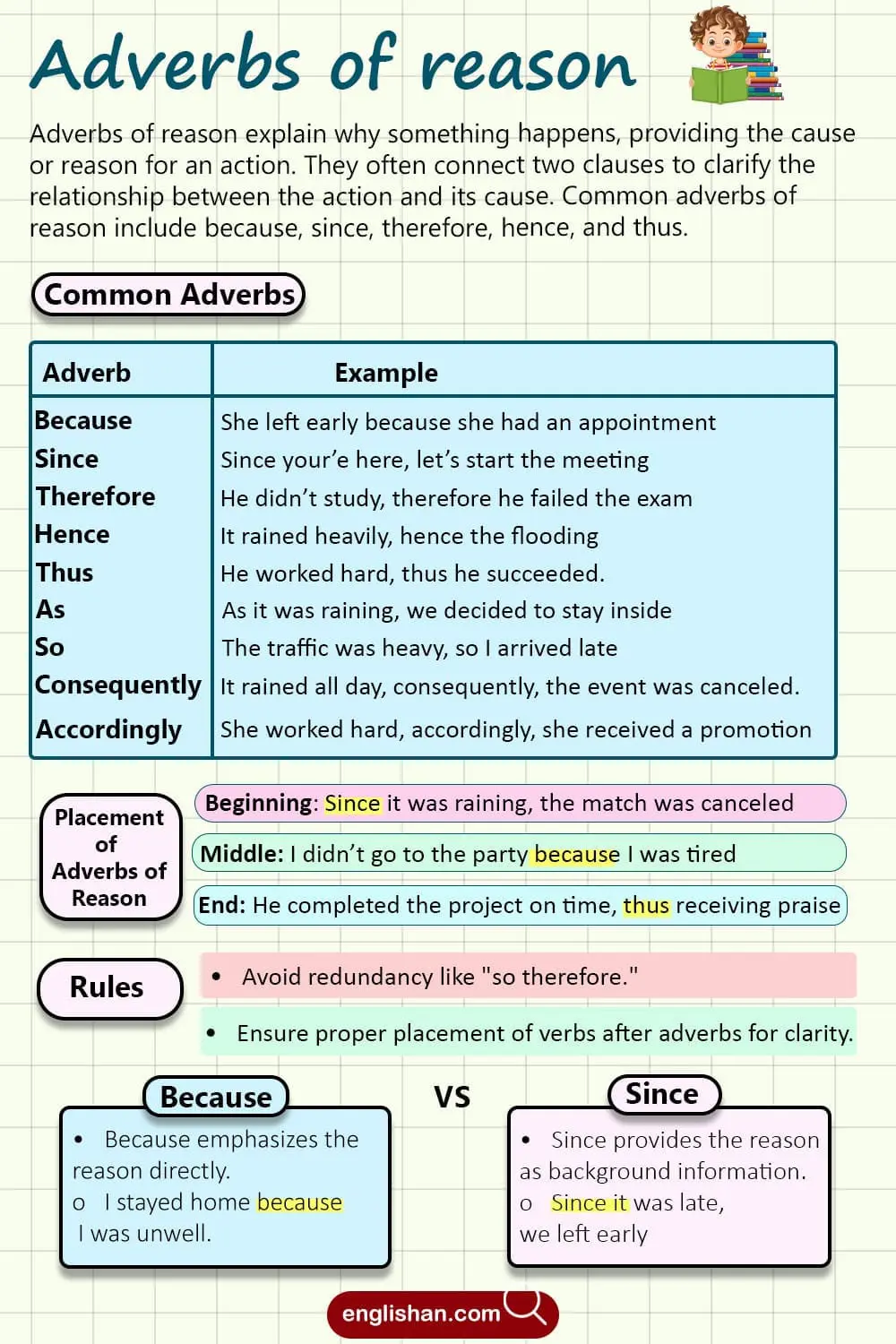
Adverbs of reason are words that explain why something happens. They show the cause or reason behind an action and are used to link ideas in a sentence. These adverbs often connect two parts of a sentence, where one part gives the reason for the other.
Example:
She stayed home because it was raining.
(“Because” explains the reason for staying home.)
Common Adverbs of Reason
Let’s look at some common adverbs of reason and see how they are used in real sentences.
| Adverb of Reason | Explanation | Example Sentence |
|---|---|---|
| Because | Indicates the cause of an action | She stayed home because it was raining. |
| Since | Explains the reason, often used at the beginning | Since you were busy, I went ahead without you. |
| Therefore | Shows a result or conclusion | He was late, therefore he missed the train. |
| Hence | Suggests a logical consequence | The roads were icy, hence the accident. |
| Thus | Indicates a result, often formal | She passed the exam, thus proving her skills. |
| Consequently | Shows the result of a previous action | It rained all day, consequently, the event was canceled. |
| As | Used to indicate a reason | As it was raining, we decided to stay inside. |
| So | Indicates a result or consequence | The traffic was heavy, so I arrived late. |
| For this reason | Shows a specific cause | He didn’t study, for this reason, he failed the test. |
| Accordingly | Suggests something is done as a result | She worked hard, accordingly, she received a promotion. |
| As a result | Shows the consequence of an action | The company lost money, as a result, they reduced staff. |
| That’s why | Explains the reason for something | I didn’t hear my alarm, that’s why I was late. |
| On account of | Provides the reason behind an action | On account of the weather, the match was postponed. |
| Owing to | Indicates a reason, formal | Owing to the high demand, we ran out of stock. |
| Due to | Explains a reason, typically formal | The meeting was canceled due to the speaker’s illness. |
Each of these adverbs provides a clear link between the action and its cause, making sentences easier to understand.
Placement of Adverbs of Reason in Sentences
Adverbs of reason can appear in different parts of a sentence, but they always explain the cause or reason for an action. Here’s how to place them correctly in different positions:
1. At the Beginning of a Sentence
Use adverbs like because or since at the start when you want to emphasize the reason first.
Examples:
- Since it was raining, the match was canceled.
- Because he was late, the meeting started without him.
2. In the Middle of a Sentence
Use because or since after the main clause to explain why something happened.
Examples:
- I didn’t go to the party because I was tired.
- She couldn’t attend the meeting since she was traveling.
3. At the End of a Sentence
Use therefore, thus, or hence at the end when showing result after cause.
Examples:
- She missed the deadline, therefore she lost the project.
- He completed the work on time, thus receiving praise.
The Difference Between Because and Since
Both because and since are used to give a reason for something, but they differ slightly in tone and focus.
- Because puts more emphasis on the reason.
→ I stayed home because I was sick. - Since introduces the reason more gently, often as background information.
→ Since it was late, we decided to leave.
Although they can often be used interchangeably, because sounds more direct, while since feels softer and more conversational.
Complex Sentences with Adverbs of Reason
Adverbs of reason are often used in complex sentences, where one part of the sentence explains why the other part happens. These sentences include:
- an independent clause (main idea)
- a dependent clause (reason or cause)
Examples:
- Because it was snowing, we canceled the trip.
- Independent clause: we canceled the trip
- Dependent clause: because it was snowing
- Since you’re here, let’s begin the meeting.
In both examples, the adverbs because and since connect the two clauses and explain the reason for the action.
Conclusion
Adverbs of reason play an important role in English grammar by explaining why actions happen and linking ideas logically. By learning to use words like because, since, therefore, hence, thus, and consequently, learners can write clearer, more connected, and coherent sentences.
FAQs
An adverb of reason tells us why something happens.
Examples:
1. Because – She is tired because she worked all day.
2. Therefore – He didn’t study, therefore he failed the test.
3. Thus – It rained, thus the game was canceled.
They explain the reason for something happening.
An adverb of purpose explains why something is done.
Examples:
1. To – She studied hard to pass the exam.
2. In order to – He ran fast in order to win the race.
3. So that – They saved money so that they could travel.
These adverbs show the purpose of an action.
Here are some examples of adverbs:
1. Quickly – She ran quickly to catch the bus.
2. Always – He always eats breakfast in the morning.
3. Very – The movie was very exciting.
4. Carefully – Please handle the glass carefully.
5. Never – I never eat chocolate.
6. Here – The kids are playing here.
7. Soon – I will finish my homework soon.
Adverbs describe how, when, where, or to what extent something happens.
An adverb clause of reason tells us why something happens. It starts with words like “because,” “since,” or “as.”
Example:
She stayed home because she was sick.
The clause because she was sick explains why she stayed home.
Read More