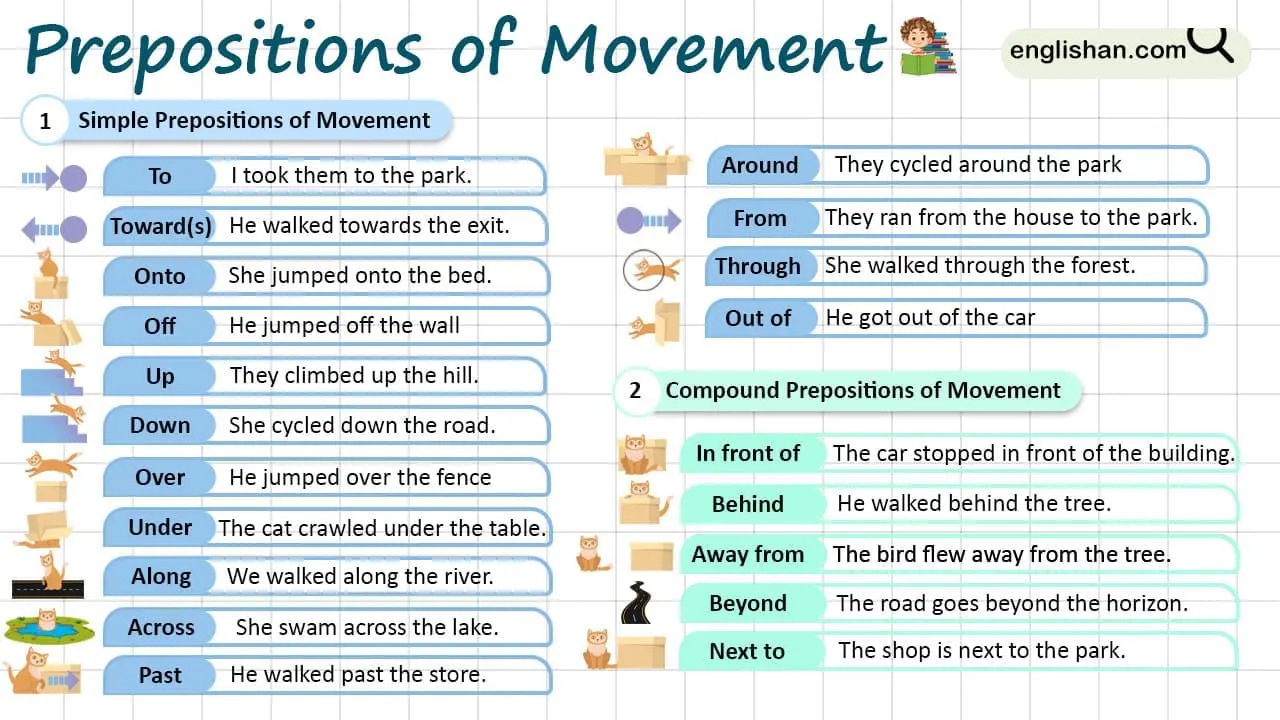
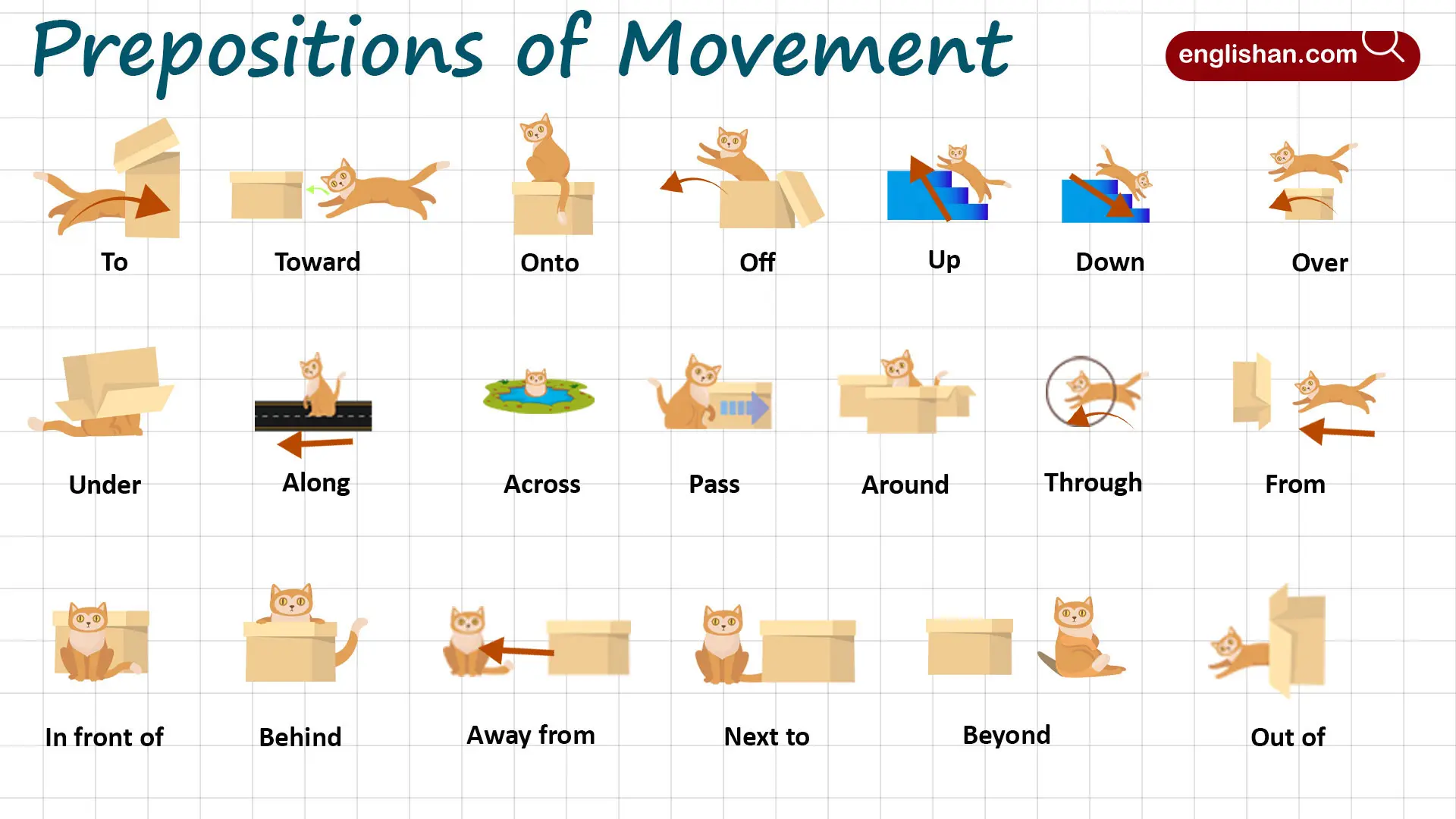
Prepositions of movement help us describe how something or someone moves in relation to another object or place. They are crucial for talking about directions, movement, and travel. Using prepositions of movement correctly can make your English sound more natural and specific.
A preposition of movement is a word that shows movement or direction from one place to another. It is commonly used to explain how people, animals, or objects move. For example, words like “to,” “across,” “up,” and “down” are prepositions of movement because they indicate direction.
These prepositions are often used with verbs to show where someone or something is going or how it moves.
Prepositions of Movement in Sentences
Below are examples of common prepositions of movement used in sentences, with explanations provided to help you understand how to use them effectively.
To
- Fatima walked to the market.
- Ali ran to his friend’s house.
Across
- Ali swam across the river.
- Maryam walked across the bridge.
Up
- Hassan climbed up the ladder.
- Sara ran up the hill.
Through
- Amina walked through the park.
- Bilal crawled through the narrow opening.
Along
- Sara walked along the street.
- Fatima strolled along the beach.
Into
- Omar jumped into the pool.
- The cat ran into the house.
Out of
- Khalid ran out of the room.
- The mouse ran out of the hole.
Over
- Ahmad jumped over the wall.
- The plane flew over the mountains.
Under
- The cat crawled under the table.
- The dog hid under the bed.
Down
- Hassan ran down the hill.
- She walked down the street.
Towards
- Layla walked towards the bus stop.
- He ran towards the finish line.
Around
- The children ran around the playground.
- They walked around the lake.
Compound Prepositions of Movement
Up into
- Maryam climbed up into the treehouse.
- The cat leaped up into the window.
Down towards
- The car moved down towards the river.
- The ball rolled down towards the road.
Over to
- He walked over to his friend’s house.
- She went over to the counter.
Back from
- She came back from the market.
- He got back from the trip.
Out of
- Khalid ran out of the building.
- She took her phone out of her pocket.
Using Prepositions of Movement
Prepositions of movement can be used in different grammatical structures to express actions involving movement. Here are some common ways to use them:
Phrasal Verbs
Phrasal verbs are verbs combined with prepositions or adverbs to create a new meaning. Some phrasal verbs include prepositions of movement.
- Get into
- Omar got into the car.
Omar is moving from outside to inside the car.
- Run across
- Ali ran across the field.
Ali moved quickly from one side of the field to the other.
- Climb over
- Hassan climbed over the fence.
Hassan moved from one side of the fence to the other by going above it.
Gerunds
Gerunds are verbs that function as nouns and can also be used with movement prepositions.
- He is fond of walking across bridges.
Walking across bridges shows his movement from one side to the other.
- She enjoys running along the beach.
Running along the beach indicates movement following the length of the beach.
Prepositional Phrases
A prepositional phrase starts with a preposition and ends with a noun or pronoun. Movement prepositions can create meaningful prepositional phrases.
- The children are running up the hill.
“Up the hill” is a prepositional phrase that indicates direction.
- They drove down the road.
“Down the road” shows the direction of their movement.
List of Prepositions of Movement
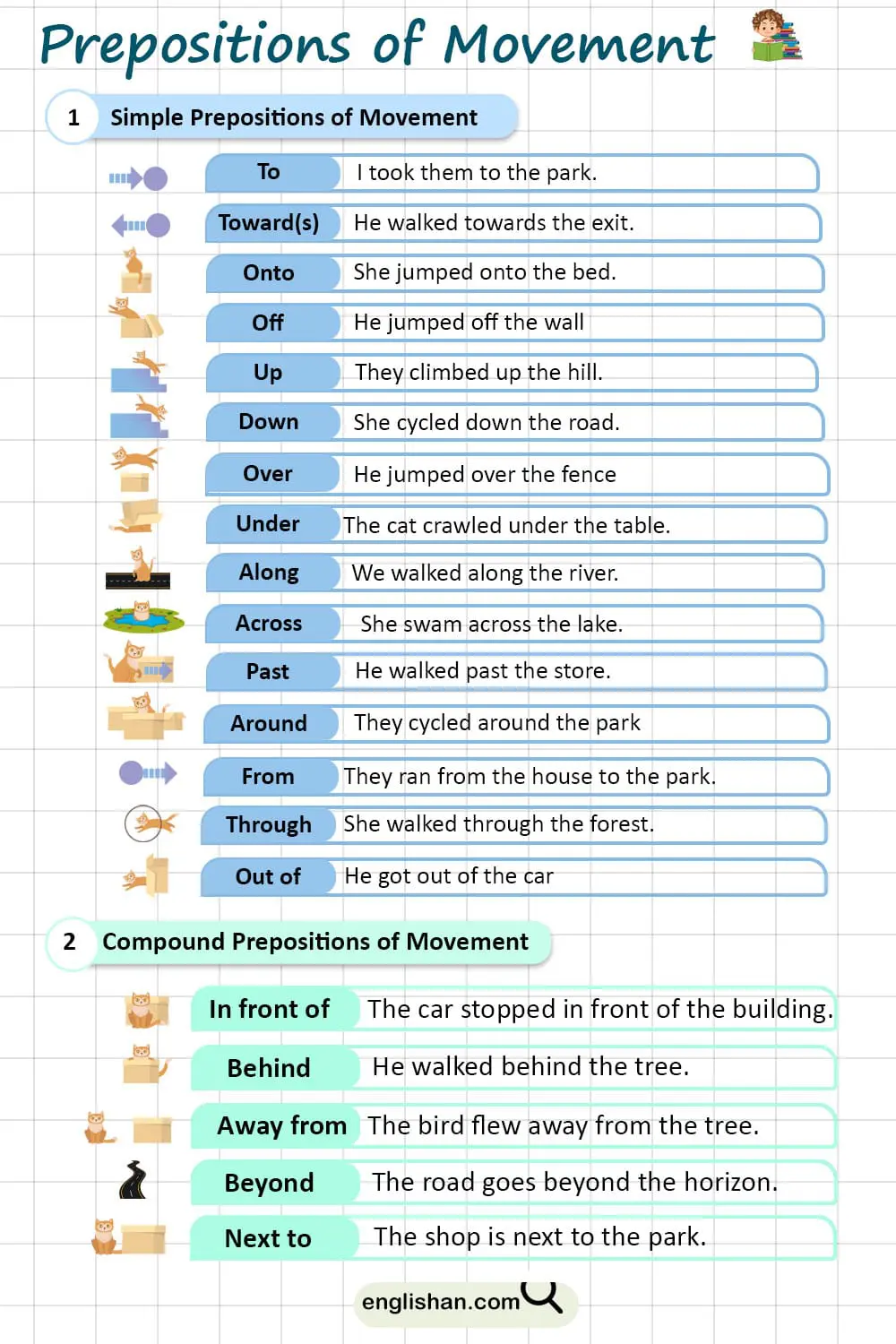
Prepositions of movement can be divided into simple and compound forms.
Simple Prepositions of Movement List
These prepositions show basic movement or direction:
| Preposition | Example Sentence |
| To | Zainab walked to the mosque. |
| From | Bilal came from the library. |
| Over | Ahmad jumped over the fence. |
| Under | The cat ran under the table. |
| Up | Hassan climbed up the ladder. |
| Down | Fatima ran down the hill. |
| Across | Ali swam across the river. |
| Through | Amina walked through the park. |
| Along | Sara walked along the street. |
| Into | Omar jumped into the pool. |
| Out of | Khalid ran out of the room. |
| Towards | Layla walked towards the gate. |
| Around | The children ran around the playground. |
Compound Prepositions of Movement List
These prepositions include more than one word to express movement:
| Preposition | Example Sentence |
| Out of | Khalid ran out of the building. |
| Up into | Maryam climbed up into the treehouse. |
| Down towards | The car moved down towards the river. |
| Over to | He walked over to his friend’s house. |
| Back from | She came back from the market. |
Prepositions of Movement in Phrases
Prepositions of movement can be used in various phrases to provide more details about an action.
- Layla walked towards the gate slowly.
Here, “towards the gate” indicates the direction of Layla’s movement.
- The ball rolled down the hill.
“Down the hill” shows the movement of the ball.
- The cat jumped over the wall.
“Over the wall” indicates the movement from one side of the wall to the other.
- They drove around the city.
“Around the city” shows the movement in a circular path covering different parts of the city.
- Maryam climbed up into the treehouse.
“Up into the treehouse” shows Maryam’s movement from the ground to inside the treehouse.
- The car moved down towards the river.
“Down towards the river” indicates the movement of the car from a higher place to a lower position.
Common Mistakes
Using prepositions of movement can sometimes be tricky. Here are common mistakes and how to avoid them:
Incorrect: He walked on the park. ❌
Correct: He walked in the park. ✅
When describing movement inside a specific place, use “in” instead of “on.”
Incorrect: She ran in the street. ❌
Correct: She ran along the street. ✅
Use “along” when describing movement that follows the path of something.
Incorrect: They jumped in the pool. ❌
Correct: They jumped into the pool. ✅
Use “into” to indicate movement from outside to inside.
Incorrect: The dog ran in the car. ❌
Correct: The dog ran into the car. ✅
Use “into” to indicate movement from outside to inside.
Summary
Prepositions of movement are essential for describing actions involving direction and movement. They help to make your descriptions clear and precise. Remember that each preposition provides specific information about the path or direction of an action. By using these prepositions correctly, you can communicate movement in English effectively.
FAQs
Use “to” for a specific destination or endpoint, such as He walked to the park (indicating he arrived at the park). “Toward” or “towards” (more common in British English) indicates general direction, such as She walked toward the lake (she moved closer to it, but didn’t necessarily arrive)
“In” describes a static position, meaning something is already inside, like The dog is in the house. “Into” shows movement from outside to inside, as in The dog ran into the house
Yes, “over” can be a preposition of movement! It shows movement from one side to the other above something.
For example, if a bird flies over a fence, it goes from one side to the other, passing above the fence.
No, “beside” is not a preposition of movement. It just shows where something is, meaning next to or at the side of something.
For example, “The cat is sitting beside the dog” tells us the cat is next to the dog but not moving.
Yes, “away” can be a preposition of movement. It shows that something is moving farther from a place.
For example, “He ran away from the house” means he started at the house and moved farther from it.
Read More
Prepositions of Movement Quiz
Prepositions of Movement
Choose the preposition.
They swam ___ the river to the far bank.
'Across' marks movement from one side to the other.
'across' marks side-to-side movement
They swam across the river.
Choose the preposition.
We walked ___ the beach for an hour.
'Along' marks movement following the length of the beach.
'along' marks movement following a length
We walked along the beach.
Choose the preposition.
The train went ___ the tunnel.
'Through' marks movement inside and out the other end.
'through' marks movement inside a space
The train went through the tunnel.
Choose the preposition.
The plane flew ___ the mountains.
'Over' marks movement above the mountains.
'over' marks movement above
The plane flew over the mountains.
Choose the preposition.
The mouse ran ___ the fence.
'Under' marks movement below the fence.
'under' marks movement below
The mouse ran under the fence.
Choose the preposition.
We drove ___ the roundabout.
'Around' marks movement in a circular path.
'around' marks circular movement
We drove around the roundabout.
Choose the preposition.
She walked ___ the shop without stopping.
'Past' marks movement by and beyond the shop.
'past' marks movement by and beyond
She walked past the shop.
Choose the preposition.
The climbers went ___ the hill.
'Up' marks movement to a higher point.
'up' marks upward movement
The climbers went up the hill.
True or false?
'Across' marks movement from one side to the other.
'Across the road' marks side-to-side movement.
'across' = side to side
She ran across the field.
Choose the preposition.
The ball rolled ___ the hill.
'Down' marks movement to a lower point.
'down' marks downward movement
The ball rolled down the hill.
Through or across?
We hiked ___ the forest for hours.
'Through' marks movement inside the forest, surrounded by trees.
'through' for movement inside a space
We hiked through the forest.
Choose the preposition.
The cat jumped ___ the wall.
'Over' marks movement above and across the wall.
'over' marks movement above and across
The cat jumped over the wall.
Complete with a movement preposition.
We sailed ___ the lake to reach the island. (side to side)
'Across' marks movement from one side of the lake to the other.
'across' = side to side
We sailed across the lake.
Choose the preposition.
The river flows ___ the valley.
'Through' marks movement passing within the valley.
'through' marks passing within
The river flows through the valley.
Choose the preposition.
They cycled ___ the park path.
'Along' marks movement following the length of the path.
'along' marks following a length
They cycled along the park path.
Choose the preposition.
The car sped ___ the other vehicles.
'Past' marks movement by and beyond the vehicles.
'past' marks movement by and beyond
The car sped past the other vehicles.
Choose the preposition.
We walked ___ the bridge to cross the river.
'Across' marks movement from one side of the bridge to the other.
'across' marks crossing to the other side
We walked across the bridge.
True or false?
'Through' marks movement inside and out of an enclosed space.
'Through the tunnel' marks movement inside and out the far end.
'through' = inside a space
The path goes through the woods.
Choose the preposition.
The boat passed ___ the bridge, beneath its arches.
'Under' marks movement below the bridge.
'under' marks movement below
The boat passed under the bridge.
Around or across?
The runners jogged ___ the lake and back to the start.
'Around' marks a circular route returning to the start.
'around' marks a circular route
The runners jogged around the lake.
Turn on JavaScript for the interactive quiz. The full practice set is shown above.