

Do-support is the use of the auxiliary verb “do” in a clause with no auxiliary verb of its own. A question or a negative in English is formed by moving an auxiliary in front of the subject or by placing “not” after it. In a clause such as “They left early”, there is no auxiliary to move. “Do” is inserted in that position, in the forms “do”, “does”, and “did”. The tense then moves onto “do”, so the main verb loses its ending and appears as the bare infinitive: “Did they leave early?”, “They did not leave early”. The same exchange decides where “do” is required and where it must stay out.
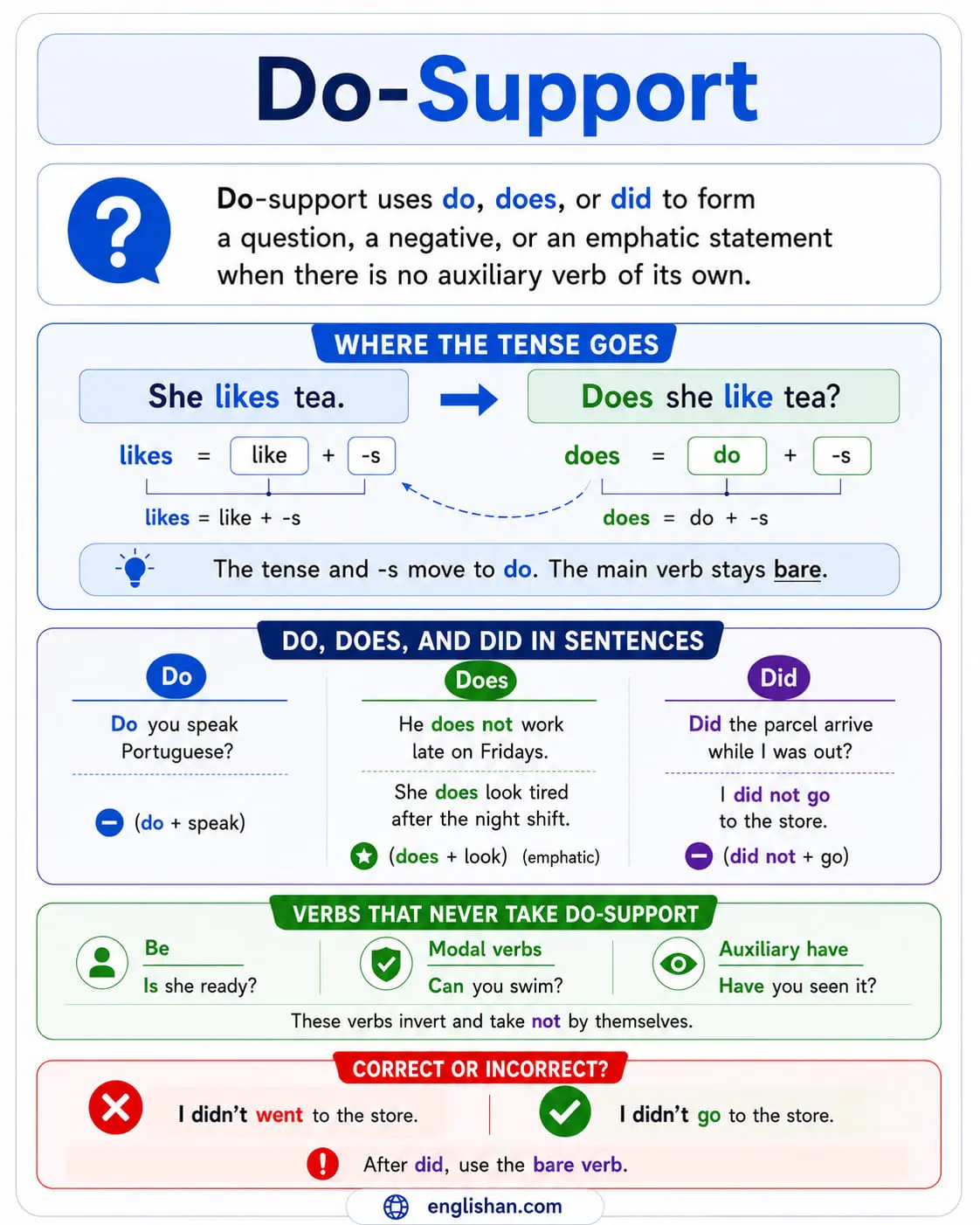
Do-support is the insertion of “do”, “does”, or “did” as an auxiliary verb when a question, a negative, or an emphatic statement is formed from a clause with no auxiliary verb in it. The tense moves onto “do”, and the main verb takes the bare infinitive, so “She likes tea” becomes “Does she like tea?” and “She does not like tea”.
To remember:
- Do-support is the auxiliary “do” inserted where a clause is without an auxiliary verb of its own.
- The construction appears in questions, negatives, emphatic statements, question tags, short answers, and negative inversion.
- “Be”, the modal verbs, and auxiliary “have” invert and take “not” themselves, so “do” stays out.
- A subject wh-question takes no “do” unless it is negative or emphatic.
Auxiliary Do And The Bare Infinitive
In a clause with no auxiliary verb, the tense and the subject agreement are marked on the main verb itself: “She likes tea”, “They left early”. An auxiliary verb is a verb that combines with a main verb to mark tense, agreement, negation, or emphasis, and the auxiliaries of English are “be”, “have”, “do”, and the modal verbs. The bare infinitive is the base form of the verb with no “-s”, no “-ed”, and no “to”, and it is the form the main verb takes once “do” is inserted.
Where a clause without an auxiliary is made to invert with its subject, to take “not”, to take stress, or to stand in for a repeated verb, the auxiliary “do” is inserted. “Do” marks the tense and the agreement, and the main verb drops to the bare infinitive. Where “be”, a modal verb, or another auxiliary is already present, that verb inverts and takes “not” itself, and “do” stays out.
- Does she like tea?
Here the third-person “-s” of “likes” has moved onto “does”, so “like” stays bare.
- Did they leave early?
- We do not eat meat on Fridays.
- He didn’t call back after the interview.
- Do you speak Portuguese?
- I did send the invoice, whatever the accounts team says.
Do, Does, And Did By Tense And Subject
| Tense and subject | Form of do | In a sentence |
|---|---|---|
| Present simple, I, you, we, they | Do | Do you agree? |
| Present simple, he, she, it | Does | Does the shop deliver? |
| Past simple, every subject | Did | Did the train stop here? |
Issue 1: The ending kept on the main verb after “does”
- Does he writes books? ❌ The third-person “-s” is on “does”, so a second “-s” on “writes” marks the same agreement twice.
- Does he write books? ✅
Issue 2: The past tense kept after “did”
- I didn’t went to the store. ❌ “Did” is the past tense of the clause, so “went” would mark the past a second time, and the main verb stays as “go”.
- I didn’t go to the store. ✅
Ask yourself which word is marking the tense. If the answer is “do”, “does”, or “did”, the main verb takes no ending at all: “does like”, “did leave”, never “does likes” or “did left”.
Questions With Do, Does, And Did
A question in English is formed by moving an auxiliary in front of the subject, which is subject-auxiliary inversion. A main verb never moves, so “Know you him?” reads as archaic and “Likes she tea?” is wrong. Where no auxiliary is present, “do” is inserted and moves in front of the subject, and the main verb stays in its place as the bare infinitive.
Yes-No Questions With Auxiliary Do
A yes-no question opens with “do”, “does”, or “did”, then the subject, then the bare main verb.
- Do you want the window seat or the aisle?
- Does the museum open on Mondays?
- Did anyone lock the back door last night?
- Do we need a visa for a two-day stopover?
- Does your manager know you are leaving at four?
- Did the parcel arrive while I was out?
Issue 1: Auxiliary “be” used where the clause takes “do”
- Are you live in an apartment? ❌ “Live” is a present simple main verb, and the auxiliary of the present simple is “do”; “be” is the auxiliary of the continuous, and “Are you living” would end in “-ing”.
- Do you live in an apartment? ✅
Wh-Questions With Auxiliary Do
A wh-question with “do” places the wh-word first, then “do”, then the subject, then the bare main verb.
- Where does she work now?
- What time did the meeting finish?
- Why do you keep checking your phone?
- How much does the course cost for part-time students?
- When did your flight land?
Subject Wh-Questions Without Do
When the wh-word is the subject of the clause, nothing moves in front of it, so no auxiliary is inserted and the main verb keeps its tense. “Do” returns in two situations: when the question is negative, and when the speaker stresses it.
- Who lives in the flat upstairs?
Here “who” is the subject, so “lives” keeps its “-s” and no “do” appears.
- Which team won the final?
- What happened to the old cinema on the corner?
- Who broke the printer again?
- Who doesn’t like chocolate?
- Who did buy the flowers, then?
Ask what the answer replaces. If the answer fills the subject position (“Sam lives upstairs”), write no “do”. If the answer fills an object or an adverbial position (“She works in Leeds”), put “do” before the subject.
Negative Questions With Don’t And Do Not
A negative question puts the contracted form before the subject; the full form puts “not” after the subject and reads formal.
- Didn’t you get my message about the venue?
- Doesn’t he phone you any more?
- Don’t they sell tickets at the door?
- Did the parents not realise what had happened?
The last question is the formal version, and it is the one an examiner or a report expects in writing.
Move “do” in front of the subject and leave the main verb bare: “Did the parcel arrive?”, never “Arrived the parcel?” or “Did the parcel arrived?”. In a subject question, keep the tense on the verb: “Who won?”.
Negatives With Do Not, Does Not, And Did Not
In current standard English, “not” attaches to an auxiliary verb or to “be”, and never to a finite main verb; “I know not” is archaic. A clause whose only verb is a main verb therefore takes “do” plus “not” plus the bare infinitive. The contractions “don’t”, “doesn’t”, and “didn’t” are the spoken and informal forms, and the full forms read formal and add weight in writing.
- I don’t want to wait for the bus.
- She does not take calls after six.
The full form is the one for a notice, a report, or a formal email; in conversation it reads as emphatic.
- We didn’t finish the report until midnight.
- The printer on the third floor doesn’t work.
- They did not expect so many guests.
- You don’t need a ticket for children under five.
- My brother didn’t recognise me with the beard.
Issue 1: The third-person form kept after “doesn’t”
- He doesn’t has a sister. ❌ “Doesn’t” already marks the third person, so the main verb is the bare “have”.
- He doesn’t have a sister. ✅
Issue 2: “Not” attached to the main verb
- She not like coffee. ❌ “Not” attaches only to an auxiliary, and there is none in the present simple, so “does” is inserted.
- She does not like coffee. ✅
Issue 3: The auxiliary not agreeing with a plural subject
- The students doesn’t understand the lesson. ❌ The agreement is on the auxiliary, so a plural subject takes “don’t”.
- The students don’t understand the lesson. ✅
Negative Imperatives With Do Not And Don’t
A negative command takes “do not” or “don’t” before the bare verb, and this is true even for “be”, which is the one construction in which “be” takes do-support.
- Don’t be late for the interview.
In a statement, “be” takes “not” itself (“I am not late”), but there is no subject in a command for “be” to invert with, so “do” is inserted before the bare “be”.
- Do not open until instructed.
- Don’t forget your passport at the hotel.
- Do not be alarmed by the noise from the roadworks.
Not Before Infinitives And Participles
A non-finite verb, meaning an infinitive, an “-ing” form, or a participle, is negated by “not” placed directly before it, with no “do”. The auxiliary is inserted only when the finite verb of the clause is the one being negated.
- I tried not to laugh during the speech.
Compare “I did not try to laugh”, where “try” is negated and “did” appears, with “I tried not to laugh”, where the infinitive is negated and no “do” is needed.
- Not knowing the area, we asked a driver for directions.
- It would be unfair not to invite her.
- They decided not to renew the lease.
Related: Infinitive Phrase in English: Definition and Examples
Write “do not” or “don’t” before a bare main verb: “does not take”, “didn’t finish”. Before an infinitive or an “-ing” form, write “not” alone: “tried not to laugh”.
Verbs That Never Take Do-Support
The verbs that take “not” directly and invert with the subject on their own never combine with “do”. Whether a sentence takes “do” depends on one question: is there already “be”, a modal verb, or an auxiliary “have” in the clause? If so, that verb moves and takes “not”. If the only verb is a main verb, “do” is inserted.
| Verb in the clause | Question | Negative |
|---|---|---|
| Be | Is she ready? | She isn’t ready. |
| A modal verb | Can you swim? | I can’t swim. |
| Auxiliary have | Have you seen it? | I haven’t seen it. |
| Have got | Have you got a pen? | I haven’t got a pen. |
| A main verb alone | Does she agree? | She doesn’t agree. |
Be Inverts And Takes Not Itself
“Be” inverts with the subject and takes “not” directly, whether it is the main verb or the auxiliary of the continuous and the passive.
- Are you ready to order?
- She isn’t in the office today.
- Were the shops open on Sunday?
- The road is not being repaired until spring.
Related: Use Of Am Is Are: 23 Rules With Examples
Issue 1: “Do” inserted before “be”
- Does he is ready? ❌ “Be” inverts on its own, and a clause never takes two auxiliaries for one question.
- Is he ready? ✅
Modal Verbs Invert And Take Not Themselves
Modal verbs invert with the subject and take “not” directly, and they never combine with “do” in any construction.
- Can you swim a full length?
- She can’t come on Friday.
- Will you be here in time for lunch?
- You shouldn’t leave the tap running.
Issue 1: “Do” combined with a modal verb
- Do you can swim? ❌ A modal verb is already an auxiliary, so it moves in front of the subject itself and there is no place for “do” in the clause.
- Can you swim? ✅
Auxiliary Have And Have Got
Auxiliary “have” inverts with the subject and takes “not” directly. It is the auxiliary of the perfect, and in British English “have got” follows the same rule.
- Have you seen the new timetable?
- I haven’t finished the application yet.
- Has she got a spare key?
- We haven’t got time for a second coffee.
Main Verb Have With Do-Support
Main verb “have”, meaning possession, takes do-support like any other main verb in current English: “Do you have a car?”, “I don’t have a car.” The forms “Have you a car?” and “I haven’t a car” survive in older and very formal British usage and read dated today. Write “Do you have” everywhere, or “Have you got” in informal British English, and read “Have you any” as old-fashioned rather than as an error when you meet it in print.
- Do you have a moment before the call?
- She doesn’t have a driving licence.
- Did they have enough chairs for everyone?
- I didn’t have a signal in the tunnel.
Before writing “do”, look for “be”, a modal verb, or an auxiliary “have”. If one is there, move it: “Is she ready?”, “Can you swim?”, “Have you seen it?”. If the only verb is a main verb, including main verb “have”, insert “do”: “Do you have a moment?”.
Emphatic Do Before A Stressed Main Verb
In an emphatic affirmative statement, “do”, “does”, or “did” is inserted to correct a claim or to contrast with what was expected. It takes the stress in speech, and the main verb stays bare. Where “be”, a modal verb, or another auxiliary is already present, the stress goes on that verb instead: “I am listening”, “She can drive”. Emphatic “do” also strengthens an invitation or a warning in the imperative.
- I did lock the door; I checked twice.
Here “did” answers a doubt that the door was locked, and “lock” stays bare because the past tense is marked on “did”.
- She does look tired after the night shift.
- We do want to help, but the budget is gone.
- Do come in and sit down.
- He did call, but the line was busy.
- Do be careful on the ice.
- You do realise the deadline is tomorrow?
Emphatic “do” belongs to speech and informal writing, where the stress is heard; in a formal report the same contrast is written with an adverb such as “in fact” rather than with a stressed “do”.
Insert a stressed “do” only where no other auxiliary is present: “I did lock it”, but “I am listening”, never “I do be listening”.
Question Tags And Short Answers With Do
A question tag and a short answer repeat the auxiliary of the clause they follow. Where there is none, “do” stands in, in the tense and person of the main verb, and the main verb itself is not repeated. A tag reverses the polarity of the statement by default, so an affirmative clause takes a negative tag.
- You work with Peter, don’t you?
- She plays the piano, doesn’t she?
- They didn’t stay long, did they?
- Do you want to come along? Yes, I do.
- Did anyone see the accident? No, nobody did.
- Who took the car? Sam did.
- I liked the film. Did you?
- He looks smart, and so do you.
Issue 1: “Do” in the answer to a question with “be”
- Are you busy? Yes, I do. ❌ The answer repeats the auxiliary of the question, and the auxiliary of the question is “be”, so the answer is “am”.
- Are you busy? Yes, I am. ✅
Issue 2: The main verb repeated after “don’t”
- Do you have a car? No, I don’t have. ❌ A short answer stops at the auxiliary; “have” is either dropped or given its object.
- Do you have a car? No, I don’t. ✅
Ask which verb would move to the front if the statement were a question. That verb, and only that verb, goes in the tag and in the short answer.
Do As A Substitute Verb
Beyond tags and short answers, “do” stands in for a whole verb phrase already mentioned, and it takes “so”, “it”, or “that” where the reference is formal or emphatic.
- We went to the concert, and they did too.
- I asked them to leave, and they did so without argument.
- He deletes emails by accident, and I do it all the time.
- Would you lend a stranger your phone? I would never do that.
Do-Support After Never, Only, And Seldom
When a negative or restrictive adverbial such as “never”, “seldom”, “only here”, or “not until” opens the clause, the subject and an auxiliary invert, which is negative inversion. A clause with a main verb alone takes “do” for the inversion. The construction belongs to formal and literary writing.
- Never did he run that fast again.
The forms without “do” or with the wrong order, “Never ran he” and “Never he did run”, are both wrong; the auxiliary goes directly after the adverbial.
- Only here do I feel at home.
- Seldom does a first draft survive a second reading.
- Not until the morning did we learn the result.
After an opening “never”, “only”, or “seldom”, write “do” before the subject: “Never did he run”, never “Never he ran”.
Did And Not In Subjunctive Clauses
A present subjunctive clause is the clause after “suggest”, “insist”, or “it is essential that”. Its negative is formed with “not” placed before the bare verb, without “do”, because a “do” here reads as an ordinary present tense and changes the meaning. In a past subjunctive after “wish”, “did” negates as in any past clause, and “be” takes “were not”.
- I suggest that he not receive any more funding.
“That he does not receive” would state a fact about him rather than a proposal, so the subjunctive keeps “not” alone.
- It is essential that she not be disturbed during the exam.
- I wish that he did not know about the surprise.
- I wish they weren’t so far away.
Write “that he not go” in the present subjunctive and “wish he didn’t go” in the past.
Auxiliary Do Beside Main Verb Do
Main verb “do” is an ordinary verb with a meaning: perform, complete, study, clean. Like every other main verb, it takes do-support, so two forms of “do” appear in one clause. The first is the auxiliary, and it marks the tense; the second is the main verb, and the meaning is on it.
- Why do you do karate on Sundays?
The first “do” is the auxiliary of the question, and the second “do” means practise.
- She doesn’t do the crossword any more.
- Did you do economics at university?
- They didn’t do the laundry on Sunday.
- What does your brother do for a living?
To tell them apart, look for the one with the tense or the “-s”. That one is the auxiliary, and the bare one after it is the main verb.
Which Sentences Take Do-Support
Three questions, asked in order, decide any sentence. First, is there “be”, a modal verb, or an auxiliary “have” in the clause? If there is, that verb inverts and takes “not”, and “do” stays out. Second, is the verb finite? A finite main verb takes “do” in a question, a negative, a tag, or an emphatic statement, and an infinitive or an “-ing” form takes “not” alone. Third, is the wh-word the subject? If it is, no “do” appears unless the question is negative or stressed.
The train leaves at six: no auxiliary and a finite main verb, so “Does the train leave at six?” and “The train doesn’t leave at six”.
She is leaving at six: “be” is present, so “Is she leaving at six?” and “She isn’t leaving at six”.
Who called: the wh-word is the subject, so no “do” in the affirmative, and “Who didn’t call?” in the negative.
I told her to wait: to negate the infinitive, “I told her not to wait”; to negate “told”, “I didn’t tell her to wait”.
Run the three questions on your own sentence before you write “do”, and the auxiliary goes in only where nothing else in the clause inverts.
FAQs
Q1. Why does English use do-support?
Do-support exists because a finite main verb no longer moves in front of the subject or takes “not” directly, while a question or a negative is still formed with an auxiliary in that position. “Do” fills the position without adding any meaning, so the tense is marked on it and the main verb stays bare.
Q2. Is do-support the same as do-insertion, dummy do, and periphrastic do?
Yes, the four names refer to one construction. “Do-insertion” and “periphrastic do” are the names used in grammars and syntax courses, “dummy do” and “dummy operator” are the classroom labels, and “do-support” is the standard term in reference grammars.
Q3. Where does do-support come from?
Do-support developed inside English between the Middle English period and the eighteenth century, when “know you” and “I know not” gave way to “do you know” and “I do not know”. The origin is disputed, with one account tracing it to an older use of “do” meaning cause and another to contact with Welsh.
Q4. Is do-support unique to English?
Among the standard Germanic languages it is, since German, Dutch, and the Scandinavian languages form questions and negatives by inversion alone. Scots shares it with English, and an auxiliary “do” with a related function exists in Welsh.
Q5. How does do-support relate to the NICE properties of auxiliary verbs?
The NICE properties are the four constructions that separate an auxiliary from a main verb: negation, inversion, code, and emphasis. Do-support is what happens when one of the four is formed from a clause with no auxiliary in it. “Do” is then inserted to take “not”, to invert, to stand in for a repeated verb, or to take stress.