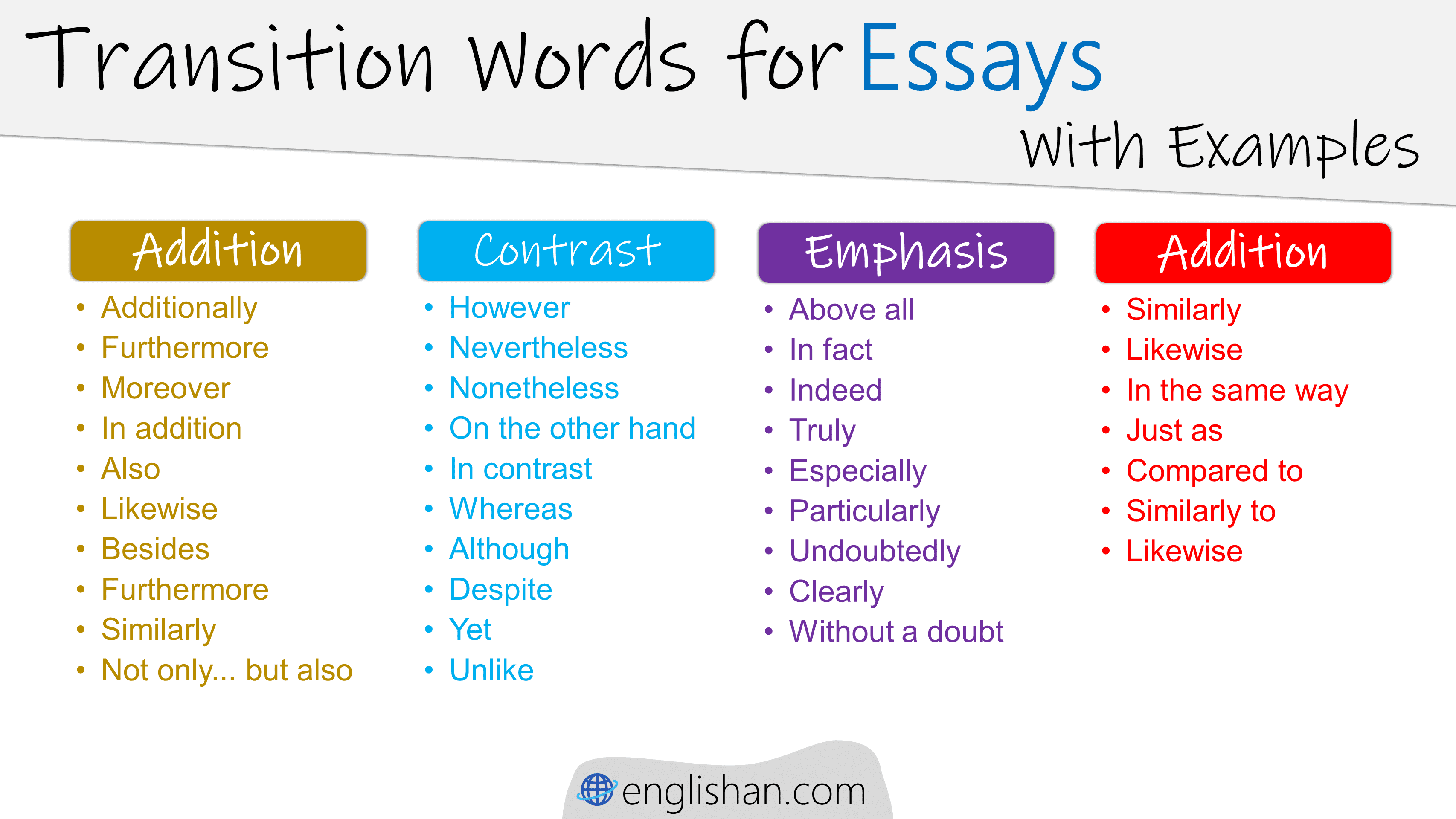
Transition words for essays show the logical relationship between claims, evidence, examples, and conclusions. Words such as however, therefore, furthermore, and for example tell the reader whether a sentence adds information, introduces a contrast, explains a result, or presents supporting evidence.
An effective transition must match the writer’s intended meaning. However introduces contrast, while therefore introduces a result. Using the wrong connector can make an argument unclear, even when the grammar is correct. In academic writing, transitions also connect body paragraphs, introduce counterarguments, and guide the reader from evidence to analysis.
Transition Words for Essays by Purpose
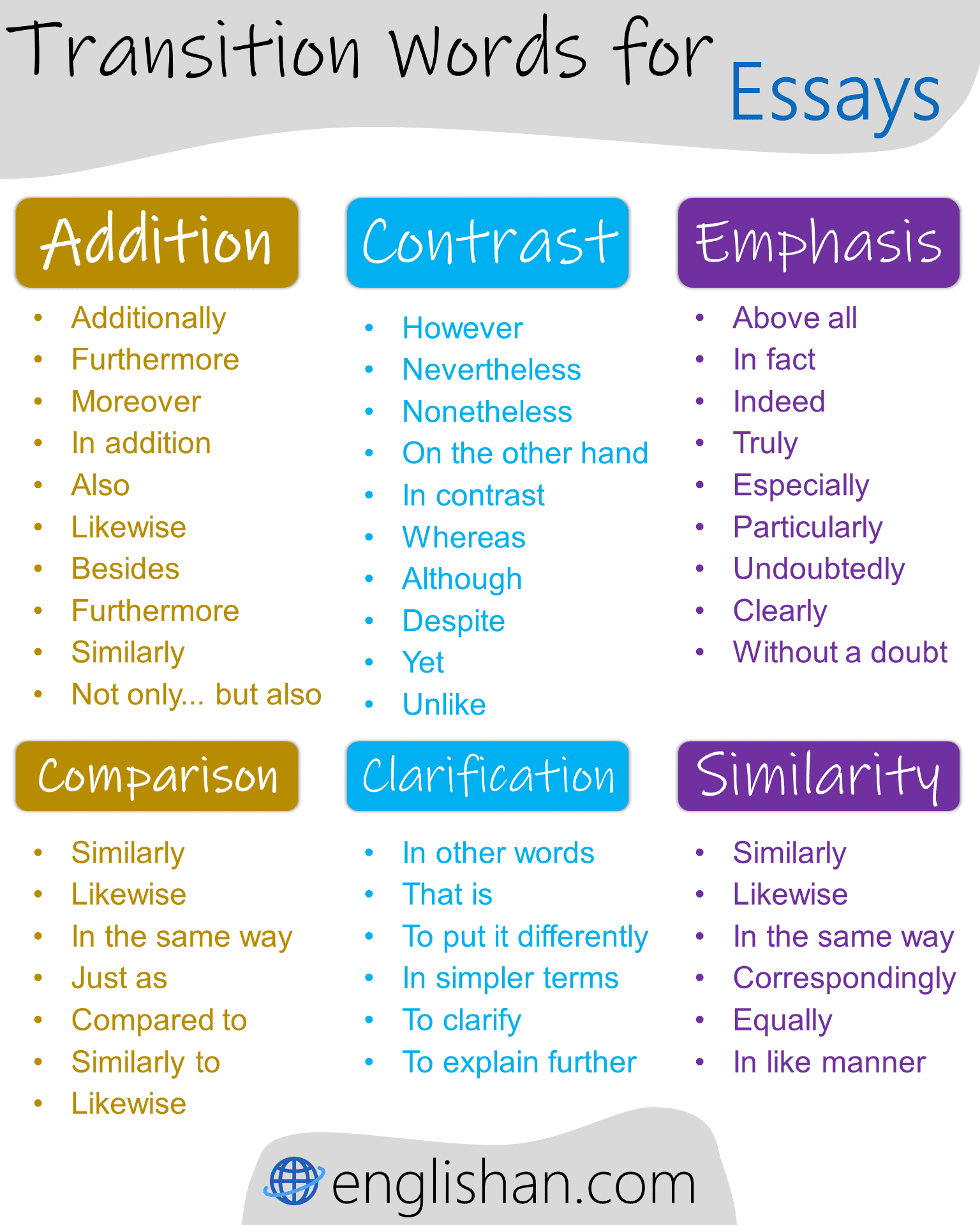
Choose an essay transition according to the relationship between the two ideas.
Choose by relationship first
Identify what the next idea does before choosing a connector. Ask whether it adds, contrasts, causes, illustrates, compares, sequences, clarifies, emphasizes, conditions, or concludes.
Addition and Reinforcement
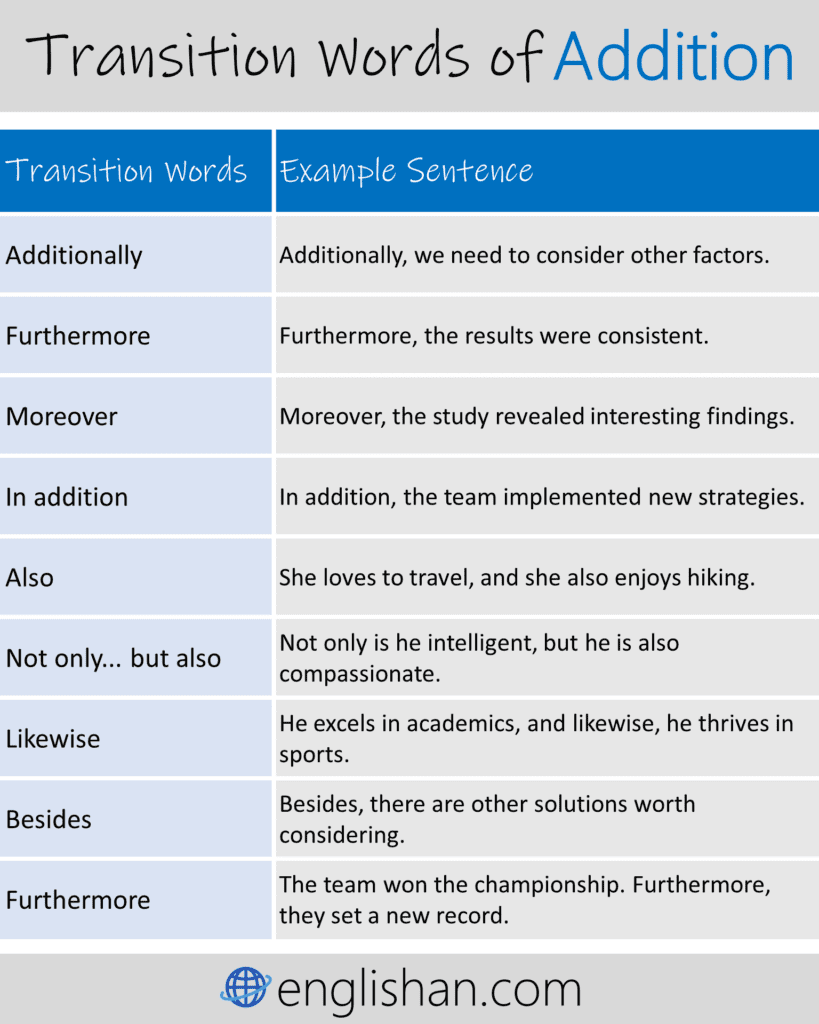
In an essay, additive transitions introduce another reason, piece of evidence, or supporting point. Formal academic writing generally favors furthermore, moreover, and in addition, while as well and not to mention have a more conversational tone.
| Also | Additionally | In Addition |
| Furthermore | Moreover | Further |
| Besides | As Well | Equally Important |
| Coupled With | Together With | Along With |
| What Is More | Not To Mention |
Examples:
- Additionally, the survey included responses from three age groups.
- Moreover, the policy reduced costs without lowering service quality.
- Equally important, the proposal protects students who need extra support.
- Along with lower fees, the program offers flexible evening classes.
Usage note:
Use not to mention sparingly in formal academic work because it has a conversational tone.
Contrast and Concession
Essay writers use contrast and concession transitions to present a difference, alternative, counterargument, or unexpected result. However, nevertheless, conversely, and on the contrary are not interchangeable, so the choice must match the exact relationship between the claims.
| However | Nevertheless | Nonetheless |
| Even So | Still | Yet |
| In Contrast | By Contrast | On The Other Hand |
| Conversely | On The Contrary | Instead |
| Rather | Alternatively | Although |
| Though | While | Despite This |
| In Spite Of This | Notwithstanding |
Examples:
- However, the second experiment produced a different result.
- Nevertheless, the researchers continued because the question remained important.
- In contrast, the rural schools reported a steady increase in attendance.
- On the other hand, a shorter schedule may reduce the time available for discussion.
Usage note:
Use on the contrary after rejecting or correcting a negative statement. It does not simply mean however.
Cause and Result
Cause-and-result transitions are especially useful in analytical and cause-and-effect essays. Use them only when the evidence supports a real causal relationship, not merely because one event appears before another.
| Therefore | Thus | Consequently |
| Hence | Accordingly | As A Result |
| For This Reason | Because Of This | Thereby |
| In Effect | Owing To This | Due To This |
| So | Then |
Examples:
- Therefore, the committee postponed the vote until the financial report was complete.
- As a result, the revised schedule gave students more time to prepare.
- Consequently, the original estimate no longer reflected the project’s actual cost.
- Because of this, the researchers repeated the test with a larger sample.
Usage note:
So is common and direct. Therefore, consequently, and accordingly usually fit a more formal academic register.
Examples and Evidence
These transitions introduce evidence, illustrations, and specific cases that support an essay claim. The sentence after the transition should provide relevant proof or analysis rather than an unrelated detail.
| For Example | For Instance | To Illustrate |
| To Demonstrate | Specifically | Namely |
| In Particular | Such As | As Evidence |
| Consider |
Examples:
- For example, many libraries now lend digital devices as well as printed books.
- To illustrate, a two-week delay at the planning stage can affect every later deadline.
- Specifically, the study measured reading speed, vocabulary recall, and comprehension.
- As evidence, the report cites five years of attendance records.
Usage note:
Such as normally introduces examples inside a sentence. For example and for instance can introduce a complete sentence.
Comparison and Similarity
Comparison transitions help comparative essays show that two texts, arguments, events, or findings share a feature or pattern. Name the basis of comparison clearly so the reader understands what is being compared.
| Similarly | Likewise | In The Same Way |
| By The Same Token | Correspondingly | Comparably |
| Equally | Just As | In A Similar Manner |
| Much Like |
Examples:
- Similarly, the second novel presents memory as unreliable.
- Likewise, small businesses benefit when application procedures are simplified.
- In the same way, a clear topic sentence prepares the reader for the paragraph’s main claim.
- Just as exercise strengthens the body, regular revision strengthens an essay.
Usage note:
Similarly and likewise usually compare parallel ideas. They should not be used merely to add an unrelated point.
Time and Sequence
Time and sequence transitions are most useful in process essays, narrative essays, historical explanations, and arguments that develop through ordered stages. In other essay types, use them only when chronology or sequence is part of the reasoning.
| First | First Of All | To Begin With |
| Initially | Next | Afterward |
| Subsequently | Meanwhile | At The Same Time |
| Later | Previously | Thereafter |
| Eventually | Finally | At Last |
| In The Meantime |
Examples:
- Initially, the team treated the issue as a temporary problem.
- Subsequently, new evidence changed the direction of the investigation.
- Meanwhile, local organizations continued to provide emergency support.
- Finally, the revised plan was submitted for public review.
Usage note:
First is usually more concise than first of all in formal prose. Avoid using firstly, secondly, and thirdly unless the pattern suits the rest of the essay.
Clarification and Restatement
Clarifying transitions let an essay writer restate a claim more precisely, define a term, or qualify an interpretation. The restatement should add precision rather than repeat the same sentence in different words.
| In Other Words | That Is | To Clarify |
| More Precisely | Put Differently | To Put It Another Way |
| In Simple Terms | More Accurately | Stated Another Way |
| To Be Clear |
Examples:
- In other words, the rule applies only when both clauses can stand as complete sentences.
- More precisely, the policy affects applicants who submit materials after the stated deadline.
- To clarify, the fee covers registration but not course materials.
- Put differently, the argument fails because its conclusion does not follow from its evidence.
Usage note:
Clarification should add precision. Do not repeat the same sentence with different wording unless the restatement makes the point easier to understand.
Emphasis
Emphasis transitions identify the evidence, distinction, or implication that matters most to the essay argument. Use them selectively, since repeated emphasis makes every point sound equally important.
| Indeed | In Fact | Above All |
| Notably | Especially | Particularly |
| Most Importantly | Chiefly | Certainly |
| Undoubtedly |
Examples:
- Indeed, the final data set was twice as large as the original sample.
- In fact, several participants changed their answers after the instructions were clarified.
- Most importantly, the new rule gives applicants a clear appeal process.
- Notably, the strongest improvement occurred among first-year students.
Usage note:
Undoubtedly and certainly express strong confidence. Use them only when the evidence justifies that level of certainty.
Condition and Purpose
In argumentative essays, conditional transitions state the circumstances under which a claim is true, while purpose transitions explain the intended outcome of an action. Several expressions in this group are conjunctions, so punctuation depends on clause structure.
| If | Unless | Provided That |
| As Long As | Under These Circumstances | In That Case |
| Otherwise | So That | In Order To |
| With This In Mind |
Examples:
- Provided that the data are complete, the analysis can begin on Monday.
- Otherwise, the results may reflect a flaw in the sampling method.
- In order to reduce bias, the researchers used the same instructions for every group.
- With this in mind, the council revised the plan before the final vote.
Usage note:
Do not place a comma automatically after if, unless, or although. These words introduce dependent clauses and follow clause-based punctuation rules.
Summary and Conclusion
Conclusion transitions signal that the essay is bringing its evidence and reasoning together. The final paragraph should explain the significance of the argument rather than repeat the thesis word for word.
| In Conclusion | To Conclude | In Summary |
| To Summarize | In Sum | Overall |
| On The Whole | All Things Considered | Ultimately |
| In Brief |
Examples:
- In conclusion, the evidence supports a gradual rather than immediate change.
- Overall, the program improved access while keeping costs within the approved budget.
- Ultimately, the decision depends on whether the proposed benefits outweigh the long-term risks.
- All things considered, the revised method offers the most reliable basis for comparison.
Usage note:
Use a conclusion transition when it clarifies the shift. A final paragraph does not need in conclusion if its purpose is already obvious.
Transition Words to Start a Paragraph
Transition words for paragraphs are most useful in an essay when they show how the new paragraph develops the argument. The opening may add support, introduce a counterargument, present evidence, qualify an earlier claim, or move toward the conclusion.
Do not force every essay paragraph to begin with a connector. A precise reference to the previous paragraph, a repeated key term, or a full transition sentence may create a stronger link than a general word such as furthermore.
| Essay Paragraph Purpose | Useful Transition Words | Sample Essay Opening |
| First Body Paragraph | To Begin With; Initially; First; One Reason Is | To begin with, public transport reduces the number of cars entering city centers. |
| Adding Another Point | Furthermore; Moreover; In Addition; Building On This | Furthermore, reliable bus routes improve access to work and education. |
| Introducing A Contrast | However; In Contrast; Nevertheless; On The Other Hand | However, rural communities may need different transport solutions. |
| Introducing Evidence | For Example; For Instance; Specifically; To Illustrate | For example, smaller towns often depend on flexible community bus services. |
| Moving To A Conclusion | Ultimately; Overall; In Conclusion; All Things Considered | Ultimately, transport policy must reflect population density and local need. |
Paragraph Transition Words in a Model Essay
Paragraph transition words should reflect the developing essay argument rather than follow a fixed formula. The sequence below shows how different connectors guide a short argumentative essay about school uniforms.
| Role in the Essay | Model Paragraph Opening |
| First Point | To begin with, a uniform policy can reduce visible differences in family income. |
| Additional Support | Furthermore, a shared dress code may reduce the time students spend choosing clothes each morning. |
| Counterargument | However, critics argue that uniforms restrict personal expression. |
| Evidence Or Qualification | For example, schools can preserve some choice by allowing several approved colors or styles. |
| Final Judgment | Ultimately, the value of a uniform policy depends on how fairly and flexibly it is applied. |
The connectors change because the argumentative role changes. Repeating furthermore at the start of every body paragraph would hide the shift from supporting reason to counterargument, evidence, and final judgment.
How to Use Transition Words in Essays
Match the Word to the Logical Relationship
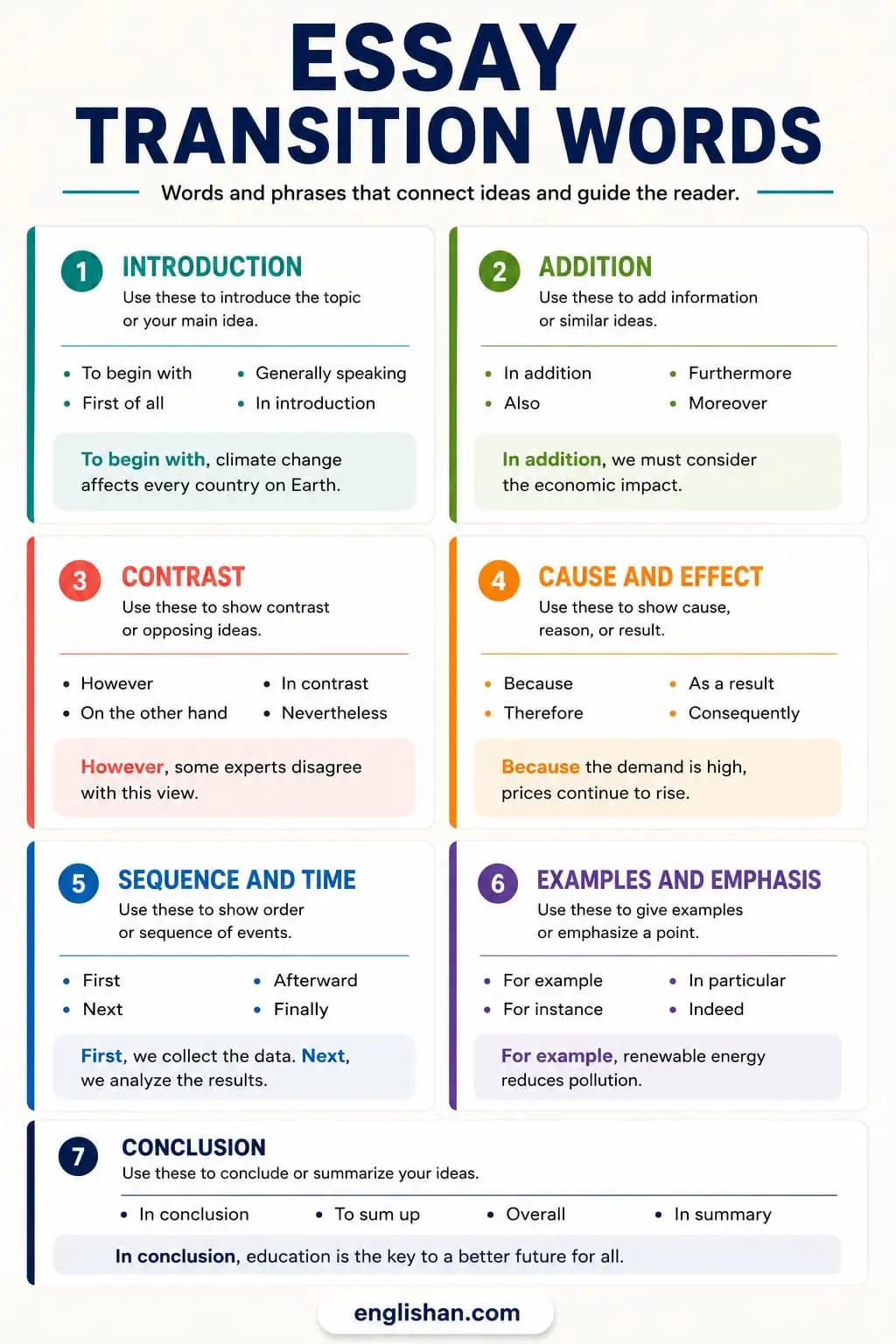
Read the two essay sentences or paragraphs without a connector and state their relationship in plain language. If the second challenges the first, choose a contrast transition. If it follows from the first, choose a cause-and-result transition. If it supplies proof, use an evidence transition.
Close alternatives require the same care. However can show a simple contrast or unexpected result. Nevertheless concedes the earlier point but says the later claim remains true. Conversely introduces an opposite or reversed relationship. The best choice is the one that states the essay logic accurately.
Place the Transition Where the Connection Changes
In an essay sentence, a transition may appear at the beginning, in the middle, or at the end. Beginning placement gives the relationship immediate emphasis. Middle placement works when the connector comments on the whole clause without dominating the sentence.
Between essay paragraphs, the strongest transition often names the exact connection to the preceding claim. Avoid a vague opening such as another important point when a specific reference can show what the new paragraph adds or challenges.
Example: These lower costs also affect how small firms decide when to hire.
The sentence links two specific paragraphs and could not be moved elsewhere in the essay without revision.
Match the Level of Formality
Academic essays do not require the most formal connector available. Choose wording that fits the audience, subject, and sentence. A direct word such as but or so is sometimes clearer than a heavier alternative, while formal transitions are useful when they express the relationship precisely.
| Everyday Option | More Formal Option | Relationship |
| Also | Furthermore Or Moreover | Adding Another Supporting Point |
| But | However Or Nevertheless | Introducing Contrast Or Concession |
| So | Therefore Or Consequently | Showing A Result |
| For Example | For Instance Or To Illustrate | Introducing Evidence Or An Illustration |
| In The End | Ultimately | Giving The Final Judgment |
| Plus | In Addition | Adding Information In Formal Prose |
Avoid Repetition and Overuse
A transition should earn its place in the essay. Remove it when the relationship is already obvious, when the sentence merely repeats the previous point, or when the connector makes the prose sound mechanical. Repetition is especially noticeable when several body paragraphs begin in the same way.
Vary the method of connection as well as the vocabulary. An essay can repeat a key noun, use a pronoun with a clear reference, pick up a phrase from the previous paragraph, or use a full transition sentence. These methods often connect developed ideas more precisely than another generic connector.
Punctuation Rules for Transition Words in Essays
Correct punctuation keeps transition words for essays from disrupting the sentence they are meant to connect. The required mark depends on whether the transition is a conjunctive adverb, introductory phrase, coordinating conjunction, or subordinating conjunction.
Conjunctive Adverbs in Essay Sentences
Conjunctive adverbs such as however, therefore, moreover, nevertheless, and consequently can connect two independent clauses in an essay. Use a semicolon before the transition and a comma after it, or separate the clauses into two sentences.
| Pattern | Example |
| Semicolon Pattern | The evidence was limited; therefore, the conclusion remained tentative. |
| Two-Sentence Pattern | The evidence was limited. Therefore, the conclusion remained tentative. |
| Comma Splice To Avoid | The evidence was limited, therefore, the conclusion remained tentative. |
Introductory and Parenthetical Transitions in Essays
Use a comma after an introductory transitional element when it is separate from the main clause of an essay sentence.
Example: In contrast, the second group showed no measurable change.
A parenthetical transition is normally set off with commas.
Example: The second group, however, showed no measurable change.
Not every word at the beginning of an essay sentence takes a comma. Subordinating conjunctions such as if, although, because, unless, and while introduce dependent clauses. Comma placement depends on clause position and structure, not simply on the first word.
Conjunctions Used in Essay Transitions
A coordinating conjunction can join two independent clauses in an essay when a comma appears before the conjunction.
Example: The first test was successful, but the second produced inconsistent results.
A subordinating conjunction makes one clause dependent and shows how it relates to the main essay claim in the sentence.
Example: Although the first test was successful, the second produced inconsistent results.
When the dependent clause follows the main clause, a comma is usually unnecessary unless clarity or a strong contrast requires one.
Example: The second test produced inconsistent results although the first test was successful.
Use an optional comma only when it clarifies a strong contrast or prevents misreading. The decision should follow meaning and sentence structure, not a rule that applies to every transition.
Transition Words vs Transition Sentences in Essays
In shorter connections, transition words for essays label a relationship briefly. A transition sentence explains how the developed idea in one paragraph leads to the claim, evidence, or question in the next. Longer academic essays often need both because one connector cannot summarize a complex paragraph-to-paragraph relationship.
| Form | Example | Best Use in an Essay |
| Transition Word Or Phrase | However, the policy created a different problem. | A direct contrast between nearby essay ideas |
| Transition Sentence | The cost savings discussed above explain why the policy attracted support, but they do not address its effect on service quality. | A specific bridge between developed essay paragraphs |
A useful essay transition sentence looks backward and forward. It names the point just completed, then identifies the question or claim the next paragraph will develop. This specific bridge is stronger than a generic opening such as another point to consider.
Common Mistakes with Transition Words for Essays
- Wrong logical relationship: The experiment ended early. For example, the equipment failed. In an analytical essay, the second sentence gives a cause, not an example. Because the equipment failed expresses the relationship accurately.
- Comma splice: The evidence was incomplete, however, the committee approved the proposal is a comma splice. Use a semicolon before however or begin a new sentence.
- Repeated paragraph opener: Starting several essay paragraphs with furthermore makes different argumentative relationships sound identical. Match each opening to its role in the argument.
- Formality over meaning: Moreover does not make an essay sentence more authoritative. It simply adds a supporting point.
- Misusing on the contrary: Use it to reject or correct a negative statement: The plan is not cheaper. On the contrary, it is likely to cost more.
- Sentence fragment: Although the sample was small is incomplete by itself. Add a main clause: Although the sample was small, the pattern was consistent.
- Organization problem: If two essay paragraphs do not have a clear relationship, a transition cannot create one. Reorder, combine, divide, or rewrite the ideas first.
- Unnecessary transition: When the essay structure already makes the result clear, therefore may be unnecessary. Read the passage without the connector and keep it only if clarity improves.
Conclusion
Finally, using conclusion transition words for essays is essential to wrap up your ideas and provide a sense of closure. These words help summarize your main points and leave a lasting impression on the reader.
Using the right transition words is crucial for a smooth essay. Additionally, if you find it challenging to organize your references effectively, you may want to buy an annotated bibliography. This service can assist you in managing your sources while you focus on writing, ensuring that your essay adheres to academic standards.
FAQs
Good transition words express the exact relationship between ideas. Common choices include furthermore for addition, however for contrast, therefore for result, for example for evidence, and ultimately for a final judgment.
Useful starters include to begin with for a first point, furthermore for added support, however for contrast, for example for evidence, and ultimately for a concluding judgment. The best choice depends on the new paragraph’s role.
To begin with, first, initially, and one reason is can introduce the first supporting point. A direct topic sentence without a connector may be stronger when the relationship to the thesis is already clear.
In conclusion, overall, ultimately, in sum, and all things considered can signal a conclusion. Use the transition to introduce a final judgment or implication rather than a word-for-word repetition of the thesis.
Transition words describe logical relationships and can move between sentences or paragraphs. Conjunctions have a grammatical role inside sentence structure by joining words, phrases, or clauses. Some expressions serve both a connective and grammatical function.
Yes. Many transitions naturally begin sentences, including however, therefore, for example, and meanwhile. Use the punctuation required by the transition’s grammatical role.
Use a comma after many introductory transitions, such as however, therefore, and for example. Do not apply the rule automatically to conjunctions such as because, although, if, and unless because their punctuation depends on clause structure.
Yes. Excessive transitions make prose repetitive and mechanical. Keep a connector when it clarifies the relationship, and remove it when sentence order, repeated key terms, or a specific transition sentence already makes the connection clear.
You May Also Like