

Nouns used as adverbs are nouns or noun phrases that modify a verb, an adjective, or another adverb with no preposition before them. They tell us when, where, how long, how far, how much, or how something happens, as in “She walked home” and “We met last week“.
A noun used as an adverb is also called an adverbial noun or an adverbial objective. The word keeps its noun form, so it can take “the”, a plural ending, or an adjective, but in the sentence it functions as an adverb. For that reason it takes no preposition, and that single fact explains the two main rules: we say “last Monday”, not “on last Monday”, and “go home”, not “go to home”.
Nouns used as adverbs are nouns or noun phrases that function as adverbs without a preposition before them. They answer the questions when, how long, how far, and where: “We met last week“, “The film lasted two hours“, and “She walked home“. We say “last Monday”, not “on last Monday”, and “go home”, not “go to home”.
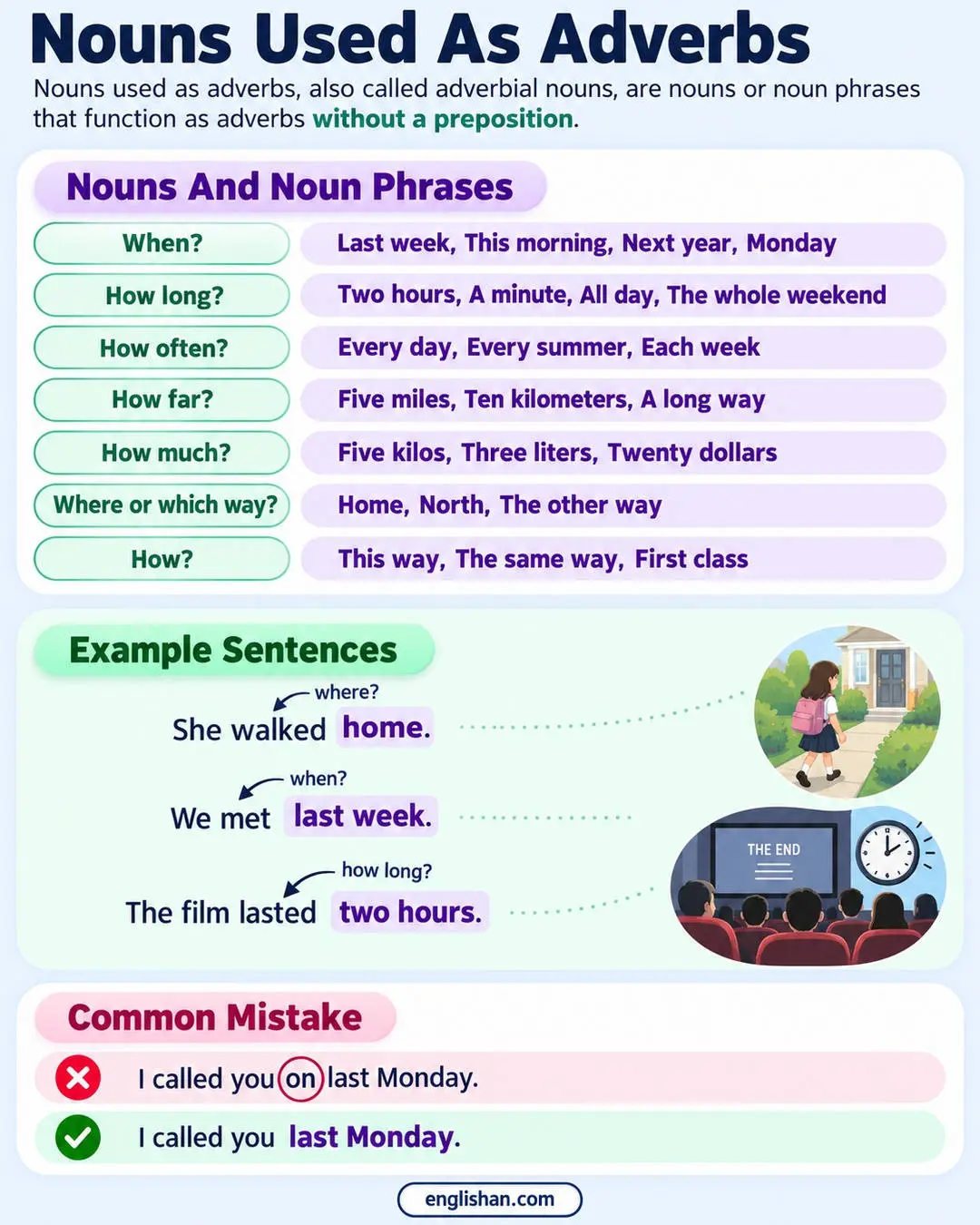
What Are Nouns Used As Adverbs?
A noun used as an adverb is a noun or noun phrase that modifies a verb, an adjective, or another adverb, with no preposition to link it to the sentence. It answers the same questions as an ordinary adverb, and the question it answers shows its meaning.
| Question | Nouns and noun phrases |
|---|---|
| When? | Last week, this morning, next year, Monday |
| How long? | Two hours, a minute, all day, the whole weekend |
| How often? | Every day, every summer, each week |
| How far? | Five miles, ten kilometers, a long way |
| How much? | Five kilos, three liters, twenty dollars |
| Where or which way? | Home, north, the other way |
| How? | This way, the same way, first class |
The word in these phrases is still a noun in form. It can take “the”, “a”, “this”, or “every” before it, an adjective such as “whole” or “long”, and a plural ending, as in “three long days”. The adverb “quickly” takes none of these, so “week” in “last week” is a noun that functions as an adverb, not a new adverb. A noun can also function as an adjective, as in “a kitchen table”, but there it comes before another noun and describes it, so it is one of the nouns as adjectives and follows different rules.
The same noun phrase can be an object in one sentence and an adverb in the next. To find the function, ask the question the noun phrase answers after the verb:
- We walked the dog. (object: what?)
- We walked five miles. (adverb: how far?)
- He enjoyed the evening. (object: what?)
- He worked all evening. (adverb: how long?)
Examples Of Nouns Used As Adverbs
Nouns used as adverbs mostly express time, duration, frequency, distance, measurement, direction, and manner. They usually come at the end of the clause, after the verb and any object, though a time phrase can also open the sentence.
Time: A time noun answers “when?” in the same way as adverbs of time such as “yesterday” and “soon”, and it usually starts with “last”, “next”, “this”, or “every”.
- We moved to Denver last spring.
- This morning the trains were twenty minutes late.
- My sister starts her new job next month.
Duration: A noun phrase of duration answers “how long?” and often follows “wait”, “last”, “stay”, or “take”.
- Wait a minute, please.
- The meeting lasted two hours.
- We stayed with my grandparents the whole summer.
Frequency: A phrase with “every” or “each” answers “how often?” for an action that happens at regular times.
- She calls her mother every Sunday.
- The airport bus leaves every twenty minutes.
Distance: A distance noun answers “how far?” after verbs of movement like “walk”, “run”, “drive”, and “swim”.
- I run five kilometers before work.
- They drove four hundred miles on the first day.
Measurement and weight: After “weigh”, “cost”, and “measure”, a noun phrase of quantity answers “how much?”.
- The suitcase weighs twenty kilos.
- This jacket cost eighty dollars in the sale.
- The kitchen measures four meters across.
Direction and manner: Compass points and phrases with “way” answer “which way?” or “how?”, close in meaning to adverbs of place and adverbs of manner.
- The road runs north along the coast.
- Turn the handle the other way.
- Fold the paper this way, not like that.
- They traveled first class to Rome.
Time Nouns Without A Preposition
A time noun that begins with “last”, “next”, “this”, “that”, “every”, or “all” takes no “on”, “in”, or “at” before it. The word before the noun already shows which day, week, or year is meant, so a preposition of time is not needed.
- I saw her last Friday.
- The new parking rules start next year.
- Are you free this afternoon?
- He goes swimming every morning.
- It rained all weekend, so we stayed in.
The same nouns take a preposition when no such word comes before them: “on Friday”, “in the afternoon”, “at night”. The words “yesterday”, “today”, “tomorrow”, and “tonight” take no “on”, “in”, or “at” either. Prepositions with other meanings still come before all of these phrases, as in “by next Friday”, “since last week”, and “until tomorrow”.
I called you on last Monday. ❌
I called you last Monday. ✅
A phrase with “last” already tells us when, so no preposition comes before it.
The error is an over-applied rule: “on” before a day is correct, but not once “last” or “next” comes before the day. The Russian phrases for ‘last week’ and ‘last Monday’ begin with a preposition, so “on last week” and “in last Monday” are word-for-word translations of that pattern.
With “the”: When “the” comes before “last” or “next”, the preposition returns. The phrase “the last Friday of the month” names one Friday in a series, and “the last week” means the seven days up to now.
- We meet on the last Friday of every month.
- I’ve slept badly in the last week. (the seven days up to now)
- I slept badly last week. (the calendar week before this one)
Day names: In informal American English, “on” is often dropped before a plain day name too, as in “See you Monday.” In formal writing and in British English, “on Monday” is the usual form.
Home Vs At Home
After a verb of movement, “home” functions as an adverb and takes no preposition. The verbs that take it this way include “go”, “come”, “get”, “walk”, “drive”, and “send”.
- What time did you get home last night?
- The kids walk home from school together.
- Can you drive me home after the party?
The word “home” is also one of the adverbs of movement, with “abroad” and “upstairs”, and they share the rule of no “to” before them. After “be” and “stay”, the choice changes, because the verb gives a location rather than a direction. Both “home” and “at home” are correct there, and “stay home” is more common in American English, “stay at home” in British English.
- Is anyone home?
- I’m staying at home tonight.
- She stayed home with a cold.
Only “to” drops out before “home”. The preposition “from” stays, as in “work from home” and “far from home“.
Once “home” has a determiner or an adjective before it (“my”, “a”, “her parents'”, “new”), it is an ordinary noun again and takes a preposition after a verb of movement.
- We drove to my parents’ home for the holidays.
- They moved into a bigger home last year.
I went to home early yesterday. ❌
I went home early yesterday. ✅
Without “my”, “a”, or another word before it, “home” takes no “to” after a verb of movement.
The Spanish phrase “ir a casa” keeps a preposition before the word for ‘home’, so “go to home” is a direct translation. Another case looks similar but is different: in “She left home at eighteen”, “home” is the object of “leave”, because it answers the question “what did she leave?”.
Noun Phrases As Adverb Modifiers
A noun phrase of measurement can also modify an adjective or an adverb. It comes directly before that word and tells us how much: how old, how long, how late, or how much more, in the way adverbs of degree such as “very” and “too” modify an adjective.
- Our daughter is ten years old.
- The new bridge is two kilometers long.
- The train arrived twenty minutes late.
- My brother is three years older than me.
- She got to the airport an hour early.
The noun phrase can also come before a preposition or a conjunction, as in “a week before the wedding” and “two days after she left”. It answers the same question there: how long before, or how long after.
The flight landed late two hours. ❌
The flight landed two hours late. ✅
The noun phrase comes before “late”, not after it; with “by”, the order changes to “late by two hours”.
The second common error is with age. We state age with “be” and, where the unit is given, with “years old” after the number.
I have twenty-five years. ❌
I am twenty-five years old. ✅
The Spanish “tengo veinticinco años” and the French “j’ai vingt-cinq ans” use the verb for ‘have’, which is the source of “I have twenty-five years”. Before a noun, the same phrase becomes a hyphenated adjective with a singular noun, so we write “a ten-year-old girl”, not “a ten-years-old girl”.
FAQs
No, a noun stays a noun in form, but it can function as an adverb in a sentence. In "We met last week", "week" is still a noun with "last" before it, and the phrase "last week" tells us when, so it functions as an adverb of time.
Yes, and most nouns used as adverbs are noun phrases rather than single nouns. Phrases such as "every evening", "the whole weekend", and "five kilometers" function as an adverbial that tells us when, how long, or how far. Adverbials that start with a preposition, such as "after dinner", are adverbial prepositional phrases instead.
Both labels are correct, depending on the function of the word in the sentence. In "Tomorrow is a holiday", "tomorrow" is the subject, so it is a noun. In "I’ll call you tomorrow", it tells us when, so it functions as an adverb.
Some plural time nouns function as adverbs in everyday English, as in "She works nights", meaning ‘every night’. Day names follow the same pattern in informal American English, as in "The shop is closed Sundays". In formal writing, "on Sundays" is the usual form.
Related:
- Types of Adverbs
- Parts of Speech
- Adverbial Phrases
- What Questions Do Adverbs Answer
- Time Expressions
