

An adverb modifies a verb, and on a CV the verb is what a reader scans first. A recruiter reads the number and not the adverb, so cut the monthly close from nine days to four beats efficiently reduced the monthly close every time. The strong verbs and adverbs for work therefore split by destination rather than by tone. A reference needs conscientiously and tactfully because conduct is what it is for, and a CV line needs a verb and a measurement instead.
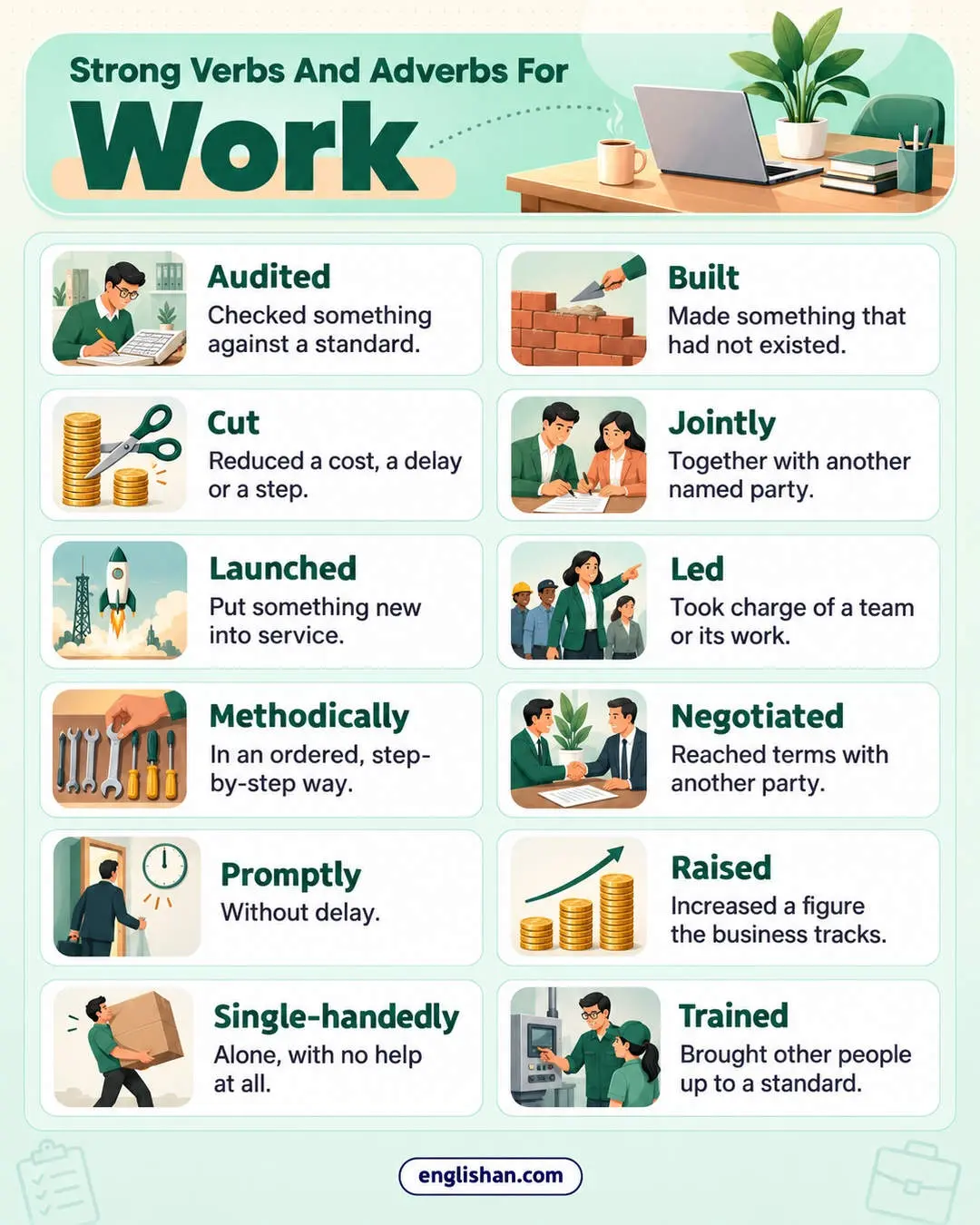
Strong Verbs and Adverbs for Work
A verb outweighs any adverb on a CV line, because it states the result rather than the activity. These twelve strong verbs and adverbs for work cover the claims an employer reads for, and all of them invite a figure straight after. The strong verbs and adverbs for work on this page sit under the destination they suit rather than under a meaning.
| Adverb | Meaning | In a sentence |
|---|---|---|
| Led | Took charge of a team or a piece of work. | Led a crew of nine through the depot rebuild. |
| Built | Made something that had not existed. | Built the reporting pack the finance team now runs on. |
| Cut | Reduced a cost, a delay or a step. | Cut the monthly close from nine days to four. |
| Raised | Increased a figure the business is judged on. | Raised renewal rates from 71 to 84 per cent. |
| Rebuilt | Replaced something broken with something that works. | Rebuilt the dispatch rota after two years of overtime claims. |
| Negotiated | Reached terms with another party. | Negotiated the haulage contract down by eleven per cent. |
| Trained | Brought other people up to a standard. | Trained fourteen apprentices on the new press. |
| Recovered | Brought something back from a bad position. | Recovered the account after two missed deliveries. |
| Simplified | Removed steps without losing the result. | Simplified the sign-off from five approvals to two. |
| Audited | Checked something thoroughly against a standard. | Audited every supplier contract in the first quarter. |
| Launched | Put something new into service. | Launched the second shift inside six weeks. |
| Resolved | Closed a dispute or a fault for good. | Resolved the backlog of 340 open tickets. |
Led and built are the strongest of the twelve, since both point to something that did not exist or did not function before.
Adverbs That Add a Fact to a Work Sentence
These are the strong verbs and adverbs for work that survive on a CV, because every one adds something checkable. Ahead, under budget and single-handedly each report a condition the sentence would otherwise leave out.
| Adverb | Meaning | In a sentence |
|---|---|---|
| Accurately | Without error in the detail. | Forecast demand accurately for six quarters running. |
| Ahead | In front of the agreed date. | Delivered the migration three weeks ahead of plan. |
| Consistently | To the same standard every time. | Consistently cleared the weekly backlog by Thursday. |
| Independently | Without direction from others. | Ran the second depot independently for eleven months. |
| Jointly | Together with another named party. | Jointly owned the audit with the finance lead. |
| Manually | By hand, where a system had been expected. | Reconciled the ledger manually until the import was fixed. |
| Promptly | Without delay. | Answered escalations promptly within the two-hour window. |
| Simultaneously | At the same time as something else. | Ran the rebuild and the audit simultaneously. |
| Single-handedly | Alone, with no help at all. | Covered the dispatch desk single-handedly over Christmas. |
| Under budget | Beneath the money allowed. | Completed the fit-out eleven per cent under budget. |
Independently and single-handedly are not the same, since the first reports no supervision and the second reports no help.
Adverbs That Weaken a CV Line
Among the strong verbs and adverbs for work, eight adverbs turn up on CVs more than the rest and take something away from every line they sit on. The fault is the same in all eight, since they claim a quality instead of showing it.
| Adverb | Meaning | In a sentence |
|---|---|---|
| Very | Adds nothing a reader is able to check. | Very in front of quickly tells a reader nothing measurable. |
| Really | Reads as filler in formal writing. | Really improved says less than a figure would. |
| Extremely | Inflates without evidence. | Extremely successful invites the question how. |
| Highly | Vague unless a named standard follows. | Highly motivated is a claim with nothing behind it. |
| Successfully | Already implied by the verb. | Successfully delivered says what delivered says. |
| Effectively | Hides the result it claims. | Effectively managed leaves the outcome unstated. |
| Efficiently | Needs a number to mean anything. | Efficiently reduced should carry the percentage. |
| Proactively | Reports activity with no result attached. | Proactively engaged is activity without a result. |
- Cut the monthly close from nine days to four.
- Raised renewal rates from 71 to 84 per cent.
- Trained fourteen apprentices on the new press.
- Delivered the migration three weeks ahead of plan.
- Completed the fit-out eleven per cent under budget.
A figure reaches what the adverb was reaching for, so the repair is a number rather than a different adverb.
- Successfully and efficiently reduced the monthly close ❌
- Cut the monthly close from nine days to four ✅
Successfully stands out among the eight, since a verb on a CV is already a claim of success and the word adds nothing to it.
- Successfully delivered the depot rebuild ❌
- Delivered the depot rebuild four weeks early ✅
Adverbs for an Appraisal or a Reference
A reference does the opposite job from a CV. No figure exists for conduct, so the adverb is the only place the judgement sits, and these twelve strong verbs and adverbs for work carry it.
| Adverb | Meaning | In a sentence |
|---|---|---|
| Candidly | Openly, with nothing held back. | She raises bad news candidly and early. |
| Capably | With enough skill for the task. | He covered the depot capably at short notice. |
| Collaboratively | By working jointly with others. | She drafts specifications collaboratively with the floor. |
| Conscientiously | With care taken over every duty. | He keeps the maintenance log conscientiously. |
| Considerately | With thought for the people affected. | She announced the closure considerately. |
| Constructively | So as to build rather than tear down. | He criticises a draft constructively. |
| Courteously | With formal politeness. | She turns away cold callers courteously. |
| Diligently | With steady, careful effort. | He works through the audit queries diligently. |
| Methodically | In an ordered, step-by-step way. | She clears a fault list methodically. |
| Reliably | Without failing, time after time. | He opens the yard reliably at six. |
| Resourcefully | By finding a way with what is to hand. | She patched the line resourcefully during the outage. |
| Tactfully | With care not to give offence. | He raises an underperformance tactfully. |
Conscientiously is the strongest word in a reference, because it reports care taken over duties nobody was checking.
Strong Verb and Adverb Pairs
Where an adverb does belong on a work line, the pairing has to be exact. A vague adverb on a strong verb weakens both, and the strong verbs and adverbs for work that hold up are the pairs where the adverb answers a question the verb raises.
| Verb | Adverb that holds | Why it works |
|---|---|---|
| Delivered | Ahead of plan | Answers when, with a date behind it |
| Ran | Independently | Answers who supervised, which was nobody |
| Covered | Single-handedly | Answers how many people, which was one |
| Completed | Under budget | Answers what it cost against the allowance |
| Forecast | Accurately | Answers whether the figures held |
| Cleared | Consistently | Answers at what rate, over a stated period |
- Delivered the migration ahead of plan.
- Ran the second depot independently for eleven months.
- Covered the dispatch desk single-handedly over Christmas.
- Forecast demand accurately for six quarters running.
- Consistently cleared the weekly backlog by Thursday.
An adverb answering none of those questions takes up space a figure would use better.
- Effectively ran the second depot for eleven months ❌
- Ran the second depot independently for eleven months ✅
Adverbs for Work by First Letter
The letter pages set out the conduct adverbs for their own letter with a meaning and a sentence apiece. Most of them start with C, since the Latin con- prefix forms words about working alongside other people.
A · B · C · D · I · K · L · M · N · R · S · T · V
Strong verbs and adverbs for work pull in opposite directions depending on the document. A CV takes the verb and the number, and a reference takes the adverb, because conduct is the one thing no figure shows.
Related:
- Adverbs Ending in LY
- Adverb Examples
- Adverbs of Manner
- Adverbs of Time
- Adverbs of Frequency
- Adverbs of Place
- Adverbs of Degree
- Types of Adverbs
- Relative Adverbs
- Adverbs of Reason
FAQs
Sparingly, and only where the adverb adds a fact. Among the strong verbs and adverbs for work, ahead of plan, under budget, independently and single-handedly all report something checkable, while successfully, effectively and efficiently claim a quality without showing it. A figure beats an adverb on any CV line that has room for one.
Led, built, cut, raised, rebuilt, negotiated, trained, recovered, simplified, audited, launched and resolved each name a result rather than an activity. All twelve invite a number straight after them, which is what puts them ahead of managed or assisted.
Very, really, extremely, highly, successfully, effectively, efficiently and proactively. All eight claim a quality the line was supposed to demonstrate, and a reader who meets them discounts the claim rather than believing it.
Conscientiously, candidly, capably, collaboratively, considerately, constructively, courteously, diligently, methodically, reliably, resourcefully and tactfully. A reference has no figures to fall back on, so these strong verbs and adverbs for work are where the judgement about conduct has to sit.
Independently reports that nobody supervised the work, and single-handedly reports that nobody helped with it. Somebody runs a depot independently with a team of six, and covers a desk single-handedly under close supervision.
At the end, after the verb and its object, or at the front when it governs the whole line. Delivered the migration ahead of plan puts it at the end, and consistently cleared the weekly backlog puts it at the front. The one position to rule out is between the verb and the object.
