

An adverb modifies a verb, an adjective or another adverb, and that modification is visible only inside a sentence. A word on its own leaves that relation invisible, which is why the adverb examples here all come with the sentence they modify. Softly on its own states a manner, while she closed the door softly attaches it to an action. Almost every adverb in use falls under one of five classes: manner, time, frequency, place and degree.
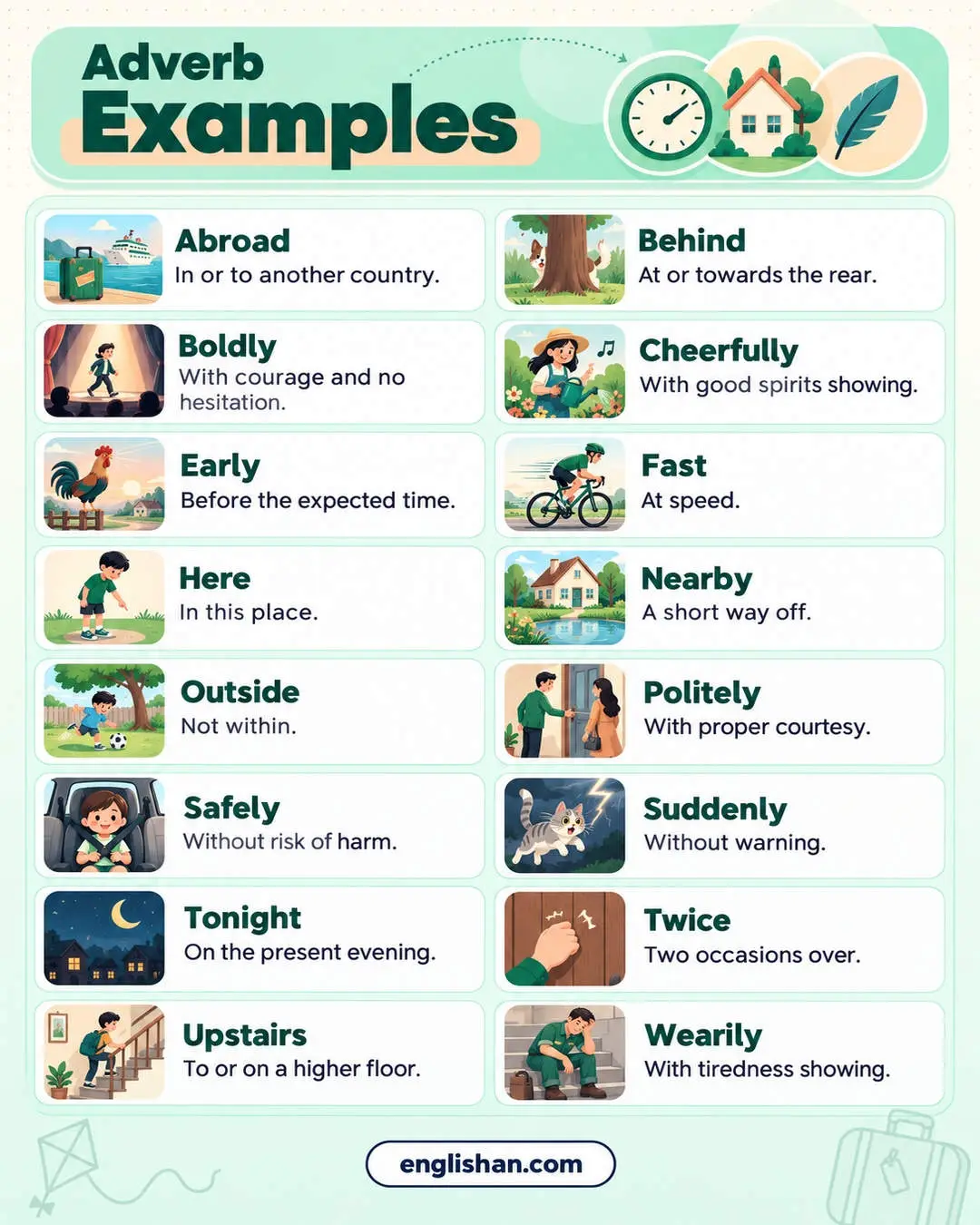
10 Adverb Examples: The Most Common Adverbs
These ten are the most used adverbs in English, and only two of them take the -ly ending. A reader who meets adverbs for the first time meets these before any of the longer words.
| Adverb | Meaning | In a sentence |
|---|---|---|
| Not | Denying the verb beside it. | The flue was not lined before the survey. |
| Very | To a high degree. | The lintel is very much older than the porch. |
| So | To that extent. | The hall was so cold that nobody took a coat off. |
| Too | More than is wanted. | The lane is too narrow for a lorry. |
| Now | At this present moment. | The surveyor is here now. |
| Then | At that time, or next in order. | Fit the gasket, then tighten the bolts. |
| Also | As well as that. | The gable also needs repointing. |
| Just | By a small margin, or only. | The beam just clears the frame. |
| Only | Picking out one part and no other. | Only the north wall was repointed. |
| Well | In a good way. | He reads well for his age. |
Not, very and so are used more between them than the whole of the manner class, which is why a definition built on the -ly ending misses the commonest adverb examples in the language.
Manner Adverbs: How Something Was Done
Manner answers the question how, and it is the largest class of adverb examples on the page. The standard position is after the verb, or after the object where the verb takes one.
| Adverb | Meaning | In a sentence |
|---|---|---|
| Badly | To a poor standard. | The flashing was fitted badly. |
| Boldly | With courage and no hesitation. | The scheme was costed boldly. |
| Calmly | Without agitation. | She read out the verdict calmly. |
| Carefully | With attention paid to avoiding error. | Lift the frame carefully at both corners. |
| Carelessly | Without the attention the work needed. | The valve was fitted carelessly. |
| Cheerfully | With good spirits showing. | He took the extra shift cheerfully. |
| Clearly | With nothing left obscure. | The terms are set out clearly on page two. |
| Easily | Without difficulty. | The sash lifts easily once the cord is renewed. |
| Fast | At speed. | The red car went fast down the hill. |
| Gently | With a light, kind touch. | Lower the glass gently onto the bed. |
| Hard | Using effort or force. | The crew worked hard through the frost. |
| Loudly | With a lot of noise. | The alarm sounded loudly across the yard. |
| Neatly | Tidily, with a close fit. | The joint was finished neatly. |
| Patiently | Without complaint at the waiting. | The crew sat patiently through the squall. |
| Politely | With proper courtesy. | The request was refused politely. |
| Quickly | At speed. | The frost cleared quickly after nine. |
| Quietly | With little sound. | She closed the vestry door quietly. |
| Safely | Without risk of harm. | The climbers reached the ledge safely. |
| Slowly | At a low speed. | Read the clause slowly and then sign it. |
| Softly | With a gentle, low touch. | She closed the door softly. |
| Suddenly | Without warning. | The line went dead suddenly. |
| Tightly | Firmly, with no looseness. | The lid was screwed tightly onto the drum. |
| Wisely | With good judgement. | They booked the earlier crossing wisely. |
Fast and hard sit here without an ending, and neither has an -ly form that means the same thing. The whole class is set out under adverbs of manner.
Adverb Examples of Time
Time answers the question when, and most of these adverb examples stand at either end of the clause. Yet is the one with a restriction, since it belongs to a question or a negative and nowhere else.
| Adverb | Meaning | In a sentence |
|---|---|---|
| Afterwards | At a later time. | The deeds were registered afterwards. |
| Already | Before now. | The frost had already lifted. |
| Early | Before the expected time. | The frost came early that year. |
| Eventually | In the end, after a delay. | The grant came through eventually. |
| Finally | At the last. | The deeds were registered finally in 1974. |
| Immediately | At once, with no gap. | Shut the valve immediately. |
| Lately | In the recent past. | The lock has been rebuilt lately. |
| Late | After the expected time. | The surveyor arrived late. |
| Recently | In the near past. | The weir was recently rebuilt. |
| Soon | After a short time. | The results will be published soon. |
| Still | Up to now, with no change. | The kettle is still boiling. |
| Today | On this present day. | The scaffold comes down today. |
| Tomorrow | The day after this one. | The crossing is booked for tomorrow. |
| Tonight | On the present evening. | The gates close early tonight. |
| Yesterday | One day back from today. | The beans went in yesterday. |
| Yet | So far, in questions and negatives. | The deeds have not arrived yet. |
Late and lately are not the same, since a surveyor who arrived late was behind time and a lock rebuilt lately was rebuilt recently. More under adverbs of time.
Frequency Adverbs: How Often It Happens
Frequency answers how often, and these adverb examples go in front of the main verb. After an auxiliary or a form of to be, the word moves in behind it.
| Adverb | Meaning | In a sentence |
|---|---|---|
| Always | At all times, without fail. | The tide reaches the steps always by nine. |
| Annually | Once a year. | The gutters are cleared annually. |
| Constantly | All the time, without break. | The alarm chirped constantly until replaced. |
| Daily | Once in each day. | The gauge is read daily. |
| Frequently | Many times over a period. | The lane floods frequently in October. |
| Hourly | Once an hour. | The levels are logged hourly. |
| Monthly | Once a month. | The gauges are read monthly. |
| Never | On no occasion. | The deeds were never registered. |
| Occasionally | Now and then. | The weir overtops occasionally. |
| Often | Many times. | It often rains in April. |
| Once | A single occasion. | The weir was raised once, in 1904. |
| Rarely | On very few occasions. | The upper gallery is rarely used. |
| Seldom | On few occasions. | The tower is seldom open. |
| Sometimes | Some occasions and not others. | Sometimes the signal drops near the tunnel. |
| Twice | Two occasions over. | The gauge was read twice before the shift. |
| Usually | Most of the time. | The weir usually holds until February. |
| Weekly | Once a week. | The bins go out weekly. |
Always, usually, often, sometimes, rarely and never make a ladder from the top of the scale to the bottom, as adverbs of frequency sets out.
Adverb Examples of Place
Place answers where, and hardly any of these adverb examples take an ending at all. A place word follows the verb, and it comes after a manner word where the two stand together.
| Adverb | Meaning | In a sentence |
|---|---|---|
| Abroad | In or to another country. | The timber was sourced abroad. |
| Ahead | In front, or further on. | The lane narrows ahead of the ford. |
| Away | At or to a distance. | The silt was carted away. |
| Back | Towards the place of origin. | Put the ledger back on the shelf. |
| Behind | At or towards the rear. | The bucket was left behind. |
| Downstairs | Down to a lower floor. | The meters are downstairs under the hall. |
| Everywhere | In all places. | Leaves were everywhere after the storm. |
| Here | In this place. | Leave the ledger here on the bench. |
| Indoors | Inside a building. | The pots were brought indoors in October. |
| Inside | Within something. | The frames were stored inside. |
| Nearby | A short way off. | A second gate opens nearby. |
| Nowhere | No place at all. | The lane leads nowhere beyond the ford. |
| Outside | Not within. | We ate outside at the long table. |
| Somewhere | Some place not named. | The deeds are filed somewhere in the attic. |
| There | At that place, away from you. | The nest is up there. |
| Upstairs | To or on a higher floor. | The library is upstairs. |
Here and there are the two a reader meets first and the two least recognised as adverbs. More under adverbs of place.
Degree Adverbs: How Much or How Far
Degree answers how much, and these adverb examples sit immediately in front of the word they measure. The class holds the most used adverb in English in very, along with the comparison words more, most, less and least.
| Adverb | Meaning | In a sentence |
|---|---|---|
| Almost | Very nearly. | The lintel is almost two metres long. |
| Barely | Only just, with nothing to spare. | The lintel barely clears the frame. |
| Completely | In full, with nothing left out. | The ledger was completely rewritten. |
| Enough | To the degree needed. | The mortar had not set enough. |
| Entirely | Wholly, with no part excepted. | The wall was rebuilt entirely. |
| Extremely | At the furthest degree. | The flue is extremely narrow for its height. |
| Fairly | To a moderate degree. | The engine ran fairly well after the service. |
| Hardly | Almost not at all. | There is hardly room for two chairs. |
| Least | To the smallest degree. | The south wall suffers least. |
| Less | To a smaller amount. | The flue draws less in a west wind. |
| More | By a greater amount. | The flue draws more in an east wind. |
| Most | To the greatest degree. | The north wall suffers most in winter. |
| Much | A great deal, as a measure. | The second kiln fires much hotter. |
| Nearly | Almost, but not quite. | The lintel is nearly two metres long. |
| Quite | Considerably, or entirely. | The cellar was quite dry by March. |
| Rather | To a moderate degree. | The hall was rather colder than the kitchen. |
| Scarcely | Barely, and only just. | The spring scarcely runs by August. |
| Slightly | To a small degree. | The floor slopes slightly towards the door. |
| Thoroughly | Completely, with nothing skipped. | The flue was swept thoroughly. |
| Totally | In full, with nothing excepted. | The schedule was totally rewritten. |
Very refuses a plain verb, so the schedule very slipped is wrong and much or greatly goes in that slot instead, as adverbs of degree sets out.
Descriptive Adverbs: Which Examples Describe Best
A descriptive adverb adds a picture rather than a measurement, which puts almost all of the descriptive adverb examples in the manner class. Stealthily, gently and neatly change what a reader sees, while very and quite change only a quantity.
| Adverb | What a reader pictures |
|---|---|
| Stealthily | Somebody moving to avoid being heard |
| Gently | A touch light enough not to mark anything |
| Abruptly | A movement that stops with no warning |
| Neatly | Edges that line up and nothing left over |
| Wearily | Shoulders down, and the end of a long day |
| Calmly | A voice unchanged while everything else moves |
- The fox moved stealthily along the hedge.
- Lower the glass gently onto the bed.
- The line ended abruptly at the fence.
- The joint was finished neatly.
- He folded the chart wearily.
The test for a descriptive adverb is whether a reader sees anything new, and a degree word never passes it.
- The door closed very ❌
- The door closed softly ✅
Position of Adverbs in a Sentence
Position follows the class, which is the practical reason for learning the five. Almost all of the adverb examples here are covered by three rules.
- A manner, place or time word follows the verb, or the object where there is one.
- Frequency words go in front of the main verb and after an auxiliary.
- Degree words sit immediately in front of what they measure.
Where two stand together, manner comes before place, and place comes before time.
- The fox moved stealthily along the hedge at dusk.
- She read the clause slowly in the vestry that morning.
The position to rule out is between the verb and its object, where the adverb separates a pair that belongs together.
- She closed softly the door ❌
- She closed the door softly ✅
All five classes and their slots are mapped under the types of adverbs.
Adverb Examples by First Letter
The letter pages set out the adverb examples for their own starting letter, all with a meaning and a sentence apiece.
A · B · C · D · I · K · L · M · N · R · S · T · V
Adverb examples demonstrate what a word list leaves out, because the sentence is where the class becomes visible. A reader who knows which of the five classes a word belongs to will place it correctly without being given a rule for it.
Related:
- Adverbs Ending in LY
- Adverbs That Do Not End in LY
- Adverbs for Kids
- Relative Adverbs
- Adverbs of Reason
FAQs
They are adverbs shown in the sentences they modify, since the word reveals its job only once a verb stands beside it. She closed the door softly holds one, and softly is the adverb because it reports how the door was closed.
Not, very, so, too, now, then, also, just, only and well are the ten most used adverbs in English. Only two of the ten take the -ly ending, which is why a definition built on that ending misses the commonest ones.
Not, very and so lead by a wide margin, followed by too, now, then, also, just, only and well. Those three are used more between them than the whole manner class, and none of the ten is built from an adjective with -ly.
Adverbs that add a picture rather than a measurement, which puts almost all of the adverb examples in the manner class. Stealthily, gently, abruptly and wearily each change what a reader sees, while very and quite change only a quantity.
Take five adverb examples from each of four classes. Manner gives carefully, quickly, quietly, softly and badly. Time gives now, soon, already, recently and yesterday. Frequency gives always, often, sometimes, rarely and never. Degree gives very, too, almost, quite and slightly.
A manner, place or time word follows the verb, or the object where there is one. A frequency word goes in front of the main verb, and a degree word sits immediately in front of what it measures. The one slot to avoid is between the verb and its object.
