

An adverb is a word that describes a verb, which is the action word in a sentence. The dog ran is a whole sentence, and the dog ran quickly adds something about the running. Most adverbs for kids answer one of three questions: how, when or where. A child who learns to ask those three questions of a sentence will find the adverb in it without being told which word to look for.
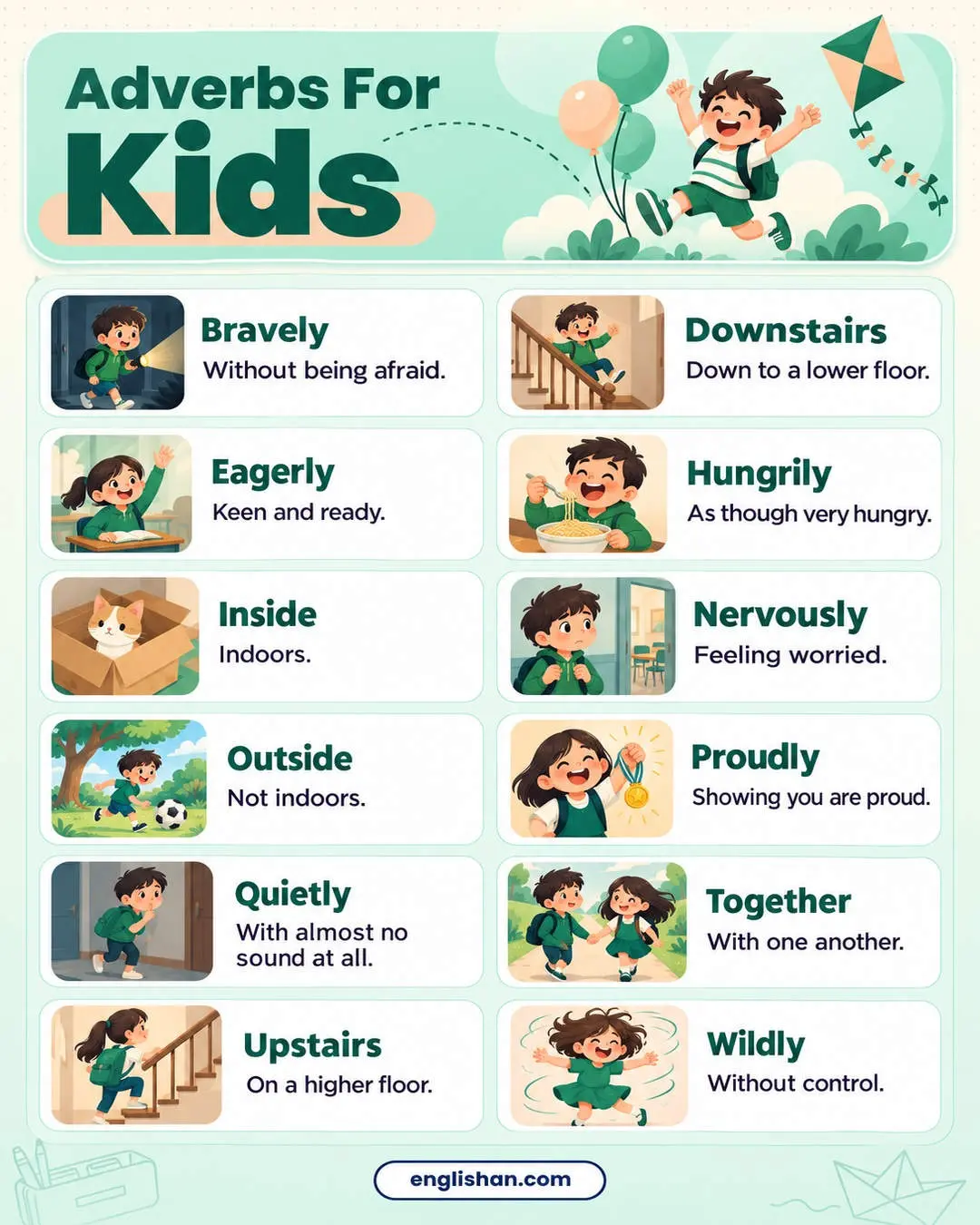
Adverbs for Kids in Year 2 and Year 3
These are the adverbs for kids who are just meeting the word. All twelve sit in a seven-year-old’s speech already, which makes the lesson a matter of naming them rather than teaching them.
| Adverb | Meaning | In a sentence |
|---|---|---|
| Quickly | Fast, in a short time. | The dog ran quickly across the field. |
| Slowly | Not fast. | The snail moved slowly up the wall. |
| Loudly | With a big sound. | The baby cried loudly in the night. |
| Quietly | With almost no sound at all. | We walked quietly past the sleeping cat. |
| Happily | In a happy way. | She skipped happily to the gate. |
| Sadly | Feeling sad about it. | He put the broken kite down sadly. |
| Carefully | With care, so nothing breaks. | Carry the eggs carefully to the kitchen. |
| Neatly | Tidily, with straight edges. | Write your name neatly at the top. |
| Kindly | In a kind way. | She spoke kindly to the new boy. |
| Badly | Not well. | The team played badly in the rain. |
| Well | In a good way. | He reads well for his age. |
| Fast | At speed. | The red car went fast down the hill. |
Well, fast and badly are worth pointing out early, since well and fast have no -ly ending and children expect one.
Harder Adverbs for Year 3 and Year 4
These twelve go a step further, and all of them add a feeling to the action. A child who writes he slammed the door angrily has told the reader about the mood and not only the door.
| Adverb | Meaning | In a sentence |
|---|---|---|
| Angrily | In an angry way. | He slammed the door angrily. |
| Bravely | Without being afraid. | She bravely held the ladder. |
| Brightly | With a lot of light. | The sun shone brightly all morning. |
| Easily | Without any trouble. | He lifted the box easily. |
| Gently | With a soft touch. | Stroke the rabbit gently. |
| Hungrily | As though very hungry. | The puppy ate hungrily. |
| Politely | With good manners. | She asked politely for a second cake. |
| Proudly | Showing you are proud. | He proudly showed us the model. |
| Safely | With no danger. | The class crossed the road safely. |
| Suddenly | All at once, with no warning. | Suddenly the lights went out. |
| Together | With one another. | The twins sang together. |
| Wildly | Without control. | The flag flapped wildly in the wind. |
Bravely and proudly suit story writing best of these adverbs for kids, because both tell the reader about the character rather than the movement.
Adverbs for Year 5 and Year 6
By Year 5 a child is ready for adverbs with a shade of meaning rather than a plain one. Cautiously is not the same as slowly, because cautiously tells the reader a risk was there.
| Adverb | Meaning | In a sentence |
|---|---|---|
| Awkwardly | Clumsily, not smoothly. | He climbed awkwardly over the fence. |
| Cautiously | Carefully, because of a risk. | She opened the gate cautiously. |
| Eagerly | Keen and ready. | The team waited eagerly for the result. |
| Frantically | In a panicky rush. | They searched frantically for the missing boot. |
| Furiously | With very great anger. | The wasp buzzed furiously at the glass. |
| Gradually | Bit by bit, over time. | The water gradually drained away. |
| Nervously | Feeling worried. | He read his poem nervously. |
| Occasionally | Now and then. | We occasionally see a kingfisher there. |
| Reluctantly | Not wanting to. | She reluctantly gave back the book. |
| Silently | With no sound at all. | The owl flew silently over the yard. |
| Stubbornly | Refusing to change. | The lid stayed stubbornly shut. |
| Thoughtfully | Thinking about it, or about others. | He answered thoughtfully. |
Gradually and occasionally are the two to teach together, since one is about speed and the other is about how many times.
Adverbs of Time for Kids
These adverbs for kids answer the question when or how often. A frequency word such as always or never goes in front of the action word, and a child applies that rule straight away.
| Adverb | Meaning | In a sentence |
|---|---|---|
| Always | At all times, without fail. | I always brush my teeth before bed. |
| Usually | Most of the time. | We usually walk to school. |
| Often | Many times. | It often rains in April. |
| Sometimes | Now and then. | Sometimes we take the bus. |
| Never | Not at any time. | She never forgets her lunch box. |
| Daily | Once in each day. | The hamster is fed daily. |
| Weekly | Once a week. | We have swimming weekly. |
| Yesterday | On the day before today. | We planted the beans yesterday. |
| Today | This day, the one we are in. | Today we are painting. |
| Tomorrow | On the day after today. | The trip is tomorrow. |
| Soon | In a short while. | The bell will ring soon. |
| Now | At this moment. | Line up now, please. |
Always, usually, often, sometimes and never make a ladder, and a class puts them in order from the top of it to the bottom.
Adverbs of Place for Kids
These answer the question where, and hardly any of them takes an -ly ending, which surprises a child who has just learned that ending. A place adverb comes after the action word.
| Adverb | Meaning | In a sentence |
|---|---|---|
| Here | In this place. | Put your bag here. |
| There | At that place, away from you. | The nest is up there. |
| Everywhere | In all places. | Leaves were everywhere after the storm. |
| Outside | Not indoors. | We ate outside at lunchtime. |
| Inside | Indoors. | The guinea pig sleeps inside. |
| Upstairs | On a higher floor. | The library is upstairs. |
| Downstairs | Down to a lower floor. | The hall is downstairs. |
| Nearby | Close to this place. | A farm stands nearby. |
| Away | To another place. | The cat ran away. |
| Back | To the place it came from. | Put the book back on the shelf. |
Here and there are the first two a child says and the last two they count as adverbs for kids, which makes them a good opening question in a lesson.
How to Find the Adverb in a Sentence
The quickest method with adverbs for kids is to find the action word first and then ask it three questions. The answer to how, when or where is the adverb, and a sentence that answers none of the three has no adverb in it.
| Question to ask | Sample sentence | The adverb |
|---|---|---|
| How? | The dog ran quickly across the field | Quickly |
| When? | We planted the beans yesterday | Yesterday |
| Where? | Put your bag here | Here |
| How often? | It often rains in April | Often |
| No answer | The dog ran across the field | None |
- The dog ran quickly across the field.
- We planted the beans yesterday.
- Put your bag here, please.
- It often rains in April.
- She spoke kindly to the new boy.
The commonest mistake in a classroom is picking the describing word in front of a noun, which is an adjective and not an adverb at all.
- The quick dog ran across the field, so quick is the adverb ❌
- The dog ran quickly across the field, so quickly is the adverb ✅
Adverb Games for Kids
Both of these need nothing but a list of verbs, so a whole class does them together. The point of each is to make a child hear the adverb change the picture rather than learn a definition.
| Game | How it runs | What it teaches |
|---|---|---|
| Walk the word | A child walks across the room as a drawn adverb tells them | The adverb changes the action, not the actor |
| Swap the adverb | Change only the adverb in one sentence, five times over | One word moves the mood of a sentence |
| Adverb | The sentence it makes |
|---|---|
| Quietly | She closed the door quietly |
| Angrily | She closed the door angrily |
| Slowly | She closed the door slowly |
| Carefully | She closed the door carefully |
| Suddenly | She closed the door suddenly |
One sentence in five versions shows a child what no definition will, since only the adverb changed and the whole picture moved with it.
Adverbs for Kids by First Letter
The letter pages set out the adverbs for their own starting letter with a meaning and a sentence apiece. The simpler words in them suit a child hunting for one that begins with a set letter.
A · B · C · D · I · K · L · M · N · R · S · T · V
Asking three questions teaches this better than one definition does. A child who asks how, when and where of the action word will find the adverb in any sentence, and will stop pointing at the adjective instead. That is the whole of adverbs for kids in one habit.
Related:
- Adverbs Ending in LY
- Adverbs That Do Not End in LY
- Adverb Examples
- Interrogative Adverbs
- Adverbs of Manner
- Adverbs of Time
- Adverbs of Frequency
- Adverbs of Place
- Adverbs of Degree
- Types of Adverbs
- Relative Adverbs
- Adverbs of Reason
FAQs
An adverb is a word that tells you more about the action in a sentence. It answers how, when or where something happened, so in the dog ran quickly the adverb is quickly because it tells you how the dog ran.
Quickly, slowly, loudly, quietly, happily, sadly, carefully, neatly, kindly and badly come first among adverbs for kids, because a child of seven says all ten already. The lesson at that stage is naming the word rather than learning it.
No, and that is worth saying early. Well, fast, here, there, now, soon, today, always, never, outside and back are all adverbs for kids with no ending at all. A child who learns the -ly rule first will miss every one of them.
Ask what the word is describing. An adjective describes a noun, as in the quick dog, and an adverb describes the action, as in the dog ran quickly. The word in front of a noun is the adjective nearly every time.
Cautiously, eagerly, frantically, furiously, gradually, nervously, reluctantly, stubbornly and thoughtfully all add a shade of meaning that a plainer word misses. Cautiously is not slowly, because it tells a reader there was a risk.
A how word goes after the action word or after the thing it acts on, as in she closed the door quietly. A when or how often word goes in front of the action word, as in it often rains, and a where word comes after the action, as in put your bag here.