

Adverbial prepositional phrases are prepositional phrases that function as adverbs, so they modify a verb, an adjective, or another adverb. A prepositional phrase is a group of words made up of a preposition and its object, as in “after lunch”, “in the kitchen”, and “with a smile”.
Most adverbial prepositional phrases modify the verb, as in “She answered with a smile.” They tell us when, where, how, or why something happens. The same words describe a noun in “a woman with a smile“, and there the phrase is an adjectival prepositional phrase instead. The words inside the phrase stay the same in both sentences, so the kind of phrase depends on the word it modifies.
An adverbial prepositional phrase is a preposition and its object used as an adverb, as in “We left before dawn.” It modifies a verb, an adjective, or an adverb and answers when, where, how, why, or to what extent. Unlike an adjectival prepositional phrase, which stays after its noun, an adverbial one can usually move to the front of the sentence.
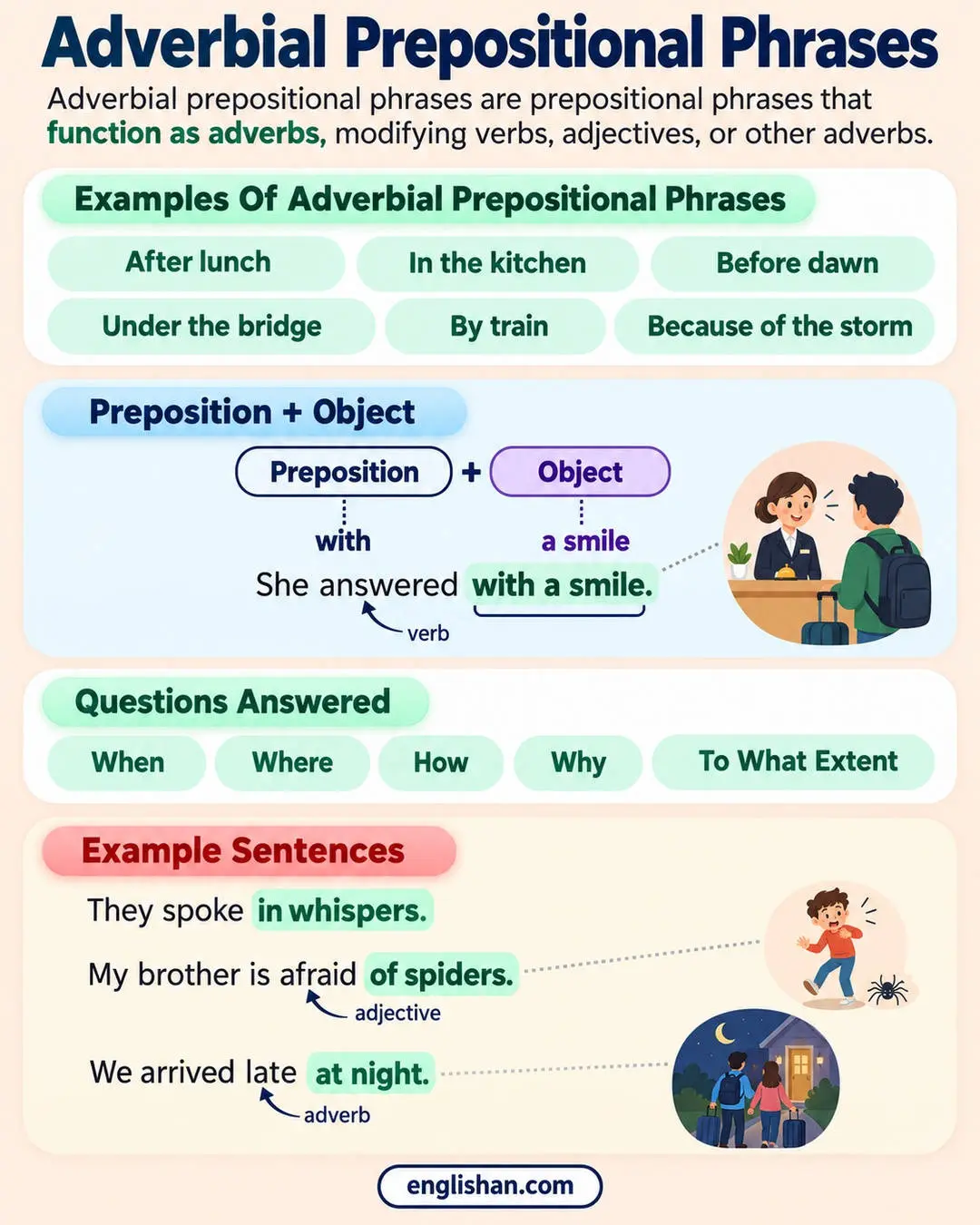
What Is An Adverbial Prepositional Phrase?
An adverbial prepositional phrase, also called an adverb prepositional phrase, is a preposition, its object, and any words that describe the object, used together as one adverb. The object is a noun, a pronoun, or an “-ing” form, as in “in the old kitchen”, “beside her”, and “after finishing work”.
- The children played in the garden.
- I’ll call you after the meeting.
- Dad fixed the shelf with a screwdriver.
- We stayed home because of the storm.
- Is the pharmacy open on Sundays?
A single adverb can often replace the whole phrase, which shows that the phrase functions as an adverb: “in the garden” becomes “there”, and “after the meeting” becomes “later”. The phrase still counts as one unit when it has several words, so “because of the storm” is one adverbial prepositional phrase with the two-word preposition “because of”.
The word “to” begins a prepositional phrase only when a noun or pronoun follows it, as in “She walked to the station.” Before a verb, “to” forms an infinitive, so “to catch the train” in “She ran to catch the train” is an infinitive phrase, not a prepositional phrase.
Adverbial prepositional phrases are one kind of adverbial phrase, and other adverbial phrases have no preposition at all, such as “very carefully”. A preposition with no object of its own is a different form: in “Please come in“, the single word “in” is one of the prepositional adverbs.
Words Modified By Adverbial Prepositional Phrases
An adverbial prepositional phrase modifies a verb, an adjective, or another adverb. The verb is by far the most common of the three, and a phrase that modifies an adjective or an adverb usually comes directly after that word.
Verbs: The phrase adds the time, place, manner, or reason of the action. An object can come between the verb and the phrase without changing what the phrase modifies.
- Mia hung her coat on the hook.
- The library closes at eight on Fridays.
- They spoke in whispers.
Adjectives: After an adjective, the phrase tells us about what or in what way the adjective is true. Many adjectives take a fixed preposition, so the pair is learned together: “afraid of”, “good at”, “interested in”, and “proud of”.
- My brother is afraid of spiders.
- She is good at chess.
- The soup was too hot for the children.
The wrong preposition after the adjective is the usual error with these phrases.
She is interested on photography. ❌
She is interested in photography. ✅
The adjective “interested” takes the preposition “in”, so the phrase after it begins with “in”.
Adverbs: A phrase after an adverb narrows the meaning of the adverb, as in “late at night” and “far from home“.
- We arrived late at night.
- My grandparents now live far from the city.
Questions Answered By Adverb Prepositional Phrases
An adverb prepositional phrase answers one of the adverb questions about the word it modifies: when, where, how, why, or to what extent. The question shows the meaning of the phrase, and each meaning has its own common prepositions, such as “during” for time and “because of” for reason.
| Question | Meaning | Common prepositions | Example phrase |
|---|---|---|---|
| When? | Time | At, on, in, before, after, during, since | After dinner |
| How long? | Duration | For, until, throughout | For three weeks |
| Where? | Place or direction | In, on, under, behind, to, from, across | Under the bridge |
| How? | Manner or means | With, by, without, like | By train |
| Why? | Reason or purpose | Because of, due to, for, out of | Because of the noise |
| To what extent? | Degree | By, to, up to | By ten percent |
These meanings match the main types of one-word adverbs. A phrase such as “at noon” answers the same question as adverbs of time like “then” and “soon”. The phrase “under the bridge” answers the question of adverbs of place like “there”. In the same way, “by train” answers the question of adverbs of manner like “quickly”.
A single preposition can begin phrases with different meanings, so the whole phrase shows the meaning, not the preposition alone. The preposition “in” answers “when?” in “in May”, “where?” in “in Paris”, and “how?” in “in silence”.
Examples Of Adverbial Prepositional Phrases
Adverbial prepositional phrases answer different questions in different sentences, and one sentence often has two of them, one for place and another for time or manner.
- Our flight leaves at 6:15. (when)
- Please sign the form in blue ink. (how)
- The road was closed because of an accident. (why)
- Lena has worked here for five years. (how long)
- Sales fell by twelve percent last quarter. (to what extent)
- She jogs in the park before work. (where, when)
- Can you drive me to the airport on Saturday? (where, when)
- During the interview, he answered every question with confidence. (when, how)
- I left the receipt in the drawer of my desk. (where)
The last example has one phrase inside another. The whole phrase “in the drawer of my desk” tells us where, so it is adverbial, but the smaller phrase “of my desk” describes the noun “drawer”, so that part is adjectival.
Position Of Adverbial Prepositional Phrases
An adverbial prepositional phrase usually comes at the end of the clause, after the verb and its object. It can also move to the front of the sentence without changing the meaning, while an adjectival prepositional phrase stays after its noun.
End position: Most phrases of place, time, and manner go at the end.
- We had lunch in the staff room.
- The package arrived on Tuesday.
Front position: A phrase at the front sets the time or place for the whole sentence, or puts a contrast first. In British primary schools, an adverbial at the start of a sentence is called a fronted adverbial.
- On Tuesday, the package finally arrived.
- In the staff room, nobody mentioned the news.
Mid position: A phrase between the subject and the verb is rare and belongs to formal writing, with a comma on each side: “The manager, after a long pause, agreed.”
When several phrases come at the end, the usual order is manner, then place, then time: “He spoke with passion at the meeting on Monday.” After a verb of movement such as “go” or “come”, the phrase of place comes before the phrase of manner: “She goes to work by bike.”
An adverbial prepositional phrase does not go between a verb and its object.
She opened with a knife the box. ❌
She opened the box with a knife. ✅
The object “the box” stays next to “opened”, and the phrase follows it. French and Spanish allow an adverb between a verb and its object, but English keeps the verb and its object together.
Commas With Introductory Prepositional Phrases
An introductory prepositional phrase takes a comma after it when it is long, when two or more phrases begin the sentence, or when a reader would misread the sentence without one. After a short phrase of two to four words, the comma is optional, and both forms are standard.
- In March the company moved to Denver.
- In March, the company moved to Denver.
- At the end of the meeting, everyone signed the agreement.
- After a long winter in the mountains, the village welcomed spring.
- Before eating, the children washed their hands.
The phrase “at the end of the meeting” contains two phrases together, so it takes the comma. Without its comma, the last sentence reads at first as “Before eating the children”, with the wrong object for “eating”.
After a phrase of place at the front, the verb sometimes comes before the subject, as in stories and descriptions. In that order, no comma follows the phrase.
On the hill, stood an old church. ❌
On the hill stood an old church. ✅
A prepositional phrase at the end of a sentence usually takes no comma before it, as in “The company moved to Denver in March.”
Adjectival Vs Adverbial Prepositional Phrases
Adjectival and adverbial prepositional phrases have the same form, a preposition and its object, and the same prepositions begin both. An adjectival prepositional phrase modifies a noun or a pronoun, and an adverbial prepositional phrase modifies a verb, an adjective, or an adverb.
- A man with a kind smile opened the door. (adjectival: which man?)
- The man opened the door with a smile. (adverbial: how?)
- The café near the station sells good coffee. (adjectival: which café?)
- We had coffee near the station. (adverbial: where?)
| Feature | Adjectival prepositional phrase | Adverbial prepositional phrase |
|---|---|---|
| Word it modifies | Noun or pronoun | Verb, adjective, or adverb |
| Questions it answers | Which one? What kind? | When? Where? How? Why? To what extent? |
| Usual position | Directly after its noun | End of the clause or front of the sentence |
| Movement to the front | Not possible | Usually possible |
| Example | The book about whales | Wait near the station |
Where the function is unclear, move the phrase to the front of the sentence. An adverbial phrase still reads correctly there, so “We had coffee near the station” becomes “Near the station, we had coffee”. An adjectival phrase must stay after its noun, so “I bought the book about whales” cannot become “About whales, I bought the book”.
Two possible readings: A phrase that comes after the object of a verb can modify either the object or the verb, so the sentence has two meanings.
- I saw the man with the telescope.
If “with the telescope” modifies “saw”, the speaker used the telescope, and the phrase is adverbial. If it modifies “man”, the man had the telescope, and the phrase is adjectival. To keep only one meaning, rewrite the sentence.
- Through the telescope, I saw the man. (adverbial)
- I saw the man who was holding the telescope. (adjectival meaning)
FAQs
No, a prepositional phrase is adverbial only when it modifies a verb, an adjective, or an adverb. A phrase that modifies a noun, as in "the girl in the photo", is adjectival. A few prepositional phrases even function as the subject: "After six is too late for a meeting."
Not always. An adverbial phrase is any group of words that functions as an adverb, and a prepositional phrase is any group of words that begins with a preposition and ends with its object. Adverbial prepositional phrases are both, but "very slowly" is an adverbial phrase with no preposition, and "a cup of tea" contains a prepositional phrase that is adjectival.
Yes. An adverb such as "right", "just", or "shortly" often comes before the preposition and modifies the whole phrase, as in "just after midnight" and "right behind the door". An adverb can also appear inside the phrase when it modifies an adjective there, as in "in a very small town".
No, it has only a preposition, its object, and any words that describe the object. The object can be an "-ing" form, as in "after finishing the report", but that form functions as a noun inside the phrase, not as the verb of the sentence.
Related:
- Adjective Phrase vs Adverb Phrase
- Adverbial Clauses
- What Do Adverbs Modify
- Comma After Introductory Phrase
