

Adverbs modify verbs, adjectives, and other adverbs, and some adverbs modify a whole clause or sentence. To modify a word is to add information to it, such as how, when, where, how often, or how much. An adverb like “carefully” adds that information to a verb, while an adverb like “very” adds it to an adjective or to another adverb.
The full answer to the question “what do adverbs modify” also includes noun phrases, numbers, and prepositional phrases, as in “almost all the guests”, “nearly forty”, and “right after lunch”. A noun on its own, by contrast, is normally described by an adjective, apart from a few adverbs of place and time that follow the noun. Of all these words, the verb is the one an adverb modifies most often.
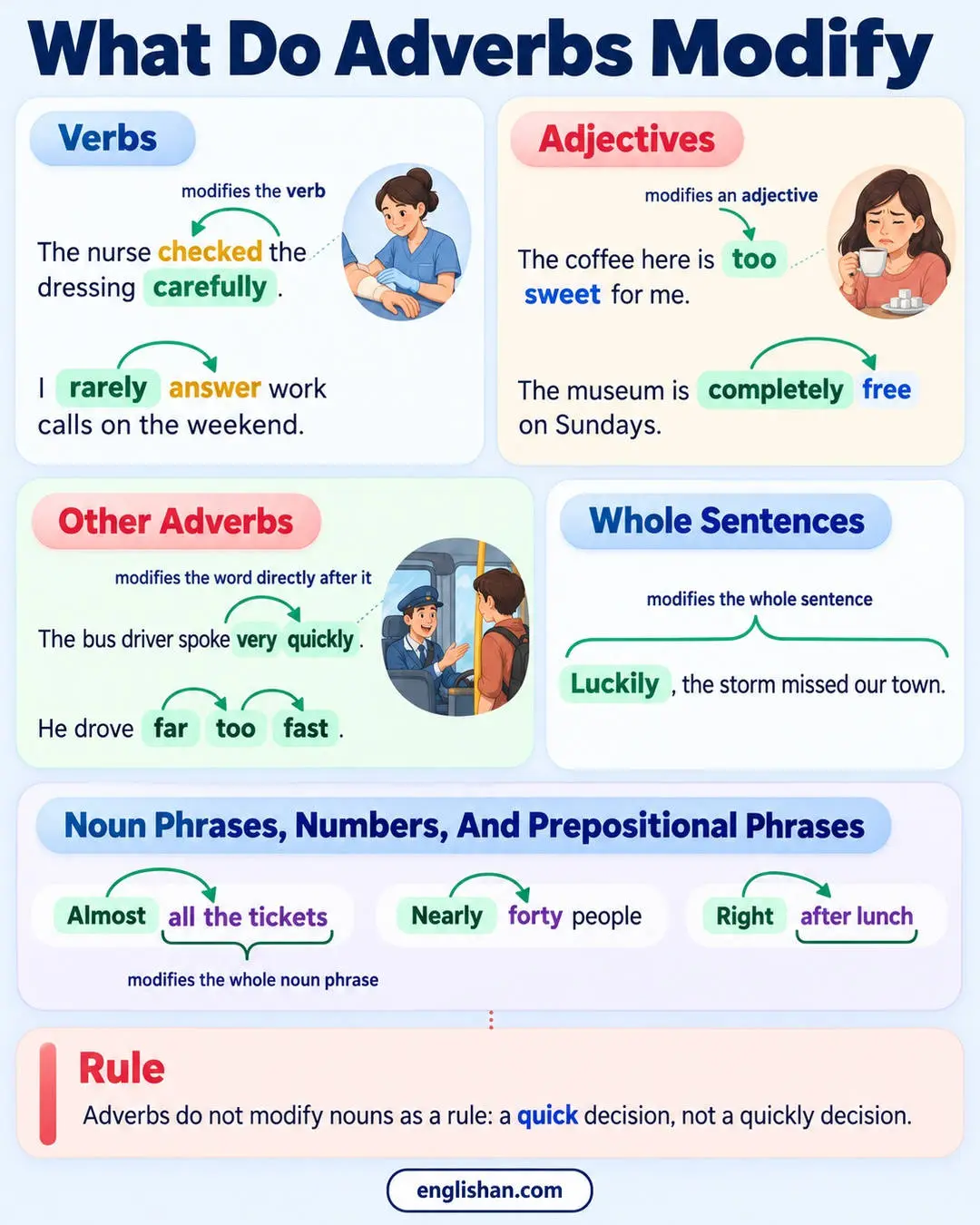
The answer to “what do adverbs modify” is verbs (sang softly), adjectives (really long), and other adverbs (very slowly). Some adverbs modify a whole sentence, as in “Luckily, nobody was hurt.” Adverbs also come before noun phrases, numbers, and prepositional phrases: almost everyone, nearly forty, right after lunch. As a rule, a noun alone takes an adjective, not an adverb.
Adverbs Modifying Verbs
An adverb that modifies a verb tells us how, when, where, or how often the action happens. Adverbs of manner, time, place, and frequency all modify verbs, and their position depends on the type. An adverb of manner usually follows the verb or its object, while an adverb of frequency usually comes before the main verb.
- The nurse checked the dressing carefully.
- Our flight leaves tomorrow.
- Please wait outside until your name is called.
- I rarely answer work calls on the weekend.
- Did the printer jam again?
- The kids didn’t sleep well on the train.
An adverb also modifies a verb with an auxiliary or an infinitive, as in “has already left” and “to speak clearly“. The adverb then modifies the whole verb, not the auxiliary alone.
Very with verbs: The adverb “very” modifies adjectives and adverbs, but it does not modify a verb.
I very like this neighborhood. ❌
I really like this neighborhood. ✅
I like this neighborhood very much. ✅
A verb takes “really” before it or “very much” after the object, never “very” alone.
Linking verbs: After a linking verb such as “be”, “seem”, “look”, or “feel”, the word that follows describes the subject, so “She looks happy” takes an adjective and “She looks happily” is an error. The same choice comes up in every adverb vs adjective pair.
Adverbs Modifying Adjectives
An adverb that modifies an adjective usually tells us how much or to what degree, and it comes directly before the adjective. Most of these words are adverbs of degree, such as “very”, “quite”, “extremely”, “too”, and “slightly”, but other adverbs modify adjectives as well, as in “surprisingly cheap” and “permanently closed”.
- The coffee here is too sweet for me.
- Your report was extremely detailed.
- The museum is completely free on Sundays.
- Isn’t the hotel rather far from the beach?
- My sister was slightly late for the wedding.
- These shoes are surprisingly comfortable.
Enough: Unlike most adverbs of degree, “enough” comes after the adjective it modifies, as in “old enough” and “warm enough to swim”.
Is the room enough big for four people? ❌
Is the room big enough for four people? ✅
The adjective “big” comes first, and “enough” follows it.
Real and really: In casual American speech, “real” often modifies an adjective, as in “real cheap”. In writing and in formal speech, the adverb “really” takes that position.
- That jacket was real cheap. (casual speech)
- That jacket was really cheap. (writing)
Adverb Modifying Another Adverb
An adverb modifying another adverb is usually an adverb of degree, and it makes the second adverb stronger or weaker. It comes directly before the adverb it modifies, and that second adverb modifies a verb or an adjective in turn.
- The bus driver spoke very quickly.
- We almost never eat out on weekdays.
- She finished the exam surprisingly early.
- Why are you walking so slowly?
- The repair went quite smoothly.
Adverbs of degree sometimes come in a pair, and each one modifies the word directly after it.
- He drove far too fast.
In that sentence, “far” modifies “too”, “too” modifies “fast”, and “fast” modifies the verb “drove”. Without “far”, the sentence is still correct, so “far” only makes “too” stronger.
Adverbs Modifying A Whole Sentence
A sentence adverb modifies a whole clause or sentence, not one word inside it, and it shows the speaker’s view of the statement. Most sentence adverbs come at the start of the sentence, followed by a comma.
- Luckily, the storm missed our town.
- Honestly, I don’t remember his name.
- Apparently, the meeting moved to Thursday.
- The parcel, unfortunately, arrived damaged.
Some adverbs modify a verb in one position and the whole sentence in another, so the position and the comma change the meaning.
- Clearly, the teacher explained the task. (it is obvious that she did)
- The teacher explained the task clearly. (in a clear way)
Conjunctive adverbs such as “however” and “therefore” also modify a whole clause, and they link it to the clause before.
Adverbs Modifying Nouns
Adverbs do not modify nouns as a rule, because the word that describes a noun is an adjective. To describe a noun, use the adjective form of the word instead, so “a quick decision” is correct and “a quickly decision” is not.
We need a quickly answer from the landlord. ❌
We need a quick answer from the landlord. ✅
A noun takes the adjective “quick”, and the adverb “quickly” modifies a verb, as in “Please answer quickly.”
A small number of adverbs of place and time follow a noun and modify it directly.
- The man downstairs plays the drums at night.
- I met her the day before.
- The people here are very welcoming.
- The room above has a balcony.
Before a noun, several of these words function as adjectives instead, as in “the downstairs bathroom” and “the above address”. They are adverbs only in the position after the noun.
Focusing adverbs such as “even” and “only” are the other exception. They come before a noun or a name and modify the whole noun phrase, as in “Even Tom laughed” and “Only Sam knew the password”.
Adverbs Modifying Noun Phrases
An adverb of degree comes before a determiner, a number, or an indefinite pronoun, and it modifies that whole noun phrase, not the noun inside it. The adverbs in this position are mostly words of amount and degree, such as “almost”, “nearly”, “quite”, “about”, and “hardly”.
Before a determiner: Adverbs of degree come before “all”, “every”, and “no” to show how close the amount is to complete.
- Almost all the tickets sold out in an hour.
- Nearly every seat on the bus was taken.
- We had practically no rain this summer.
Before a or an: The adverbs “quite” and “rather” come before the article, so the order is adverb, then “a”, then the noun.
- It was quite a shock to see him again.
- We had rather a long wait at the clinic. (more common in British English)
Before a number: Adverbs such as “about”, “nearly”, “almost”, “roughly”, and “exactly” come before a number and show how close the figure is.
- Nearly forty people came to the meeting.
- The trip takes about six hours.
- She was exactly ten minutes late.
Before a pronoun: Indefinite pronouns such as “everyone”, “anything”, and “nobody” take adverbs of degree too.
- Almost everyone agreed with the plan.
- Hardly anyone replied to my message.
Almost students passed the driving test. ❌
Almost all the students passed the driving test. ✅
Most students passed the driving test. ✅
The adverb “almost” modifies a determiner such as “all”, so it does not come straight before a noun, while “most” is a determiner and comes directly before the noun. The error follows Japanese, where one word, “hotondo”, means both ‘almost all’ and ‘most’ before a noun.
Adverbs Modifying Prepositions
A prepositional phrase is a preposition with its object, such as “after lunch” or “into the lake”. An adverb that comes before a preposition modifies that whole phrase, not the preposition alone, and it makes the time, place, or distance more exact.
- Call me right after lunch.
- The dog jumped straight into the lake.
- We stopped halfway up the hill.
- The project is well behind schedule.
- Their office is directly opposite the bank.
- The film started just before nine.
In this position, “right” means ‘exactly’ or ‘immediately’, not ‘correct’, and “well” means ‘by a large amount’.
We left very after the concert. ❌
We left right after the concert. ✅
The adverb “very” modifies adjectives and adverbs, so a prepositional phrase takes “right”, “just”, or “soon” instead.
Word Modified By An Adverb
To find the word an adverb modifies, ask which word it adds information to. In most sentences, the answer to “what do adverbs modify” is the verb, adjective, or adverb directly beside the adverb. Focusing adverbs such as “only”, “even”, “just”, “also”, and “especially” are the hard case, since the word they modify changes with their position.
- Only I saw her. (nobody else saw her)
- I only saw her. (I saw her but did not speak to her)
- I saw only her. (I saw nobody else)
In careful writing, “only” and “even” go directly before the word or phrase they modify, and the full rules for their position are part of adverb placement in a sentence.
FAQs
Adverb clauses modify the verb of the main clause, or the whole main clause, and tell us when, why, where, or under what condition something happens. In "We left because it was raining", the clause modifies "left". Conjunctions such as "because", "when", and "if" introduce adverb clauses.
Adverb phrases modify the same words as single adverbs: verbs, adjectives, other adverbs, and whole sentences. In "She spoke very quietly", the phrase modifies "spoke", and in "In my opinion, the price is fair", it modifies the whole sentence. A prepositional phrase is one common form of adverb phrases.
No, an adjective describes only a noun or a pronoun. A word that modifies an adverb is itself an adverb, so in writing we say "really well", not "real well".
Yes, because a gerund keeps the meaning of its verb, an adverb modifies it as it modifies any verb: "Driving carefully saves fuel." When "the" or a possessive comes before the gerund, an adjective describes it instead, as in "his careful driving".
Adverbs of time usually modify the verb and tell us when the action happens, as in "The parcel arrived yesterday". At the start of a sentence, words such as "recently" and "today" modify the whole clause: "Recently, prices have gone up." The common ones and their positions are set out under adverbs of time.
Related:
- What Questions Do Adverbs Answer
- Types of Adverbs
- How to Identify an Adverb in a Sentence
- Adverbial Prepositional Phrases