

An adverb adds degree, manner, or place to an action. The adverbs that start with B express degree in barely and basically, manner in boldly and briefly, and place in behind and beneath, the last two needing no -ly ending. A run opening with bl- defines an absence: blankly is without expression, blandly without flavour, bleakly without comfort and blindly without sight. The list runs from the praising beautifully to the faulting badly.
Choose the first letter:
A · B · C · D · I · K · L · M · N · R · S · T · V
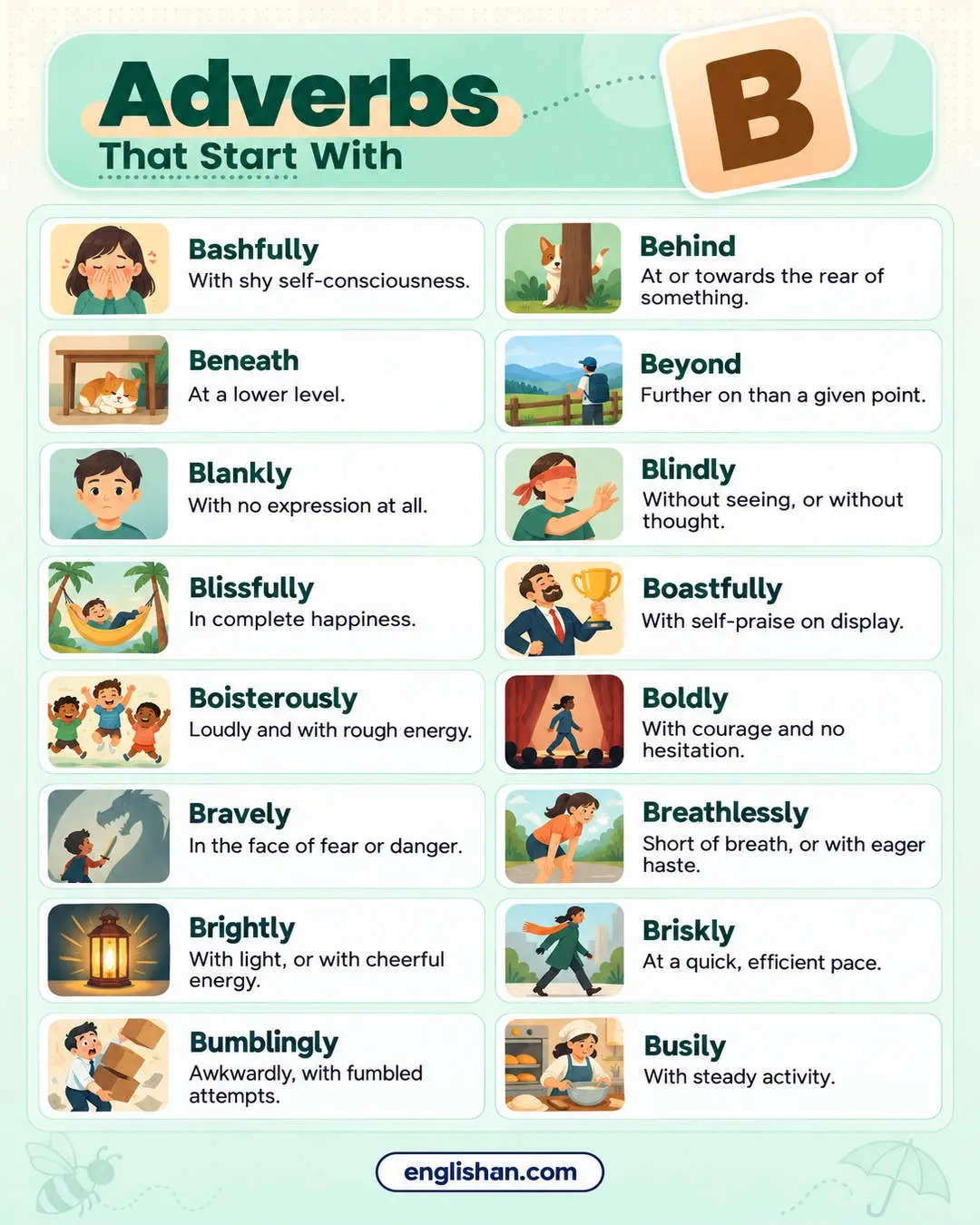
Adverbs That Start With B
The adverbs that start with B run alphabetically from backhandedly to busily, with the meaning beside the word and a sentence showing where the adverb belongs. The letter splits into four parts so that near-neighbours stay close enough to weigh against one another. The bl- run repays the closest reading, since its words differ by one shade of lack.
Adverbs That Start With Ba to Be
| Adverb | Meaning | In a sentence |
|---|---|---|
| Backhandedly | With a compliment that hides an insult. | The review praised the cast backhandedly. |
| Baldly | Plainly, with nothing softened. | The shortfall was stated baldly in one line. |
| Banally | With dull obviousness. | The ending was written banally. |
| Banteringly | In light teasing. | He raised the bet banteringly. |
| Barbarically | With savage cruelty. | The prisoners were treated barbarically. |
| Bearably | Just enough to be endured. | The attic was bearably warm by evening. |
| Beatifically | With serene, blissful calm. | She smiled beatifically at the news. |
| Befittingly | As is proper to the occasion. | The hall was decorated befittingly. |
| Beguilingly | In a way that charms and misleads at once. | The offer was presented beguilingly. |
| Behaviourally | In relation to conduct rather than belief. | The siblings differ behaviourally. |
| Believably | So as to be accepted as true. | The part was acted believably. |
| Beneficially | With advantage to those involved. | The weir was rebuilt beneficially for the fishery. |
| Benightedly | In ignorance, with no light shed on it. | The policy was defended benightedly. |
| Beseechingly | With urgent pleading. | The dog looked beseechingly at the table. |
| Besides | On top of what has been said. | The roof leaks, and besides, the wiring is old. |
| Besottedly | With foolish infatuation. | He wrote besottedly about the car. |
| Best | To the highest standard of all. | The ridge tiles weathered best on the south side. |
| Better | To a higher standard than before. | The second kiln fires better than the first. |
| Bewilderingly | So as to leave the reader lost. | The forms are worded bewilderingly. |
| Bewitchingly | With enchanting attraction. | The garden was lit bewitchingly. |
Adverbs That Start With Bi
| Adverb | Meaning | In a sentence |
|---|---|---|
| Bilaterally | On or by two sides together. | The treaty was agreed bilaterally. |
| Bilingually | In two languages. | The notices are printed bilingually. |
| Bindingly | So as to create a legal obligation. | The minute was recorded bindingly. |
| Biologically | In relation to living organisms. | The two species differ biologically. |
| Bitingly | With a cold or cutting edge. | The wind came bitingly off the estuary. |
| Bizarrely | Strangely, past the point of explanation. | The clock was mounted bizarrely over the door. |
Adverbs That Start With Bl
| Adverb | Meaning | In a sentence |
|---|---|---|
| Blackly | Darkly, with grim humour or mood. | The diary reads blackly in the final year. |
| Blamelessly | Without fault attaching. | The driver had acted blamelessly. |
| Blandly | Without flavour or feeling. | He answered the accusation blandly. |
| Blankly | With no expression at all. | She stared blankly at the diagram. |
| Blasphemously | Irreverently, against what is held sacred. | The pamphlet was written blasphemously. |
| Blazingly | With fierce heat or brightness. | The forge burned blazingly by six. |
| Bleakly | Without comfort or hope. | The surveyor reported bleakly on the roof. |
| Blearily | With tired, unfocused eyes. | He read the label blearily. |
| Blindly | Without seeing, or without thought. | The order was followed blindly. |
| Bloodily | With violence and bloodshed. | The siege ended bloodily. |
| Bloodlessly | Without violence or loss of life. | The coup was carried out bloodlessly. |
| Bluffly | In a hearty, blunt manner. | The landlord greeted them bluffly. |
| Bluntly | Directly, with no attempt to soften. | He put the question bluntly. |
| Blurrily | Out of focus. | The photograph printed blurrily. |
| Blusteringly | With loud empty threat. | The letter complained blusteringly. |
Adverbs That Start With Bo to Bu
| Adverb | Meaning | In a sentence |
|---|---|---|
| Bodily | As a whole body, physically lifted or moved. | The shed was shifted bodily onto the new base. |
| Bombastically | With inflated, pompous language. | The speech ended bombastically. |
| Boomingly | In a deep, resonant voice. | The verger answered boomingly. |
| Boringly | Without interest. | The minutes are written boringly. |
| Botanically | In relation to plants. | The two hedges differ botanically. |
| Bounteously | With generous abundance. | The orchard cropped bounteously that year. |
| Brainlessly | With no thought applied. | The lock was fitted brainlessly on the inside. |
| Brassily | Loudly, with vulgar brightness. | The band played brassily. |
| Breadthwise | Across the width. | Cut the board breadthwise. |
| Breathlessly | Short of breath, or with eager haste. | She reported the result breathlessly. |
| Briskly | At a quick, efficient pace. | He walked briskly to the gate. |
| Brokenly | In broken fragments, or with a faltering voice. | He spoke brokenly about the loss. |
| Bruisingly | With force that leaves damage. | The campaign ran bruisingly for six weeks. |
| Bullishly | With aggressive confidence. | The firm bid bullishly for the site. |
| Bumblingly | Awkwardly, with fumbled attempts. | The repair was attempted bumblingly. |
| Bunglingly | With clumsy mishandling. | The accounts were kept bunglingly. |
| Bureaucratically | Through official procedure and delay. | The claim was handled bureaucratically. |
| Busily | With steady activity. | The yard worked busily through the frost. |
Positive Adverbs That Start With B
Approval sits in the positive adverbs that start with B, and the letter runs to plenty as readily as to beauty. Bountifully and bounteously report abundance, while beautifully and brilliantly report standard.
| Adverb | Meaning | In a sentence |
|---|---|---|
| Beautifully | To a standard that pleases the eye or ear. | The staircase was restored beautifully. |
| Becomingly | In a way proper to the wearer or the setting. | The hall was furnished becomingly. |
| Benevolently | With kindly goodwill. | The trust was administered benevolently. |
| Benignly | Mildly, with no harm in it. | The tumour behaved benignly. |
| Blessedly | With welcome relief. | The afternoon was blessedly quiet. |
| Blissfully | In complete happiness. | The pair slept blissfully through the alarm. |
| Boldly | With courage and no hesitation. | The scheme was costed boldly. |
| Bountifully | In generous plenty. | The vines yielded bountifully. |
| Bracingly | So as to refresh and invigorate. | The wind blew bracingly off the sea. |
| Bravely | In the face of fear or danger. | The crew went back bravely for the last man. |
| Brightly | With light, or with cheerful energy. | She answered the complaint brightly. |
| Brilliantly | To an outstanding standard of skill or shine. | The second movement was played brilliantly. |
| Buoyantly | With cheerful lightness. | The team came off the pitch buoyantly. |
Blessedly differs from the other positive adverbs that start with B, since it reports relief at what has stopped rather than pleasure at what is there.
Adverbs of Manner That Start With B
Most adverbs that start with B qualify manner, which is the how of an action. The standard position is after the verb, or after the object where there is one. Front position is available for stress, and it throws the weight onto the manner rather than the action.
- He put the question bluntly.
- She signed the pages briskly.
- Blankly, he stared at the diagram.
- The order was followed blindly.
- The shed was shifted bodily onto the new base.
The position to rule out is between the verb and its object, where the adverb separates a pair that belongs together.
- He put bluntly the question ❌
- He put the question bluntly ✅
The bl- words follow that rule without exception, as described under adverbs of manner and across the types of adverbs.
Negative Adverbs That Start With B
Disapproval runs through the negative adverbs that start with B, and the target shifts from word to word. Badly faults the work, while basely and boorishly fault the person who did it.
| Adverb | Meaning | In a sentence |
|---|---|---|
| Badly | To a poor standard. | The flashing was fitted badly. |
| Balefully | With menace in the look. | The gander watched them balefully. |
| Barbarously | Savagely, with brutal force. | The town was sacked barbarously. |
| Basely | With dishonourable motive. | The witness acted basely for money. |
| Begrudgingly | With reluctance showing. | The refund was paid begrudgingly. |
| Belligerently | Ready to fight at every turn. | The question was answered belligerently. |
| Bitterly | With resentment that has set hard. | He spoke bitterly about the pension. |
| Blatantly | Openly, with no attempt at concealment. | The rule was broken blatantly. |
| Boorishly | Rudely, with no social grace. | The guest behaved boorishly at dinner. |
| Brashly | With loud, tactless confidence. | The takeover was announced brashly. |
| Brazenly | Shamelessly, in full view. | The sign was ignored brazenly. |
| Brutally | With savage force or unsparing honesty. | The schedule was cut brutally. |
| Brutishly | With coarse, animal roughness. | The crowd was handled brutishly. |
Brutally holds a second use that the other negative adverbs that start with B do not, since a schedule cut brutally draws no blame while a crowd handled brutishly draws plenty.
Adverbs That Start With B to Describe a Person
Manner adverbs take the weight when a person heads the sentence, and the adverbs that start with B hold several matched pairs. He answered bashfully and he answered brusquely report one action and two different people.
| Adverb | Meaning | In a sentence |
|---|---|---|
| Bashfully | With shy self-consciousness. | He accepted the medal bashfully. |
| Blithely | Carelessly cheerful, with no thought of trouble. | She signed the lease blithely. |
| Boastfully | With self-praise on display. | He described the sale boastfully. |
| Boisterously | Loudly and with rough energy. | The team celebrated boisterously. |
| Bookishly | With the manner of a reader rather than a doer. | He corrected the date bookishly. |
| Bossily | Giving orders without the standing to give them. | The nephew ran the picnic bossily. |
| Boyishly | With the manner of a young boy. | He grinned boyishly at the camera. |
| Breezily | Lightly, with careless unconcern. | She dismissed the overdraft breezily. |
| Broodingly | With dark, silent thought. | He watched the river broodingly. |
| Brusquely | Abruptly, to the point of rudeness. | The porter answered brusquely. |
| Bumptiously | With irritating self-importance. | The junior clerk interrupted bumptiously. |
Blithely is the densest of the person adverbs that start with B, since it reports cheerfulness and carelessness in one word.
Adverbs of Place and Direction That Start With B
The place adverbs that start with B include back, behind, beneath and beyond, and none of them takes an ending. A place adverb follows the verb or the object, and it comes after a manner adverb when the two stand together.
| Adverb | Meaning | In a sentence |
|---|---|---|
| Back | Towards the place of origin. | Put the ledger back on the shelf. |
| Backward | To the rear. | The cart rolled backward on the slope. |
| Backwards | With the back part first. | He read the inscription backwards. |
| Behind | At or towards the rear of something. | The bucket was left behind. |
| Beneath | At a lower level. | The cellar runs beneath the whole house. |
| Beyond | Further on than a given point. | The track continues beyond the ford. |
| Broadside | With the side turned towards something. | The barge swung broadside across the lock. |
Backward and backwards are both correct, with the -s form standard in British writing, as adverbs of place sets out.
Adverbs of Time and Frequency That Start With B
On B the time and frequency words come mostly from the bi- prefix, and they state when and how many times. A frequency word such as biweekly belongs in front of the main verb, while beforehand takes either end of the sentence.
| Adverb | Meaning | In a sentence |
|---|---|---|
| Beforehand | In advance of the event. | Book the crossing beforehand. |
| Belatedly | Later than it should have come. | The apology arrived belatedly. |
| Betimes | Early, in good time. | The shepherd was out betimes. |
| Biennially | In a two-year cycle. | The survey is repeated biennially. |
| Bimonthly | At two-month intervals. | The newsletter goes out bimonthly. |
| Biweekly | At two-week intervals. | The bins are emptied biweekly. |
| Briefly | For a short time. | The sun broke through briefly at noon. |
Biweekly and bimonthly are read two ways by different writers, so a schedule is safer spelled out in full, as adverbs of frequency sets out.
Adverbs of Degree That Start With B
Degree words grade how much of a quality applies. Barely and broadly pull a statement down, while blindingly, blisteringly and breathtakingly push it up into opinion.
| Adverb | Meaning | In a sentence |
|---|---|---|
| Bang | Exactly, as an intensifier before a time or position. | The train left at six bang on the clock. |
| Barely | Only just, and no more. | The lintel barely clears the frame. |
| Basically | At the root of the matter. | The fault is basically in the pump. |
| Blindingly | To a degree that overwhelms the eye or mind. | The answer is blindingly plain. |
| Blisteringly | With burning intensity. | The afternoon turned blisteringly hot. |
| Bolt | Straight, as an intensifier before upright. | He sat bolt upright at the sound. |
| Boundlessly | Without any limit. | The fund was not boundlessly deep. |
| Breathtakingly | To a degree that stops the breath. | The restoration is breathtakingly exact. |
| Broadly | In general terms, without the detail. | The two accounts broadly agree. |
Bang and bolt join the degree adverbs that start with B with no ending at all, so bang on the clock and bolt upright read correctly, as adverbs of degree sets out.
Adverbs That Start With B Without LY
These adverbs that start with B take no -ly ending: back, backward, backwards, behind, beneath, beyond, besides, best, better, bang, bolt, barefoot, bareheaded, broadside and breadthwise. Several of these change meaning if an ending is added, and the rest have no -ly form in the language at all.
- Put the ledger back on the shelf.
- The track continues beyond the ford.
- He sat bolt upright at the sound.
- The children ran barefoot across the sand.
- Cut the board breadthwise.
Bolt is an adverb in front of upright and nowhere else, so an ending on it produces a word that does not exist.
- He sat boltly upright at the sound ❌
- He sat bolt upright at the sound ✅
Besides adds to what has been said and beside places one thing next to another, so the final letter settles which the sentence needs.
- Beside, the wiring is old ❌
- Besides, the wiring is old ✅
Adverbs That Start With Bl
A long run of the adverbs that start with B opens with bl-, and those words report what is missing rather than what is there. Blankly reports no expression, blandly no flavour, bleakly no comfort, blindly no sight, and blithely no care.
- She stared blankly at the diagram.
- He answered the accusation blandly.
- The surveyor reported bleakly on the roof.
- The order was followed blindly.
- She signed the lease blithely.
Blissfully and blazingly are the two that break the pattern, since both report a presence rather than its lack, which is why they trade places with blithely by mistake.
- She signed the lease blissfully, without reading it ❌
- She signed the lease blithely, without reading it ✅
Commonly Confused Adverbs That Start With B
Pairs among the adverbs that start with B trade places in print, and the two halves of a pair are not interchangeable. The split in most cases turns on what the word attaches to rather than on how strongly it reads.
| Pair | What separates them |
|---|---|
| Badly / Bad | Badly follows an ordinary verb; bad follows a linking verb. |
| Blithely / Blissfully | Blithely means carelessly cheerful; blissfully means wholly happy. |
| Barely / Bearably | Barely means only just; bearably means enough to endure. |
| Besides / Beside | Besides adds a point; beside puts one thing next to another. |
| Bitterly / Bitingly | Bitterly reports resentment; bitingly reports a cutting edge. |
- The flashing was fitted badly.
- I feel bad about the delay.
- The lintel barely clears the frame.
- The attic was bearably warm by evening.
- He spoke bitterly about the pension.
Bad follows a linking verb such as feel or look, and badly follows an ordinary verb such as fitted.
- I feel badly about the delay ❌
- I feel bad about the delay ✅
The adverbs that start with B divide between the bl- words that report a lack and the rest that report plenty. Bleakly and bountifully sit at opposite ends of one letter, and few sentences have room for both.
Related:
- Adverbs Ending in LY
- Adverbs That Do Not End in LY
- Adverb Examples
- Adverbs of Time
- Types of Adverbs
- Relative Adverbs
- Adverbs of Reason
FAQs
Around a hundred and twenty qualify in standard English, and 119 adverbs that start with B are gathered here with a meaning and a sentence. B runs shorter than S or C because fewer B adjectives take the -ly ending, and the letter makes up the difference with endingless words such as back, beyond and bolt.
Badly and barely lead the adverbs that start with B in written English, with better, briefly and broadly close behind. None of the five opens with bl-, which is the part of the letter that does description rather than report.
Beautifully, bravely, brilliantly, bountifully and buoyantly state open approval, and all five belong in a reference or a review. Blessedly stands at one remove, since it reports relief rather than pleasure.
Bashfully, boastfully, bossily, breezily and brusquely report how a person acts rather than what they are, so the verb keeps the action and the adverb holds the character. Blithely and broodingly are opposite ends of one mood.
No, and fifteen of the 119 on this page are exceptions. Back, backward, behind, beneath, beyond, besides, best, better, bang, bolt, barefoot and broadside take no ending, and adding one to any of them produces a form that is not English.
A manner adverb such as bluntly goes after the verb, or after the object where there is one. A place word such as behind follows the verb, a frequency word such as biweekly goes in front of the main verb, and a degree word such as barely goes beside the word it measures.