

Comparative and superlative adverbs are the forms of an adverb that we use to compare actions. A comparative adverb compares two actions, as in “Mia types faster than Leo”, and a superlative adverb compares one action with the rest of a group, as in “Mia types fastest in the office”.
To form comparative and superlative adverbs, we add “-er” and “-est” to short adverbs such as “fast” and “hard”, and we put “more” and “most” before adverbs ending in “-ly”. A few common adverbs, such as “well” and “badly”, change to a different word, so their forms are learned one by one. The two degrees answer different questions about an action, and the number of actions compared shows which form a sentence takes.
Comparative and superlative adverbs compare actions. A comparative adverb compares two actions and is usually followed by “than”: “She drove more carefully than her brother.” A superlative adverb compares one action with a group of three or more: “She drove most carefully of all.” One-syllable adverbs add “-er” and “-est”, and “-ly” adverbs take “more” and “most”. The forms of “well”, “badly”, and “far” are irregular.
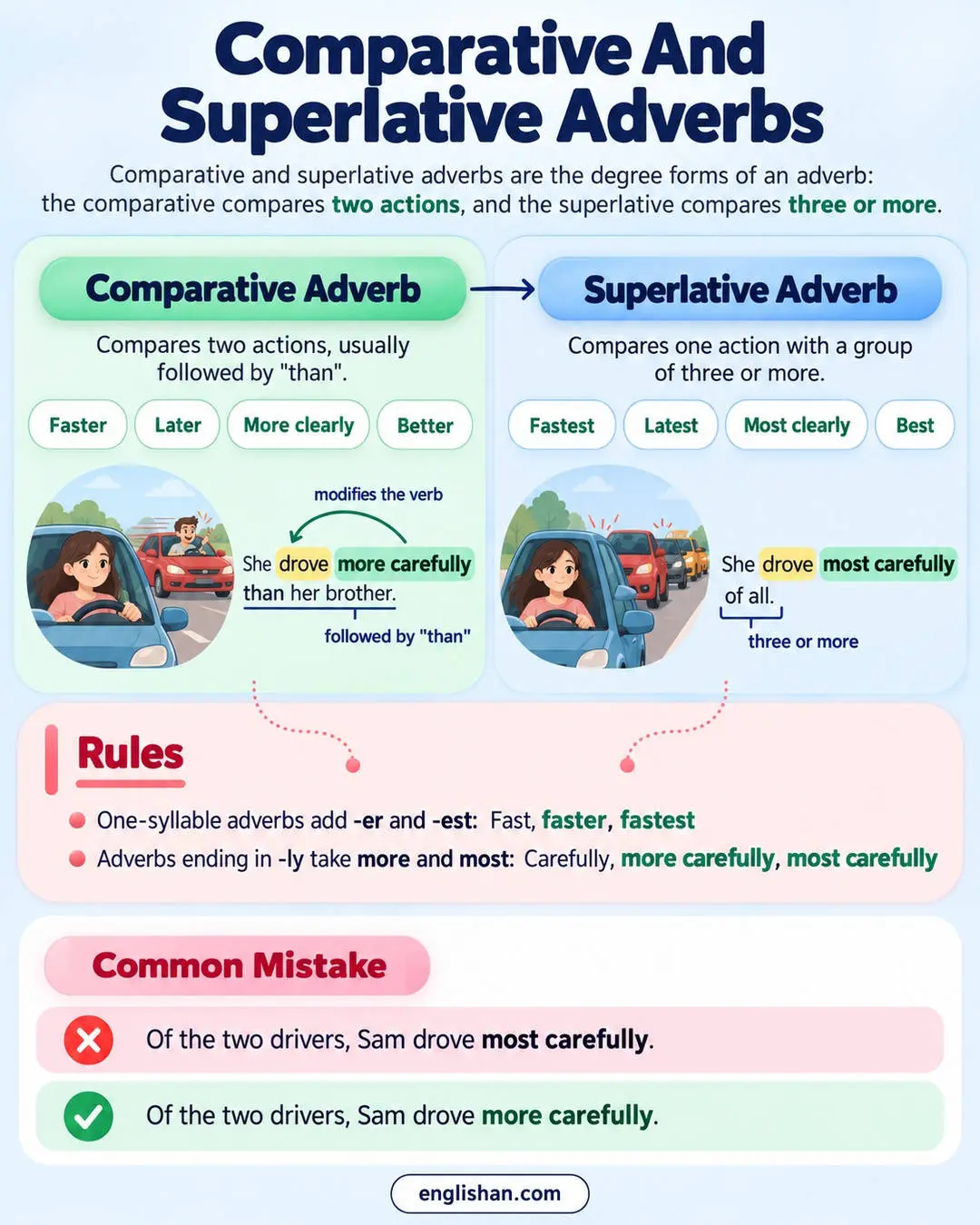
What Are Comparative And Superlative Adverbs?
A comparative adverb is an adverb that compares how two actions happen, and a superlative adverb is an adverb that compares one action with all the others in a group of three or more. Both forms usually modify a verb, so they describe the action itself, not the person who does it.
Comparative adverbs show a higher or lower degree of an action when only two actions are compared. The second part of the comparison usually comes after “than”, though it is left out when the context already shows it.
- The bus arrived later than the timetable said.
- Can you speak more slowly, please?
- Our new printer prints more quietly than the old one.
- Since the operation, my father walks more easily.
Superlative adverbs show the highest or lowest degree of an action within a group. A phrase with “of” or “in” often names the group, as in “of all the runners” or “in the class”.
- Of all the runners, Kemal finished fastest.
- Which of your children sleeps the longest?
- Nadia answered most confidently in the interview.
With only two actions, the comparative is the correct form, even when the sentence names a pair with “of”.
Of the two drivers, Sam drove most carefully. ❌
Of the two drivers, Sam drove more carefully. ✅
The phrase “of the two” compares a pair, so the sentence takes the comparative.
Some forms belong to both word classes, so the word they modify shows which one a sentence has. In “Lena is faster than her sister”, “faster” follows the linking verb “is” and describes Lena, which makes it one of the comparative adjectives. In “Lena runs faster than her sister”, “faster” modifies the verb “runs”, so it is a comparative adverb.
Positive Comparative And Superlative Degrees Of Adverbs
There are three degrees of comparison for adverbs: positive, comparative, and superlative. The positive degree is the plain adverb with no comparison, as in “She sings well“, and the comparative and superlative degrees are built on it.
| Positive | Comparative | Superlative |
|---|---|---|
| Fast | Faster | Fastest |
| Late | Later | Latest |
| Soon | Sooner | Soonest |
| Clearly | More clearly | Most clearly |
| Quietly | More quietly | Most quietly |
| Well | Better | Best |
A comparative or superlative adverb takes one sign of degree only: either the ending or “more” and “most” before it, never both.
He finished the test more faster than his brother. ❌
He finished the test faster than his brother. ✅
The “-er” ending already forms the comparative, so “more” is not added.
Formation Of Comparative And Superlative Adverbs
The form of a comparative or superlative adverb depends on the length of the adverb and on its ending. Most adverbs follow one of two regular rules, and “early” follows the shorter pattern even though it ends in “-ly”.
One-syllable adverbs: Short adverbs of one syllable add “-er” for the comparative and “-est” for the superlative, so “hard” becomes “harder” and “hardest”. An adverb that already ends in “-e” adds only “-r” and “-st”, which gives “later” and “latest”.
- The train leaves sooner on Sundays.
- Whoever trains hardest gets the place on the team.
- Please don’t arrive later than eight.
Adverbs ending in -ly: Longer adverbs with this ending take “more” and “most” before the positive form, so “carefully” becomes “more carefully” and “most carefully”. The “-ly” ending stays on the word, and “more” is not placed before the adjective.
- Could you explain the second step more clearly?
- The nurse spoke most gently to the youngest patients.
- Prices rose more sharply in March than in April.
He drives more careful than his father. ❌
He drives more carefully than his father. ✅
The word “more” comes before the full adverb “carefully”, because “careful” is the adjective.
The opposite error happens with short adverbs, where “more” is added to a word that takes “-er”.
Our team worked more hard this week. ❌
Our team worked harder this week. ✅
A one-syllable adverb takes the ending, so “more hard” is not used.
Early: The “-ly” in “early” is part of the word, not an ending added to an adjective, so “early” takes “-er” and “-est” with “y” changing to “i”. Its forms are “earlier” and “earliest”, as in “The office opens earlier in summer”.
Informal forms: In everyday speech, a few adverbs with a short form and an “-ly” form, such as “slow”, “quick”, and “loud”, take “-er” and “-est”: “Drive slower near the school.” In formal writing, “more slowly”, “more quickly”, and “more loudly” are the standard forms.
Irregular Comparative And Superlative Adverbs
Irregular comparative and superlative adverbs are adverbs whose comparative and superlative forms are different words, not the positive form with an ending or with “more” and “most”. There are five common irregular adverbs: “well”, “badly”, “far”, “little”, and “much”.
| Positive | Comparative | Superlative |
|---|---|---|
| Well | Better | Best |
| Badly | Worse | Worst |
| Far | Farther or further | Farthest or furthest |
| Little | Less | Least |
| Much | More | Most |
- My grandmother hears better with her new hearing aid.
- The team played worst in the last match of the season.
- I eat less at night than at lunch.
- Which of the three hikers walked farthest?
- She travels most in the summer months.
The words “better” and “best” are also the forms of the adjective “good”, so “She is a better cook” and “She cooks better” share one word. The adverb in the second sentence is still the comparative of “well”, because it modifies “cooks”.
She sings more well than her brother. ❌
She sings better than her brother. ✅
The adverb “well” has the irregular comparative “better”, so “more well” is not used as its comparative.
Farther or further: Both forms are standard for physical distance, as in “walk farther” and “walk further“. For the meaning ‘more’ or ‘to a greater degree’, only “further” is used: “We need to discuss the plan further.”
Adverbs Without Comparative And Superlative Forms
Only gradable adverbs have comparative and superlative forms. A gradable adverb is an adverb whose meaning can be stronger or weaker, such as “quickly”, “hard”, “soon”, or “often”. Most adverbs of manner are gradable. A few adverbs of time, place, and frequency are gradable too.
Many other adverbs express a fixed meaning with no degrees, so they have no comparative or superlative form:
- Time: “now”, “then”, “today”, “yesterday”
- Place: “here”, “there”, “everywhere”
- Degree: “very”, “too”, “quite”, “almost”
- Frequency: “never”, “always”, “daily”, “again”
Adverbs of degree such as “very”, “too”, and “quite” make other words stronger or weaker and have no degrees of their own. To compare times, we use a gradable adverb instead of “now” or “then”: “We should leave sooner” or “Can you call me later?”
Uses Of Comparative Adverbs
We use a comparative adverb to compare two actions, or one action at two different times. The comparison with “than” is the most frequent pattern, and the size of the difference can be stated with a word before the comparative.
- Dana replies to messages more quickly than her manager.
- The engine runs more smoothly after the repair.
- Could you come earlier next week?
- My son reads better than he did last year.
With than: The word “than” is followed by a noun, a pronoun, or a clause: “than her manager”, “than I expected”. In formal writing, a subject pronoun with an auxiliary verb is the standard choice (“He works harder than I do“), while “than me” is common in speech.
Much and far: The words “much”, “far”, and “a lot” before a comparative adverb show a big difference, and “a little”, “a bit”, and “slightly” show a small one. The intensifier “very” modifies only the positive form, so it does not come before a comparative.
The new laptop starts very faster than the old one. ❌
The new laptop starts much faster than the old one. ✅
The word “much” strengthens a comparative, while “very” strengthens a positive adverb.
Less: The word “less” before the positive form shows a lower degree, as in “less often” and “less carefully”. With one-syllable adverbs, “not as … as” is the more natural choice: “He doesn’t run as fast as his brother” rather than “He runs less fast”.
Equal comparisons: The pattern “as” + positive adverb + “as” shows that two actions are equal, as in “Jon swims as well as his coach”. The negative form takes “not as” or “not so”, and the adverb between the two words stays in the positive form.
She types as faster as her colleague. ❌
She types as fast as her colleague. ✅
The adverb between “as” and “as” is always the positive form.
Uses Of Superlative Adverbs
We use a superlative adverb to show that one action has the highest or lowest degree in a group of three or more. A superlative adverb usually comes at the end of the clause, and a phrase with “of” or “in” or a relative clause names the group.
- Of all the applicants, Priya answered most honestly.
- Who in your family drives the most carefully?
- The red team scored highest in the second round.
- Which of these paints dries fastest?
- That is the trip I remember best.
Least: The word “least” before the positive form shows the lowest degree, as in “least often” and “least clearly”. It is used mainly with longer adverbs: “Of the three students, Ali spoke the least confidently.”
Most meaning ‘very’: In formal speech and writing, “most” before an “-ly” adverb can mean ‘very’, with no group compared: “She spoke most kindly about you.” This use takes no “the”.
A superlative adverb is not followed by “than”, because it compares with a whole group and not with one other action.
She works hardest than anyone in the office. ❌
She works harder than anyone in the office. ✅
The phrase “than anyone” compares her with each other person one at a time, so the sentence takes the comparative.
Use Of The Article Before Superlative Adverbs
The article “the” before a superlative adverb is optional when the sentence compares different people or groups, so the questions “Who ran fastest?” and “Who ran the fastest?” are both correct, and the form with “the” is common in conversation.
When the sentence compares one person’s action in different situations, “the” is usually left out:
Of all the speakers, Omar spoke the most clearly. (compared with others) ✅
Omar speaks most clearly when he has notes. (one speaker, different situations) ✅
Before a noun, superlative adjectives take “the” or a possessive word, as in “the fastest runner” and “my best friend”. The optional “the” applies to superlative adverbs, which modify a verb and have no noun after them.
FAQs
Yes, "most" is the superlative form of the adverb "much", as in "She travels most in summer". It also comes before "-ly" adverbs to form their superlative, as in "most carefully".
Superlative is neither a word class nor a single word; it is a degree of comparison. Adjectives and adverbs both have superlative forms, so "fastest" is a superlative adjective in "the fastest car" and a superlative adverb in "She ran fastest".
Comparative adverbs compare actions, which are expressed by verbs. In "Tom swims faster than Ben", the comparison is between how Tom swims and how Ben swims, not between the two people.
A comparative adverb modifies a verb, while a comparative adjective describes a noun. The form "faster" is an adverb in "She drives faster" and an adjective in "a faster car", and for "-ly" adverbs the forms differ, as in "more quickly" and "quicker".
The usual forms are "more often" and "most often", as in "We should meet more often". The forms "oftener" and "oftenest" also exist, but they are rare in modern English.
Related:
- Types of Adverbs
- Adverbs of Place
- Adverbs of Frequency
- Adverbs Without LY
- Adverb Chart
- Adverb vs Adjective
- How to Form Adverbs from Adjectives
- Further vs Farther