

An adjective is a word that describes a noun or a pronoun, and an adverb is a word that modifies a verb, an adjective, another adverb, or a whole sentence. In every adverb vs adjective choice, the deciding question is what the word describes: a person or thing, or an action or quality.
Both word classes add detail, and many pairs share one root, as in “a careful driver” and “she drives carefully“. The adjective “careful” describes the driver, while the adverb “carefully” describes the way she drives. The root stays the same in both sentences, so the word next to the modifier, a noun or a verb, shows which form the sentence takes.
An adjective describes a noun or a pronoun: a quiet room, the room is quiet. An adverb modifies a verb, an adjective, or another adverb: she speaks quietly, a very quiet room. Many adverbs are formed by adding “-ly” to an adjective. After linking verbs such as “be”, “feel”, and “seem”, use an adjective: I feel bad, not I feel badly.
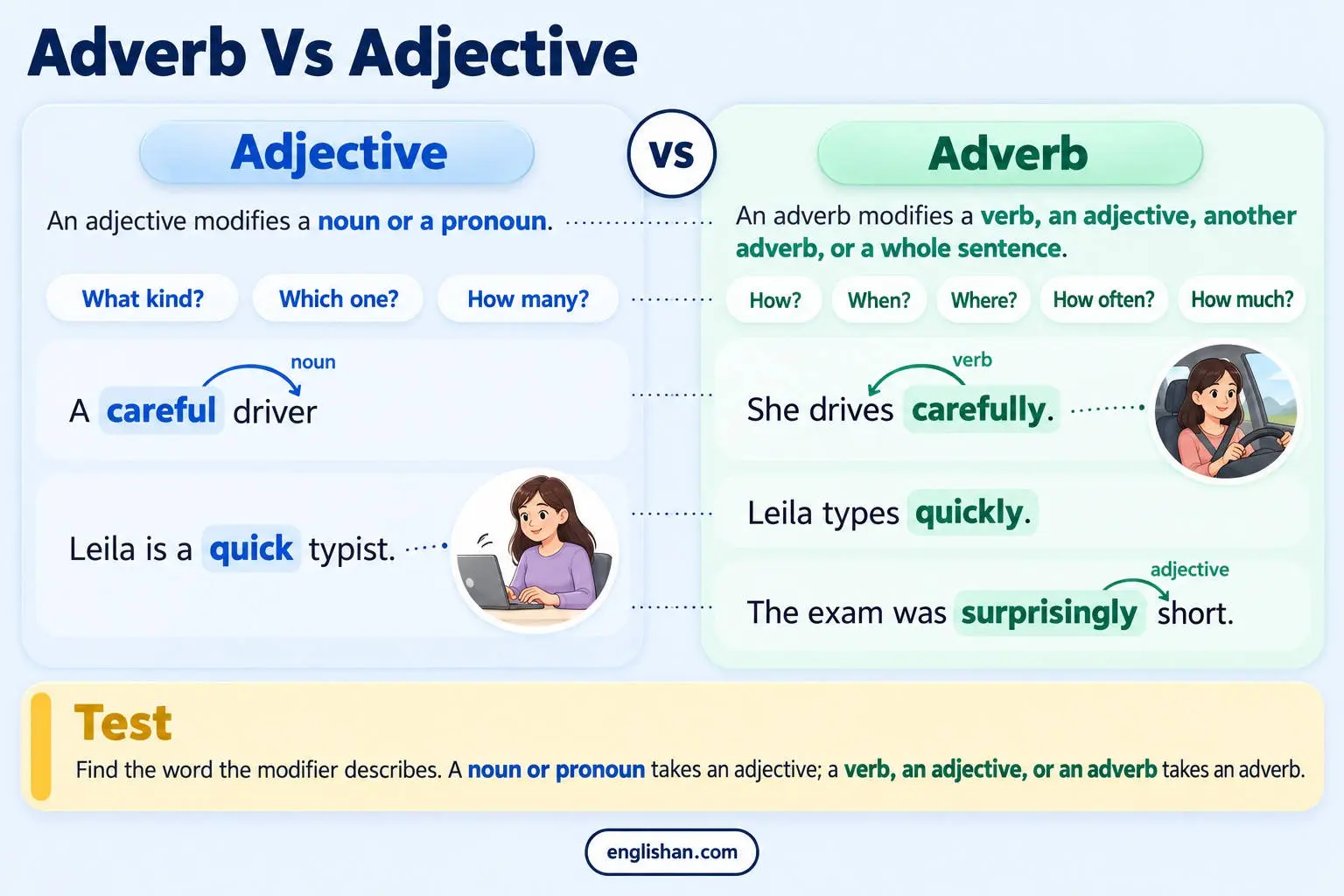
Difference Between Adjective And Adverb
An adjective modifies a noun or a pronoun, and an adverb modifies a verb, an adjective, another adverb, or a sentence. The two word classes also answer different questions and appear in different positions, so several features separate an adjective from an adverb at once.
| Feature | Adjective | Adverb |
|---|---|---|
| What it modifies | A noun or a pronoun | A verb, an adjective, another adverb, or a sentence |
| Questions it answers | What kind? Which one? How many? | How? When? Where? How often? How much? |
| Position | Before a noun, or after a linking verb | After the verb or its object, before an adjective, or at the start of a sentence |
| Form | Often no fixed ending: big, warm, careful | Often “-ly” added to an adjective: warmly, carefully |
| Comparison | Taller, more careful | Faster, more carefully |
Both word classes have comparative forms. The comparative adjectives compare people and things, as in “taller” and “more careful”. The comparative and superlative adverbs compare actions, as in “faster” and “most carefully”.
To settle an adverb vs adjective choice in a sentence, find the word that the modifier describes. If it is a noun or a pronoun, use an adjective; if it is a verb, an adjective, or an adverb, use an adverb.
- Leila is a quick typist. (modifies “typist”)
- Leila types quickly. (modifies “types”)
- The exam was surprisingly short. (modifies “short”)
A common error puts the adjective form after an action verb. The habit follows a pattern found in German and Dutch, where one word, such as “schnell”, functions as both adjective and adverb.
He answered the question honest. ❌
He answered the question honestly. ✅
The verb “answered” takes an adverb, so the “-ly” form follows the object.
Adverb Vs Adjective Examples
An adverb vs adjective pair built on one root shows the rule most directly, because only the word being described changes. In the first sentence of each pair, the adjective describes a person or thing, and in the second, the adverb describes how the action happens.
- Our manager is patient with new staff.
- She explains new tasks patiently.
- The flight was smooth from start to finish.
- The plane landed smoothly in heavy rain.
- Your last message sounded angry.
- Why did you reply so angrily?
- The children were noisy at dinner.
- They ate noisily and left early.
An adverb is not always placed next to a verb. It also modifies an adjective, another adverb, or a whole sentence:
- The final question was extremely difficult.
- Grace arrived unusually early this morning.
- Fortunately, the last train was still waiting.
Words such as “extremely” and “very” are adverbs of degree, and they come directly before the adjective or adverb they modify. A word like “fortunately” at the start modifies the whole sentence, so it is a sentence adverb.
The final question was extreme difficult. ❌
The final question was extremely difficult. ✅
The adjective “difficult” is modified by an adverb, not by another adjective, so “extreme” changes to “extremely”.
Adverb And Adjective Form
Most adverbs of manner are formed by adding “-ly” to an adjective, so “quiet” becomes “quietly” and “honest” becomes “honestly”. The spelling changes with three endings. A final “-y” changes to “-ily” (happy, happily), “-le” changes to “-ly” (gentle, gently), and “-ic” adds “-ally” (basic, basically), with “publicly” as the common exception. The full spelling rules are set out under how to form adverbs from adjectives.
The ending alone does not show the word class, because many adverbs have no “-ly” and some adjectives end in it. The adverbs without ly include some of the most frequent words in the language, such as “soon”, “here”, “very”, and “fast”, while “friendly” and “lovely” are adjectives.
Adjectives And Adverbs With Linking Verbs
A linking verb connects the subject to a word that describes the subject, so in an adverb vs adjective choice after a linking verb, the adjective is correct. Linking verbs include “be”, “become”, “seem”, and “appear”, and the sense verbs “look”, “feel”, “smell”, “sound”, and “taste” also take an adjective when they describe the subject.
- The soup smells good.
- These strawberries taste sweet.
- Your plan sounds reasonable to me.
- Daniel seemed nervous before the interview.
- I feel bad about missing your call.
The adjective after the verb describes the subject in every sentence: the soup, the strawberries, the plan, Daniel, and the speaker.
I feel badly about the mistake. ❌
I feel bad about the mistake. ✅
The verb “feel” links the speaker to the adjective “bad”, so “bad” describes the speaker.
The “-ly” in “feel badly” comes from an over-applied rule that every verb takes an adverb. The form is heard in American speech, but “feel bad” is the standard form in writing.
Look vs look carefully: A sense verb can also function as an action verb, and then it takes an adverb. When the verb shows how the subject seems, use an adjective, and when it shows an action the subject performs, use an adverb.
- You look tired today. (how you seem)
- Ines looked carefully at the contract. (what she did)
- The milk tastes sour. (how it seems)
- The chef tasted the sauce quickly before serving it. (what he did)
Where the choice is unclear, replace the verb with a form of “be”. If the sentence keeps its meaning, as in “You are tired”, the verb is a linking verb and takes an adjective.
Good Vs Well
The adjective “good” describes a noun, and its adverb “well” modifies a verb. Unlike most pairs, the two words share no root, so “well” is learned as the irregular adverb of “good”.
- Mariam is a good singer.
- She sings well in front of large audiences.
- The hotel staff did a good job.
- Our complaint was handled well.
She speaks Spanish very good. ❌
She speaks Spanish very well. ✅
The verb “speaks” is an action verb, so it takes the adverb “well”.
The word “well” is also an adjective with one meaning, ‘healthy’. After a linking verb, “I feel well” means the speaker is not ill, while “I feel good” usually means the speaker is happy or comfortable.
- I don’t feel well today, so I’m staying home.
- Is your grandmother well after her operation?
Words That Are Both Adjective And Adverb
Some words have one form for both word classes, and the position in the sentence shows which one it is. Before a noun, the word is an adjective, and after a verb, it is an adverb.
| Word | As an adjective | As an adverb |
|---|---|---|
| Fast | A fast car | Drives fast |
| Hard | A hard exam | Works hard |
| Late | A late lunch | Arrived late |
| Early | An early flight | Left early |
| Daily | A daily walk | Walks daily |
| Straight | A straight road | Went straight home |
| High | A high wall | Jumped high |
| Low | A low price | Flew low |
| Kindly | A kindly neighbor | Spoke kindly |
The adverb form of these words adds no “-ly”, and where an “-ly” word exists, such as “hardly”, “lately”, or “highly”, it has a different meaning.
Ravi drives very fastly. ❌
Ravi drives very fast. ✅
The adverb form of “fast” is “fast”, and “fastly” is not a word in standard English.
Hard and hardly: The adverb “hardly” is not the “-ly” form of “hard”. It means ‘almost not’, so “She hardly worked” means she did very little, while “She worked hard” means she put in a lot of effort.
I studied hardly for the exam. ❌
I studied hard for the exam. ✅
Late and lately: The adverb “late” means ‘after the expected time’, while “lately” means ‘recently’. With “lately”, the verb is usually in the present perfect, as in “Have you seen Omar lately?”, and “late” follows the verb, as in “Omar arrived late again”.
Adjective Or Adverb Words
Short function words cause the most doubt, because many of them are not adjectives or adverbs at all. A word before a noun is usually a determiner, also called a limiting adjective, and a word that modifies an adjective, an adverb, or a verb is an adverb.
| Word | Before a noun | As an adverb |
|---|---|---|
| Too | No | Yes: too hot (degree), me too (‘also’) |
| Very | No | Yes: very hot |
| Already | No | Yes: already finished |
| When | No | Yes: When did you arrive? (also a conjunction) |
| This, that | Yes: this book | Yes, informal: this big, that tall |
| Some | Yes: some milk | Yes: some fifty people (‘about’) |
| Enough | Yes: enough time | Yes: big enough |
| A, an | Yes: a desk (article) | No |
| The | Yes: the desk (article) | Yes: the more, the better |
The words “a”, “an”, and “the” are articles, so before a noun they function as adjectives, and “the” is an adverb only in comparisons such as “the sooner, the better”.
Adjectives Ending In -ly
Some adjectives end in “-ly” and have no adverb form: “friendly”, “lovely”, “lonely”, “silly”, “costly”, and “elderly”. These words describe nouns, as in “a friendly waiter” and “a lovely garden”, and they never follow an action verb as adverbs. To describe the manner of an action, use a phrase with “way” or “manner”.
- The receptionist greeted us in a friendly way.
- Oliver laughed in a silly way at his own joke.
- The house was decorated in a lovely manner.
The waiter spoke to us friendly. ❌
The waiter spoke to us in a friendly way. ✅
The word “friendly” has no adverb form in everyday English, so the manner after a verb takes the phrase “in a friendly way”.
Flat Adverbs In Speech
A flat adverb is an adverb with the same form as its adjective, as with “fast”, “hard”, and “late”. In everyday speech, adjectives also appear in places where writing has an “-ly” adverb, and the spoken and written forms then differ.
- Drive slow near the school. (speech, road signs)
- Drive slowly near the school. (writing)
- The concert was real good. (informal speech)
- The concert was really good. (writing)
- She did great in the interview. (informal speech)
- She did very well in the interview. (writing)
The adverb “slow” is standard after verbs of movement, as in “go slow” and “drive slow”, so it is correct in speech and on signs. The adverb “real” before an adjective belongs to informal American speech, and in writing the adverb is “really”. In formal writing and in exams, use the “-ly” adverb, unless the word is a flat adverb that is standard in every style, such as “fast”, “hard”, or “late”.
FAQs
No, adjectives describe only nouns and pronouns. An adverb is modified by another adverb, as in "very quickly", where "very" modifies "quickly".
Not when the two modify the same noun phrase: the adverb comes first and modifies the adjective, as in "a really fast car". After a linking verb, an adjective often comes before an adverb of time, as in "She was happy yesterday", because the two modify different words.
Only when the adverb has no "-ly" ending and the pair comes before a noun, as in "a well-known writer". An adverb ending in "-ly" takes no hyphen, so we write "a highly paid job" and "a newly built house". After the noun, the hyphen is dropped: "The writer is well known."
As an adverb of degree, "very" modifies adjectives and adverbs, as in "very cold" and "very slowly". It also functions as an adjective in a few fixed phrases meaning ‘exact’, as in "the very person I needed".
Both add description to a sentence: which person or thing and what kind, or how, when, and where an action happens. The sentence "The man drove home" says nothing about the man or the drive, while "The tired man drove home slowly" does. Adjectives and adverbs are two of the main parts of speech, alongside nouns and verbs.
Related: