Adjective and adverb clauses are dependent clauses that function as an adjective or an adverb in a sentence. An adjective clause modifies a noun, while an adverb clause modifies a verb, an adjective, or another adverb.
The two clauses often begin with the same word, such as “when” or “where”, so the first word does not always show the type. The type depends on the word the clause modifies, and asking what that word is settles the hard cases too.
Adjective and adverb clauses are both dependent clauses, but they modify different words. An adjective clause modifies a noun and begins with “who”, “whom”, “whose”, “which”, “that”, “where”, or “when”: the café where we met. An adverb clause modifies a verb, an adjective, or an adverb and begins with a subordinating conjunction such as “because”, “if”, or “until”: We left because it rained.
What Are Adjective And Adverb Clauses?
Adjective and adverb clauses are the two kinds of dependent clause that modify another word in a sentence. A dependent clause, also called a subordinate clause, has its own subject and verb, but it is not a complete sentence by itself, so it is joined to a main clause.
An adjective clause is a dependent clause that modifies a noun or a pronoun. It usually comes directly after that noun, and it begins with a relative word: “who”, “whom”, “whose”, “which”, “that”, “where”, or “when”. The adjective clause is also called a relative clause.
- The nurse who took my blood pressure was very kind.
- I finally read the book that you lent me.
- Our neighbors, whose dog barks all night, are moving in May.
An adverb clause is a dependent clause that modifies a verb, an adjective, or another adverb, and most adverb clauses modify the verb of the main clause. It begins with a subordinating conjunction such as “because”, “although”, “when”, “if”, “since”, or “until”. The conjunction expresses the meaning of the clause: time, reason, condition, contrast, place, or purpose.
- Text me when your train gets in.
- Although the apartment is small, the rent is high.
- We stayed inside because the storm was getting worse.
- The soup was hotter than I expected.
In the last sentence, the clause modifies the adjective “hotter”, not the verb. Groups of words with no subject and verb are phrases rather than clauses, and adjective phrase vs adverb phrase follows the same split between describing a noun and modifying an action.
Adjective Vs Adverb Clauses
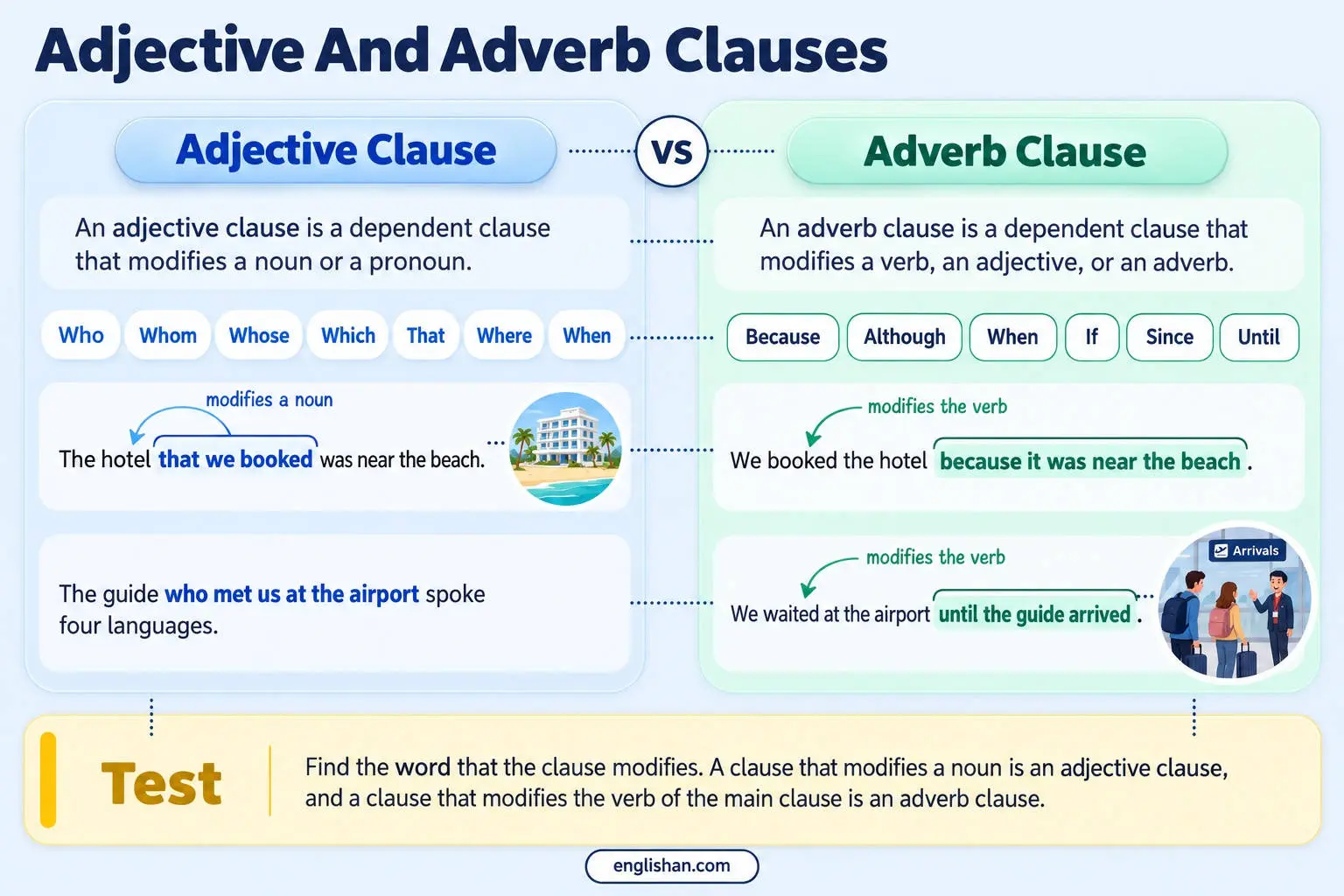
An adjective clause and an adverb clause are both dependent clauses with a subject and a verb, and both are joined to a main clause. An adjective clause modifies a noun, and an adverb clause modifies a verb, an adjective, or an adverb.
- The hotel that we booked was near the beach. (modifies “hotel”)
- We booked the hotel because it was near the beach. (modifies “booked”)
- The guide who met us at the airport spoke four languages. (modifies “guide”)
- We waited at the airport until the guide arrived. (modifies “waited”)
Use an adjective clause to say which person or thing you mean, or to add a fact about it. Use an adverb clause to say when, where, why, or under what condition the action of the main clause happens.
The two clauses differ in their first word, their position, and their commas:
| Feature | Adjective clause | Adverb clause |
|---|---|---|
| Job | Modifies a noun or a pronoun | Modifies a verb, an adjective, or an adverb |
| Question it answers | Which one? What kind? | When? Where? Why? Under what condition? |
| First word | Who, whom, whose, which, that, where, when | Because, although, when, if, since, until, where |
| Position | Directly after the noun it modifies | Before, after, or inside the main clause |
| Moves to the start of the sentence | No | Yes, usually |
| First word left out | Possible when it is the object | Not possible |
| Commas | Around a non-defining clause only | After the clause when it comes first |
Identification Of Adjective And Adverb Clauses
To identify an adjective or adverb clause, find the word that the clause modifies. A clause that modifies a noun is an adjective clause, and a clause that modifies the verb of the main clause is an adverb clause. An adverb clause can usually move to the start of the sentence with a comma after it, while an adjective clause has to stay next to its noun.
- She left the meeting before the manager arrived.
- Before the manager arrived, she left the meeting.
A clause that comes straight after a noun is not always an adjective clause. A “because” clause after “plumber” modifies “called”, since it gives the reason for the call, while a “who” clause in the same position modifies “plumber” and tells us which plumber.
- I called the plumber because the sink was leaking.
- I called the plumber who fixed our sink last year.
An adjective clause can also begin with no relative word at all. When the relative pronoun is the object of the clause, it is often left out in everyday English, so the clause begins with its own subject. An adverb clause does not lose its conjunction in this way, because the conjunction expresses its meaning.
- The photos you sent were lovely.
- That is the man I told you about.
- Is this the charger you were looking for?
The first word also has a different job inside each clause. A relative pronoun is the subject or the object of its own clause, so it replaces a noun, while a subordinating conjunction only joins the two clauses. For that reason, an adjective clause does not repeat the noun with a pronoun.
The phone that I bought it last week has stopped working. ❌
The phone that I bought last week has stopped working. ✅
The relative pronoun “that” is already the object of “bought”, so the clause takes no second object. The extra pronoun follows the relative clause pattern of Arabic and Hebrew, where the pronoun is repeated inside the clause.
The linking words “however” and “therefore” are conjunctive adverbs, not subordinating conjunctions, so they do not begin an adverb clause.
Uses Of When And Where In Adjective And Adverb Clauses
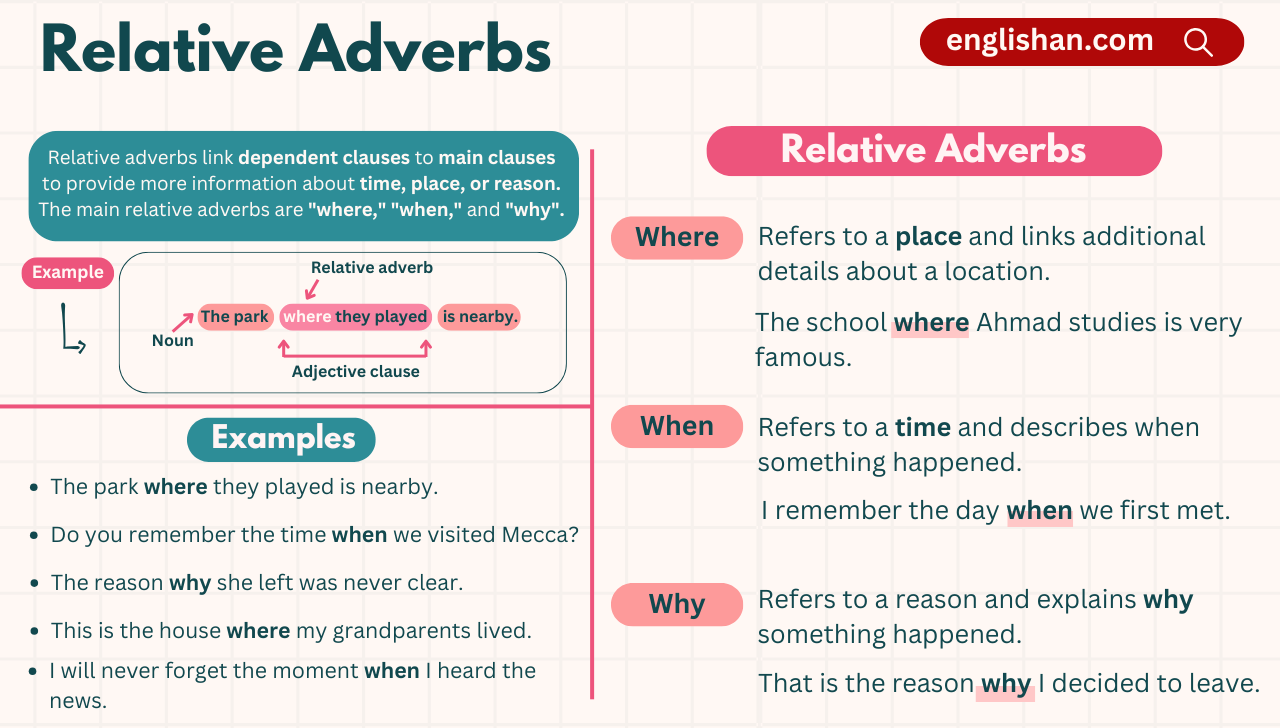
The words “when” and “where” begin both clause types, and the noun before them shows which type the clause is. After a noun of place, such as “town” or “office”, “where” means ‘in which’ or ‘at which’ and begins an adjective clause. With no such noun before it, “where” begins an adverb clause that tells us where the action of the main clause happens.
- This is the town where I grew up. (adjective clause)
- We camped where the river bends. (adverb clause)
The word “when” follows the same rule. After a noun of time, such as “day”, “year”, or “moment”, “when” means ‘on which’ or ‘in which’ and begins an adjective clause. Without that noun, “when” begins an adverb clause of time.
- Do you remember the day when we first met? (adjective clause)
- Call me when you land. (adverb clause)
- I still think about the summer when the power was out for a week. (adjective clause)
Used after a noun in this way, “where”, “when”, and “why” are relative adverbs, and “why” follows only the noun “reason”: the reason why she left. The adverb clause can move to the start of the sentence, as in “When you land, call me”, but the adjective clause stays after “day” or “town”.
I’ll never forget the day where we got the keys. ❌
I’ll never forget the day when we got the keys. ✅
The relative word “where” refers to a place, so “day” and other nouns of time take “when”, “that”, or no relative word at all.
Commas With Adjective And Adverb Clauses
Commas with adjective and adverb clauses follow two separate rules. An adjective clause takes commas when it is non-defining, and an adverb clause takes a comma when it comes before the main clause.
A defining adjective clause, also called an essential clause, tells us which person or thing we mean, so it takes no commas. A non-defining adjective clause adds a fact about a person or thing that is already identified, so commas go around it. The commas can change the meaning of a sentence.
- The students who finished early can leave. (defining)
- My sister, who lives in Denver, is visiting next week. (non-defining)
- The passengers who had tickets boarded the train. (only some)
- The passengers, who had tickets, boarded the train. (all of them)
The relative pronoun “that” begins defining clauses only, so it does not come after the comma of a non-defining clause.
My sister, that lives in Denver, is visiting next week. ❌
My sister, who lives in Denver, is visiting next week. ✅
A non-defining clause about a person begins with “who”, and one about a thing begins with “which”.
An adverb clause at the start of a sentence is followed by a comma. At the end of the sentence, it usually takes no comma, but a contrast clause with “although”, “though”, or “whereas” often has one before it.
- If the printer jams again, call the help desk.
- Call the help desk if the printer jams again.
- We kept working, although the power was off.
When the meeting ended we went for lunch. ❌
When the meeting ended, we went for lunch. ✅
The comma separates the opening adverb clause from the main clause that follows it.
Examples Of Adjective And Adverb Clauses
Adjective and adverb clauses often appear in the same sentence, with the adjective clause after a noun and the adverb clause attached to the verb of the main clause. A clause can even contain another clause.
- When the guests arrive, show them the room that we cleaned this morning.
- The bus that goes to the airport leaves whenever it is full.
- Anyone who wants a refund should call before the store closes.
- My brother still lives in the house where we grew up, although he works in Chicago.
- Since the café where we usually meet is closed, we’re meeting at my place.
In the last sentence, the adjective clause “where we usually meet” modifies “café”, and it is part of the adverb clause that begins with “since”.
Noun Adjective And Adverb Clauses
There are three main types of dependent clauses: noun clauses, adjective clauses, and adverb clauses. A noun clause is a dependent clause that functions as a noun, so it is the subject of a verb, the object of a verb, or the object of a preposition. It begins with “that”, “whether”, “if”, or a question word such as “what”, “who”, or “where”.
- What she said surprised everyone. (subject)
- I know that you tried your best. (object)
- We talked about where we should live. (object of preposition)
| Clause | Job in the sentence | Common first words |
|---|---|---|
| Noun clause | Subject, object, or object of a preposition | That, whether, if, what, who, where, when |
| Adjective clause | Modifies a noun or a pronoun | Who, whom, whose, which, that, where, when |
| Adverb clause | Modifies a verb, an adjective, or an adverb | Because, although, if, since, until, when, where |
The word “when” begins all three types, so the job of the clause shows its type, not the first word. A noun clause answers “what?” about the verb, an adjective clause follows a noun, and an adverb clause tells us when the action happens.
- I don’t know when the bank opens. (noun clause)
- Monday is the day when the bank opens late. (adjective clause)
- I’ll pay the bill when the bank opens. (adverb clause)
A noun clause can be replaced with “it” or “something”, as in “I don’t know something”, and the sentence keeps its structure. An adjective or adverb clause cannot be replaced that way, because it modifies another word instead of acting as one.
FAQs
Yes, an adjective clause has its own subject and verb, like any clause. The relative pronoun is often the subject itself, as in "the man who called", where "who" is the subject of "called".
An adjective clause can begin with a preposition in formal writing, where the preposition comes before "whom" or "which", as in "the colleague with whom I share an office". In everyday English, the preposition usually moves to the end of the clause: "the colleague I share an office with". The relative words "that" and "who" do not follow a preposition at the start of the clause.
Not with "that" alone, but "that" is part of several subordinating conjunctions: "so that", "now that", "in order that", and "provided that". The clause "so that everyone can hear" is an adverb clause of purpose.
Most adverb clauses modify the verb of the main clause, as in "She smiled when she saw the cake". Some modify an adjective or an adverb instead: in "He ran as fast as he could", the clause "as he could" modifies "fast".
No, an adjective clause follows the noun it modifies, so it cannot open a sentence by itself. It can still come early, inside the subject, as in "People who cycle to work rarely complain about traffic", where the clause follows "People".
Related:
- Adverb
- Types of Adverbs
- Adverbs of Time
- Adverbs of Place
- Adverbs of Reason
- Adverb vs Adjective
- Clauses and Their Types
- Complex Sentences