

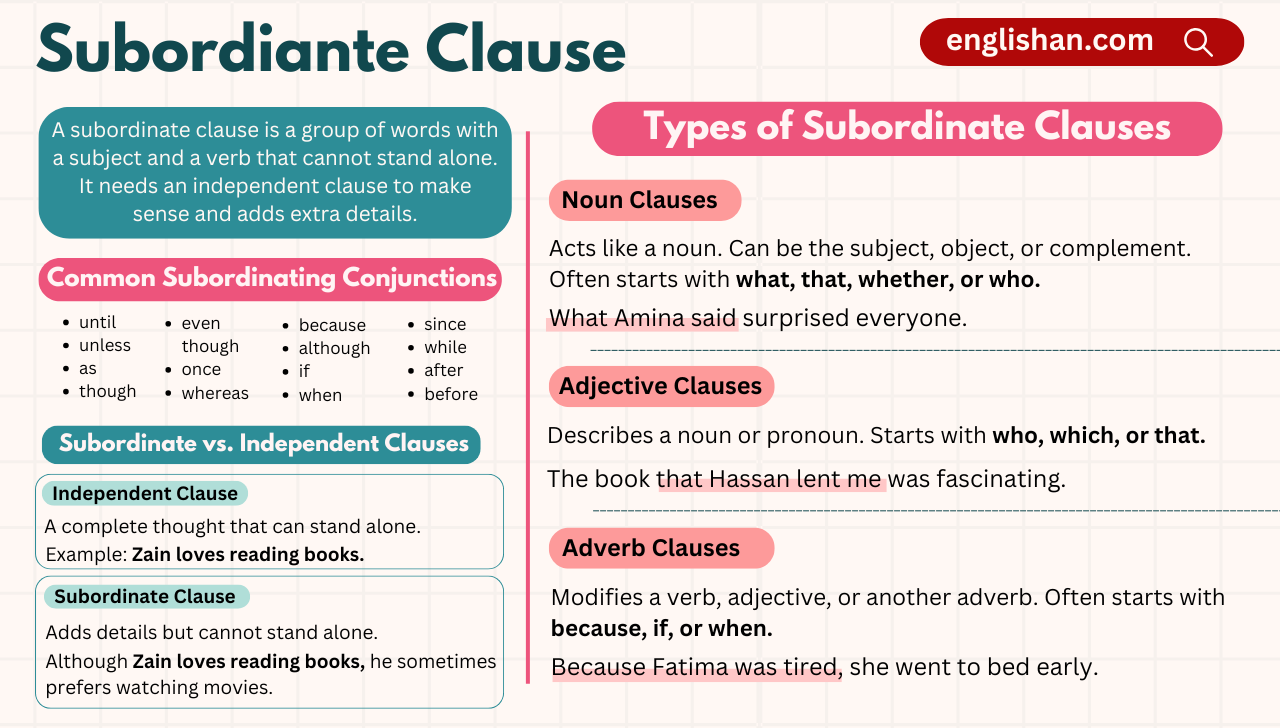
In English grammar, a subordinate clause is a group of words that adds extra information to a sentence but can’t stand alone as a complete thought. Learning about subordinate clauses helps you make more complex and interesting sentences.
What is a Subordinate Clause?
A subordinate clause is a group of words that has a subject and a verb but doesn’t express a complete thought. It needs to be connected to an independent clause to make sense. It adds details to the main clause, making the sentence more meaningful.
Subordinate clauses often start with a subordinating conjunction like because, although, if, or when. These words link the subordinate clause to the main part of the sentence and show how the two ideas are connected. Knowing how to use subordinate clauses helps you write better complex sentences.
Types of Subordinate Clauses
English has three main subordinate clauses: nouns, adjectives, and adverbs. Each type has a different job in a sentence.
- Noun Clauses
A noun clause acts like a noun in a sentence. It can be the subject, object, or complement. These clauses often start with words like what, that, whether, or who.
Example: What Amina said surprised everyone.
In this example, “what Amina said” is a noun clause that acts as the subject.
- Adjective Clauses
An adjective clause (a relative clause) describes a noun or pronoun and gives more information about it. It usually starts with a relative pronoun like who, which, or that.
Example: The book that Hassan lent me was fascinating.
Here, “that Hassan” lent me is an adjective clause that gives more details about the book.
- Adverb Clauses
An adverb clause modifies a verb, adjective, or another adverb. It tells you things like time, reason, condition, or contrast and often starts with a Subordinating conjunction.
Example: Because Fatima was tired, she went to bed early.
In this example, “Fatima was tired” is an adverb that explains why she went to bed early.
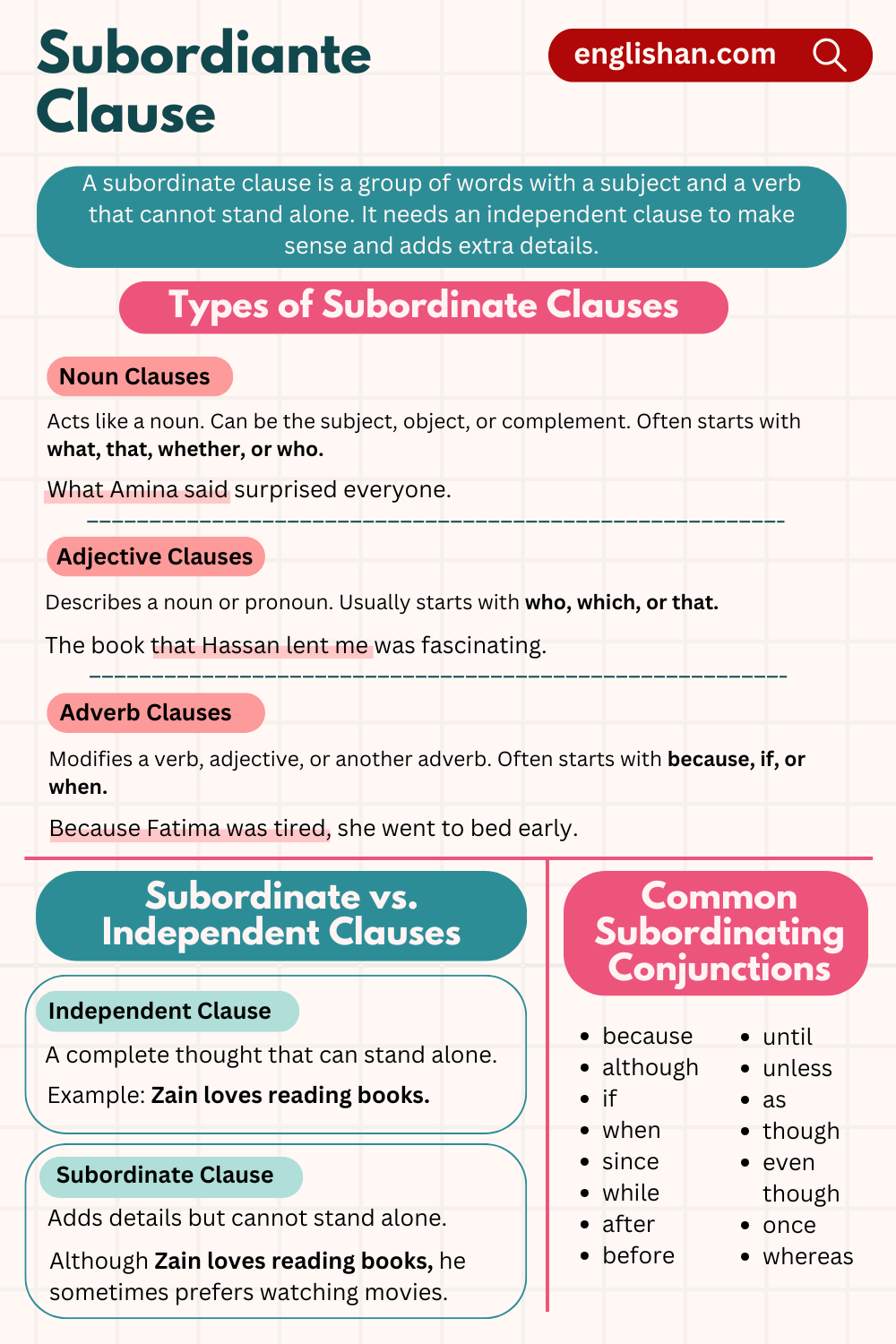
Where to Put a Subordinate Clause in a Sentence
You can put a subordinate clause at a sentence’s beginning, middle, or end. Its position can change the emphasis of the sentence.
- Beginning: If it rains tomorrow, we will stay indoors.
- Middle: The teacher, who was very patient, explained the problem again.
- End: I will call you when I get home.
Understanding sentence structure and where subordinate clauses fit helps you create more complex and compound sentences that are interesting to read.
Subordinate Clause vs. Independent Clause
An independent clause is a complete thought and can stand alone as a sentence. A subordinate clause cannot stand alone and depends on the main clause to make sense.
Example:
- Independent Clause: Zain loves reading books.
- Subordinate Clause: Although Zain loves reading books, he sometimes prefers watching movies.
In this sentence, “although Zain loves reading books” is the subordinate clause. It depends on the independent clause “he sometimes prefers watching movies” to complete the sentence.
Common Subordinating Conjunctions
Subordinating conjunctions are words that connect a subordinate clause to an independent clause. Here are some common ones:
because, although, if, when, since, while, after, before, until, unless, as, though, even though, once, whereas
These words help create complex sentences by showing relationships like cause, time, condition, or contrast between ideas. Knowing these conjunctions makes it easier to use subordinate clauses effectively.
Summary
A subordinate clause is integral to making sentences more detailed and exciting. It cannot stand alone as a complete sentence but adds extra information to an independent clause. You can make your writing more complex and engaging by understanding the different types of subordinate clauses—noun, adjective, and adverb clauses. Remember, a subordinate clause often starts with a subordinating conjunction and needs a main clause to make sense. Subordinate clauses will help you improve your writing and create more complex sentence structures.
FAQs
A subordinate clause is a part of a sentence that has a subject and a verb but doesn’t make sense on its own. It depends on another part of the sentence to make sense.
Examples:
Because I was tired (needs another part: “I went to bed early.”)
When she smiled (needs another part: “everyone felt happy.”)
If it rains (needs another part: “we will stay inside.”)
These clauses need to be joined with a main part of the sentence to have a complete meaning.
Here are simple examples of clauses:
She laughed. (Independent – can stand alone.)
Because it was raining. (Subordinate – needs more to make sense, like “We stayed inside.”)
He sings. (Independent – can stand alone.)
When I woke up. (Subordinate – needs more, like “It was already morning.”)
They play games. (Independent – can stand alone.)
Independent clauses make sense by themselves, while subordinate clauses need more to complete their meaning.
A subordinate clause is a part of a sentence that can’t stand by itself. It needs the rest of the sentence to make sense.
Example:
Because it was raining, we stayed inside.
“Because it was raining” is the subordinate clause. It doesn’t make sense alone. “We stayed inside” is the main part that makes the whole sentence complete.
A main clause can stand alone, while a subordinate clause needs a main clause to make sense.
Examples:
Main Clause: She went to the store.
Subordinate Clause: Because it was raining.
Full sentence: Because it was raining, she went to the store.
You May Also Like
Subordinate Clause Quiz
Subordinate Clause
Which is a subordinate clause?
'Because' opens a clause that depends on a main clause.
a subordinating word makes the clause dependent
because it was late
Which word begins the subordinate clause?
We left when the show ended.
'When' introduces the dependent clause.
subordinating conjunctions open dependent clauses
when the show ended
Which part is the subordinate clause?
The book that you lent me was excellent.
A relative clause beginning with 'that' modifies 'book' and cannot stand alone.
a relative clause is subordinate
that you lent me
Choose the correctly punctuated sentence.
A subordinate clause at the front takes a comma.
a leading subordinate clause takes a comma
Although she was tired, she finished the work.
Which is a fragment?
A subordinate clause standing alone is a fragment.
a subordinate clause alone is a fragment
Whenever I visit my grandmother, I feel at home.
How does 'why he left' work here?
I know why he left.
The clause names what is known and fills the object slot.
a noun clause can act as an object
I know why he left.
Which group of words is a subordinate clause?
Choose the dependent clause.
'Because' opens a clause that cannot stand alone.
subordinate clause depends on a main clause
...because he was late.
True or false?
A subordinate clause expresses a complete thought on its own.
A subordinate clause leaves the thought unfinished and leans on a main clause.
subordinate clause = dependent, incomplete alone
I stayed in because it was raining.
Find the subordinate clause.
I'll call you when I arrive.
'When' opens a dependent clause that relies on the main clause.
a subordinator introduces the dependent clause
...when I arrive.
Which word starts a subordinate clause?
Pick the subordinating word.
'Although' subordinates one clause to another.
subordinators: because, although, since, when, if
Although it was late, we kept working.
Add a subordinate clause beginning with 'because'.
We cancelled the trip ___ .
'Because' opens the dependent clause that gives the reason for the main clause.
attach a reason with a subordinate clause
We cancelled the trip because it was raining.
True or false?
A relative clause such as 'who lives next door' is a subordinate clause.
A relative clause modifies a noun and depends on the main clause, so it is subordinate.
relative clauses are subordinate
The man who lives next door is a doctor.
Which group of words is a subordinate clause?
Choose the dependent clause.
'When' opens a clause that cannot stand alone.
a subordinator introduces a dependent clause
...when the bell rang.
True or false?
A subordinate clause can stand alone as a sentence.
A subordinate clause depends on a main clause and cannot stand alone.
subordinate clauses are dependent
We waited until the rain stopped.
Find the subordinate clause.
We left after the show ended.
'After' opens a dependent clause that relies on the main clause.
a subordinator introduces the dependent clause
...after the show ended.
Which word starts a subordinate clause?
Pick the subordinating word.
'Unless' subordinates one clause to another.
subordinators: unless, because, although, when, if
Unless you hurry, we'll be late.
Add a subordinate clause beginning with 'when'.
I'll text you ___ .
'When' opens the dependent clause the main clause leans on for timing.
attach timing with a subordinate clause
I'll text you when I arrive.
True or false?
A clause beginning with 'that', such as 'that she left', can be subordinate.
'That' introduces a dependent noun clause that relies on the main clause.
'that' can open a subordinate clause
I heard that she left.
Find the subordinate clause.
The book that I borrowed is overdue.
'That I borrowed' modifies 'book' and depends on the main clause.
relative clauses are subordinate
...that I borrowed...
Which word does NOT start a subordinate clause?
Pick the coordinating word.
'But' coordinates two independent clauses; it does not subordinate.
coordinators (and, but, or) do not subordinate
She tried, but she failed.
Turn on JavaScript for the interactive quiz. The full practice set is shown above.