

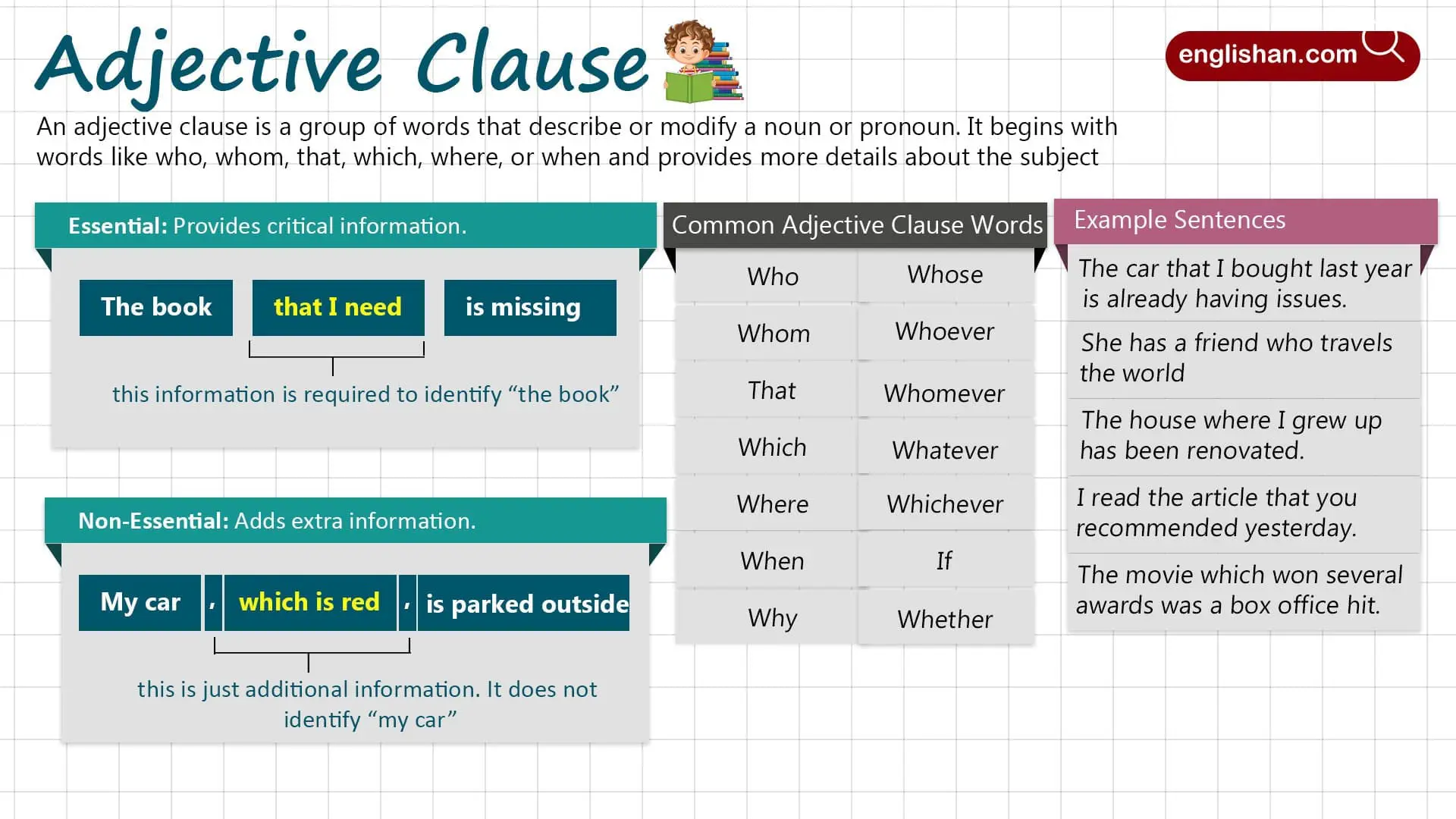
An adjective clause describes a noun or pronoun using a full group of words that carries its own subject and verb. Grammar books also name it a relative clause, because it opens with a relative pronoun such as who, which, or that. Where a single adjective gives one word of description, an adjective clause builds a whole descriptive statement and attaches it to the noun it follows.
Take the sentence The teacher who inspired me still writes to me. The words who inspired me form the adjective clause, and they tell you exactly which teacher the writer means. That precision is what these clauses do best, and mastering them starts with a firm definition.
What Is an Adjective Clause?
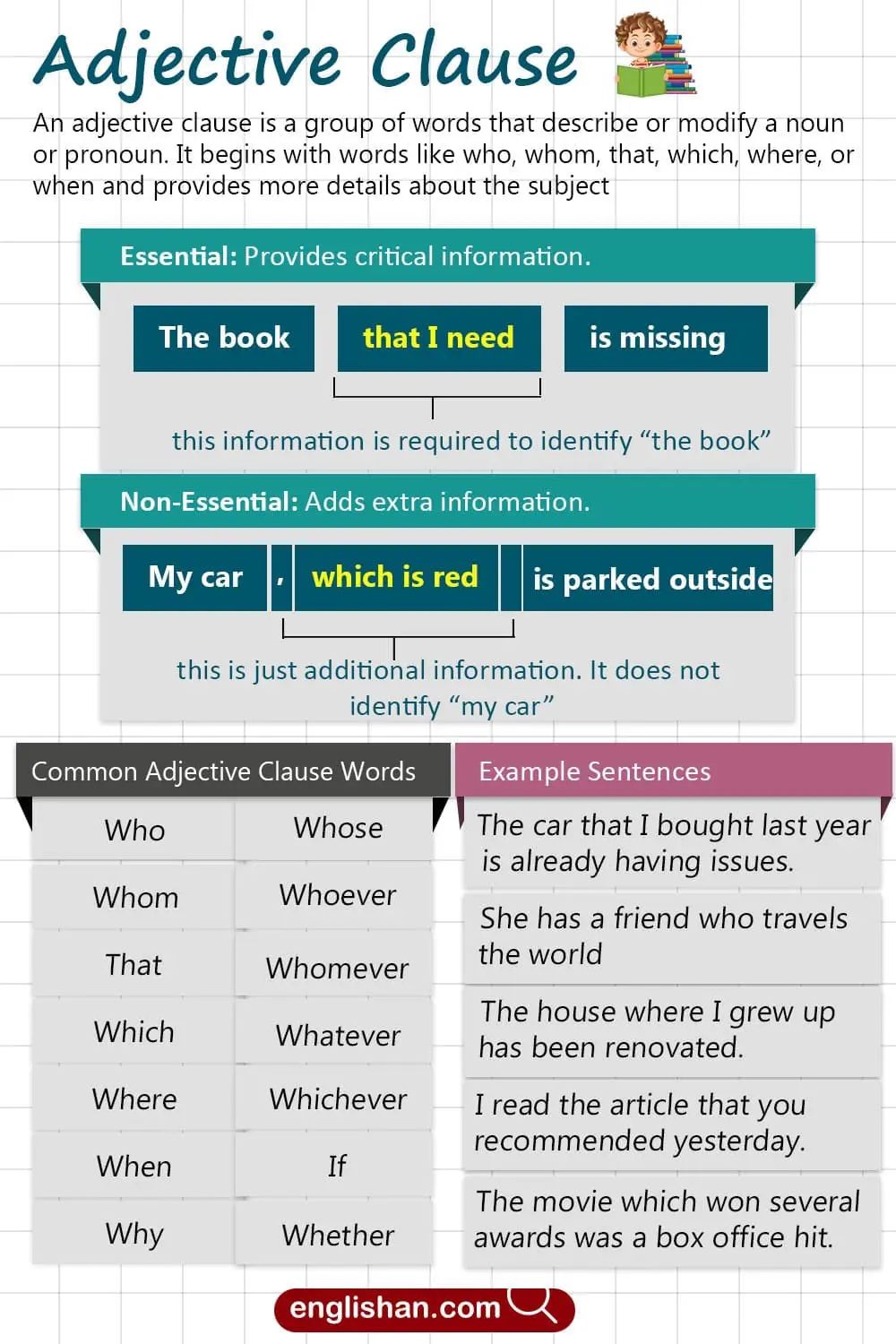
An adjective clause is a dependent clause that works as an adjective, describing a noun or pronoun somewhere in the main sentence. Like every clause, it holds a subject and a verb, which separates it from a phrase. And like every dependent clause, it depends on an independent clause to finish the thought, so it never stands alone as a sentence.
Two features mark it out. First, it sits directly after the noun it describes, not before it. Second, it answers the same questions a one-word adjective answers: which one, what kind, how many. In The house that Lily bought sits on a hill, the clause that Lily bought follows house and pins down which house.
Set a single adjective beside a full clause and the difference shows plainly:
- Single adjective: the red car.
- Adjective clause: the car that won the race.
Both describe car. The clause carries more, because it brings its own subject (that) and verb (won).
Adjective Clause Examples in Sentences
Reading adjective clauses in context is the fastest way to recognize them. In each sentence the clause is italicized, and the noun it describes comes just before it.
- The scientist who discovered the vaccine won a national award. (describes scientist)
- I still own the bike that my father gave me. (describes bike)
- The city where I grew up has changed a lot. (describes city)
- Students whose essays were late lost marks. (describes students)
- Sunday is the day when the market opens early. (describes day)
Notice a shared shape across all five. Each clause opens with a relative pronoun or relative adverb, each carries a subject and a verb, and each attaches to the noun right in front of it. Once that shape becomes familiar, adjective clauses are hard to miss.
Relative Pronouns and Relative Adverbs That Begin Adjective Clauses
Only a small set of words opens an adjective clause, and knowing them ends most of the guesswork. Five relative pronouns and three relative adverbs do nearly all the work.
| Word | Used for | Example in a sentence |
|---|---|---|
| Who | People, as the subject | The nurse who treated me was kind. |
| Whom | People, as the object | The friend whom I trust moved away. |
| Whose | Possession | The boy whose kite tore cried. |
| Which | Animals and objects | The film, which won awards, bored me. |
| That | People, animals, objects | The keys that I lost turned up. |
| Where | Places | The town where we met is tiny. |
| When | Times | The year when they married was 1990. |
| Why | Reasons | The reason why he left stays unknown. |
The rarer forms whoever, whomever, and whichever open adjective clauses on occasion, though the eight above cover almost everything you write.
One caution worth stating plainly: words such as before, after, since, if, whether, and what do not begin adjective clauses. Before, after, and since open adverb clauses that describe time, while what, whether, and if open noun clauses. Folding these into an adjective-clause list is a frequent error, and it leads writers to mislabel whole sentences.
When to Use Who, Whom, and Whose
These three confuse more writers than any other opener, because they all point to people. The choice depends on the job the word does inside the clause.
Use who when the person is the subject, the one acting: the artist who painted this. Use whom when the person is the object, the one acted upon: the artist whom they hired. Use whose to show ownership: the artist whose work sold first. A fast check for who versus whom: if you would answer with he or she, pick who; if the answer would be him or her, pick whom.
That vs Which in Adjective Clauses
That and which both point to animals and objects, yet they are not interchangeable. That introduces essential clauses, the kind a sentence needs to stay precise, and it takes no commas. Which introduces non-essential clauses, the kind that adds a side note, and it sits between commas.
- ✅ The laptop that crashed is still under warranty. (essential, no commas)
- ✅ My laptop, which cost a fortune, still crashes. (non-essential, commas)
Swap them and the meaning shifts. This choice rests on whether the clause is essential or not.
Essential and Non-Essential Adjective Clauses
Every adjective clause falls into one of two groups, and the split decides your punctuation.
An essential clause (also called restrictive) identifies the noun. Remove it and the sentence loses precision or meaning. It takes no commas.
- People who exercise daily sleep better. Drop who exercise daily and the claim collapses into people sleep better, which says something else entirely.
A non-essential clause (also called non-restrictive) adds extra description to a noun already identified. Remove it and the sentence still holds. It sits inside commas.
- My brother, who lives in Rome, called last night. You already know which brother; the clause fills in where he lives.
✅ Comma test: if you would drop the clause and still know exactly who or what the noun refers to, wrap it in commas. If dropping it leaves the noun vague, use no commas.
How to Form an Adjective Clause
These clauses earn their place by combining two short sentences into one fuller statement, which cuts repetition. Building one follows three moves.
Start with two sentences that share a noun:
- I called the plumber. The plumber fixed our sink.
Replace the repeated noun in the second sentence with a relative pronoun:
- The plumber becomes who fixed our sink.
Slot that clause directly after the matching noun in the first sentence:
- I called the plumber who fixed our sink.
The result reads as one sentence, keeps both facts, and names the plumber with precision. The same method works with which for objects and whose for possession.
Reducing an Adjective Clause to an Adjective Phrase
An adjective clause often shortens into an adjective phrase without losing meaning. The phrase drops the relative pronoun, and the sentence turns leaner. Three moves cover most cases.
Drop the relative pronoun and the be verb:
- The house that is for sale becomes the house for sale.
Drop the pronoun and be, then keep the main verb in -ing form:
- The man who is standing by the door becomes the man standing by the door.
Turn a passive clause into a past participle:
- The money that was stolen becomes the money stolen.
Each reduced version reads faster, though the full clause stays correct. Choose the phrase for tighter prose and the clause when you want the added weight of a subject and verb.
When You Can Omit the Relative Pronoun
English lets you drop the relative pronoun in some clauses and keep it in others, and one test settles which. Look at the word right after the relative pronoun.
When a verb follows the pronoun, the pronoun is the subject of the clause, and it stays:
- The dog that bit him ran off. Here that is the subject, so dropping it breaks the sentence.
When a noun or a new subject follows, the relative pronoun is the object, and it drops out freely:
- The book that I read was long becomes The book I read was long.
So the deciding question is short: does a verb sit right after the relative pronoun, or a new subject? A verb means keep it. A new subject means you are free to remove it.
Relative adverbs behave differently. Where, when, and why stay in place, since dropping them leaves the clause unclear.
Adjective Clause vs Adjective Phrase
Both describe a noun, so telling them apart comes down to one test: an adjective clause holds a subject and a verb, an adjective phrase does not.
| Feature | Adjective clause | Adjective phrase |
|---|---|---|
| Subject and verb | Present | Absent |
| Opener | Relative pronoun or adverb | None required |
| Sample | The car that runs on batteries | The car running on batteries |
The car that runs on batteries carries the subject that and the verb runs, so it is a clause. The car running on batteries has no subject-verb pair, so it is a phrase. The phrase is the shorter form of the clause, produced by the reduction shown earlier.
Adjective Clause vs Adverb Clause
These two dependent clauses modify different parts of speech, and that difference decides which one you are reading. An adjective clause modifies a noun and answers which one. An adverb clause modifies a verb, an adjective, or another adverb, and answers when, where, why, or how.
- Adjective clause: The house that stands on the hill is old. Here that stands on the hill describes the noun house.
- Adverb clause: We left the house because it was cold. Here because it was cold describes the verb left.
Their openers differ too. Adjective clauses start with relative pronouns and adverbs; adverb clauses start with subordinating conjunctions such as because, although, since, and if. Spotting the opener is the fastest route to labeling the clause correctly.
Adjective Clause vs Noun Clause
A noun clause fills a noun slot in the sentence, working as a subject, object, or complement. An adjective clause never fills that slot; it attaches to a noun and describes it. The same opening word plays both roles, so the test is function, not vocabulary.
- Noun clause: What she said surprised everyone. Here What she said is the subject of surprised.
- Adjective clause: The village where she lives floods each spring. Here where she lives describes the noun village.
Ask what the clause is doing. If it names the thing the sentence is about, it is a noun clause. If it describes a noun already present, it is an adjective clause.
Common Mistakes With Adjective Clauses
A few errors recur often enough to watch for in your own writing.
Wrong relative pronoun. Using which for a person, or who for an object, breaks the match.
- ❌ The doctor which treated me was kind.
- ✅ The doctor who treated me was kind.
Comma misuse. Placing commas around an essential clause, or dropping them from a non-essential one, changes the meaning.
- ❌ People, who break the law, face consequences.
- ✅ People who break the law face consequences.
A fragment left standing. An adjective clause on its own is a sentence fragment, since it does not finish a thought.
- ❌ The student who passed the exam.
- ✅ The student who passed the exam thanked her tutor.
Overloading one sentence. Stacking three or four adjective clauses turns a sentence into a maze. Break it in two.
- ❌ The man who owns the shop that sells the bread that we love retired.
- ✅ The man who owns our favorite bread shop retired.
FAQs
An adjective clause is a dependent clause that describes a noun or pronoun using its own subject and verb, and it opens with a relative pronoun such as who, which, or that. It always follows the noun it describes and does not stand alone as a sentence.
Find a noun, then look for a group of words right after it that starts with who, whom, whose, which, that, where, when, or why and holds a subject and a verb. If that group describes the noun and answers which one, it is an adjective clause.
An adjective clause contains a subject and a verb, while an adjective phrase does not. The book that I bought is a clause; the book on the table is a phrase. Both describe a noun.
An adjective clause describes a noun and starts with a relative pronoun or adverb. An adverb clause describes a verb, adjective, or adverb and starts with a subordinating conjunction such as because or although.
Yes. When and where are relative adverbs that open adjective clauses when they describe a noun, as in the house where I was born or the day when we met.
Use that for essential clauses that identify the noun, with no commas. Use which for non-essential clauses that add extra description, set off by commas.
You May Also Like
Adjective Clauses Quiz
Adjective Clauses
Find the adjective clause.
The boy who won the race smiled.
'Who won the race' describes the noun 'boy', so it is an adjective clause.
adjective clauses describe a noun
The boy who won the race smiled.
What does the adjective clause describe?
'The book that I borrowed was long.'
'That I borrowed' describes the noun 'book'.
an adjective clause modifies a noun
The book that I borrowed was long.
Which word opens the adjective clause?
'The house where we stayed was old.'
'Where' opens the adjective clause describing 'house'.
adjective clauses open with who, which, that, where, when, whose
The house where we stayed was old.
Find the adjective clause.
The woman whose bag was stolen called the police.
'Whose bag was stolen' describes 'woman', so it is an adjective clause.
adjective clauses can show possession with 'whose'
The woman whose bag was stolen called the police.
Reduce the adjective clause.
'The man who is standing there is my uncle.' Reduced, this becomes ___ .
An adjective clause with 'who is' can reduce to a participle phrase.
'who/which is' + -ing can reduce to a participle
The man standing there is my uncle.
Find the adjective clause.
The film that we watched was thrilling.
'That we watched' describes 'film', so it is an adjective clause.
adjective clauses modify nouns
The film that we watched was thrilling.
Defining or non-defining adjective clause?
'My phone, which is new, broke.'
The clause adds extra detail about a known phone, so commas fit.
non-defining adjective clauses take commas
My phone, which is new, broke.
What does the adjective clause describe?
'The song that she sang moved us.'
'That she sang' describes the noun 'song'.
an adjective clause modifies a noun
The song that she sang moved us.
True or false?
An adjective clause does the work of an adjective by describing a noun.
An adjective clause modifies a noun, just as a single adjective would.
adjective clauses describe nouns
The car that he drives is fast.
Which word opens the adjective clause?
'The teacher who taught us retired.'
'Who' opens the adjective clause describing 'teacher'.
'who' opens adjective clauses about people
The teacher who taught us retired.
Reduce the adjective clause.
'The letters that were sent yesterday arrived.' Reduced, this becomes ___ .
An adjective clause with 'that were' can reduce to a past participle phrase.
'that/which were' + participle can reduce
The letters sent yesterday arrived.
Find the adjective clause.
The dog that barked all night kept us awake.
'That barked all night' describes 'dog', so it is an adjective clause.
adjective clauses modify nouns
The dog that barked all night kept us awake.
Name the clause type.
In 'the man who called', 'who called' is a(n) ___ clause.
'Who called' describes the noun 'man', so it is an adjective (relative) clause.
a clause describing a noun is an adjective clause
The man who called left a message.
Which noun does the clause describe?
'The students who studied passed the exam that was hard.'
'Who studied' describes 'students'; 'that was hard' describes 'exam'.
each adjective clause attaches to its own noun
The students who studied passed the exam that was hard.
Find the adjective clause.
The city which he visited was ancient.
'Which he visited' describes 'city', so it is an adjective clause.
'which' opens adjective clauses about things
The city which he visited was ancient.
Can the pronoun be omitted?
'The book (that) I read was long.' The pronoun can be dropped because it is the ___ .
An object relative pronoun in a defining adjective clause can be left out.
an object relative pronoun may be omitted
The book I read was long.
What does the adjective clause describe?
'The road that leads home is closed.'
'That leads home' describes the noun 'road'.
an adjective clause modifies a noun
The road that leads home is closed.
True or false?
An adjective clause is another name for a relative clause.
An adjective clause and a relative clause both describe a noun.
adjective clause = relative clause
The man who called left.
Which word opens the adjective clause?
'The year when we met was 2010.'
'When' opens the adjective clause describing 'year'.
'when' opens adjective clauses about time
The year when we met was 2010.
Find the adjective clause.
Anyone who breaks the rule will be fined.
'Who breaks the rule' describes 'anyone', so it is an adjective clause.
adjective clauses can modify indefinite pronouns
Anyone who breaks the rule will be fined.
Turn on JavaScript for the interactive quiz. The full practice set is shown above.