

An adjective is a word that describes a noun or a pronoun. In “a tall building”, the adjective “tall” describes the noun “building”, and in “She is tall“, it describes the pronoun “she”.
Adjectives answer the questions what kind, which one, how many, and whose, and they are divided into types by the question each one answers. An adjective keeps one form for singular and plural nouns, so “a red car” and “red cars” use the same word.
Most adjectives can be compared as well, so “small” becomes “smaller” and “the smallest”. Whatever its type, an adjective does one job in the sentence: it tells us more about a noun or a pronoun.
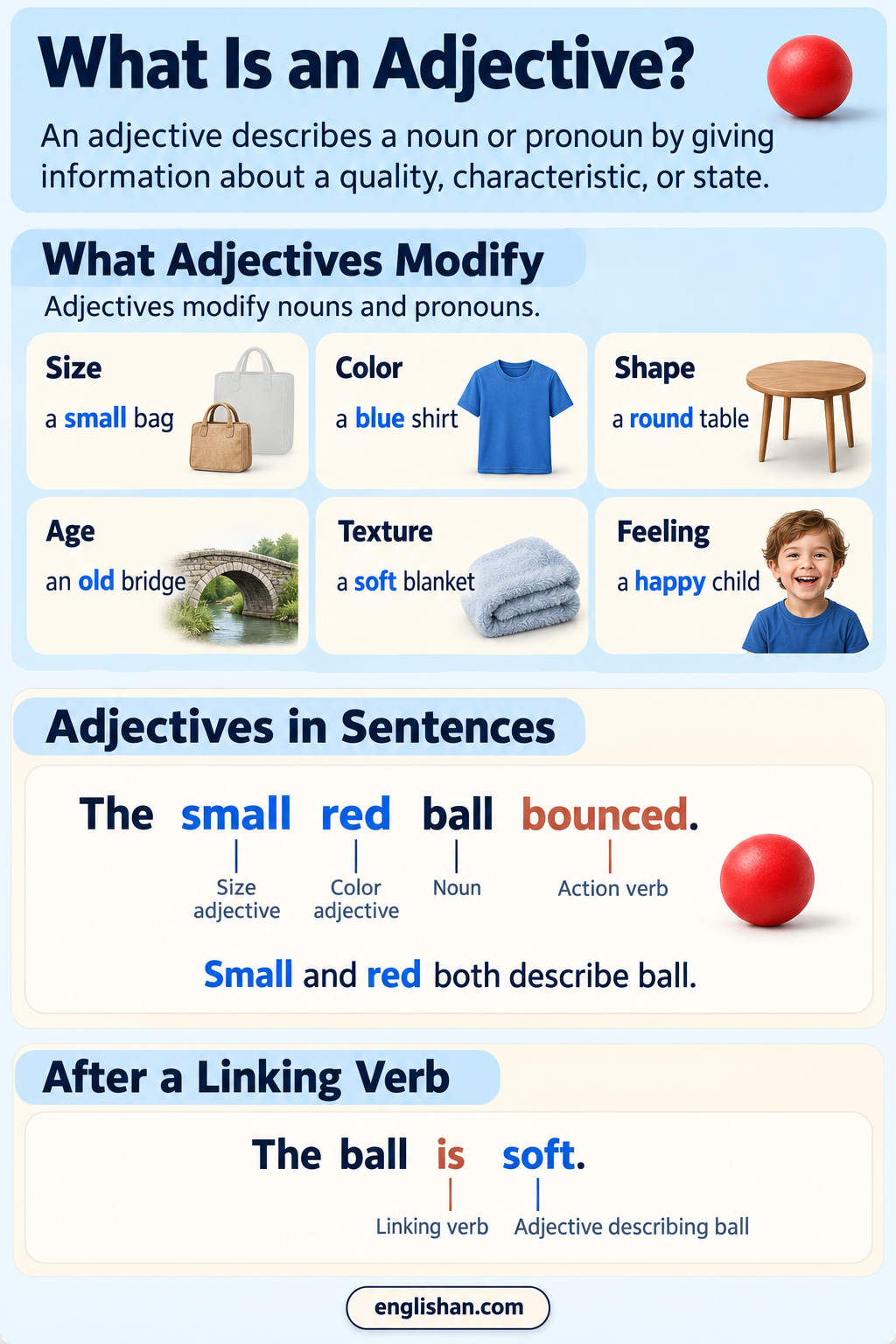
An adjective is a word that describes a noun or a pronoun, as in “a cold morning” and “The morning was cold“. Adjectives tell us what kind, which one, how many, or whose. An adjective usually comes before its noun or follows a linking verb, and most adjectives can be compared: “cold”, “colder”, “coldest”.
Function Of Adjectives In A Sentence
An adjective adds a detail to a noun or a pronoun: its size, color, age, number, owner, or kind. The noun names who or what is meant, and the adjective narrows that meaning, so “a car” becomes “a small car” or “an electric car”.
- The new manager answered every difficult question.
- We rented a small apartment near the old harbor.
- My little sister sent me a funny voice message.
An adjective describes a pronoun in the same way. With personal pronouns the adjective follows a linking verb, and with pronouns such as “someone” and “anything” it comes directly after the pronoun.
- She is patient with beginners.
- It smells wonderful in the kitchen.
- We need someone reliable for the night shift.
Each adjective answers one of four questions about its noun: what kind (“a wooden table”), which one (“that table”), how many (“six tables”), or whose (“our table”). The question an adjective answers shows which of the types below it belongs to.
Types Of Adjectives
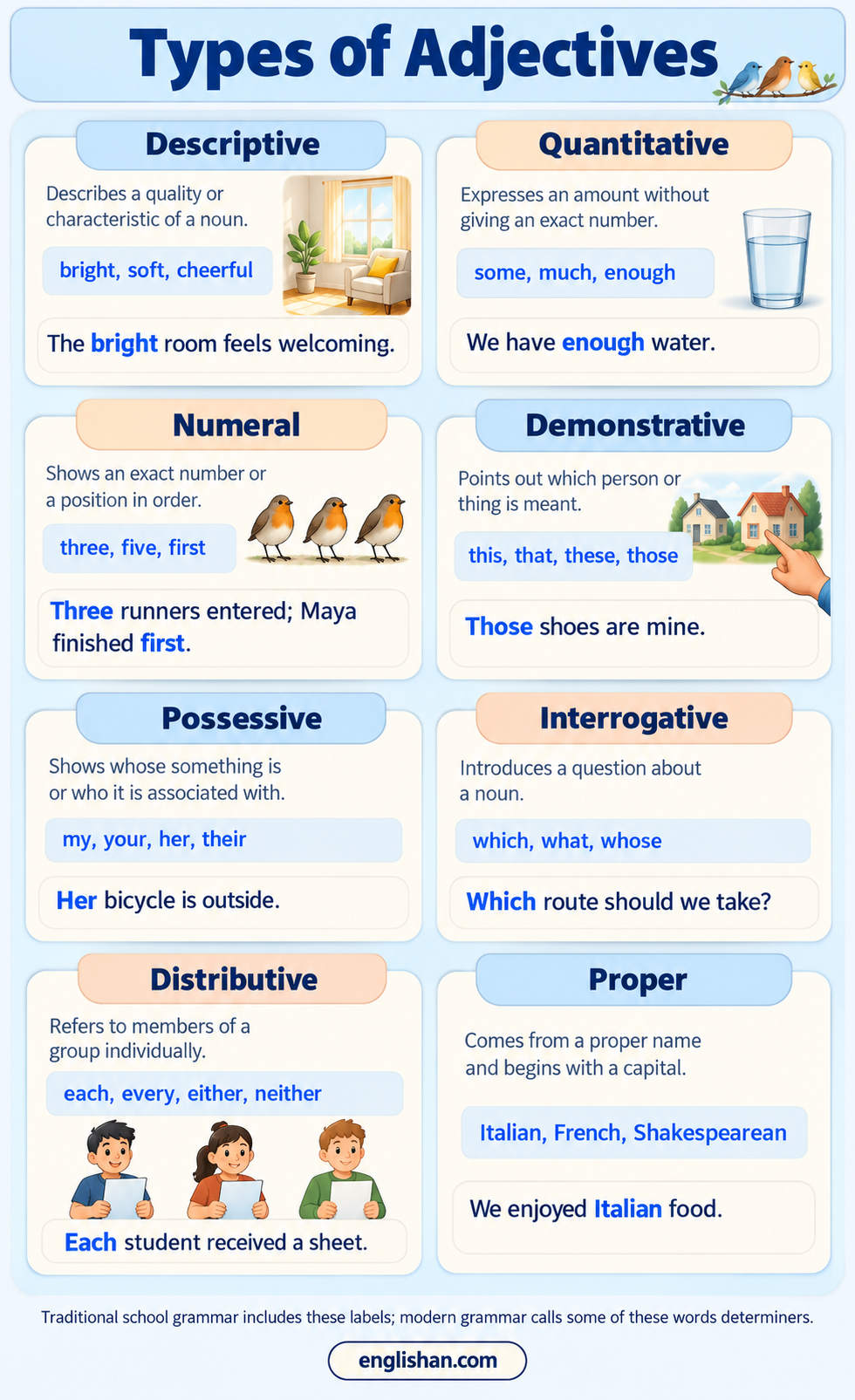
There are eight main types of adjectives: descriptive, participial, proper, quantitative, demonstrative, possessive, interrogative, and distributive adjectives. Comparative, superlative, attributive, predicate, and compound adjectives are sometimes counted as types too, which brings the number to thirteen. Each of those is a form or a position of an adjective, not a type of its own. A single word can belong to different types in different sentences, so the use in the sentence, not the word alone, shows the type.
Descriptive Adjectives
Descriptive adjectives tell us the quality of a noun: its size, shape, color, age, feel, or state. They form the largest type, and the rules for order, commas, and comparison apply mainly to them.
- The narrow street was full of noisy scooters.
- Her woolen scarf kept out the cold wind.
- The tired nurse finished a long shift.
Participial Adjectives
A participial adjective is an adjective formed from a verb, usually ending in “-ing” or “-ed”, as in “a boring lecture” and “a bored student”. With feelings, the “-ing” form names the cause, and the “-ed” form names the person who feels it.
- The broken window let in the rain.
- We watched an exciting match.
- The excited fans sang for an hour.
I am boring in this class. ❌
I am bored in this class. ✅
The speaker feels it, so the form is “bored”; “boring” would name the cause of the feeling.
Related: Participle Adjectives
Proper Adjectives
A proper adjective is an adjective formed from a proper noun, the name of a particular person or place. It begins with a capital letter in every position, before the noun or after a linking verb.
- We ordered Turkish coffee after dinner.
- She is reading a Victorian novel.
- My cousin married a Brazilian engineer.
I love italian food. ❌
I love Italian food. ✅
The adjective is formed from the name “Italy”, so it keeps the capital letter.
Quantitative Adjectives
A quantitative adjective tells us how many or how much: an exact number, as in “two tickets”, or a general amount, as in “many passengers” and “some rice”. The word “many” is used with nouns you can count, and “much” with nouns you cannot.
- I bought three tickets for the night train.
- Many passengers missed the connection.
- There is not much milk left.
How many money do you need? ❌
How much money do you need? ✅
The noun “money” is uncountable, so it takes “much”, not “many”.
Related: Countable and Uncountable Nouns
Demonstrative Adjectives
A demonstrative adjective points out which noun is meant: “this” and “these” for nouns near the speaker, “that” and “those” for nouns farther away. A singular noun takes “this” or “that”, and a plural noun takes “these” or “those”.
- This seat is free.
- Those clouds look heavy.
- I prefer that color for the walls.
I like this shoes. ❌
I like these shoes. ✅
The noun “shoes” is plural, so it takes the plural form “these”.
Possessive Adjectives
A possessive adjective shows who owns or has the noun: “my”, “your”, “his”, “her”, “its”, “our”, and “their”. It comes before the noun, while the possessive pronouns “mine”, “yours”, and “hers” replace the noun instead.
- Her flight lands at noon.
- The dog buried its bone in our garden.
- Their apartment has a view of the river.
The company changed it’s logo. ❌
The company changed its logo. ✅
The form “its” with no apostrophe is the possessive adjective, and “it’s” means ‘it is’.
Interrogative Adjectives
An interrogative adjective asks a question about a noun and comes directly before it: “which”, “what”, and “whose”. The word “which” asks about a known set of choices, and “what” asks with no set in mind.
- Which platform does the train leave from?
- What size do you wear?
- Whose umbrella is this?
Distributive Adjectives
A distributive adjective picks out the members of a group one at a time: “each”, “every”, “either”, and “neither”. All four take a singular noun and a singular verb, even when they describe a whole group.
- Each student presents for five minutes.
- Neither answer is correct.
- Either road leads to the stadium.
Every students passed the exam. ❌
Every student passed the exam. ✅
The word “every” takes a singular noun, even though it describes the whole group.
Position Of Adjectives In A Sentence
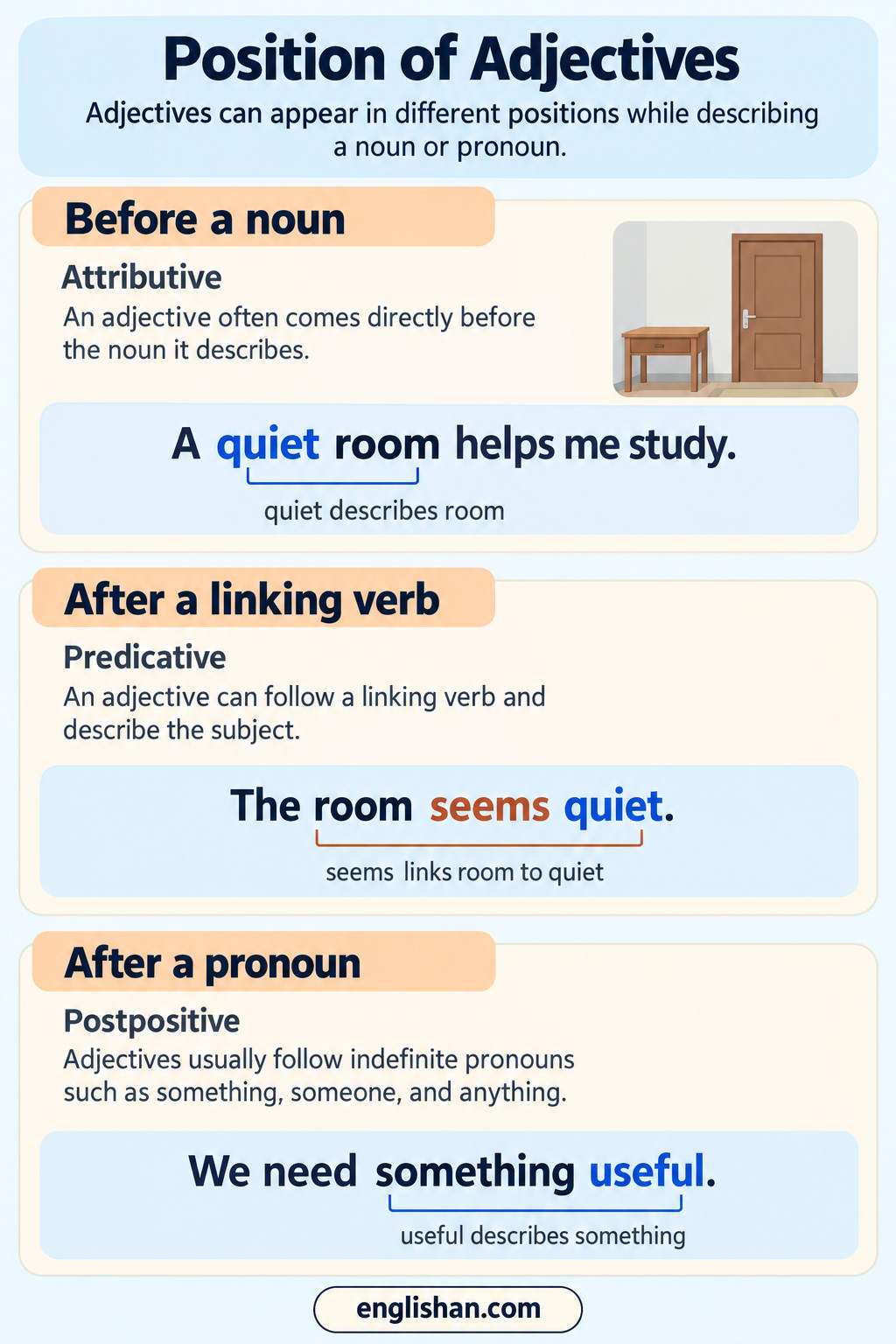
An adjective goes in one of two main positions: before its noun, or after a linking verb. Before the noun it is called an attributive adjective, as in “a quiet library”, and after a linking verb it is called a predicate adjective, as in “The library is quiet“.
A linking verb joins the subject to a word that describes it. The common linking verbs are “be”, “seem”, “become”, “feel”, “look”, “taste”, “smell”, and “sound”.
- The quiet library closes at eight.
- Your idea sounds practical.
- The soup tasted salty to everyone at the table.
In a small group of fixed phrases, the adjective comes directly after its noun, as in “the president elect” and “the best seats available“. With pronouns such as “someone”, “anyone”, and “nothing”, the adjective always follows: “someone famous“, “nothing serious“.
A few adjectives beginning with “a-“, such as “afraid”, “asleep”, “alive”, and “alone”, are used only after a linking verb, never before a noun.
Do not wake the asleep baby. ❌
Do not wake the sleeping baby. ✅
The adjective “asleep” is used only after a linking verb, so “sleeping” is the form used before a noun.
Order Of Adjectives
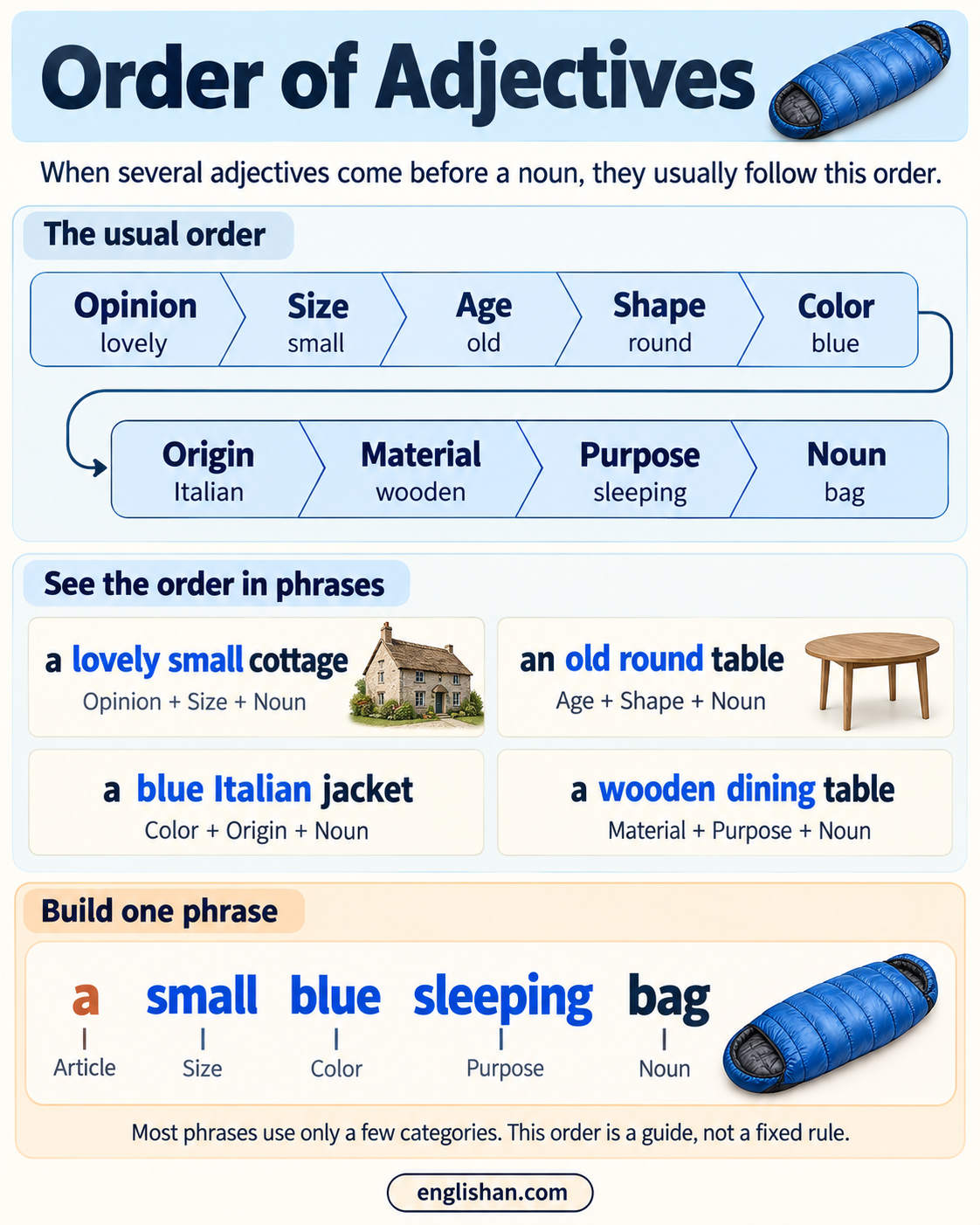
When two or more adjectives come before one noun, they follow a fixed order: opinion, size, age, shape, color, origin, material, and purpose. The order is the reason “a lovely old Spanish guitar” sounds natural and “a Spanish old lovely guitar” does not.
- She bought a beautiful little desk for the study. (opinion, size)
- He wore an old gray woolen coat. (age, color, material)
- They sold a round wooden picnic table. (shape, material, purpose)
He bought a leather black Italian jacket. ❌
He bought a black Italian leather jacket. ✅
Color comes before origin, and origin comes before material.
A noun with more than three adjectives before it is rare, and the order stays the same however many there are.
Related: Order of Adjectives
Coordinate And Cumulative Adjectives
Coordinate adjectives describe the noun separately and take a comma between them, as in “a long, tiring journey”. Cumulative adjectives form one unit of meaning and take no comma, as in “a bright red door”, where “bright” describes “red” rather than “door”. The comma between two adjectives follows this split, not the length of the phrase.
- We hiked through a dark, silent forest.
- She wore a pale blue silk dress.
- He gave a short, honest answer.
When you are unsure, place “and” between the two adjectives. A phrase that still sounds natural, as in “a long and tiring journey”, takes the comma, and a phrase that does not, as in “a bright and red door”, stays without one.
Coordinate adjectives can also change their order, so “a silent, dark forest” is correct too. Cumulative adjectives keep one order, the fixed order of adjectives.
Degrees Of Comparison Of Adjectives
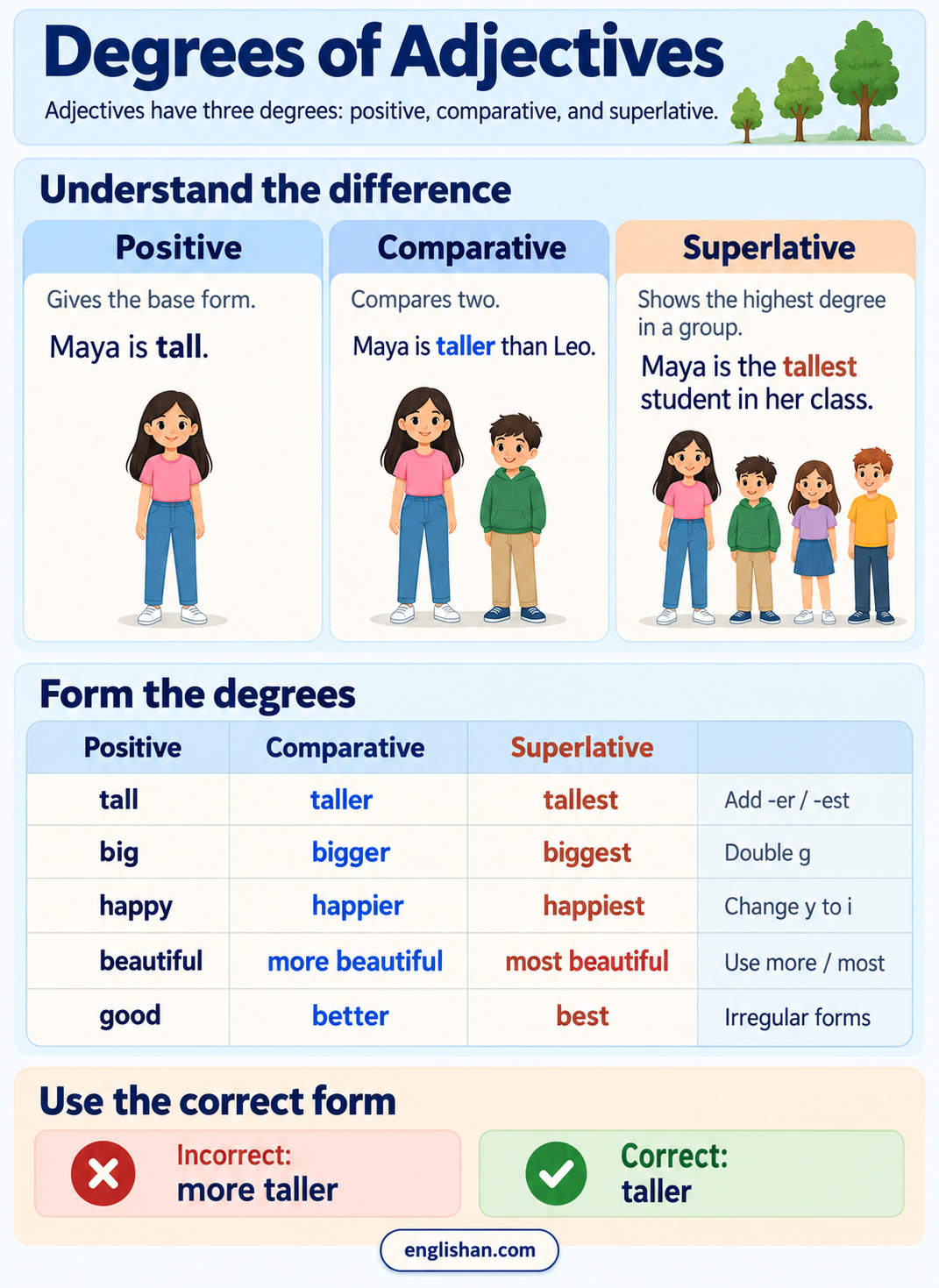
An adjective has three degrees: the positive (“tall”), the comparative (“taller”) for comparing two, and the superlative (“the tallest”) for three or more. The comparative is formed with “-er” or “more”, and the superlative with “-est” or “most”.
One-syllable adjectives take “-er” and “-est”. An adjective ending in a consonant plus “-y” changes the “-y” to “-i” before the ending, so “busy” becomes “busier” and “the busiest”. Adjectives of three or more syllables take “more” and “most” instead, and so do most adjectives of two syllables.
| Adjective | Comparative | Superlative |
|---|---|---|
| “Cold” | “Colder” | “The coldest” |
| “Busy” | “Busier” | “The busiest” |
| “Expensive” | “More expensive” | “The most expensive” |
| “Good” | “Better” | “The best” |
| “Bad” | “Worse” | “The worst” |
The adjectives “good” and “bad” have irregular forms, so no ending is added to them.
- The metro is faster than the bus.
- January is colder than March here.
- That was the most expensive meal of the trip.
- Her results were better than mine.
This road is more longer than the highway. ❌
This road is longer than the highway. ✅
An adjective takes “-er” or “more”, never both; doubling the comparative is an over-applied rule, not a different meaning.
A small group of adjectives names a complete state and is not usually compared: “unique”, “perfect”, “dead”, and “impossible”. Something is either unique or not unique, so “very unique” and “more unique” are avoided in careful writing.
Related: Degrees of Comparison
Compound Adjectives
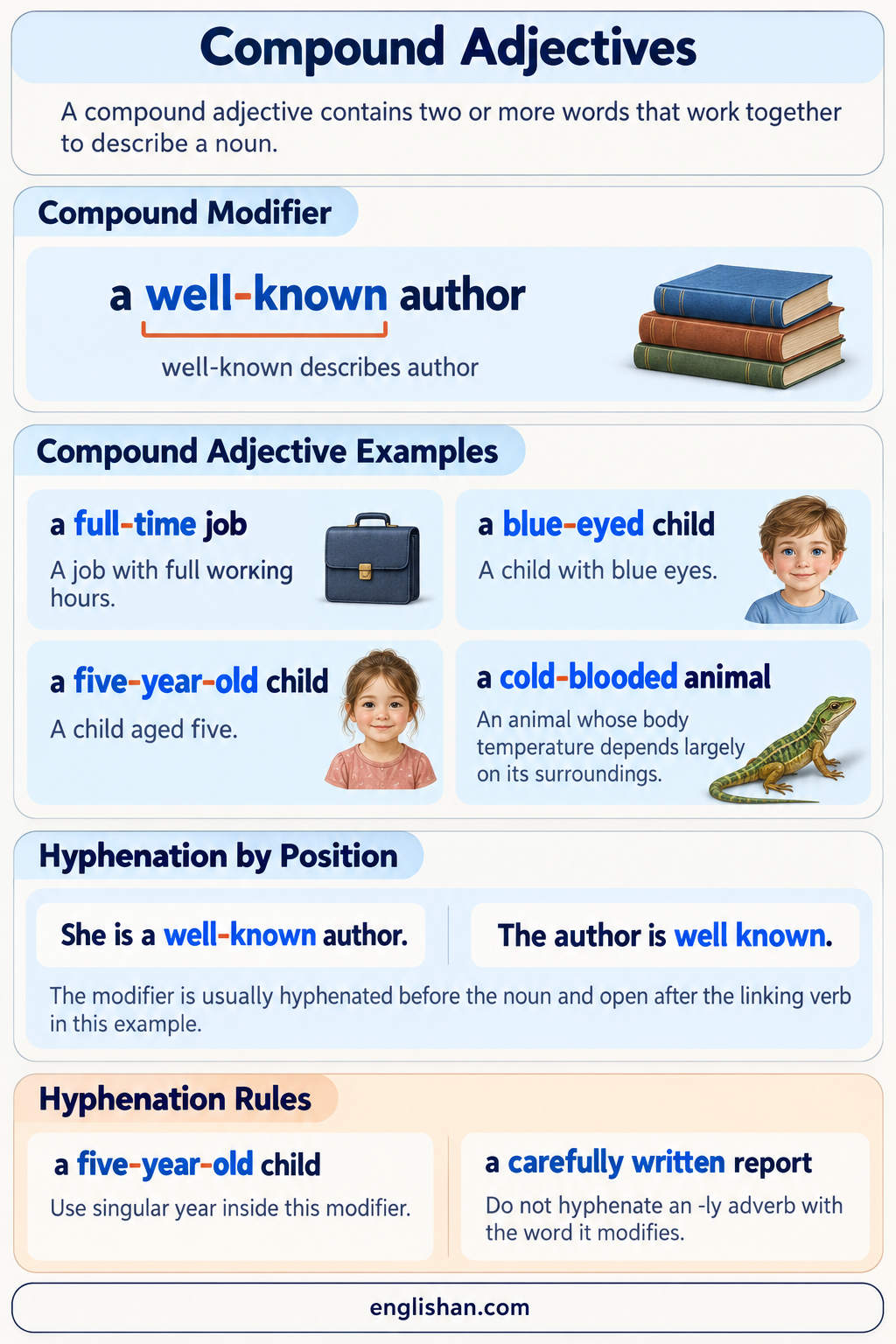
A compound adjective is one adjective made of two or more words, usually joined with hyphens, as in “a well-known author” and “a ten-minute break”. Before the noun, the hyphens show that the words form one adjective; after a linking verb, the hyphen is usually dropped, so the author is “well known”.
- She has a part-time job at the clinic.
- We booked a last-minute flight to Doha.
- The hotel serves an all-day breakfast.
A number inside a compound adjective takes a singular noun. A break of ten minutes is “a ten-minute break”, and a girl who is ten years old is “a ten-year-old girl”.
They live in a two-bedrooms apartment. ❌
They live in a two-bedroom apartment. ✅
The noun inside a compound adjective stays singular, whatever the number before it.
Nouns Used As Adjectives
A noun can come before another noun and function as an adjective, as in “a school bus” and “a chicken sandwich”. The first noun names the type or purpose of the second.
- We met at the railway station.
- He repairs computer screens for a living.
- The kitchen window looks onto the yard.
She opened a books shop near the market. ❌
She opened a book shop near the market. ✅
A noun used as an adjective keeps its singular form, even when the meaning is plural.
Adjectives used as nouns: With “the”, an adjective can name a whole group of people, as in “the young” and “the unemployed“, where the noun “people” is understood rather than written.
Adjective Vs Adverb
Adjectives and adverbs are both describing words, and the word class each one describes separates them: an adjective describes a noun or a pronoun, and an adverb describes a verb, an adjective, or another adverb. The pair “quick” and “quickly” shows the split: “Her answer was quick” describes the answer, and “She answered quickly” describes the answering.
Most adverbs are formed from an adjective plus “-ly”, so “careful” becomes “carefully”. Some adjectives end in “-ly” as well: “friendly”, “lovely”, “lonely”, and “costly” are adjectives, so the ending alone does not mark the word class. A few words keep one form for both classes, so “fast”, “hard”, “late”, and “early” are adjectives in “a fast train” and adverbs in “The train left late.”
A linking verb is followed by an adjective, not an adverb, because the word after it describes the subject rather than the action.
I feel badly about the mistake. ❌
I feel bad about the mistake. ✅
The verb “feel” links the subject to a description, so it is followed by the adjective “bad”; the error comes from over-applying the rule that adverbs describe verbs.
Related:
Adjective Phrases And Clauses
An adjective phrase is a group of words that functions as one adjective, usually an adjective together with its modifiers, as in “very proud of her team”. The phrase goes in the same positions as a single adjective, before the noun or after a linking verb.
- The students were very proud of their results.
- That box is too heavy to carry alone.
An adjective clause is a dependent clause that describes a noun, so it has a subject and a verb of its own. It is introduced by “who”, “which”, “that”, “whose”, “where”, or “when” and comes directly after the noun it describes.
- The nurse who treated my father has retired.
- We stayed in a town where the buses stop at nine.
Both structures function as adjectives built from more than one word, and each has rules of its own, from the commas around clauses to the choice between “that” and “which”.
FAQs
Q1. Are words like “my”, “this”, and “the” adjectives?
Yes, under one of their two names: “my” is a possessive adjective, “this” is a demonstrative adjective, and all such words, together with the articles “a”, “an”, and “the”, are also called determiners. Both names are standard for the same words.
Q2. Can an adjective describe a pronoun?
Yes, an adjective describes a pronoun the way it describes a noun, usually after a linking verb: “She is generous“, “It looks empty“. With pronouns such as “someone” and “anything”, the adjective follows the pronoun directly: “someone generous“.
Q3. Are adjectives capitalized?
Only proper adjectives are capitalized, because they are formed from names: “French bread”, “Shakespearean drama”. Every other adjective is written in lowercase unless it begins the sentence.
Q4. Is “fast” an adjective or an adverb?
The word “fast” is both, and the sentence shows which: in “a fast train”, it describes the noun “train”, so it is an adjective, and in “He drives fast“, it describes the verb “drives”, so it is an adverb. The words “hard”, “late”, and “early” belong to both classes in the same way.
Q5. How do you identify an adjective in a sentence?
Look at what the word describes: a word that describes a noun or a pronoun is an adjective. Most adjectives also fit after “very” and between “a” and a noun, so “very tall” and “a tall tree” both mark “tall” as an adjective.
You May Also Like
- Parts of Speech
- Adjectival Phrases
- Dependent Clauses
- Relative Clauses
- List of Adjectives
- Examples of Adjectives in Sentences
- Worksheets on Adjectives
