

An adverb is a word that modifies a verb, an adjective, or another adverb, and a preposition is a word that links a noun or pronoun to the rest of the sentence. Both word classes can tell us where and when something happens, and short words such as “in”, “over”, and “before” belong to both.
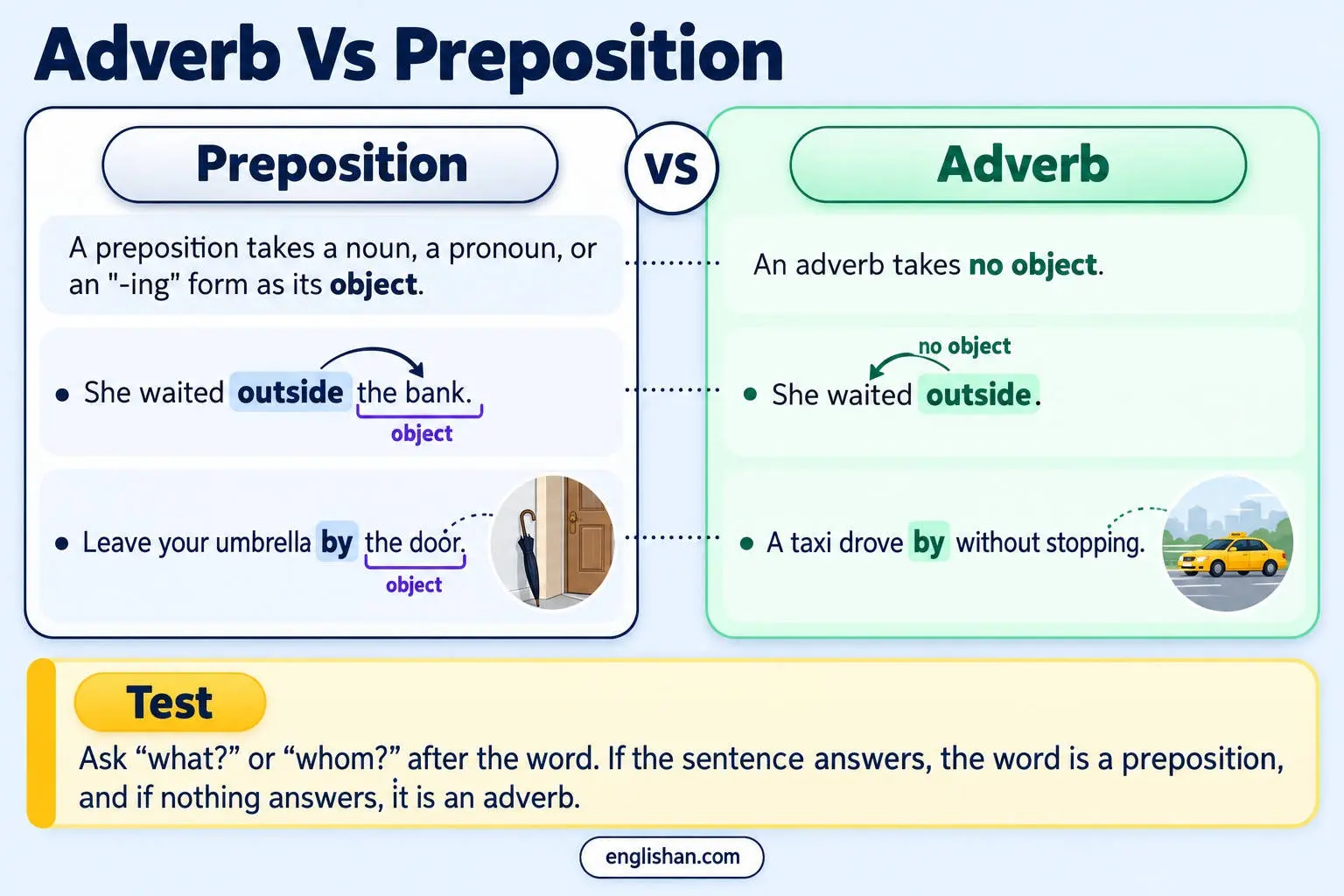
The adverb vs preposition choice depends on one fact: a preposition takes an object, and an adverb does not. In “She waited outside the bank”, the noun phrase “the bank” is the object of “outside”, so the word is a preposition. In “She waited outside“, nothing follows the word as its object, so the same word is an adverb. The other differences between the two classes follow from the object, from what each word modifies to where it can go in a sentence.
A preposition takes an object, a noun or pronoun after it, and an adverb does not. In “Wait inside the car”, the word “inside” is a preposition with the object “the car”, and in “Wait inside“, it is an adverb. The prepositions “of”, “from”, and “at” always take an object, while the adverbs “here”, “soon”, and “abroad” never do.
What Is The Difference Between An Adverb And A Preposition?
The difference between an adverb and a preposition is that a preposition has an object and an adverb has none. The object of a preposition is a noun, a pronoun, or an “-ing” form, and a preposition with its object is a prepositional phrase, as in “under the bridge”, “with her”, or “after leaving work”. An adverb is complete without an object.
- Leave your umbrella by the door. (preposition)
- A taxi drove by without stopping. (adverb)
- My grandparents live near the lake. (preposition)
- My grandparents live quite near. (adverb)
- Write your name above the line. (preposition)
- Write your name in the box above. (adverb)
For any adverb vs preposition question, ask “what?” or “whom?” after the word. If the sentence answers, as “the door” answers “by what?”, the word is a preposition, and if nothing answers, it is an adverb.
Several more differences follow from the object rule, in what the word modifies, whether it can stand alone, and where it can go:
| Feature | Preposition | Adverb |
|---|---|---|
| Object | Takes a noun, pronoun, or “-ing” form as its object | Takes no object |
| What it modifies | Nothing by itself; the prepositional phrase modifies a noun or a verb | A verb, an adjective, another adverb, or a whole sentence |
| Standing alone | Usually only together with its object | Yes, even as a one-word answer |
| End of a sentence | Only when its object comes earlier in the question or clause | Often, with nothing after it |
| Moving in the sentence | Moves only together with its object | Often moves to the start or the end by itself |
A preposition at the end of a sentence still has an object, but the object has moved to the front of the question or clause. In “Which drawer did you look in?”, the object of “in” is “which drawer”, so “in” is a preposition, and the same is true of “to” in “the friend I was talking to“. An adverb at the end of a sentence, as in “Come in“, has no object anywhere in the sentence.
Adverb Vs Preposition Examples
Adverbs and prepositions are separate parts of speech, yet many short words belong to both. The common ones are “about”, “above”, “across”, “after”, “along”, “around”, “before”, “behind”, “below”, “by”, “down”, “in”, “inside”, “near”, “off”, “on”, “outside”, “over”, “past”, “since”, “through”, “under”, and “up”. With these words, the adverb vs preposition answer changes from sentence to sentence:
- We sat around the fire. (preposition)
- Everyone gathered around. (adverb)
- The cat is hiding under the bed. (preposition)
- Children aged twelve and under travel free. (adverb)
- We drove through the tunnel. (preposition)
- The guard checked our tickets and waved us through. (adverb)
- The meeting is about the new budget. (preposition)
- About forty people came to the meeting. (adverb)
The last pair is the hard case. In “About forty people came”, a noun phrase follows “about”, but “about” modifies the number “forty” and means ‘roughly’, so it is an adverb, not a preposition with an object.
When one of these words completes a verb with a new meaning, as in “give up” or “turn off”, it is one of the prepositional adverbs, which follow their own word order with a pronoun object.
Some words belong to one class only. The prepositions “of”, “from”, “at”, “into”, “onto”, and “during” always take an object, even when the object comes earlier, as in “What is it made of?”. The adverbs “here”, “there”, “away”, “back”, “ago”, and “abroad” never take an object, so a noun after them belongs to another part of the sentence.
Adverb Of Place Vs Preposition
An adverb of place tells us where something happens by itself, while a preposition of place tells us where only together with a noun or pronoun. Common adverbs of place include “here”, “there”, “upstairs”, “downstairs”, “inside”, “outside”, “home”, and “abroad”. The prepositions of place “at”, “in”, “on”, and “under” take a noun after them, as in “at the station” or “on the roof”.
- Your keys are here.
- Your keys are on the hall table.
- Dad is working upstairs.
- Dad is working in the spare room.
- The dog sleeps outside in summer.
- In winter, the dog sleeps under the stairs.
An adverb of place already includes the idea of position or direction, so it takes no preposition to show where.
No “to” before home: After a verb of movement such as “go”, “come”, “get”, or “move”, the adverbs “home”, “abroad”, “upstairs”, “downstairs”, “inside”, “outside”, “here”, and “there” follow the verb directly. A “to” before them is a common error.
We went to home after the match. ❌
We went home after the match. ✅
Several of my friends moved to abroad. ❌
Several of my friends moved abroad. ✅
After a verb of movement, “home” and “abroad” are adverbs, so they take no preposition.
The word “home” is also a noun, and as a noun it takes a preposition. For position, it takes “at”, as in “She is at home”, and with a word such as “my” before it, it takes “to” after a verb of movement: “Come to my home on Sunday.” In American English, “stay home” and “stay at home” are both standard.
Adverb Of Time Vs Preposition Of Time
An adverb of time tells us when something happens by itself, while a preposition of time tells us when only together with a time expression. Common adverbs of time are “now”, “soon”, “yesterday”, “later”, and “recently”. The prepositions of time “at”, “on”, “in”, “during”, and “until” take a time expression as their object: “at noon”, “on Monday”, “in July”, “until Friday”.
The words “before”, “after”, and “since” are both, and the adverb vs preposition choice depends on what follows them. With a time expression after them, they are prepositions, and with nothing after them, they are adverbs:
- I had met her before. (adverb)
- I met her before lunch. (preposition)
- Raj moved to Leeds in 2022, and we haven’t spoken since. (adverb)
- Raj has lived in Leeds since 2022. (preposition)
- The bus left at nine, and the next one came soon after. (adverb)
- Call me after the interview. (preposition)
As an adverb, “after” usually has a word before it, as in “soon after”, “the day after”, and “long after”. At the end of a clause on its own, the usual adverb is “afterward” in American English or “afterwards” in British English: “We had lunch and went for a walk afterward.”
With a full clause after it, as in “before the meeting starts”, the same word is a conjunction. The same rule separates adverbs and conjunctions: a conjunction is followed by its own subject and verb.
Ago and before: The adverb “ago” comes after a length of time and counts back from now, as in “three days ago“. The adverb “before” with a length of time counts back from a moment in the past, as in “She had left three days before“, and the preposition “before” takes a point in time: “before Friday”.
I moved to Denver before two years. ❌
I moved to Denver two years ago. ✅
The wrong sentence follows the pattern of the preposition in “before Friday”, but “ago” is an adverb and always comes after the length of time.
Prepositions Before Adverbs
A few adverbs of place and time can follow a preposition as its object, as in “from here”, “until now”, and “since then”. The preposition adds a starting point, an end point, or a limit, which the adverb alone does not express.
- The airport is forty minutes from here by train.
- Until now, nobody had complained about the noise.
- Our team moved offices in May and has been busier since then.
- The new printer should arrive by then.
- Let’s keep the old laptop for now.
- Some of the best fruit in the shop comes from abroad.
The hard case is “abroad”. The phrase “from abroad” is correct because “from” adds the starting point, but “to abroad” is wrong because the direction is already part of the meaning of “abroad”. Pairs of adverbs such as “in here”, “over there”, and “up there” are standard too, as in “It’s warm in here.”
FAQs
The word "there" is an adverb, never a preposition, because it never takes an object. In "Put the boxes there", it is an adverb of place, and a preposition can come before it, as in "from there". At the start of a "there is" or "there are" sentence, the word has no meaning of place and introduces the real subject after the verb.
Yes, a few adverbs, such as "right", "just", "straight", and "shortly", modify a preposition and its object. They come before the preposition, as in "right behind you", "just after midnight", and "shortly before the end". The adverb narrows the place or the time, and the preposition still takes its object.
Mostly a preposition: "for" takes an object, as in "a present for my sister", and it is not used as an adverb. In formal and literary writing, it can also be a conjunction meaning ‘because’, as in "She stayed indoors, for it was raining."
Not as a part of speech, because a prepositional phrase is a group of words, but it often functions as an adverb. In "We met after lunch", the phrase tells us when, so it is one of the adverbial prepositional phrases. In "the café on the corner", the phrase describes a noun and functions as an adjective instead.
Always an adverb: "usually" is one of the adverbs of frequency, and it never takes an object. It normally comes before the main verb, as in "I usually walk to work", or after "be", as in "The trains are usually on time."
Related:
- Adverb
- Types of Adverbs
- Adverbs of Movement
- Adverb vs Adjective
- Object of Preposition
- Types of Prepositions
- Dangling Prepositions
