

Adverbs of movement are adverbs that tell us the direction of an action: where a person or thing goes, or which way it moves. They usually follow a verb of movement such as “go”, “come”, “run”, “walk”, or “drive”, as in “The children ran outside” and “We flew home on Friday.”
An adverb of movement is complete without a noun after it. The phrase “go home” ends there, while “go into the house” takes the noun “house” to finish it. That single fact explains most of the rules for these words, from the missing “to” in “go home” to the change in word order in “Here comes the bus.”
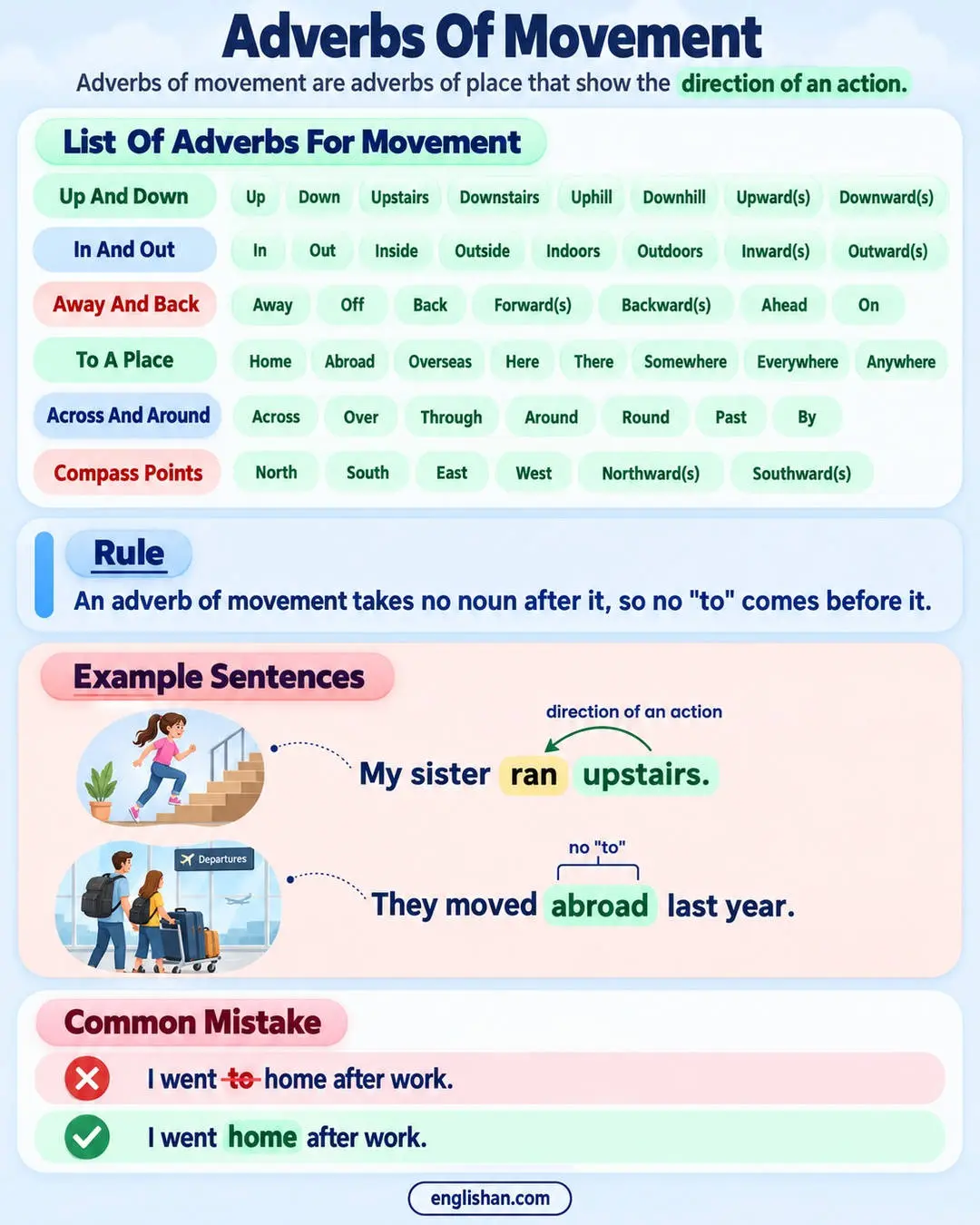
Adverbs of movement, also called adverbs of direction, tell us where something goes or which way it moves: up, down, away, back, home, abroad, upstairs, and forward. They modify verbs of movement and take no noun after them, so no “to” comes before them either. We say “go home”, not “go to home”.
What Are Adverbs Of Movement?
An adverb of movement answers the question “where to?” or “which way?” about a verb, so it shows the path or the end point of a movement rather than a fixed location. Adverbs of movement form one part of the larger class of adverbs of place, and several words belong to both.
The verb shows which meaning the word has. After a verb of position such as “be”, “live”, or “stay”, the adverb gives a location. After a verb of movement, the same adverb gives a direction.
- My sister is upstairs. (location)
- My sister ran upstairs. (movement)
- They live abroad now. (location)
- They moved abroad last year. (movement)
These adverbs modify verbs, usually a verb of movement like “go”, “come”, “walk”, “climb”, or “fly”, or a verb that moves an object, like “bring”, “take”, “put”, or “send”. They do not modify adjectives or other adverbs, so “very upstairs” and “quite abroad” are not possible.
List Of Adverbs For Movement
The common adverbs of movement and direction are short, everyday words, and many of them come in pairs with opposite directions.
| Direction | Words |
|---|---|
| Up and down | Up, down, upstairs, downstairs, uphill, downhill, upward(s), downward(s) |
| In and out | In, out, inside, outside, indoors, outdoors, inward(s), outward(s) |
| Away and back | Away, off, back, forward(s), backward(s), ahead, on |
| To a place | Home, abroad, overseas, here, there, somewhere, everywhere, anywhere |
| Across and around | Across, over, through, around, round, past, by |
| Compass points | North, south, east, west, northward(s), southward(s) |
The word “round” in the sense of “around” is mainly British English. The words “toward”, “towards”, “into”, and “onto” are missing from the list for a reason: they are prepositions only, so they always need a noun or pronoun after them.
Examples Of Adverbs Of Movement
An adverb of movement keeps the same form in a statement, a negative, and a question, and it is common in everyday talk about travel, work, and home.
- The kids went outside after lunch.
- Could you bring the chairs in before it rains?
- I’m not going out tonight.
- Our neighbors moved away in the spring.
- The lift is going down.
- Are you coming over later?
- Please send the signed form back by Friday.
- The hikers walked uphill for two hours before the first break.
With “come”, the movement is toward the speaker or the listener, as in “Come here” and “Are you coming over?” With “go”, the movement is away from the speaker, as in “Go away” and “Let’s go there next summer.”
Position Of Adverbs Of Movement
An adverb of movement usually comes directly after the verb, or after the object when the verb has one. It comes before adverbs of time, so the order is verb, then direction, then time.
- We drove home after the concert.
- She sent the parcel back on Monday.
- They are flying abroad next week.
- He ran upstairs as soon as the phone rang.
With a verb of movement, the adverb of movement often comes before an adverb of manner: “He walked back slowly.” The other order, “He walked slowly back”, is also correct.
A common error puts time before direction. In German, time usually comes before place in a sentence such as “Ich bin gestern nach Hause gekommen”, and the same order in English puts “yesterday” before “home”.
I came yesterday home. ❌
I came home yesterday. ✅
The adverb of movement stays next to the verb, and the time expression goes at the end.
Pronoun objects: With a noun object, the adverb can come before or after the noun: “Take out the bins” and “Take the bins out” are both correct. With a pronoun object, the adverb always comes after the pronoun.
Take out them. ❌
Take them out. ✅
Adverbs Of Movement Without A Preposition
Some of these adverbs already express the destination, so no preposition comes before them. The words “home”, “abroad”, “overseas”, “upstairs”, “downstairs”, “indoors”, “outdoors”, “inside”, “outside”, “here”, and “there” follow a verb of movement directly, with no “to”.
- I usually walk home from the station.
- My brother wants to study abroad.
- Shall we go downstairs for coffee?
- Come here for a second.
The common error with these words is “go to home”. In Spanish “voy a casa” and in French “je rentre à la maison”, the word for home follows a preposition, and that order in English produces the extra “to”.
I went to home after work. ❌
I went home after work. ✅
After a verb of movement, “home” is an adverb, so it takes no preposition. The same rule applies to “abroad”, which is never a noun after “go”:
She wants to go to abroad. ❌
She wants to go abroad. ✅
The preposition “to” returns when “home” is a noun with a possessive or an article before it: “We drove to her parents’ home.” After “be” or “stay”, “home” gives a location, and “at home” is the usual form: “She is at home today.” In American English, “stay home” without “at” is also standard.
Prepositions And Adverbs Of Movement
Prepositions and adverbs of movement share many forms, including “in”, “out”, “up”, “down”, “over”, “across”, “through”, “around”, “past”, and “off”. The difference is the noun after the word. A preposition of movement takes a noun or pronoun after it, while an adverb of movement takes none.
- The cat climbed up the tree. (preposition)
- The cat looked up. (adverb)
- We walked across the bridge. (preposition)
- The bridge was closed, so we swam across. (adverb)
- She ran past the bakery. (preposition)
- A bus drove past. (adverb)
Where the form is unclear, look for a noun directly after the word: with a noun, it is a preposition, and without one, it is an adverb. Words of this kind, used without a noun, are also called prepositional adverbs.
Some prepositions never function as adverbs: “into”, “onto”, “toward”, and “towards” always take a noun. When no noun follows, “in” replaces “into”.
Please come into. ❌
Please come in. ✅
The preposition “into” takes a noun after it, as in “Please come into the kitchen”, but “in” is complete by itself.
Adverbs Of Movement Ending In -Ward And -Wards
The suffix “-ward” or “-wards” forms adverbs of direction from words of place and direction: “backward”, “forward”, “upward”, “downward”, “inward”, “outward”, “homeward”, “northward”, and “skyward”. In American English, the adverb usually ends in “-ward”. In British English, “-wards” is the usual form of the adverb.
The car rolled backward into the gate. (American English) ✅
The car rolled backwards into the gate. (British English) ✅
The adjective form before a noun ends in “-ward” in both varieties: “a backward glance”, “an upward trend”, “the homeward journey”. Adding “-s” to an adjective before a noun is a common error.
There was an upwards trend in sales. ❌
There was an upward trend in sales. ✅
An adjective before a noun takes “-ward”, whichever variety you write in.
British English usually keeps “forward” without “-s” in “move forward” and “step forward“, and “look forward to” never takes “-s”. The prepositions “toward” and “towards” follow the same regional split, with “toward” more common in American English.
Inversion After Adverbs Of Place And Movement
When a short adverb of place or movement such as “here”, “there”, “up”, “down”, “in”, “out”, “away”, “off”, or “back” starts the sentence, a noun subject comes after the verb. The verb is usually “be” or a verb of movement in the present simple or the past simple.
- Here comes the bus.
- There goes our train.
- Off went the runners.
- Down came the rain.
- Away flew the pigeons.
- In walked the new manager.
Inversion after “here” and “there” is everyday spoken English, while openings such as “Off went” and “Away flew” are more common in stories and descriptions.
A pronoun subject does not invert. With “it”, “he”, “she”, “we”, or “they”, the subject comes before the verb, as in normal word order.
Here comes it. ❌
Here it comes. ✅
The pronoun stays before the verb after the other adverbs too, as in “Off they went” and “There she is.”
After “here” and “there”, the inverted verb is in the present simple, not the present continuous.
Here is coming the bus. ❌
Here comes the bus. ✅
This inversion has no auxiliary verb, unlike the inversion after negative adverbs such as “never” and “rarely”, where “have” or “do” comes before the subject.
FAQs
No, "movement" is a noun, as in "a sudden movement". The verb is "move", and the adverb that describes a movement depends on its meaning: "upward" and "away" for direction, "quickly" and "slowly" for manner.
Adverbs that describe how something moves are adverbs of manner: "slowly", "quickly", "smoothly", "gracefully", and "steadily". An adverb of movement shows the direction instead: "She walked slowly" describes the manner, while "She walked away" gives the direction. A sentence with both is also correct: "She walked away slowly."
Both, depending on its position. The word "outside" is an adverb of movement in "The kids ran outside", an adverb of place in "They are playing outside", and an adjective before a noun in "the outside wall". With a noun after it, as in "outside the school", it is a preposition.
Sometimes. A verb with an adverb of movement in its literal meaning, such as "go out" or "come back", is a verb followed by an adverb. When the two words together have a new meaning, as in "The lights went out" or "She gave up", the combination is a phrasal verb.
Related:
