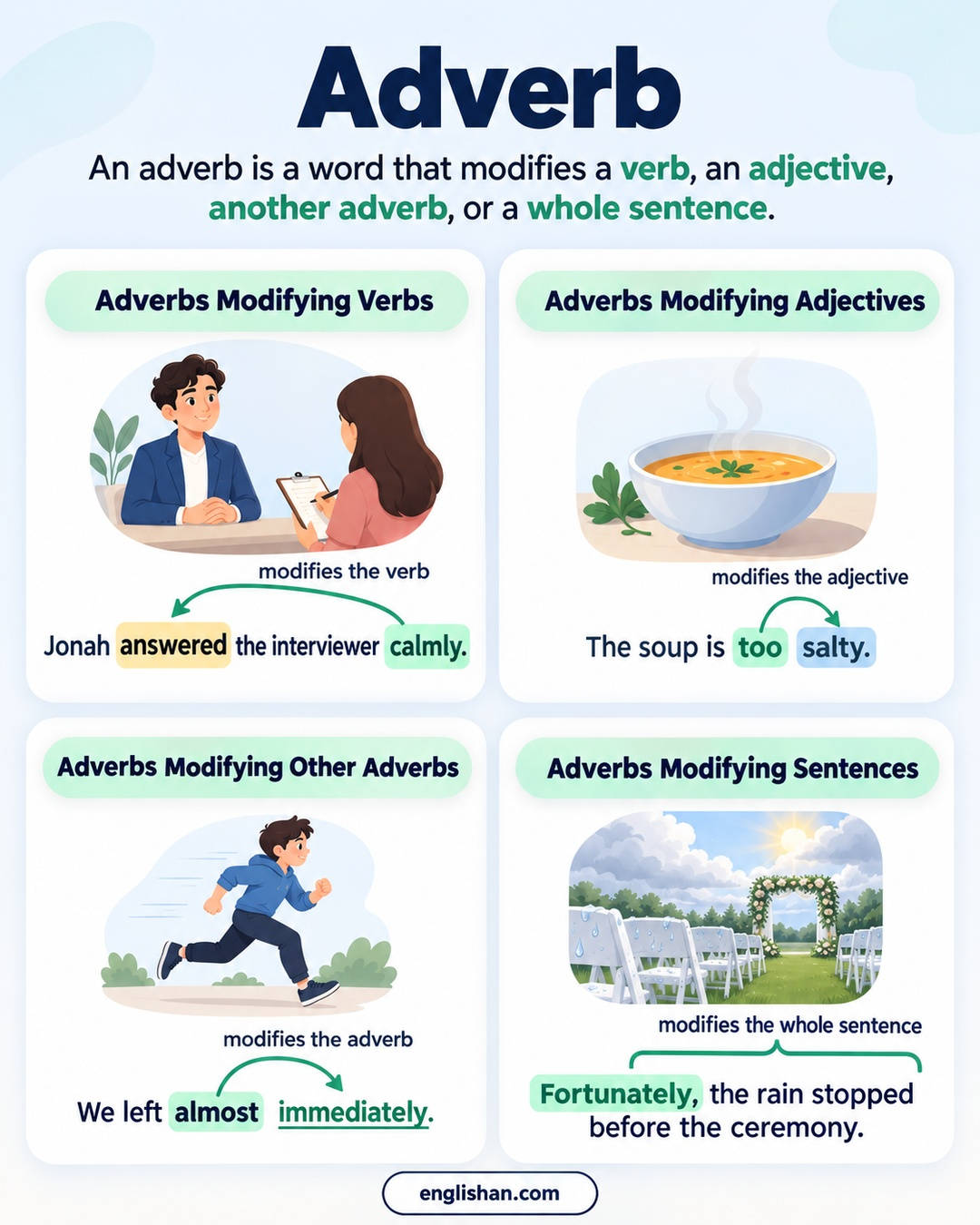
An adverb is a word that modifies a verb, an adjective, another adverb, or a whole sentence. Most adverbs tell us how, when, where, how often, or how much something happens, as in “Lena sings softly” and “The bus arrived late“. The adverb is one of the eight parts of speech, and it shares the job of modifying with the adjective, which modifies a noun or a pronoun instead.
An adverb is a word that adds to the meaning of a verb, an adjective, another adverb, or a whole sentence. It answers questions such as how, when, where, how often, and to what extent, as in “She drives carefully” and “It is very cold”. Many adverbs end in “-ly”, but common ones such as “soon”, “often”, and “well” do not.
What Is An Adverb?
An adverb is the part of speech that can modify almost any part of a sentence except a single noun, which takes an adjective instead. It most often modifies a verb: in “Mira laughed loudly“, the adverb “loudly” tells us how Mira laughed. Adverbs also modify adjectives and other adverbs to show degree, as in “very tired” and “quite slowly”, and some modify a whole sentence.
Adverbs express many different meanings. They include “carefully”, which describes an action, “tomorrow”, which tells us when, “very”, which shows degree, “not”, which negates a sentence, and “however”, which links two sentences. So a word is an adverb because of the job it does in its sentence, and neither its ending nor its meaning alone is enough.
Function Of Adverbs
The function of an adverb is to modify, which means to add to or limit the meaning of another part of the sentence. An adverb usually modifies a verb, an adjective, another adverb, or a whole sentence, and a few adverbs also modify prepositions, numbers, and noun phrases. Its position depends on the word it modifies: a degree adverb comes directly before the adjective, adverb, or preposition it modifies, while an adverb that modifies a verb has several possible places.
Adverbs Modifying Verbs
An adverb that modifies a verb tells us how, when, where, how often, or why the action happens. Most adverbs modify verbs, and they can come before the verb, after it, or at the end of the clause.
- The courier finally delivered the parcel.
- Jonah answered the interviewer calmly.
- We often eat dinner on the balcony.
- Did the plumber come yesterday?
- The children ran outside after the storm.
An adverb of manner does not go between a verb and its object. Many first languages allow that word order, but in English the object follows the verb directly.
He speaks very well English. ❌
He speaks English very well. ✅
The object “English” follows the verb “speaks”, so the adverb phrase “very well” comes after the object.
Adverbs Modifying Adjectives
An adverb that modifies an adjective usually comes directly before it and shows degree, which is how much of the quality there is.
- The soup is too salty.
- Her presentation was extremely short.
- I’m really sorry about the noise.
- The hotel room was surprisingly quiet.
The main exception is “enough”, which comes after the adjective, as in “The box isn’t big enough“.
The adverb “very” modifies adjectives and adverbs but never modifies a verb directly, so it cannot come before a verb such as “like”.
I very like this song. ❌
I really like this song. ✅
A verb takes “really” before it or “very much” after it, so “I like this song very much” is also correct.
Adverbs Modifying Other Adverbs
An adverb can modify another adverb, and the first adverb again shows degree. The two adverbs then function as one adverb phrase, usually after the verb.
- The old printer prints incredibly slowly.
- She finished the crossword quite quickly.
- We left almost immediately.
- Do you visit your parents fairly often?
In “We left almost immediately”, the adverb “almost” modifies “immediately”, and “immediately” modifies the verb “left”.
Adverbs Modifying Sentences
A sentence adverb modifies a whole clause or sentence and shows the speaker’s view of it, such as luck, certainty, or opinion. It usually comes at the start, followed by a comma.
- Fortunately, the rain stopped before the ceremony.
- Obviously, someone forgot to lock the door.
- Apparently, the bakery closes early on Sundays.
The same word can modify a verb instead. As a sentence adverb, “naturally” comments on the whole sentence in “Naturally, the children were tired”, but in “She smiled naturally for the photo”, it tells us how she smiled.
Adverbs Modifying Prepositions
Some adverbs of degree modify a preposition, or more exactly the whole prepositional phrase that begins with it. A prepositional phrase is a preposition followed by a noun or a pronoun, such as “after lunch” or “into the room”.
- The ball rolled right under the sofa.
- Call me just after lunch.
- We arrived well before the deadline.
- The cat walked straight into the kitchen.
These adverbs come directly before the preposition. Without the adverb, the sentence is still correct but less exact, so “just after lunch” means a few minutes after, and “after lunch” leaves the time open.
Adverbs Modifying Nouns
An adverb does not modify a single noun in the way an adjective modifies it, so “a quick answer” is correct and “a quickly answer” is not. A few adverbs combine with nouns, though, in three positions that are all standard English.
Before a noun phrase: Focusing adverbs such as “only”, “even”, and “just”, and the degree adverb “quite”, come before a whole noun phrase, including its “a” or “the”. Examples are “Only the manager has a key”, “Even my grandmother plays chess online”, and “That was quite a party”.
Before determiners and numbers: The degree adverbs “almost”, “nearly”, and “about” modify a determiner or a number inside the noun phrase. The adverb comes before the determiner or number, as in “almost all the tickets”, “nearly every seat”, and “about fifty guests”.
After a noun: Some adverbs of place and time follow a noun, as in “the room upstairs“, “the people here“, and “the meeting yesterday“. Before the noun, “upstairs” changes class, so in “the upstairs room” it is an adjective.
She gave a quickly answer. ❌
She gave a quick answer. ✅
A noun takes an adjective, so “answer” takes “quick” and not the adverb “quickly”.
Types Of Adverbs
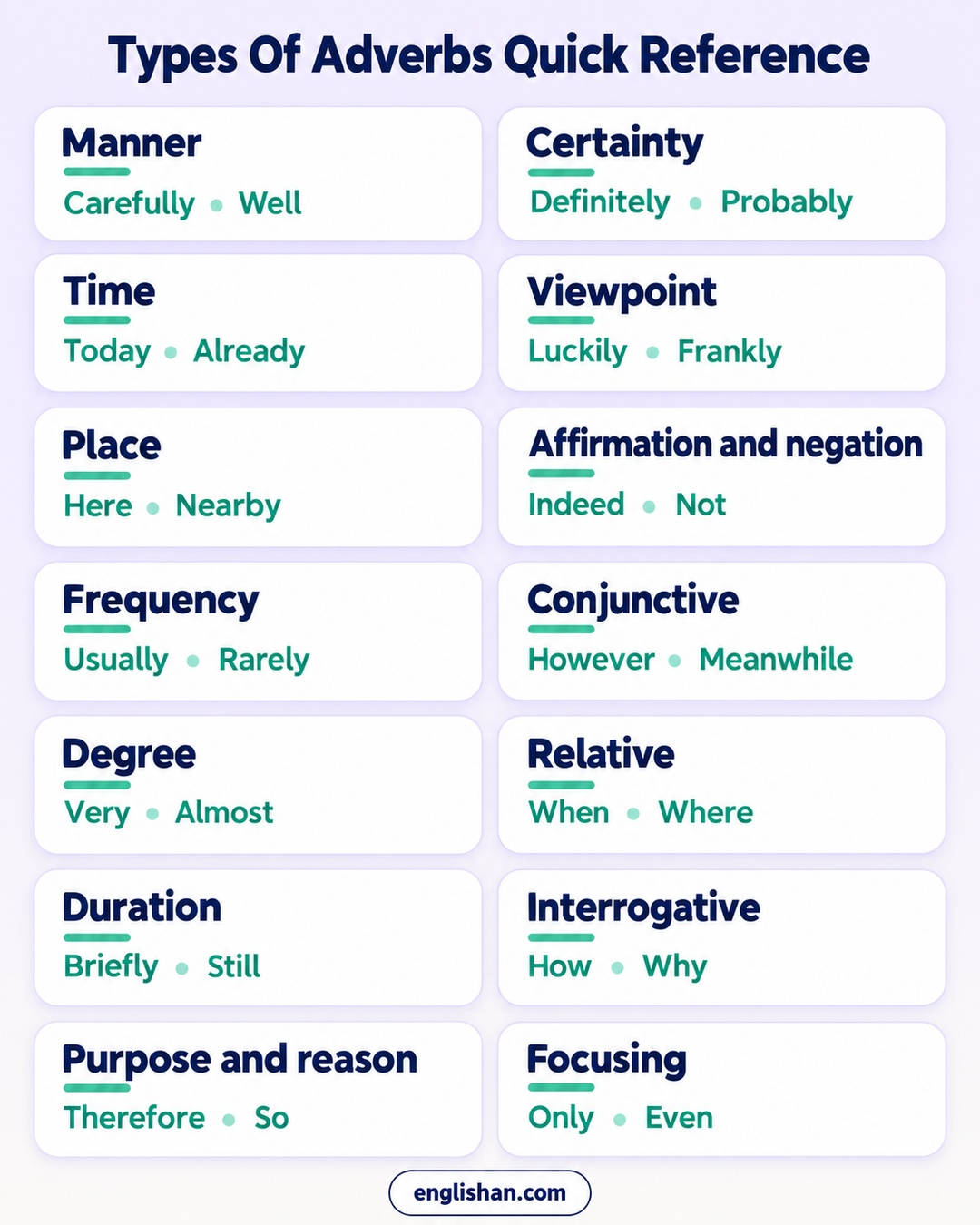
There are 14 types of adverbs. Some tell us about the action itself, some comment on the whole statement, and others join clauses, ask questions, or limit one part of the sentence:
| Type | What it tells us or does | Examples |
|---|---|---|
| Adverbs of manner | How something happens | Carefully, fast, well |
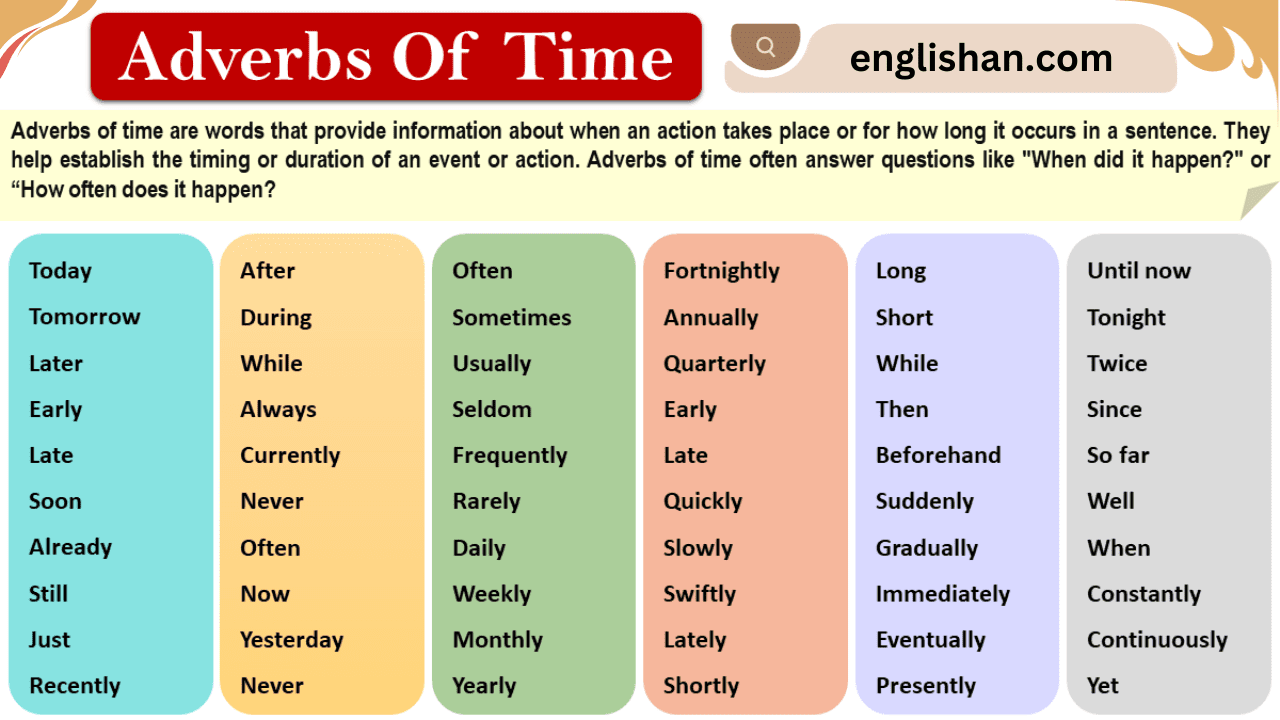
| Adverbs of time | When it happens | Today, later, already |
| Adverbs of place | Where it happens | Here, upstairs, nearby |
| Adverbs of frequency | How often it happens | Usually, rarely, twice |
| Adverbs of degree | How much or how strongly | Very, almost, extremely |
| Adverbs of duration | How long it lasts | Briefly, still, forever |
| Adverbs of purpose and reason | Why it happens | Therefore, so, consequently |
| Adverbs of certainty | How sure the speaker is | Definitely, probably, surely |
| Adverbs of viewpoint | The speaker’s opinion of the statement | Luckily, frankly, sadly |
| Adverbs of affirmation and negation | Affirm or deny the statement | Indeed, not, never |
| Conjunctive adverbs | Link two clauses or sentences | However, otherwise, meanwhile |
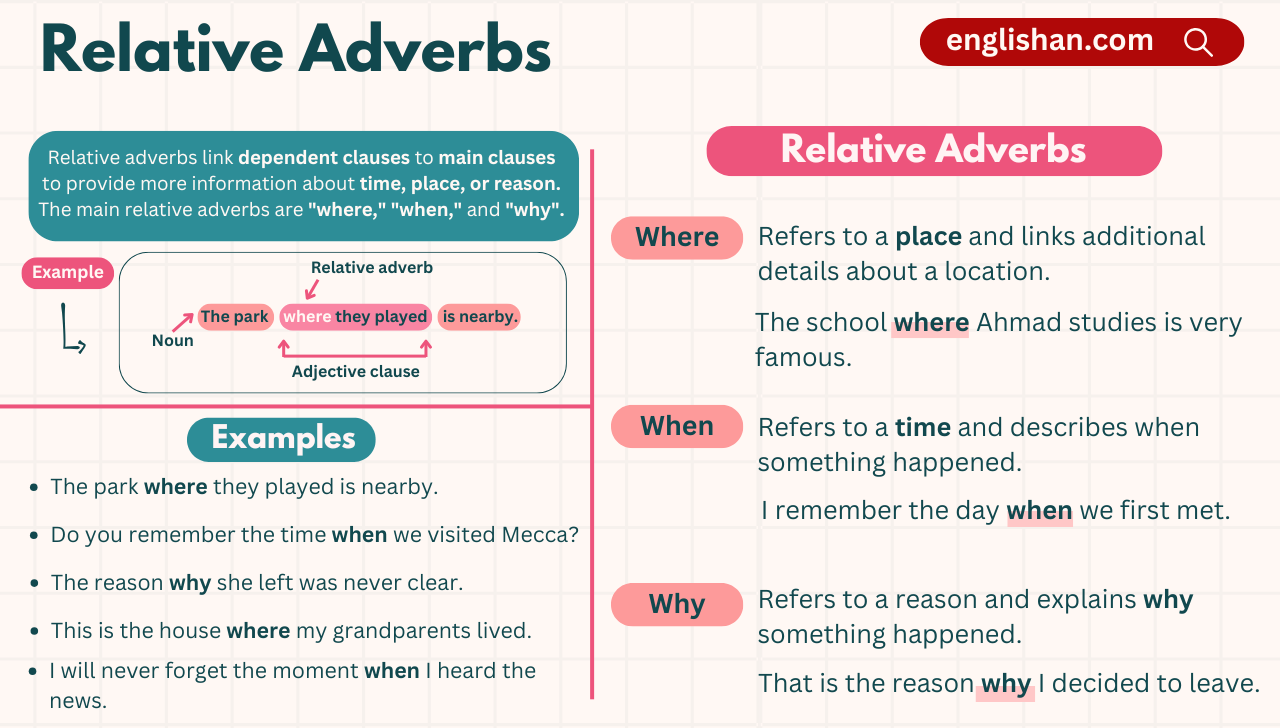
| Relative adverbs | Introduce a clause about a time, place, or reason | When, where, why |
| Interrogative adverbs | Ask a question | How, when, where, why |
| Focusing adverbs | Limit or add to one part of the sentence | Only, even, just |
Some adverbs belong to more than one type, and the sentence shows which one applies. The adverb “when” is an interrogative adverb in “When did you arrive?” and a relative adverb in “the day when we met”.
Adverb Questions
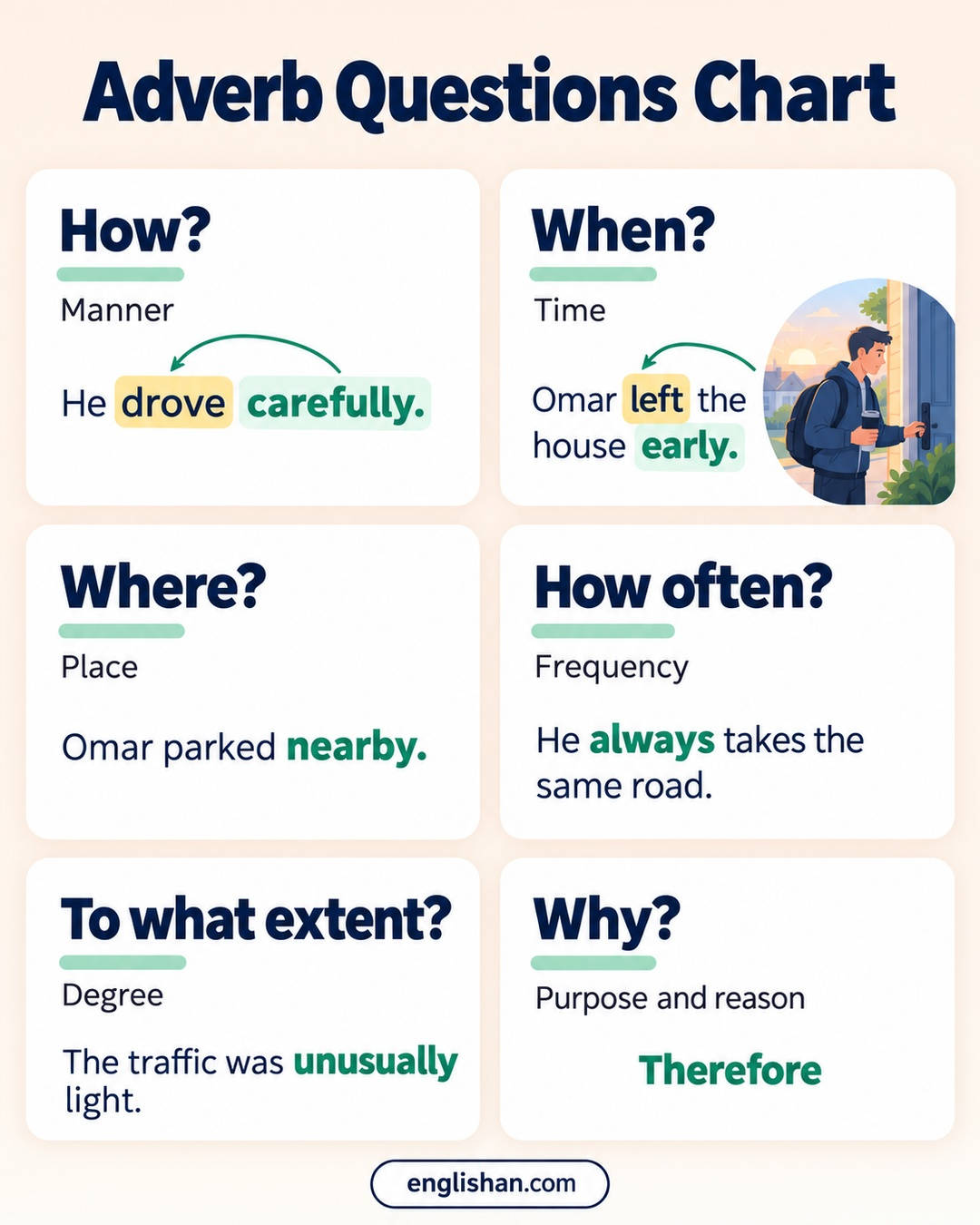
Adverb questions are the questions an adverb answers about the word it modifies. There are six main adverb questions, and each one matches a type of adverb:
| Question | Type of adverb |
|---|---|
| How? | Manner |
| When? | Time |
| Where? | Place |
| How often? | Frequency |
| To what extent? | Degree |
| Why? | Purpose and reason |
In one morning drive, a different adverb answers a different question about the action.
- Omar left the house early.
- He always takes the same road.
- He drove carefully.
- The traffic was unusually light.
- Omar parked nearby.
The question “why?” is the one that single adverbs answer least often. A phrase or a clause usually answers it, as in “because of the rain”, and the few adverbs of reason, such as “therefore”, also link two sentences.
Examples Of Adverbs
Adverbs of almost every type appear in a single ordinary morning at home, from the alarm clock to the missed bus.
- The alarm rang loudly at six.
- Dev usually makes coffee first.
- The milk carton was almost empty.
- He looked everywhere for his keys.
- Unfortunately, the bus had already left.
- His sister walked to school very slowly.
- They will probably be late again.
- Is breakfast ready yet?
In “His sister walked to school very slowly”, the adverb “very” modifies “slowly”, and “slowly” modifies the verb “walked”. The bus example has two adverbs modifying different parts of one sentence: “unfortunately” modifies the whole sentence, and “already” modifies the verb “left”.
List Of Adverbs
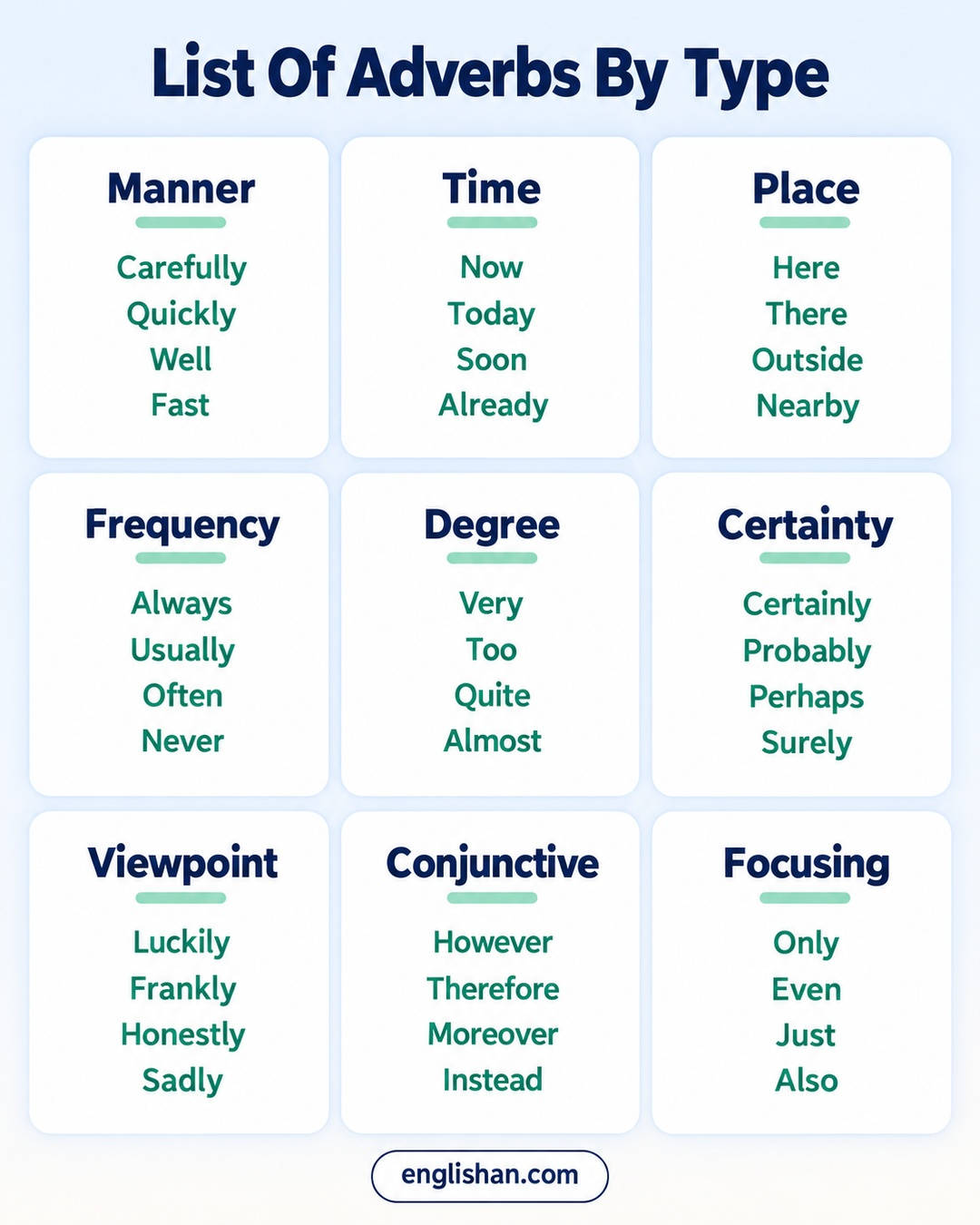
The most common English adverbs are short everyday words, and most of them belong to one of the main types of adverbs:
| Type | Common adverbs |
|---|---|
| Manner | Carefully, quickly, slowly, quietly, well, badly, hard, fast |
| Time | Now, today, yesterday, tomorrow, soon, later, already, yet |
| Place | Here, there, everywhere, outside, inside, upstairs, nearby, abroad |
| Frequency | Always, usually, often, sometimes, rarely, seldom, never, daily |
| Degree | Very, too, quite, almost, extremely, really, enough, nearly |
| Certainty | Certainly, definitely, probably, perhaps, maybe, surely, clearly, obviously |
| Viewpoint | Luckily, fortunately, unfortunately, frankly, honestly, sadly, hopefully, apparently |
| Conjunctive | However, therefore, moreover, meanwhile, otherwise, consequently, instead, furthermore |
| Focusing | Only, even, just, also, mainly, especially, simply, particularly |
A few of these words are another part of speech in a different sentence, as “daily” is an adjective in “a daily walk”. Hundreds more adverbs appear in alphabetical order in the full list of adverbs.
Formation Of Adverbs
Most adverbs of manner are formed by adding “-ly” to an adjective, so “quick” becomes “quickly” and “careful” becomes “carefully”. The spelling changes after some endings: “-y” becomes “-ily” (happy, happily), “-le” becomes “-ly” (gentle, gently), and “-ic” adds “-ally” (tragic, tragically). For “good”, the adverb is irregular: “well”.
Adverbs without -ly: Many of the most common adverbs have no suffix at all: “soon”, “often”, “very”, “here”, “never”, “too”, and “quite”. They are not formed from adjectives, so they have no “-ly” ending to remove.
Flat adverbs: A flat adverb has the same form as its adjective, as with “fast”, “hard”, “late”, “early”, “straight”, and “daily”. The words “daily” and “early” are adjectives before a noun and adverbs after a verb, as in “a daily walk” and “We walk daily“.
Some flat adverbs also have an “-ly” form with a different meaning. In these pairs, “hardly” means ‘almost not’, and “lately” means ‘recently’, so the two sentences in each pair have different meanings:
- The team worked hard all week.
- The team hardly worked all week.
- Nadia arrived late to the meeting.
- Nadia has been tired lately.
Adjectives ending in -ly: Some adjectives also end in “-ly”, among them “friendly”, “lovely”, “lonely”, “silly”, and “costly”, and they have no adverb form.
She smiled at us friendly. ❌
She smiled at us in a friendly way. ✅
An adjective ending in “-ly” takes a phrase such as “in a friendly way” where an adverb is needed.
Comparison Of Adverbs
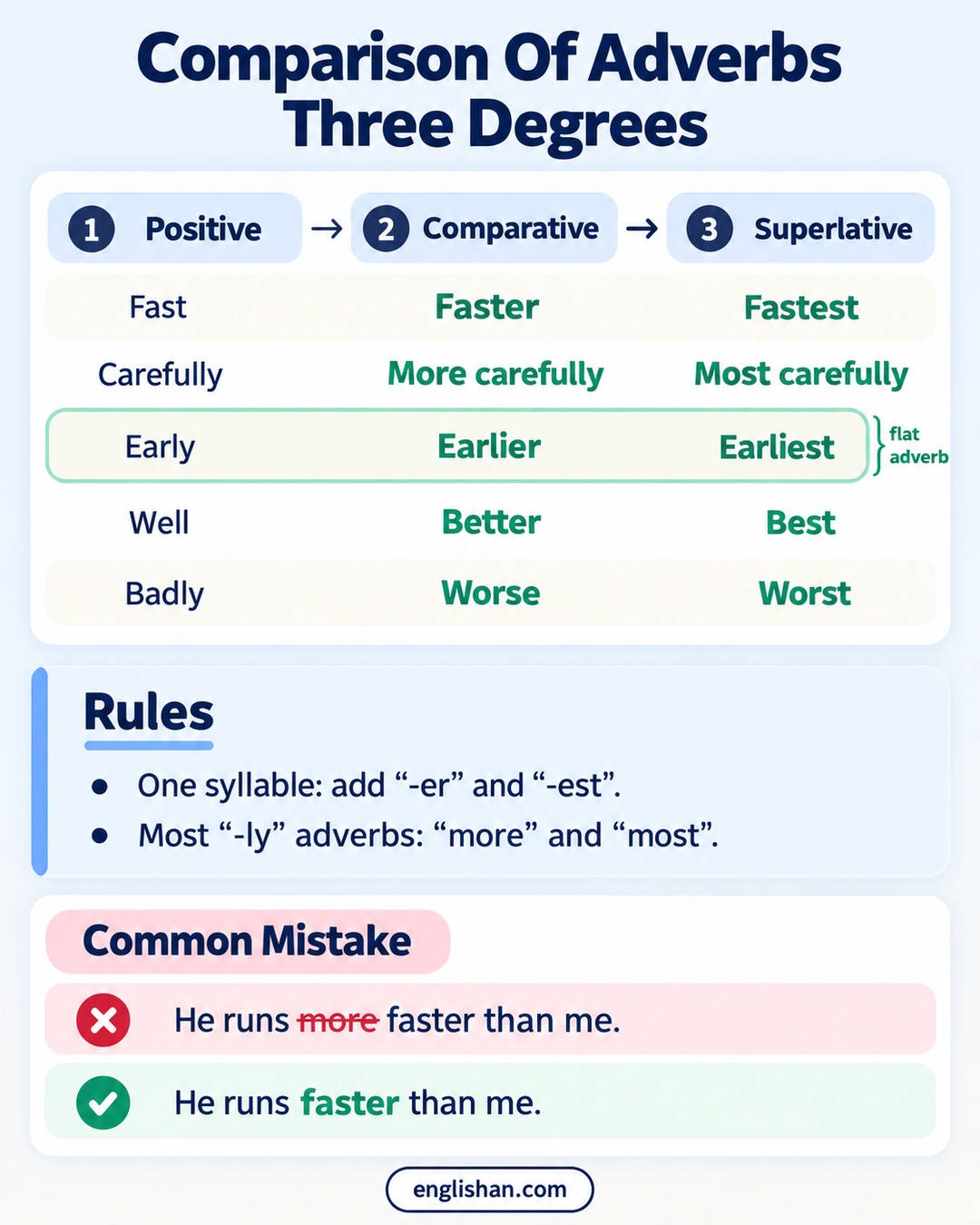
Many adverbs have three degrees of comparison: the positive, the comparative for two actions, and the superlative for three or more. Adverbs with one syllable, as “fast” and “soon” are, add “-er” and “-est”, and most adverbs ending in “-ly” take “more” and “most”.
| Positive | Comparative | Superlative |
|---|---|---|
| Fast | Faster | Fastest |
| Soon | Sooner | Soonest |
| Carefully | More carefully | Most carefully |
| Early | Earlier | Earliest |
| Well | Better | Best |
| Badly | Worse | Worst |
| Far | Farther or further | Farthest or furthest |
The adverb “early” ends in “-ly” but takes “-er” and “-est”, because it is a flat adverb and not an adjective plus “-ly”. Adverbs such as “very”, “here”, “now”, and “never” have no comparative or superlative form.
He runs more faster than me. ❌
He runs faster than me. ✅
The “-er” ending already shows the comparative, so “faster” takes no “more”.
Adverb Before Or After The Verb
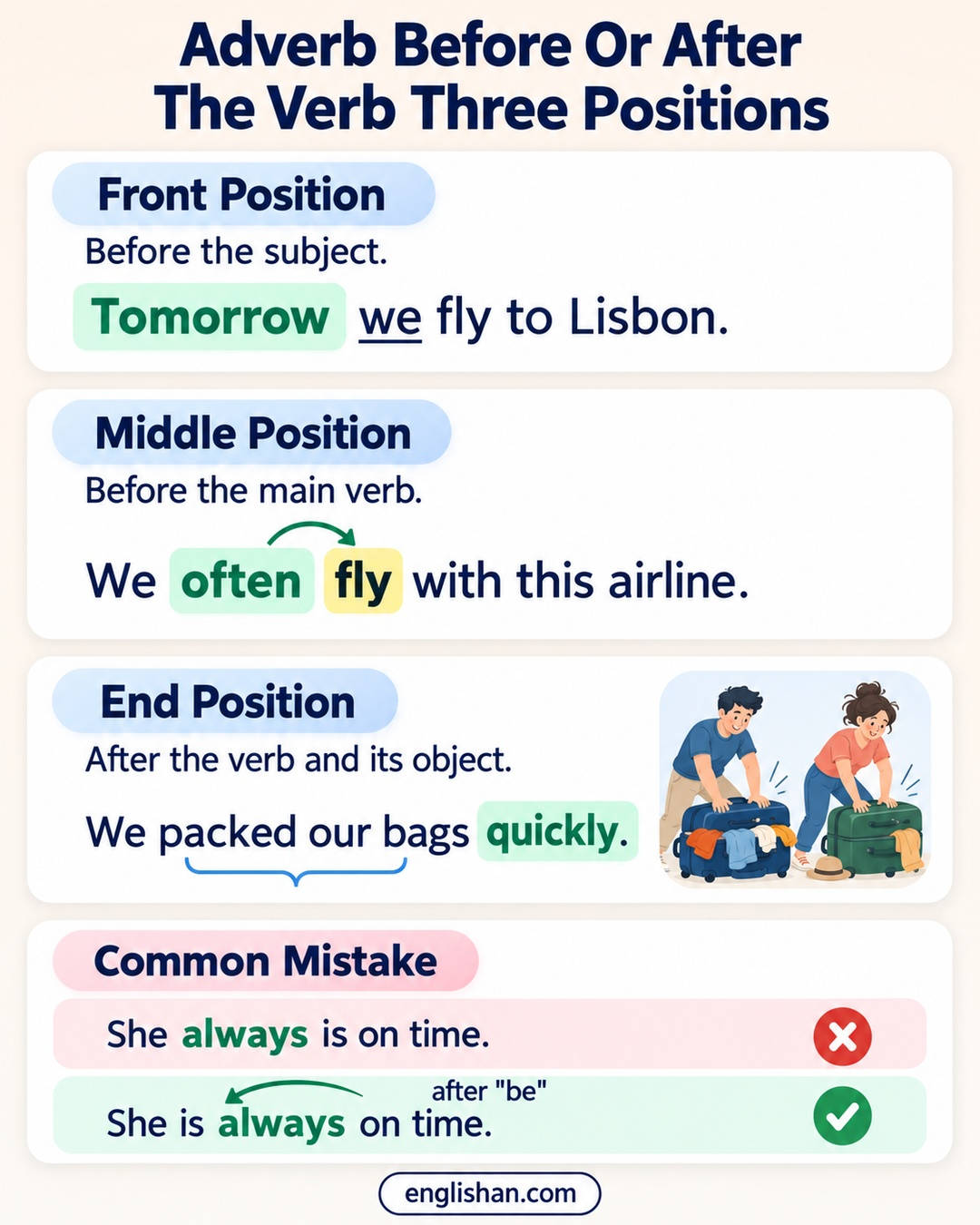
An adverb can come before or after the verb, and the usual position depends on its type. Adverbs of frequency usually come before the main verb, while adverbs of manner, place, and time usually come after the verb or after its object.
There are three positions for an adverb in a clause: the front position before the subject, the middle position before the main verb, and the end position after the verb and its object.
- Tomorrow we fly to Lisbon.
- We often fly with this airline.
- We packed our bags quickly.
The middle position has two conditions. In this position, the adverb comes after the verb “be” when “be” is the main verb, and after the first auxiliary verb, the helping verb such as “have” or “will”, when the verb has one: “She is always on time” and “They have never met”.
She always is on time. ❌
She is always on time. ✅
With “be” as the main verb, an adverb of frequency comes after “be”, not before it.
At the end of a clause, adverbs and phrases usually follow the order manner, place, time, as in “She sang beautifully at the concert last night“. A time phrase can also open the sentence, with a comma after it: “Last night, she sang at the concert.”
Identification Of Adverbs
An adverb is identified by its function in the sentence, not by its spelling. Most adverbs answer how, when, where, how often, or to what extent about a verb, an adjective, or another adverb. To find the adverb, find the verb first and ask the adverb questions about it. The word that answers is the adverb, as “quietly” answers “how?” in “The baby slept quietly“.
Many adverbs can also move within the clause without changing the meaning, while an adjective stays before its noun or after a linking verb. For example, “Sometimes I walk to work”, “I sometimes walk to work”, and “I walk to work sometimes” are all correct.
The same word can be an adverb in one sentence and another part of speech in the next, because the part of speech depends on the word’s function in that sentence:
| Word | As an adverb | As another part of speech |
|---|---|---|
| Very | Very cold | The very end (adjective) |
| Fast | Run fast | A fast car (adjective) |
| Yesterday | Arrived yesterday | Yesterday was Monday (noun) |
| Hard | Work hard | A hard question (adjective) |
| Well | Sing well | I feel well (adjective, ‘healthy’) |
The words “always” and “quickly” are adverbs in every sentence, but “very”, “fast”, “yesterday”, “hard”, and “well” change class with their function. A word that is the subject of the sentence, as “yesterday” is in “Yesterday was Monday”, is a noun and not an adverb.
Adverb Vs Adjective
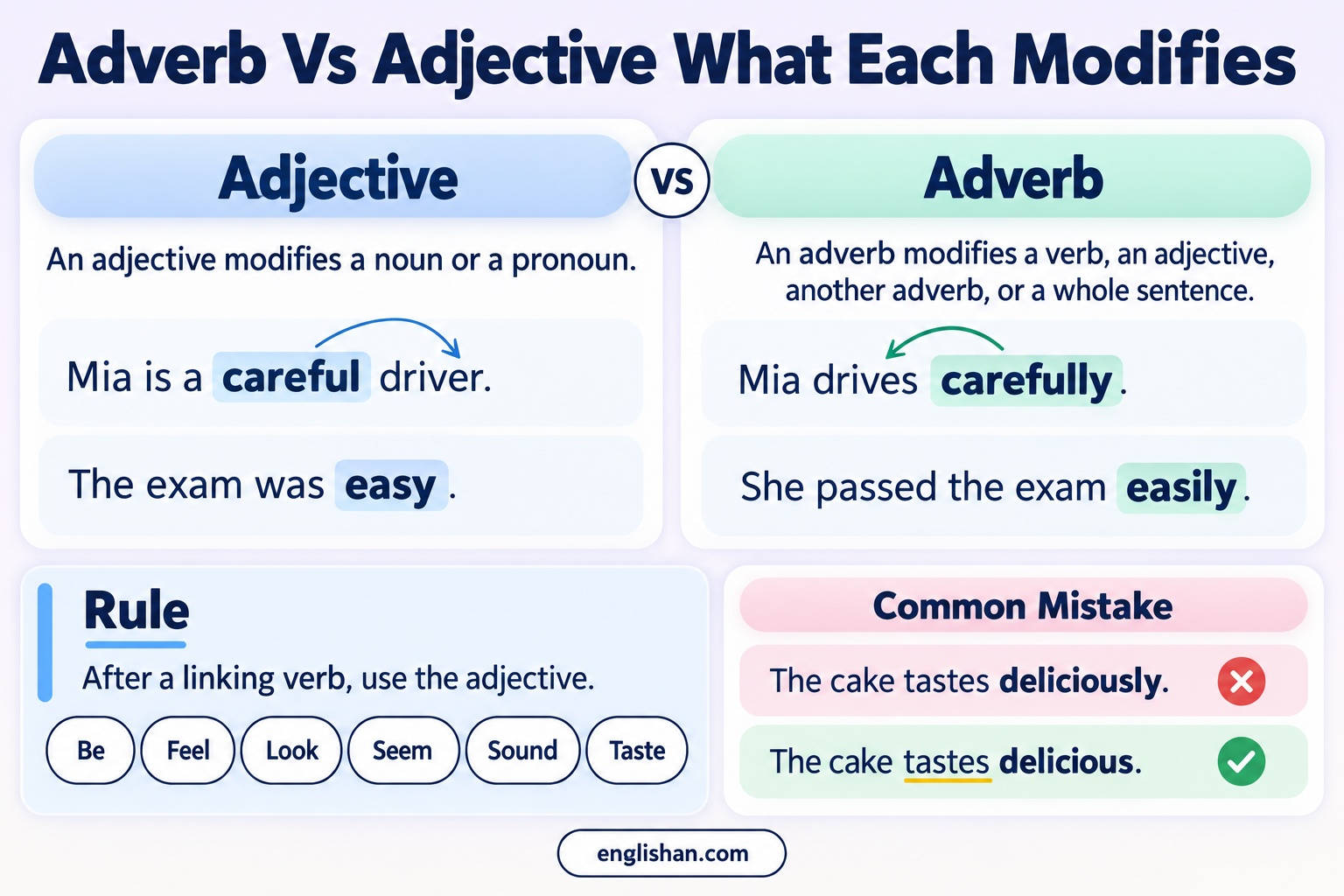
An adjective and an adverb both modify other words, but they modify different ones. A noun or a pronoun takes the adjective, while a verb, an adjective, another adverb, or a whole sentence takes the adverb.
- Mia is a careful driver.
- Mia drives carefully.
- The exam was easy.
- She passed the exam easily.
After a linking verb, the word describes the subject and not an action, so it is an adjective. Linking verbs include “be”, “feel”, “look”, “seem”, “smell”, “sound”, and “taste”.
The cake tastes deliciously. ❌
The cake tastes delicious. ✅
The verb “tastes” is a linking verb when it means ‘has a flavor’, so the adjective “delicious” describes the cake.
The adjective and adverb pair “good” and “well” follows the same rule: “good” is the adjective and “well” is the adverb, as in “a good singer” and “She sings well“. To choose between an adjective and an adverb, find the word being described: a noun or a pronoun takes the adjective, and an action takes the adverb.
Adverb Vs Adverbial
An adverb is a single word from the adverb class, and an adverbial is any word, phrase, or clause that functions as an adverb in a sentence. So “adverb” names a part of speech, and “adverbial” names a function that a word, a phrase, or a clause can have.
- Adverb: She left early.
- Adverb phrase: She left very early.
- Prepositional phrase: She left after lunch.
- Noun phrase: She left last week.
- Adverbial clause: She left when the rain stopped.
In all five sentences, the adverbial tells us when she left, but its form changes from a single word to a full clause. An adverb phrase has an adverb as its main word, as “very early” does, while an adverbial phrase is any phrase that functions as an adverb, including “after lunch”. Likewise, an adverbial clause, also called an adverb clause, is a dependent clause that modifies the verb of the main clause.
FAQs
Is an adverb a verb?
No, an adverb and a verb are different parts of speech. A verb shows an action or a state, such as “run” or “seem”, and an adverb modifies the verb, as “slowly” does in “run slowly”.
Can you end a sentence with an adverb?
Yes, the end of a sentence is the normal position for most adverbs of manner, place, and time. Sentences such as “She finished the report quickly” and “We stayed home” are both correct.
Do all adverbs end in -ly?
No, many common adverbs have no “-ly” ending, such as “soon”, “often”, “very”, “here”, “never”, and “well”. Some words ending in “-ly”, such as “friendly” and “lovely”, are adjectives and not adverbs.
Can an adverb modify a noun?
An adverb does not modify a single noun, so “a quick answer” is correct and “a quickly answer” is not. A few adverbs, such as “only”, “even”, and “quite”, come before a whole noun phrase, as in “only the manager”.
Related:
- What Do Adverbs Modify
- What Questions Do Adverbs Answer
- Adverb Chart
- How to Identify an Adverb in a Sentence
- How to Form Adverbs From Adjectives
- Adverbs Without LY
- Comparative and Superlative Adverbs
- Adverb Placement
- Adverbs of Reason
- Negative Adverbs
- Prepositional Adverbs
- Adverbs of Movement
- Nouns Used as Adverbs
- Adverbial Prepositional Phrases
- Adjective Phrase vs Adverb Phrase
- Adjective and Adverb Clauses
- Adverb vs Adjective
- Adverb vs Verb
- Adverb vs Preposition
- Adverbs and Conjunctions