

An adverb ends in -ly in most words, and the ending alone does not prove it. The adverbs that start with L express manner in lightly and loudly, time in lately, place in locally, and degree in less and least, with long and low taking no -ly ending. Lovely, lonely, lively, likely, lowly and leisurely end in -ly and are adjectives, so they are set apart from the true adverbs.
Choose the first letter:
A · B · C · D · I · K · L · M · N · R · S · T · V
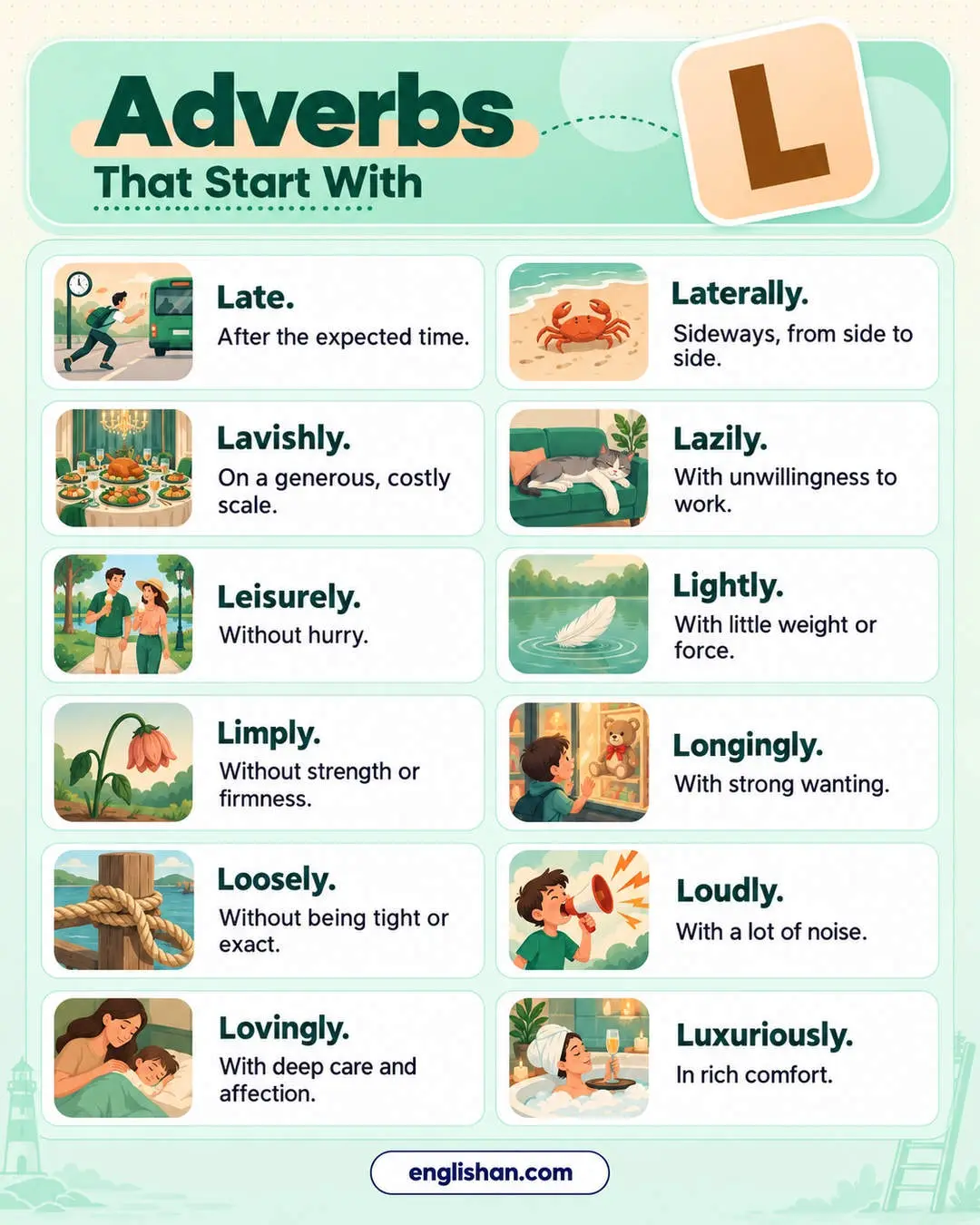
Adverbs That Start With L
The adverbs that start with L run alphabetically from laboriously to lyrically, with the meaning beside the word and a sentence showing where the adverb belongs.
| Adverb | Meaning | In a sentence |
|---|---|---|
| Laboriously | With hard, slow effort. | The index was written out laboriously by hand. |
| Laterally | Sideways, from side to side. | The beam shifted laterally under load. |
| Lawfully | Within the law. | The gate was moved lawfully after notice. |
| Laxly | With discipline left loose. | The register was kept laxly. |
| Legally | By the terms of the law. | The covenant binds legally on both plots. |
| Legibly | So as to be read. | Print the surname legibly. |
| Legitimately | By right, and without question. | The grant was claimed legitimately. |
| Lengthily | At great length. | The objection was argued lengthily. |
| Lexically | In relation to vocabulary. | The two dialects differ lexically. |
| Liberally | Generously, and in large amounts. | The oil was applied liberally. |
| Linearly | Along a line, or in direct proportion. | Costs rise linearly with the span. |
| Linguistically | In relation to language. | The border is mixed linguistically. |
| Literally | In the exact sense of the words. | The lane floods literally to the doorstep. |
| Lithely | With supple, loose movement. | She climbed the stile lithely. |
| Locally | Close by, rather than further off. | The stone was quarried locally. |
| Logically | By sound reasoning. | The schedule follows logically from the survey. |
| Longitudinally | Along the length. | The joists run longitudinally over the hall. |
| Loosely | Without being tight or exact. | The clause is drafted loosely. |
| Loudly | With a lot of noise. | The alarm sounded loudly across the yard. |
| Loyally | With steady allegiance. | The tenants supported the trust loyally. |
| Lucidly | Clearly enough to follow at once. | The physics is explained lucidly. |
| Luminously | Giving off light, or throwing it back. | The alabaster glows luminously. |
| Lyrically | In the manner of song or poetry. | The second movement is scored lyrically. |
Words Ending in LY That Are Not Adverbs
The -ly ending normally turns an adjective into an adverb, and on this letter it also turns nouns into adjectives, which is where the confusion starts. Love plus -ly gives the adjective lovely, and there is no adverb behind it.
| Word | What it is | How to use it |
|---|---|---|
| Lovely | Adjective | A lovely morning, never she sang lovely |
| Lonely | Adjective | A lonely farm, never he waited lonely |
| Lively | Adjective | A lively debate, never they argued lively |
| Likely | Adjective in British use | A likely story, with probably for the adverb |
| Lordly | Adjective, and an adverb only in older writing | A lordly gesture in the doorway |
| Leisurely | Both, which is why it reads oddly either way | A leisurely walk, or walked leisurely |
- It was a lovely morning for the crossing.
- The farm stands lonely over the levels.
- A lively debate followed the vote.
- That is a likely story and nothing more.
- They walked the towpath leisurely.
An adjective in an adverb slot is the error this group produces, and the repair is a real adverb or a rebuilt sentence.
- She sang lovely at the carol service ❌
- She sang beautifully at the carol service ✅
Leisurely is the one that goes both ways, so a leisurely walk and walked leisurely are both correct, which is why the other five look as though they should be.
- They argued lively about the boundary ❌
- They argued heatedly about the boundary ✅
Positive Adverbs That Start With L
Approval sits in the positive adverbs that start with L, and the letter runs to abundance rather than to standard. Lavishly, lushly and luxuriantly all report plenty, which is more than most letters hold in one sense.
| Adverb | Meaning | In a sentence |
|---|---|---|
| Laudably | In a way that earns praise. | The backlog was cleared laudably. |
| Lavishly | On a generous, costly scale. | The dining room was furnished lavishly. |
| Leniently | With punishment softened. | The breach was treated leniently. |
| Lovingly | With deep care and affection. | The old mare was groomed lovingly. |
| Luckily | By good fortune. | The frost lifted luckily before the planting. |
| Lushly | With rich, abundant growth. | The bank was planted lushly. |
| Luxuriantly | In thick, healthy abundance. | The vine grew luxuriantly over the porch. |
| Luxuriously | In rich comfort. | The cabin was fitted luxuriously. |
Luxuriantly and luxuriously are a letter apart and not interchangeable, since a vine grows luxuriantly and a cabin is fitted luxuriously.
Adverbs of Manner That Start With L
Manner takes the largest share of L, and a manner adverb modifies the verb with how. The standard position is after the verb, or after the object where there is one. Front position is available for stress.
- The physics is explained lucidly.
- He answered the charge lamely.
- Laboriously, the index was written out by hand.
- The oil was applied liberally.
- The alarm sounded loudly across the yard.
The position to rule out is between the verb and its object, where the adverb separates a pair that belongs together.
- They applied liberally the oil ❌
- They applied the oil liberally ✅
The rule holds even for the -ly adjectives that look like adverbs, as set out under adverbs of manner and across the types of adverbs.
Negative Adverbs That Start With L
Disapproval runs through the negative adverbs that start with L, and the letter holds more words for loose living than for poor work. Lasciviously, licentiously and lawlessly all report restraint abandoned.
| Adverb | Meaning | In a sentence |
|---|---|---|
| Lamely | Weakly, and without conviction. | He answered the charge lamely. |
| Lasciviously | With open, coarse desire. | The letters are written lasciviously. |
| Lawlessly | Outside all law. | The woodland was cleared lawlessly. |
| Lethally | So as to kill. | The pump discharged lethally into the stream. |
| Licentiously | Without moral restraint. | The estate was run licentiously. |
| Litigiously | Quick to go to law. | The boundary was contested litigiously. |
| Loathingly | With disgust shown. | She pushed the plate away loathingly. |
| Ludicrously | To an absurd degree. | The lane is ludicrously narrow for two lanes. |
| Lugubriously | With exaggerated gloom. | The organ played lugubriously. |
Lamely is the one aimed at an argument rather than at conduct, so a charge answered lamely was answered without conviction and nothing worse is implied.
Adverbs That Start With L to Describe a Person
Manner adverbs take the weight when a person heads the sentence, and the adverbs that start with L run to low energy. He answered languidly and he answered lividly report one action and two different people.
| Adverb | Meaning | In a sentence |
|---|---|---|
| Lackadaisically | Without energy or interest. | The forms were filed lackadaisically. |
| Languidly | Slowly, and with drooping ease. | He turned the pages languidly. |
| Lazily | With unwillingness to work. | The afternoon was spent lazily. |
| Lethargically | With dull, heavy slowness. | The engine turned over lethargically. |
| Limply | Without strength or firmness. | The flag hung limply at the mast. |
| Lingeringly | Staying longer than needed. | He looked lingeringly at the forge. |
| Listlessly | With no spirit or appetite. | The patient ate listlessly. |
| Lividly | In furious anger. | He read the invoice lividly. |
| Longingly | With strong wanting. | The dog watched the door longingly. |
| Lustily | With hearty vigour. | The crew sang lustily. |
Lackadaisically is the most precise of these, since it reports the lack of energy and the lack of interest together.
Adverbs of Time and Degree That Start With L
Time and degree run together on this letter, because several words in both types take no -ly ending. Less and least measure downward, while lately and long place an action in time.
| Adverb | Meaning | In a sentence |
|---|---|---|
| Lastly | In the final position in a sequence. | Lastly, the drains were never adopted. |
| Late | After the expected time. | The surveyor arrived late. |
| Lately | In the recent past. | The lock has been rebuilt lately. |
| Least | To the smallest degree. | The south wall suffers least in winter. |
| Leisurely | At an unhurried pace. | They walked the towpath leisurely. |
| Less | To a smaller degree. | The flue draws less in a west wind. |
| Lightly | With little weight or force. | Dust the tin lightly with flour. |
| Likewise | In the same way. | The second gate was hung likewise. |
| Limitlessly | Without any limit. | The fund was not limitlessly deep. |
| Long | For a great length of time. | The frost held long into April. |
| Low | At or to a low level. | The swallows were flying low over the water. |
Lately and latterly part company here, since a lock rebuilt lately was rebuilt recently while a practice that changed latterly changed towards the end. Both classes are mapped under adverbs of time and adverbs of degree.
Commonly Confused L Adverbs
Pairs among the adverbs that start with L trade places in print, and the split turns on what the word measures rather than on how strongly it reads.
| Pair | What separates them |
|---|---|
| Lately / Latterly | Lately means recently; latterly means towards the end. |
| Luxuriantly / Luxuriously | Luxuriantly is thick growth; luxuriously is rich comfort. |
| Lastly / Finally | Lastly closes a list; finally closes a wait. |
| Lawfully / Legally | Lawfully means within the law; legally means by its terms. |
| Literally / Figuratively | Literally means in the exact sense; figuratively means not. |
| Lightly / Loosely | Lightly is little force; loosely is little precision. |
- The lock has been rebuilt lately.
- The vine grew luxuriantly over the porch.
- That cabin was fitted luxuriously.
- Lastly, the drains were never adopted.
- Dust the tin lightly with flour.
Luxuriantly reports thick growth and luxuriously reports rich comfort, so a vine takes the first and a fitted-out cabin takes the second.
- The vine grew luxuriously over the porch ❌
- The vine grew luxuriantly over the porch ✅
The -ly ending does not prove an adverb on this letter. Lovely, lonely and lively wear the mark of an adverb and belong to a different class, which is the one fact a writer needs from the adverbs that start with L.
Related:
- Adverbs Ending in LY
- Adverbs That Do Not End in LY
- Adverb Examples
- Adverbs of Frequency
- Adverbs of Place
- Adverbs of Degree
- Types of Adverbs
- Relative Adverbs
- Adverbs of Reason
FAQs
About sixty qualify in standard English, and 61 adverbs that start with L are gathered here with a meaning and a sentence. The letter runs short because many L words ending in -ly are adjectives rather than adverbs and do not qualify.
Less and least are the most common of the adverbs that start with L, followed by lightly, lately and long. All but one of the five take no -ly ending, which is the pattern on most short letters.
No. Lovely is an adjective, and the -ly on it comes from a noun rather than from an adjective, so there is no adverb behind it. A sentence needing an adverb in that slot takes beautifully, and the same applies to lonely, lively and likely.
Laudably, lavishly, leniently, lovingly and luckily are words of approval, and all five belong in a reference or a review. The letter runs to abundance, so lushly and luxuriantly apply to growth rather than to conduct.
Languidly, lazily, listlessly and lividly report how a person acts rather than what they are, so the verb keeps the action and the adverb holds the state behind it. The letter runs to low energy, with lackadaisically and lethargically alongside them.
A manner adverb such as lucidly goes after the verb, or after the object where there is one. A degree word such as less goes beside the word it measures, and lastly and likewise open the clause they belong to.