

An adverb is a word that modifies a verb, an adjective, another adverb, or a whole sentence. It usually answers one of five questions about the word it modifies: how, when, where, how often, or to what extent.
The answer to how to identify an adverb in a sentence follows from those two facts. You start from the verb and the adjectives, ask the five questions about them, and then look at the word that answers, because the word it modifies shows its word class. The ending is the weakest sign, since some adjectives also end in “-ly”, so an adverb is found by its job in the sentence rather than by its form.
To identify an adverb in a sentence, find the verb, the adjectives, and any other adverbs, then ask how, when, where, how often, or to what extent about them. The word that answers is an adverb when it modifies a verb, an adjective, an adverb, or the whole sentence. A word that modifies a noun is an adjective, even when it ends in “-ly”.
What Is The Adverb In This Sentence?
The adverb in a sentence is the word that modifies the verb, an adjective, another adverb, or the whole sentence, and it answers how, when, where, how often, or to what extent. A sentence can have one adverb, several adverbs, or none at all.
- Rosa finished the report quickly.
- The bus usually leaves early on Sundays.
- My brother bought a new laptop.
The second sentence has two adverbs: “usually” answers how often the bus leaves, and “early” answers when. The third sentence has no adverb, because “new” describes the noun “laptop”, so it is an adjective, and “bought” is the verb.
So the question “what is the adverb in this sentence” can have more than one answer, and sometimes the answer is that the sentence has no adverb. Each word that answers one of the five questions about a verb, an adjective, or another adverb is a separate adverb.
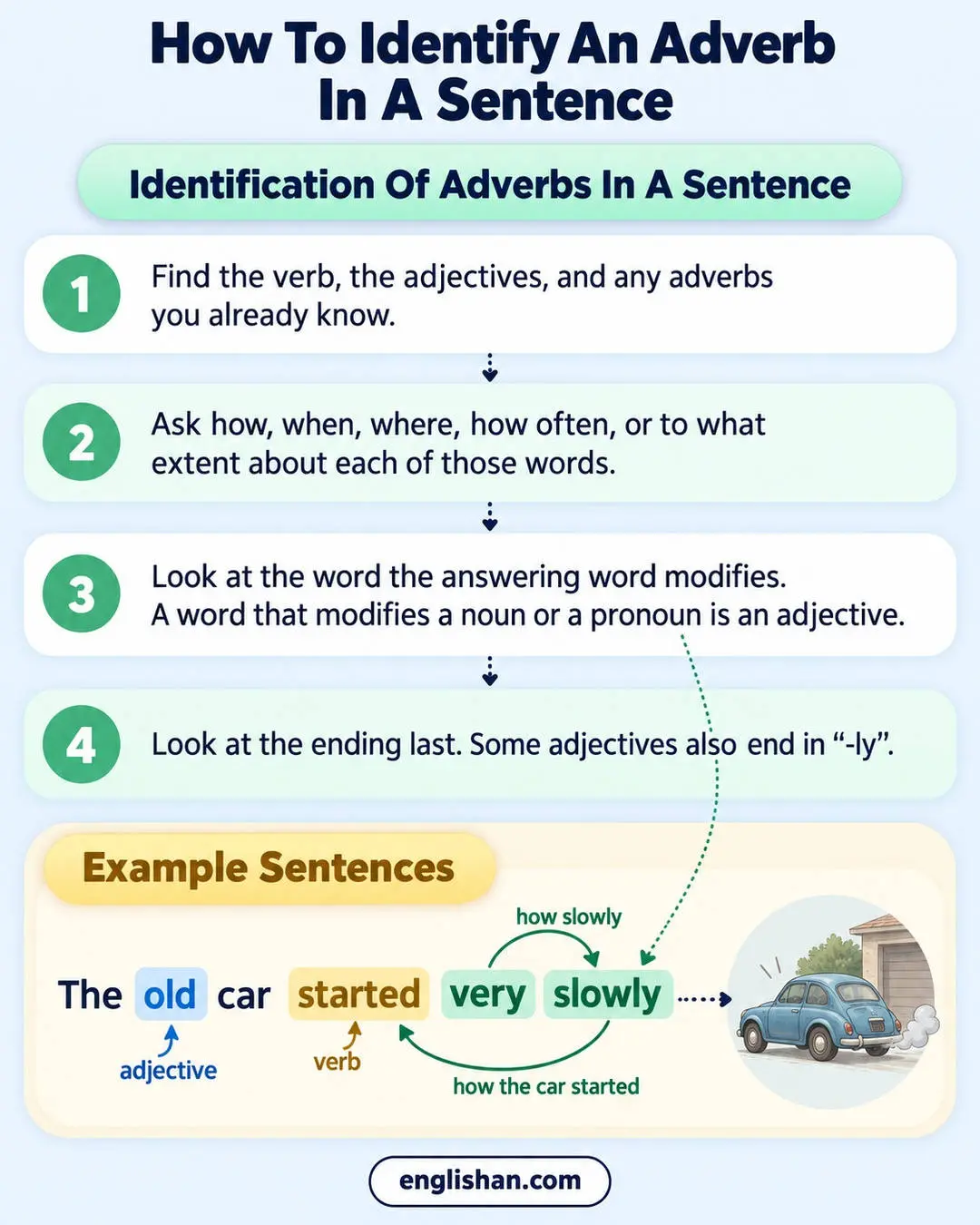
Identification Of Adverbs In A Sentence
An adverb is identified through the word it modifies, so the method starts with the verb and the adjectives and reaches the adverb last. Use the steps in order, because a word that answers “how” can still be an adjective, and the third step settles its word class.
- Find the verb, the adjectives, and any adverbs you already know. An adverb modifies one of these words or the whole sentence, so they are the words to start from. In “The old car started very slowly”, the verb is “started”, the adjective is “old”, and “very” and “slowly” are the words left to explain.
- Ask how, when, where, how often, or to what extent about each of those words. The word that answers is usually the adverb, and the question also names its type: manner for “how”, time for “when”, place for “where”, frequency for “how often”, and degree for “to what extent”. In the same sentence, “slowly” answers how the car started, and “very” answers how slowly.
- Look at the word the answering word modifies. A word that modifies a verb, an adjective, another adverb, or the whole sentence is an adverb. A word that modifies a noun or a pronoun is an adjective, whatever question it answers.
- Look at the ending last. Many adverbs end in “-ly”, such as “slowly” and “carefully”, but “friendly”, “lovely”, “lonely”, and “costly” are adjectives. “Fast”, “well”, “soon”, “often”, and “here” are adverbs with no “-ly” at all.
Linking verbs: After a linking verb such as “be”, “seem”, “look”, “feel”, or “smell”, the word that answers “how” is usually an adjective, because it describes the subject, not the action.
- The milk smells sour. (adjective)
- The dog sniffed the bag carefully. (adverb)
The word “sour” describes the milk, so step 3 identifies it as an adjective, while “carefully” modifies the verb “sniffed”.
Adjectives in -ly: An adjective ending in “-ly” still describes a noun, so it cannot modify a verb. To use its meaning after a verb, put it in a phrase such as “in a friendly way”.
She smiled friendly at the new students. ❌
She smiled at the new students in a friendly way. ✅
The word “friendly” is an adjective, so after the verb “smiled” the meaning takes the phrase “in a friendly way”.
Examples Of Identifying An Adverb
The hard cases in how to identify an adverb in a sentence are words with two word classes and words whose spelling misleads. Each one follows the same steps: find the word that answers the question, then see what it modifies.
Several adverbs: A sentence can have two or three adverbs, and each one modifies its own word.
- Our neighbors often play music very loudly.
- Kim called her mother twice yesterday.
In the first sentence, “often” modifies “play” and answers how often, “loudly” modifies “play” and answers how, and “very” modifies the adverb “loudly” and answers to what extent.
Same spelling: Before a noun, “fast” is an adjective, and after a verb it is an adverb, with no change in spelling.
- Kofi has a fast bike. (adjective)
- Kofi rides fast. (adverb)
The words “late”, “early”, and “high” follow the same rule: before a noun they describe the noun, and after a verb they modify the verb.
Hard and hardly: The adverb of the adjective “hard” is “hard”, and “hardly” is a separate adverb that means ‘almost not’.
- The nurses worked hard all night.
- I could hardly hear the speaker.
The team tried hardly to win. ❌
The team tried hard to win. ✅
After a verb, “hard” means ‘with effort’, while “hardly” means ‘almost not’, so the sentence about effort takes “hard”.
Adverb before an adjective: An adverb of degree comes before an adjective or another adverb and modifies it, so the word it modifies is not a verb.
- The soup was extremely hot.
- This is a surprisingly easy recipe.
The adverb “surprisingly” modifies the adjective “easy”, not the noun “recipe”, so it is an adverb even though a noun comes after it.
Sentence adverb: A sentence adverb modifies the whole sentence, and it usually comes at the start, followed by a comma.
- Unfortunately, the last train had already left.
- Clearly, the plan needs more time.
The adverb “unfortunately” expresses the speaker’s view of the whole event, while “already” modifies the verb “had left” and answers when.
Common Words As Adverbs
Many short words belong to two or three word classes, so the same word can be an adverb in one sentence and a pronoun or a preposition in another. In the table, “Yes” means the word is usually an adverb, “No” means it is never an adverb, and “Sometimes” means its word class depends on the word it modifies.
| Word | Adverb? | Word class or use |
|---|---|---|
| What | Sometimes | Usually a pronoun or determiner; rarely an adverb meaning ‘in what way’ |
| Extremely | Yes | Adverb of degree |
| That | Sometimes | Usually a determiner, pronoun, or conjunction; an adverb of degree in “that tall” |
| The | Sometimes | Usually the definite article; an adverb before a comparative in “the sooner” |
| There | Sometimes | Adverb of place; an introductory word in “there is” and “there are” |
| It | No | Pronoun |
| On | Sometimes | Preposition with a noun after it; prepositional adverb with no noun after it |
| Be | No | Verb (linking verb and auxiliary) |
| Too | Yes | Adverb of degree; also an adverb meaning ‘also’ |
| Will | No | Modal auxiliary verb; also a noun |
| Very | Yes | Adverb of degree; an adjective meaning ‘exact’ in “the very person” |
| Not | Yes | Negative adverb |
| Never | Yes | Adverb of frequency and negative adverb |
| Here | Yes | Adverb of place; also an introductory word in “here is” |
| When | Sometimes | Interrogative or relative adverb; a conjunction before a clause of time |
| Where | Sometimes | Interrogative or relative adverb; a conjunction before a clause of place |
| Why | Yes | Interrogative or relative adverb |
| So | Sometimes | Adverb of degree before an adjective or adverb; a conjunction between clauses |
| Then | Yes | Adverb of time; also a conjunctive adverb |
| Really | Yes | Adverb of degree; also an adverb meaning ‘in fact’ |
| Always | Yes | Adverb of frequency |
| Who | No | Pronoun |
| Have | No | Verb (main verb and auxiliary) |
| Should | No | Modal auxiliary verb |
For a word marked “Sometimes”, step 3 settles the word class, because the word next to it shows what it modifies.
- Put your coat on. (prepositional adverb)
- The keys are on the table. (preposition)
- Leave the boxes there. (adverb of place)
- There is a pharmacy near the station. (introductory word)
- The film was not that long. (adverb of degree)
- The sooner you book, the cheaper the tickets. (adverbs)
The word “on” is a preposition when a noun or pronoun follows it, and a prepositional adverb when nothing follows it. In “there is”, the word “there” introduces the subject, “a pharmacy”, and tells us nothing about place, so the place comes from “near the station”.
Adverb Phrases And Clauses In A Sentence
An adverb phrase is a group of words that functions as an adverb, and an adverb clause is a group of words with its own subject and verb that functions as an adverb. Both answer the same questions as a one-word adverb, so the steps find them in the same way.
- She left the meeting in a hurry.
- We stayed inside because it was raining.
- After the guests left, we washed the dishes.
An adverb clause begins with a subordinating conjunction such as “because”, “when”, “after”, “if”, or “although”, and it can come before or after the main clause. Many adverb phrases begin with a preposition, as in “in a hurry”, and the whole group of words answers how, when, where, or why about the verb.
FAQs
Ask the question the adverb answers about the word it modifies, and the question names the kind. The question "how" shows an adverb of manner, "when" an adverb of time, "where" an adverb of place, "how often" an adverb of frequency, and "to what extent" an adverb of degree. These five are the main types of adverbs by meaning.
Yes, many adverbs come at the end of a sentence, especially adverbs of manner, place, and time, as in "She sings beautifully" and "We met yesterday". Some adverbs of degree, such as "very" and "extremely", do not end a sentence, because they come before the adjective or adverb they modify.
In speech and informal writing, a single adverb can stand as a complete reply, as in "Definitely" or "Tomorrow". The rest of the sentence is understood from the question before it. In formal writing, use a full sentence with a subject and a verb.
An adverb of degree can modify another adverb, as in "very quietly" and "quite often". The adverbs that modify other adverbs are usually adverbs of degree, such as "very", "too", "quite", "rather", and "so".
No, adverbs and verbs are different parts of speech. The verb expresses the action or state, and the adverb modifies it, as in "He answered politely", where "answered" is the verb and "politely" is the adverb.
Related:
- What Do Adverbs Modify
- What Questions Do Adverbs Answer
- Adverb vs Adjective
- Adverbs Without LY
- Adverb Placement in a Sentence
- Adverb vs Verb
- Adverb vs Preposition
- Subordinating Conjunctions
