

The questions adverbs answer are how, when, where, how often, and to what extent (how much), and some adverbs also answer why. An adverb is a word that modifies a verb, an adjective, or another adverb, and the question it answers about that word shows which type of adverb it is.
Ask “how?” about “She speaks softly“, and the answer is “softly”, an adverb of manner. Ask “when?” about “We left early“, and the answer is “early”, an adverb of time. To answer “what questions do adverbs answer” in one line, name the core four: how, when, where, and to what extent. How often and why complete the list, and each question has its own type of adverb with its own example words.
Adverbs answer four core questions: how (manner), when (time), where (place), and to what extent (degree). They also answer how often (frequency), and a few adverbs, such as “therefore”, answer why (reason). Adverbs do not answer who, what, or which, because nouns, pronouns, and adjectives answer those questions.
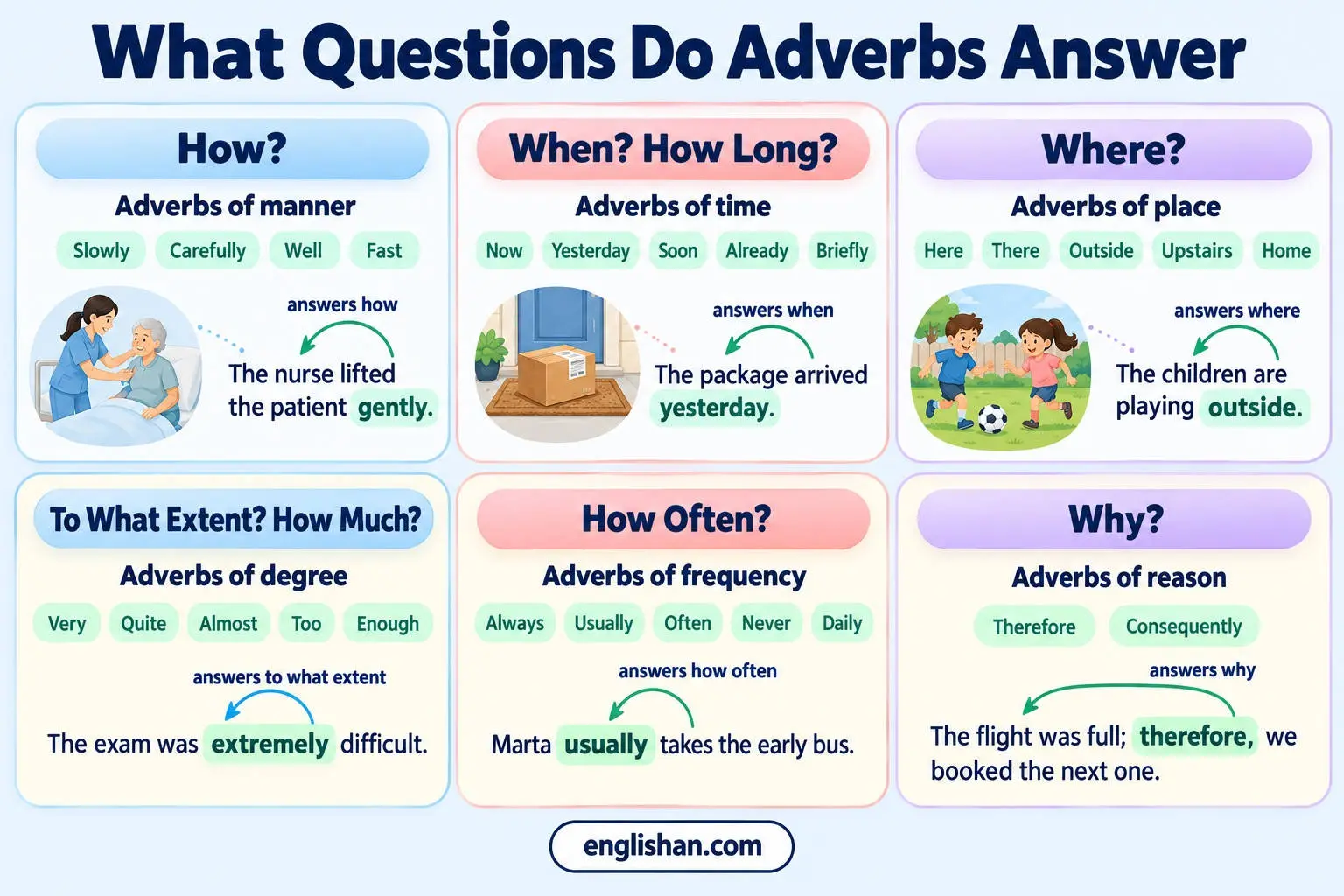
Questions Adverbs Answer
There are four main questions that adverbs answer: how, when, where, and to what extent. Adverbs also answer how often and why, which brings the full list to six questions, with one of the main types of adverbs for each.
| Question | Type of adverb | Example words |
|---|---|---|
| How? | Adverbs of manner | Slowly, carefully, well, fast |
| When? How long? | Adverbs of time | Now, yesterday, soon, already, briefly |
| Where? | Adverbs of place | Here, there, outside, upstairs, home |
| To what extent? How much? | Adverbs of degree | Very, quite, almost, too, enough |
| How often? | Adverbs of frequency | Always, usually, often, never, daily |
| Why? | Adverbs of reason | Therefore, consequently |
The question is asked about the word the adverb modifies, and the answer to what do adverbs modify is a verb, an adjective, another adverb, or a whole sentence. To find the adverb in a sentence, ask one of the six questions about the verb, and the word that answers it is the adverb: in “The bus arrived late“, the question “When did the bus arrive?” has the answer “late”.
Adverbs That Answer How
Adverbs of manner tell us how something happens. Most of them are formed by adding “-ly” to an adjective, so “careful” becomes “carefully”, and “fast”, “hard”, and “late” have the same form as their adjectives.
- The nurse lifted the patient gently.
- Our team worked hard before the launch.
- Did you sleep well on the flight?
- He doesn’t drive fast in the rain.
After a linking verb such as “be”, “seem”, “look”, “feel”, “taste”, or “sound”, the question “how?” asks about the subject, not the action. An adjective answers it there, so “How does the soup taste?” takes “delicious”, a word that describes the soup.
The soup tastes deliciously. ❌
The soup tastes delicious. ✅
A linking verb is followed by an adjective that describes the subject, not by an adverb of manner.
Adverbs That Answer When
Adverbs of time tell us when something happens, as in “now”, “today”, “yesterday”, “soon”, “later”, and “recently”. Most of them come at the end of the clause, and they move to the start when the time is the point of the sentence.
- The package arrived yesterday.
- I’ll call you back later.
- Tomorrow the office opens at ten.
- Have you paid the bill already?
How long: Adverbs of time also answer how long, the question about duration, as in “She didn’t stay long” and “The shop closed briefly for repairs”. Longer answers to how long are usually phrases, such as “for two hours” and “all week”.
The tense of the verb depends on the adverb of time, because the present perfect connects the past to now.
I have finished the report yesterday. ❌
I finished the report yesterday. ✅
An adverb of finished time, such as “yesterday” or “last week”, takes the past simple, not the present perfect.
Adverbs That Answer Where
Adverbs of place tell us where something happens, as in “here”, “there”, “outside”, “upstairs”, “nearby”, “abroad”, and “home”. An adverb of place usually comes after the verb, or after the object when the verb has one.
- The children are playing outside.
- Please leave your shoes there.
- My brother has never worked abroad.
- Is there a pharmacy nearby?
The word “home” answers where without a preposition after verbs of movement such as “go”, “come”, and “get”.
We went to home after the concert. ❌
We went home after the concert. ✅
After a verb of movement, “home” functions as an adverb of place, so it takes no “to”.
Adverbs That Answer To What Extent
Adverbs of degree tell us to what extent, or how much, something happens or is true. They usually come before the adjective, adverb, or verb they modify, as with “very”, “quite”, “rather”, “too”, “almost”, and “extremely”.
- The exam was extremely difficult.
- We almost missed the last train.
- You’re walking too fast for me.
- The room isn’t quite ready yet.
The one exception in position is “enough”, which comes after the adjective or adverb it modifies.
The box isn’t enough big for the printer. ❌
The box isn’t big enough for the printer. ✅
As an adverb of degree, “enough” follows the adjective; before a noun, as in “enough chairs”, it is a determiner, not an adverb.
Adverbs That Answer How Often
Adverbs of frequency tell us how often something happens. Some show an indefinite frequency, such as “always”, “usually”, “often”, “sometimes”, “rarely”, and “never”, and others show a definite one, such as “daily”, “weekly”, “once”, and “twice”.
- Marta usually takes the early bus.
- We never eat out on Mondays.
- Do you often work from home?
- The board meets twice a year.
Position depends on the kind of frequency. Indefinite adverbs of frequency usually go before the main verb and after “be”, while definite ones usually come at the end of the clause.
I go always to the gym after work. ❌
I always go to the gym after work. ✅
An adverb of indefinite frequency comes before the main verb, not between the verb and the rest of the clause.
Adverbs That Answer Why
Adverbs of reason tell us why something happens, but only a few single words answer why, mainly “therefore” and “consequently”. These adverbs do not state the reason themselves, because they refer back to a reason given in the clause or sentence before them.
- The flight was full; therefore, we booked the next one.
- Sam missed the meeting, and consequently he missed the vote.
Both words are conjunctive adverbs, because they link the ideas in two independent clauses. Most answers to why are groups of words instead. An adverb phrase like “to catch the train” answers why with a purpose, as in “She left early to catch the train“.
An adverb clause with “because”, “since”, or “as” states the reason in full, as in “We stayed in because it was raining“. Adverb phrases and clauses answer the other five questions too, as with “after lunch” (when) and “in the garden” (where).
We stayed in. Because it was raining. ❌
We stayed in because it was raining. ✅
A clause with “because” is a dependent clause, so it joins a main clause and does not stand as a sentence by itself.
Questions Adverbs Do Not Answer
Adverbs do not answer who, what, or which. A noun or a pronoun answers who and what, as the subject or the object of the verb, and an adjective answers which one and what kind about a noun.
- Who called? Priya called.
- What did you buy? I bought a lamp.
- Which coat is yours? The blue one.
A full answer to what questions do adverbs answer names these three as well, because a word that answers which one or what kind is an adjective, even when it looks like an adverb. The hard case is a word with the same form in both word classes:
- The fast train leaves at noon. (what kind)
- The train moves fast. (how)
- We took an early flight. (which one)
- We got up early. (when)
In the first and third sentences, “fast” and “early” describe a noun, so they are adjectives. In the second and fourth, they modify the verb, so they are adverbs.
Adjective questions: Adjectives answer which one, what kind, and how many about a noun or a pronoun. Adverbs answer how, when, where, and to what extent about a verb, so the question you ask settles an adverb vs adjective choice. How many takes an adjective, as in “three tickets”, while how much about a verb takes an adverb of degree, as in “I really miss you”.
FAQs
Interrogative adverbs ask questions, so "how", "when", "where", and "why" open questions about manner, time, place, and reason. An interrogative adverb asks the question, as in "Where do you work?", and an adverb of place such as "nearby" or "abroad" answers it.
Yes, all three are adverbs. In a question they are interrogative adverbs, and inside a clause such as "the town where I grew up" or "the day when we met", "where" and "when" are relative adverbs that introduce the clause.
How is the question most often linked with adverbs, because a large share of adverbs ending in "-ly" are adverbs of manner, such as "quickly" and "carefully". In everyday speech, the most frequent single adverbs include time and place words such as "now", "then", "here", and "there".
No, adverbs are a normal part of English, and many sentences lose their meaning without one, as in "She never eats meat". An adverb is extra only where it repeats the meaning of the verb, as in "whispered quietly", where "whispered" already means ‘spoke quietly’.
Related:
- How to Identify an Adverb in a Sentence
- Adverb Placement in a Sentence
- Present Perfect vs Past Simple
