The Present Perfect vs Past Simple are two of the most commonly used tenses in English, but they can sometimes be confusing for learners. Both tenses talk about actions related to the past, which is why many people mix them up in speaking and writing. However, each tense is used in different situations and carries a different meaning.
The Present Perfect usually connects a past action to the present, while the Past Simple describes something that happened at a definite time in the past. Learning the difference between the present perfect vs past simple can help you communicate more clearly and naturally in English. In this article, we’ll explore the rules, structures, uses, and examples of both tenses in a simple and easy-to-understand way.
Present Perfect vs Past Simple
The Present Perfect and Past Simple are both used for talking about the past, but they don’t work in the same way. The main difference is how they connect (or don’t connect) with the present moment.
The Present Perfect is used when something happened in the past but is still important or relevant now. We usually don’t focus on the exact time in these sentences, because the result matters more than when it happened.
Example 1: I have finished my homework. (It’s done now, and the result matters)
Example 2: She has visited Lahore many times. (It’s part of her experience)
Example 3:They have already eaten dinner. (So they are not hungry now)
The Past Simple is used when something happened and completely finished in the past. In this case, we often mention when it happened, because the time is clear and important.
Example 1: I finished my homework yesterday. (A clear time in the past)
Example 2: She visited Lahore last year. (It’s a completed past event)
Example 3: They ate dinner at 8 o’clock. (Finished at a specific time)
In short: Use Present Perfect when the past action still feels connected to now, and use Past Simple when the action is fully finished and you’re just talking about what happened in the past.
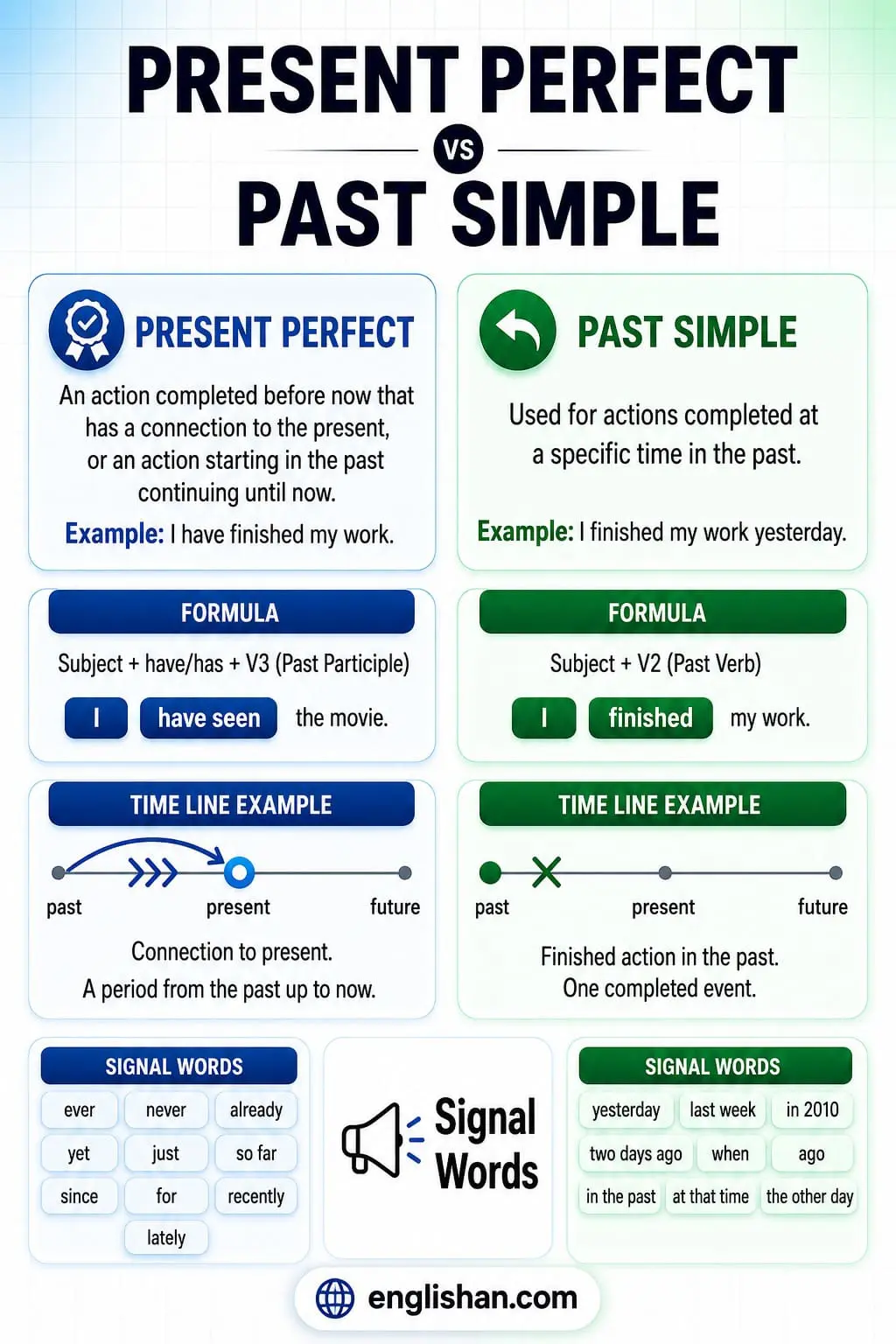
What is the Present Perfect?
The Present Perfect is a verb tense used to talk about actions or events that happened in the past but are still connected to the present. It is commonly used when the exact time of the action is not important or when the result of the action can still be seen now.
The Present Perfect is formed by using has/have + past participle of the main verb.
Example 1: I have finished my homework.
Example 2: She has visited Lahore many times.
Example 3: They have already eaten dinner.
This tense is often used to talk about experiences, completed actions with present results, unfinished time periods, and actions that started in the past and continue into the present.
When to Use Present Perfect
The Present Perfect is used to talk about actions or situations that are connected to the present in some way. Unlike the Past Simple, this tense does not usually mention a specific past time. Instead, it focuses on the result, experience, or ongoing effect of an action. Because of this, the Present Perfect is very common in daily conversations and writing.
To Talk About Life Experiences
We use the Present Perfect to describe experiences we have had in life. In these sentences, the exact time of the experience is not important.
Example 1: I have visited Islamabad many times.
Example 2: She has never ridden a horse.
This use is common when talking about things we have done, seen, tried, or experienced at any point in our lives.
To Describe Actions with Present Results
The Present Perfect is also used when a past action still affects the present situation. The action is finished, but its result can still be seen now.
Example 1: He has lost his wallet.
Example 2: They have painted the house.
In the first example, the wallet is still missing. In the second example, the house is now painted.
To Talk About Actions That Continue into the Present
We use the Present Perfect for actions or situations that started in the past and are still continuing now. These sentences often include for and since.
Example 1: I have worked here for three years.
Example 2: She has lived in Lahore since 2020.
This use shows that the action began in the past and has not stopped yet.
To Talk About Recent Actions
The Present Perfect is often used for actions that happened recently, especially when the result is important in the present moment. Words like just, already, and yet are commonly used here.
Example 1: I have just finished my lunch.
Example 2: Have you completed your homework yet?
These sentences focus more on the current situation than the exact time of the action.
To Talk About Unfinished Time Periods
We also use the Present Perfect when talking about a time period that has not finished yet, such as today, this week, or this year.
Example 1: I have watched three movies this week.
Example 2: She has met many new people this month.
Since the week or month is not over, the Present Perfect is the correct tense here.
In simple words, the Present Perfect is used when the past action has a connection to the present. Whether you are talking about experiences, recent actions, continuing situations, or present results, this tense helps show that the action still matters now.
Present Perfect Structure
The Present Perfect tense is formed by using has/have with the past participle of the main verb. The helping verb changes depending on the subject, but the past participle form of the verb always stays the same. Understanding this structure is important because it helps you create correct positive, negative, and question sentences in everyday English.
Positive Structure
In positive sentences, we use:
Structure: Subject+has/have+past participle+object
- We use have with subjects like I, you, we, and they.
- We use has with he, she, and it.
Example 1: I have completed my work.
Example 2: She has watched this movie before.
In both examples, the action happened in the past, but it still has a connection to the present.
Negative Structure
To make negative sentences, we simply add not after has or have.
Structure: Subject+has/have+not+past participle+object
Example 1: They have not finished the project.
Example 2: He has not visited Karachi yet.
In everyday conversation, people often use contractions like haven’t and hasn’t.
Question Structure
To make questions, we place has or have at the beginning of the sentence before the subject.
Structure: Has/Have+subject+past participle+object?
Example 1: Have you seen my phone?
Example 2: Has she completed her assignment?
This structure is commonly used in conversations when asking about experiences or completed actions.
Understanding the Past Participle
The past participle is the third form of the verb. For regular verbs, we usually add -ed.
- Work → Worked
- Clean → Cleaned
However, irregular verbs have different forms.
- Go → Gone
- Eat → Eaten
- Write → Written
Because irregular verbs do not follow one fixed rule, they need to be memorized with practice.
The structure of the Present Perfect is simple once you understand the role of has/have and the past participle. Whether you are making positive sentences, negatives, or questions, the basic pattern stays almost the same. Learning this structure properly will help you speak and write more naturally and accurately in English.
Common Time Expressions With Present Perfect
The Present Perfect is often used with certain time expressions that connect the past to the present. These words and phrases help show whether an action has happened, is unfinished, or still has relevance now.
- Already
- Yet
- Just
- Ever
- Never
- Recently
- Lately
- So far
- Until now
- Up to now
- Since
- For
- Today
- This week
- This month
- This year
- Before
- Once
- Several times
- Many times
- In the last few days
- Over the years
In short, these time expressions help connect past actions with the present moment, making the Present Perfect tense more meaningful and natural in everyday English.
What Is Past Simple?
The Past Simple tense is used to talk about actions or events that happened and were completed in the past. It focuses on a specific time in the past, even if that time is not always mentioned in the sentence. This tense shows that the action is finished and has no direct connection to the present.
The Past Simple is formed by using the second form (past form) of the verb. For regular verbs, we usually add -ed, while irregular verbs have different forms that need to be memorized.
Example 1: I visited my grandmother yesterday.
Example 2: She went to school early in the morning.
Example 3: They played football in the evening.
In simple words, the Past Simple is used when we want to clearly say that something happened in the past and is now complete.
When to Use Past Simple
It is typically used when the time of an action is clearly stated or understood from the context. Unlike the Present Perfect, it does not link the action to the present in any way. It is used to indicate that an action is fully completed and has no relevance to the present situation.
Completed Actions in the Past
We use the Past Simple to talk about actions that started and finished at a specific time in the past. These actions are done and cannot be changed or continued now.
Example 1: He finished his homework in the evening.
Example 2: They moved to Lahore in 2020.
In short, we use the Past Simple in this case when an action is fully completed at a definite time in the past.
Past Actions in a Sequence
The Past Simple is also used when we describe a series of actions that happened one after another in the past. It is very common in storytelling or when explaining events step by step.
Example 1: She entered the room, turned on the light, and sat down.
Example 2: He picked up the phone, called his friend, and left the house.
In this case, we use the Past Simple to show a clear order of completed actions in the past.
Finished Time Expressions
We often use the Past Simple with time expressions that clearly show the action is finished. Words like yesterday, last week, ago, or specific past dates are commonly used.
Example 1: I saw that movie last night.
Example 2: We traveled to Murree two years ago.
In short, we use the Past Simple when a finished time expression clearly tells us the action happened in the past.\
So simply, the Past Simple is used whenever we talk about finished actions, clear past events, or completed situations that have no connection to the present.
Past Simple Structure
The Past Simple tense has a very straightforward structure. It is mainly used to describe finished actions in the past, and the verb form changes depending on whether the sentence is positive, negative, or a question. Once you understand the basic pattern, it becomes easy to use in everyday English.
Positive Structure
In positive sentences, we simply use the second form of the verb (past form).
Structure: Subject+Past form of verb+Object
Example 1: I visited my friend yesterday.
Example 2: She went to school early.
In short: Just use the past form of the verb when you are telling something that happened in the past.
Negative Structure
In negative sentences, we use did not (didn’t) + base form of the verb.
Structure: Subject+did not (didn’t)+base form of verb+Object
Example 1: I did not visit my friend yesterday.
Example 2: She did not go to school early.
In this case, we don’t change the main verb; it always stays in its base form after “did not”.
Question Structure
In questions, we start with Did, then add the subject and the base form of the verb.
Structure: Did+Subject+base form of verb+Object?
Example 1: Did you visit your friend yesterday?
Example 2: Did she go to school early?
In short: When you make a question, just start with “Did” and keep the main verb in its base form.
In short, the structure is simple: use the past form in positive sentences, “did not + base form” in negatives, and “did + subject + base form” in questions. Once you get used to this pattern, using the Past Simple becomes very natural in everyday English.
Common Time Expressions With Past Simple
The Past Simple is often used with time expressions that clearly show the action is finished in the past. These words help us understand when something happened, even if the exact time is not very important in conversation.
- Yesterday
- Last night
- Last week
- Last month
- Last year
- Ago
- Two days ago
- Three years ago
- In 2010
- In the morning
- In the evening
- On Monday
- On Friday
- At that time
- Then
- Once
- Earlier
- In the past
- The other day
- A long time ago
- When I was a child
In short: These time expressions are commonly used with the Past Simple to clearly show that an action is completed in the past.
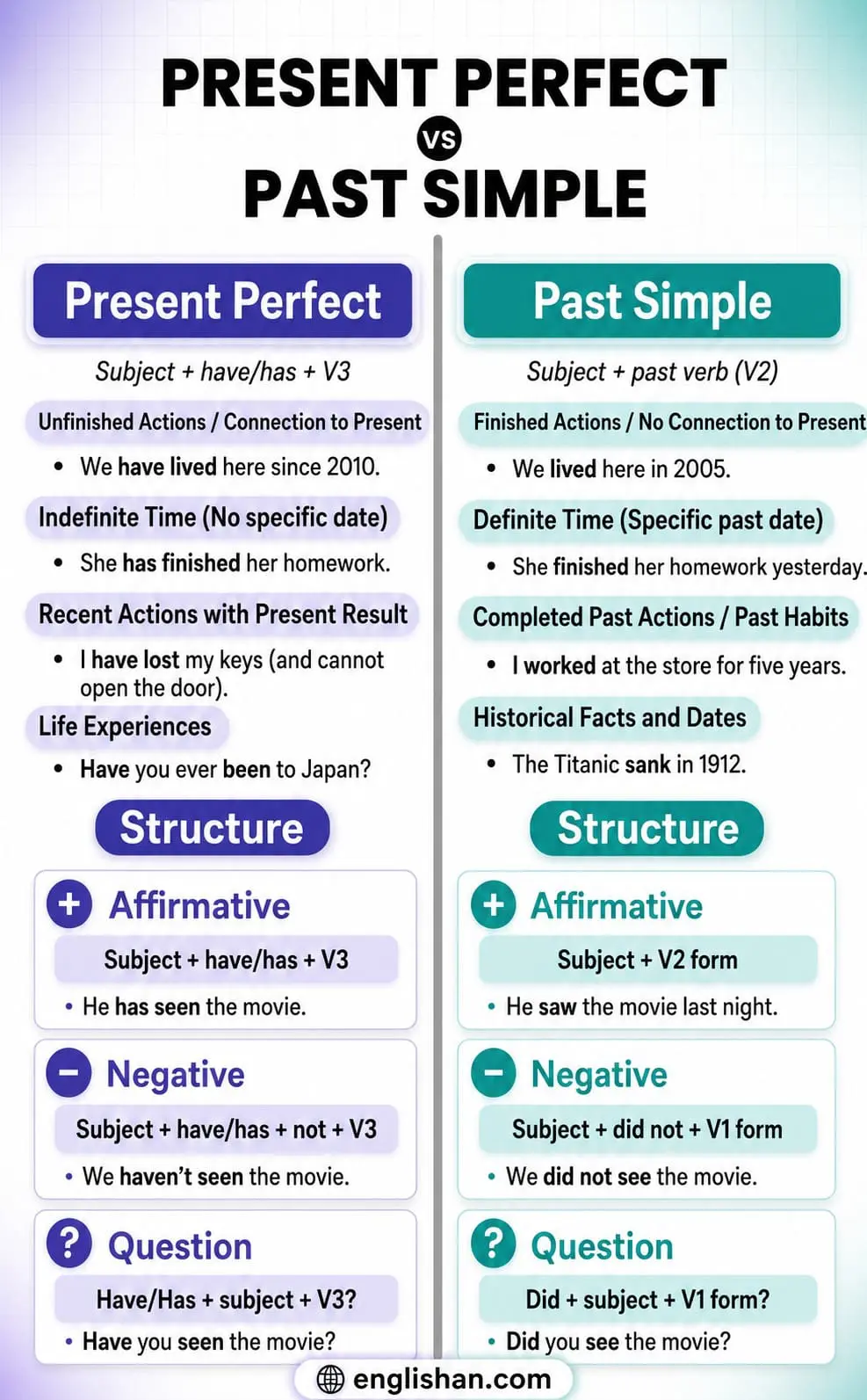
Comparison Table: Present Perfect vs Past Simple
Here’s a simple comparison table to clearly understand how Present Perfect and Past Simple are different in structure, meaning, and use:
| Point | Present Perfect | Past Simple |
|---|---|---|
| Definition | Used for actions that happened in the past but are still connected to the present. | Used for actions that happened and are completely finished in the past. |
| Structure | has/have + past participle | past form of verb |
| Time Reference | No specific time is mentioned or important | Specific time in the past is usually mentioned |
| Example | I have completed my homework. | I completed my homework yesterday. |
| Focus | Focus is on result or experience | Focus is on completed action |
| Usage Idea | When the past still matters now | When the action is fully finished in the past |
In short, the Present Perfect links past actions to the present, while Past Simple talks about finished actions in the past with a clear time.
Common Mistakes Learners Make
Many learners get confused between Present Perfect and Past Simple because both refer to past actions. This often leads to small but important grammar mistakes that change the meaning of a sentence.
Using Specific Time with Present Perfect
One common mistake is using a definite past time with Present Perfect, which is incorrect. The Present Perfect should not be used with words like yesterday, last week, or ago.
Incorrect: I have seen him yesterday.
Correct: I saw him yesterday.
This happens because Present Perfect is not meant for a clearly finished time in the past.
Wrong Verb Form in Present Perfect
Another frequent mistake is using the wrong past participle form of the verb. Learners sometimes use the past simple form instead of the correct participle.
Incorrect: I have went to school.
Correct: I have gone to school.
This is why learning the correct third form of verbs is very important.
Mixing Both Tenses Incorrectly
Sometimes learners use Past Simple when the action still has a connection to the present, or use Present Perfect when the action is clearly finished with a specific time.
Incorrect: I have finished my homework yesterday.
Correct: I finished my homework yesterday.
This usually happens when the difference between “finished past” and “present connection” is not clear.
In simple words, these mistakes usually happen when learners mix up time expressions or verb forms. Once you clearly understand when to use each tense, these errors become much easier to avoid.
Tips to Remember the Difference
Here are some quick and simple tips that can help you easily remember the difference between Present Perfect and Past Simple:
- Check if the time is specific or not
- Use Past Simple with: yesterday, last week, ago, last night
- Use Present Perfect when time is not mentioned or is not important
- Think: does it have a connection to now?
- Use Present Perfect for life experiences
- Use Past Simple for finished actions
- Remember: has/have + past participle = Present Perfect
- Remember: past form of verb = Past Simple
- Learn common signal words for both tenses
In short, once you start noticing time clues and verb forms, choosing between Present Perfect and Past Simple becomes much easier and more natural.
Practice Exercises: Present Perfect vs Past Simple
To get better at using Present Perfect and Past Simple, practice is very important. These exercises will help you understand when to use each tense correctly, how time words change the meaning, and how to avoid common mistakes. Try to solve them on your own first, then check the answers below.
Exercise 1: Fill in the blanks (Present Perfect or Past Simple)
I ______ (finish) my homework yesterday.
She ______ (visit) London many times.
They ______ (not see) him last week.
Exercise 2: Fix the mistake
I have saw that movie last night.
He has went to school in 2018.
We have met him yesterday.
Exercise 3: Choose the correct option
She has just finished / finished her work.
They visited / have visited Paris last year.
I have already eaten / ate dinner.
Exercise 4: Rewrite correctly
I have finished my project yesterday.
She has met him last week.
They have traveled to Karachi two days ago.
Exercise 5: Identify the tense
I have lived here for five years.
He played football yesterday.
We have never tried sushi.
Answer Key:
- I finished my homework yesterday.
She has visited London many times.
They did not see him last week. - I saw that movie last night.
He went to school in 2018.
We met him yesterday. - She has just finished her work.
They visited Paris last year.
I have already eaten dinner. - I finished my project yesterday.
She met him last week.
They traveled to Karachi two days ago. - Present Perfect
Past Simple
Present Perfect
Conclusion
Understanding the difference between Present Perfect and Past Simple becomes much easier once you focus on time and meaning. The Present Perfect is used when a past action is still connected to the present, while the Past Simple is used for actions that are completely finished in the past with a clear time reference.
Both tenses are very important in everyday English, and using them correctly helps you sound more natural and accurate. With regular practice and attention to time expressions, you can easily avoid confusion and use both tenses with confidence.
FAQs
The main difference is how they relate to time. Present Perfect is used when a past action is still connected to the present or its result is important now. Past Simple is used when the action is completely finished in the past and has no connection with the present situation.
No, we cannot use “yesterday” with Present Perfect because it refers to a specific finished time in the past. Words like this are only used with Past Simple.
For example, we say “I saw him yesterday,” not “I have seen him yesterday.”
The structure of Present Perfect is has/have + past participle form of the verb. We use have with I, you, we, they and has with he, she, it.
For example: I have finished my homework and She has visited Lahore.
We use Past Simple when we talk about actions that happened and are completely finished in the past. It is often used with time expressions like yesterday, last week, ago, or a specific date. For example: He went to school yesterday.
Yes, both tenses can be used in one context, but they show different meanings. For example, you might describe a past experience using Present Perfect and then give a specific detail using Past Simple. This helps show both the experience and the exact time clearly.
You May Also Like
- Past Perfect Tense
- Present Perfect Tense Worksheets and Exercises
- 100 Useful Present Tense Examples in Sentences
- 100 Useful Simple Past Tense Sentences List
- 100 Simple Past Examples for Easy Grammar Learning
Present Perfect vs Past Simple Quiz
Present Perfect vs Past Simple
Which fits a present result?
I ___ my homework. Here it is.
'Here it is' shows a present result with no stated time, which is the present perfect.
present result now -> present perfect
I have finished my homework. Here it is.
Which fits '2019'?
We ___ Spain in 2019.
'In 2019' is a finished time, and finished times take the simple past.
specific past time -> past simple
We visited Spain in 2019.
Ask about life experience.
___ a celebrity?
'Ever' asks about experience across your life so far, which is the present perfect.
ever + experience -> present perfect
Have you ever met a celebrity?
Which fits 'last summer'?
She ___ to Japan last summer.
'Last summer' is finished time, so the simple past reports the trip.
last summer -> past simple
She went to Japan last summer.
Which keeps the result relevant now?
I can't find my phone. ___ it?
The phone is still missing, so the present perfect keeps the result alive now.
result relevant now -> present perfect
I can't find my phone. Have you seen it?
True or false?
You can use the present perfect with a finished time like 'yesterday', as in 'I have seen him yesterday.'
Finished times take the simple past, so this should be 'I saw him yesterday.'
finished time -> past simple, not present perfect
I saw him yesterday.
Finished or unfinished time?
I ___ Sophie yesterday.
A finished time word like 'yesterday' takes the simple past.
finished time -> simple past
I saw Sophie yesterday.
Experience up to now.
___ to Australia?
An open question about life experience takes the present perfect.
ever + present perfect for experience
Have you ever been to Australia?
Type the correct form of the verb in brackets.
We ___ (live) here since 2018.
'Since 2018' marks a span still true now, so the present perfect fits, not the simple past.
since + present perfect for an unfinished span
We have lived here since 2018.
Recent news vs finished report.
The results ___; check them now.
Recent news with present relevance takes the present perfect.
present perfect for recent news with present relevance
The results have arrived; check them now.
True or false?
'I have finished my homework two hours ago' is correct.
'Ago' marks finished time and needs the simple past: 'I finished my homework two hours ago.'
ago -> simple past
I finished my homework two hours ago.
Time reaching now.
She ___ three cups of coffee today.
'Today' is not over, so the present perfect counts within the unfinished day.
unfinished time (today) -> present perfect
She has had three cups of coffee today.
Finished or unfinished time?
___ you finished your work yet?
'Yet' points to a result that reaches now, so the present perfect fits.
yet -> present perfect
Have you finished your work yet?
Finished or unfinished time?
She ___ to Paris last summer.
'Last summer' is finished time and takes the simple past.
finished time -> simple past
She went to Paris last summer.
Life experience.
I have ___ eaten sushi.
'Never' with the present perfect states experience across a lifetime up to now.
ever / never + present perfect for experience
I have never eaten sushi.
Type the correct form of the verb in brackets.
We ___ (know) each other for ten years.
'For ten years' names a span still true now, so the present perfect fits.
for + present perfect for an unfinished span
We have known each other for ten years.
Question about finished time.
When ___ you ___ this photo?
A 'when' question points to a finished moment and takes the simple past.
when-questions -> simple past
When did you take this photo?
True or false?
'I have seen him last week' is correct.
'Last week' is finished time and takes the simple past: 'I saw him last week.'
last week -> simple past
I saw him last week.
Recent action with 'just'.
They have ___ arrived.
'Just' with the present perfect marks an action completed a moment ago with present relevance.
just + present perfect for a recent action
They have just arrived.
Specific past year.
In 2019, she ___ her degree.
A named past year is finished time and takes the simple past.
a named past year -> simple past
In 2019, she completed her degree.
Turn on JavaScript for the interactive quiz. The full practice set is shown above.