The simple present tense is used to talk about actions that happen regularly, general truths, and fixed situations. Words like always, never, and every day often appear in this tense. Reading and practicing sentences helps learners notice structure and grammar patterns clearly. This post gives real sentence examples that help you recognize usage naturally and understand how sentence forms are built without needing long explanations.
Positive Sentences In Simple Present Tense
Below is a list of positive sentence examples where actions are stated simply. These sentences use the base form of the verb for most subjects.
- I like chocolate milk.
- They walk to school every morning.
- Sara reads a book after dinner.
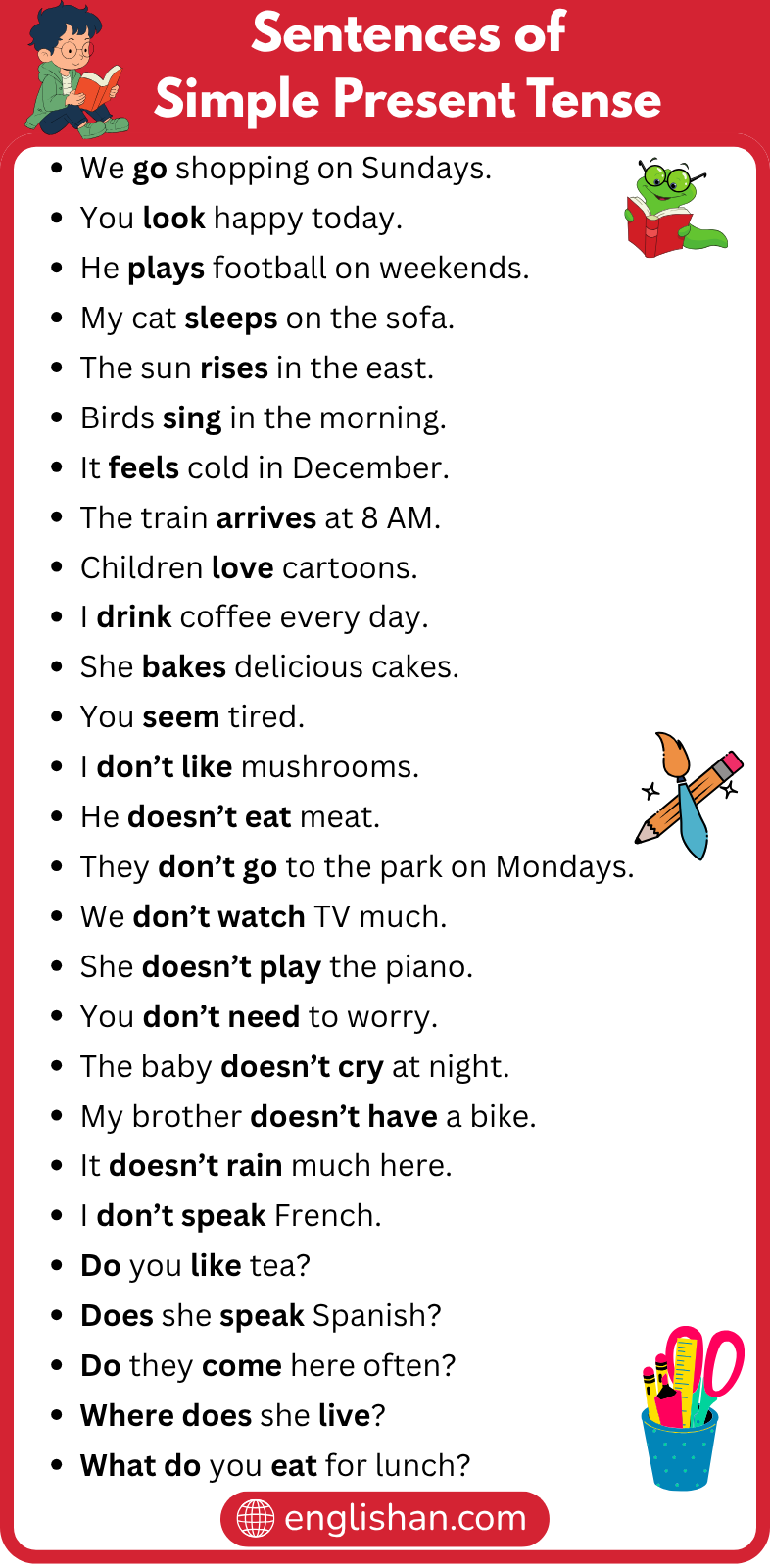
- We go shopping on Sundays.
- You look happy today.
- He plays football on weekends.
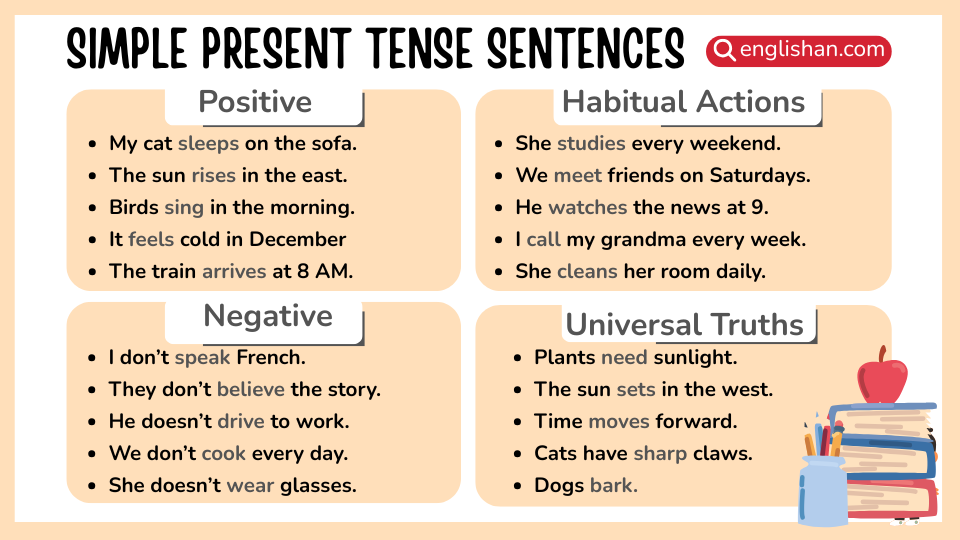
- My cat sleeps on the sofa.
- The sun rises in the east.
- Birds sing in the morning.
- It feels cold in December.
- The train arrives at 8 AM.
- Children love cartoons.
- I drink coffee every day.
- She bakes delicious cakes.
- You seem tired.
Negative Sentences In Simple Present Tense
Below is a list of examples that show how to express negative actions using do not and does not in present tense.
- I don’t like mushrooms.
- He doesn’t eat meat.
- They don’t go to the park on Mondays.
- We don’t watch TV much.
- She doesn’t play the piano.
- You don’t need to worry.
- The baby doesn’t cry at night.
- My brother doesn’t have a bike.
- It doesn’t rain much here.
- I don’t speak French.
- They don’t believe the story.
- He doesn’t drive to work.
- We don’t cook every day.
- She doesn’t wear glasses.
- You don’t sound excited.
Questions In Simple Present Tense
Below is a list of example questions formed in the present tense using do or does to ask about actions.
Yes/No Questions
- Do you like tea?
- Does she speak Spanish?
- Do they come here often?
- Does he live nearby?
- Do we need more milk?
- Does it work properly?
- Do you play cricket?
- Does your cat bite?
Wh-Questions
- What do you eat for lunch?
- Where does she live?
- Why do they argue so much?
- When do you get up?
- Who does he talk to every day?
- How do we solve this?
- Which book do you recommend?
Habitual Actions And Daily Routines
Below is a list of sentences that show regular actions and repeated behavior in the present tense.
- I brush my teeth twice a day.
- She wakes up at 6 AM.
- They go to the gym every evening.
- We take the bus to work.
- He reads the newspaper in the morning.
- My mom cooks dinner every night.
- You check your phone too often.
- I drink water before bed.
- They walk their dog after dinner.
- She studies every weekend.
- We meet friends on Saturdays.
- He watches the news at 9.
- I call my grandma every week.
- She cleans her room daily.
- We practice English every day.
Universal Truths And General Facts
Below is a list of present tense examples that show facts and things that are always true.
- Water boils at 100°C.
- The Earth revolves around the sun.
- Dogs bark.
- The sky looks blue.
- Ice melts in heat.
- Fish live in water.
- The moon reflects sunlight.
- Gravity pulls everything down.
- Fire burns.
- Bees make honey.
- Birds fly.
- Plants need sunlight.
- The sun sets in the west.
- Time moves forward.
- Cats have sharp claws.
Using “Do” And “Does” In Present Tense
Below is a list of examples that highlight the use of do and does in different types of sentences.
- Do you know the answer?
- She does her homework daily.
- We do exercises every morning.
- He does his best every time.
- I do all the chores myself.
- Does it matter to you?
- They do the cleaning together.
- Does your friend live nearby?
- You do amazing work.
- Do they need help?
Third Person Singular Sentences
Below is a list of sentences using third-person singular subjects (he, she, it, or names) which require -s or -es with verbs.
- He likes pizza.
- She goes to the library often.
- It makes a buzzing sound.
- Sara writes neat notes.
- My dog barks at strangers.
- The machine starts at 6.
- She paints beautiful pictures.
- He drinks orange juice every morning.
- It works just fine now.
- John drives to school.
Present Tense Sentences With Time Words
Below is a list of sentences that include common time expressions used with simple present tense such as always, never, every day, sometimes, etc.
- I always carry a pen.
- She never eats fast food.
- They usually arrive on time.
- He often visits his grandma.
- We sometimes skip lunch.
- You rarely call me now.
- The shop opens at 9 AM every day.
- I wake up early on weekends.
- They watch movies every Friday.
- He goes jogging in the morning.
- She checks emails daily.
- We celebrate birthdays once a year.
- He reads the news every morning.
You May Also Like
Simple Present Tense Sentences Quiz
Simple Present Tense Sentences
Complete the sentence.
She ___ (go) to school every day.
After he/she/it, a verb ending in -o adds -es: goes.
third person: add -es after -o
She goes to school every day.
Choose the correct form.
He ___ tea in the morning.
Third person negatives use 'doesn't' plus the base verb.
he/she/it negative: doesn't + base verb
He doesn't like tea in the morning.
Complete the sentence.
The sun ___ (rise) in the east.
A fact with a third-person subject adds -s: rises.
third person: add -s
The sun rises in the east.
Complete the sentence.
She ___ (study) every night.
A verb ending in consonant + y changes y to i and adds -es: studies.
consonant + y -> -ies
She studies every night.
Complete the sentence.
He ___ (watch) the news at nine.
A verb ending in -ch adds -es: watches.
add -es after -ch
He watches the news at nine.
Choose the correct form.
They ___ meat.
'They' takes 'don't' plus the base verb.
plural negative: don't + base verb
They don't eat meat.
Choose the correct form.
___ she work here?
A third-person question opens with 'does' plus the base verb.
he/she/it question: Does + subject + base
Does she work here?
Choose the natural order.
Place the frequency adverb.
An adverb of frequency sits before the main verb.
frequency adverb before the main verb
I always get up early.
True or false?
'He go to work by bus' is correct.
The third person adds -s: 'He goes to work by bus'.
third person: add -s
He goes to work by bus.
Complete the sentence.
Cats ___ (like) warm places.
A plural subject keeps the base verb: like.
plural subject: base verb
Cats like warm places.
Complete the sentence.
My brother ___ (fix) old cars.
A verb ending in -x adds -es: fixes.
add -es after -x
My brother fixes old cars.
Fix the error.
She don't know the answer.
'She' takes 'doesn't' plus the base verb.
he/she/it negative: doesn't + base
She doesn't know the answer.
Choose the correct form.
___ they live near the park?
'They' takes 'do' plus the base verb in a question.
plural question: Do + subject + base
Do they live near the park?
Complete the sentence.
The baby ___ (cry) at night.
A verb ending in consonant + y changes y to i and adds -es: cries.
consonant + y -> -ies
The baby cries at night.
True or false?
'Does she likes coffee?' is correct.
After 'does', the verb drops the -s: 'Does she like coffee?'.
does + base verb (no -s)
Does she like coffee?
Choose the correct form.
We ___ early on Sundays.
'We' takes 'don't' plus the base verb.
plural negative: don't + base
We don't wake early on Sundays.
Complete the sentence.
He ___ (have) a red bicycle.
'Have' becomes 'has' after he/she/it.
he/she/it: have -> has
He has a red bicycle.
Choose the correct form.
She ___ English at a college.
A verb ending in -ch adds -es after 'she': teaches.
add -es after -ch
She teaches English at a college.
Fix the error.
I doesn't agree with that.
'I' takes 'don't' plus the base verb.
I/you/we/they negative: don't + base
I don't agree with that.
True or false?
'Dogs bark at strangers' is correct.
A plural subject keeps the base verb: bark.
plural subject: base verb
Dogs bark at strangers.
Turn on JavaScript for the interactive quiz. The full practice set is shown above.