

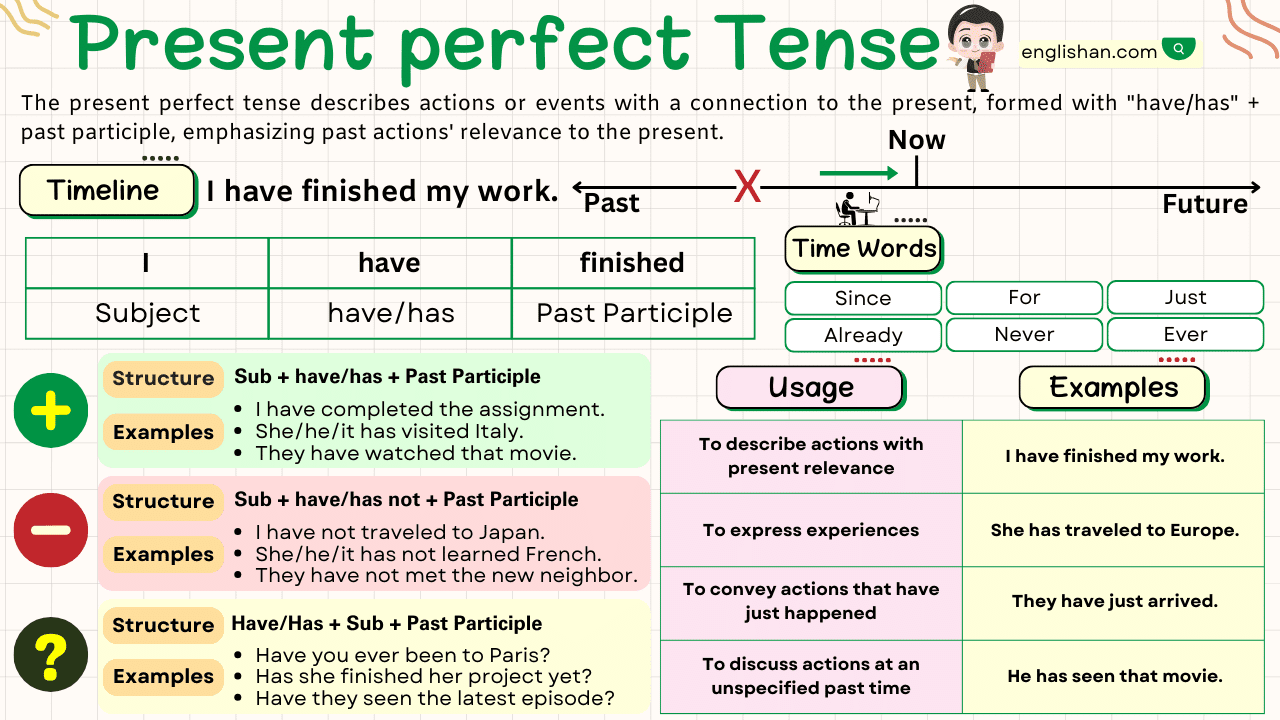
The Present Perfect Tense is used to talk about actions that happened in the past but still matter now. It often shows experiences, recent actions, or changes. We make it by using has or have + the past participle of a verb.
Examples:
- Aisha has visited three countries this year.
- They have finished their homework.
What is the Present Perfect Tense?
The Present Perfect Tense is used to talk about actions that happened in the past but still matter now. It often shows experiences, recent actions, or things that continue into the present.
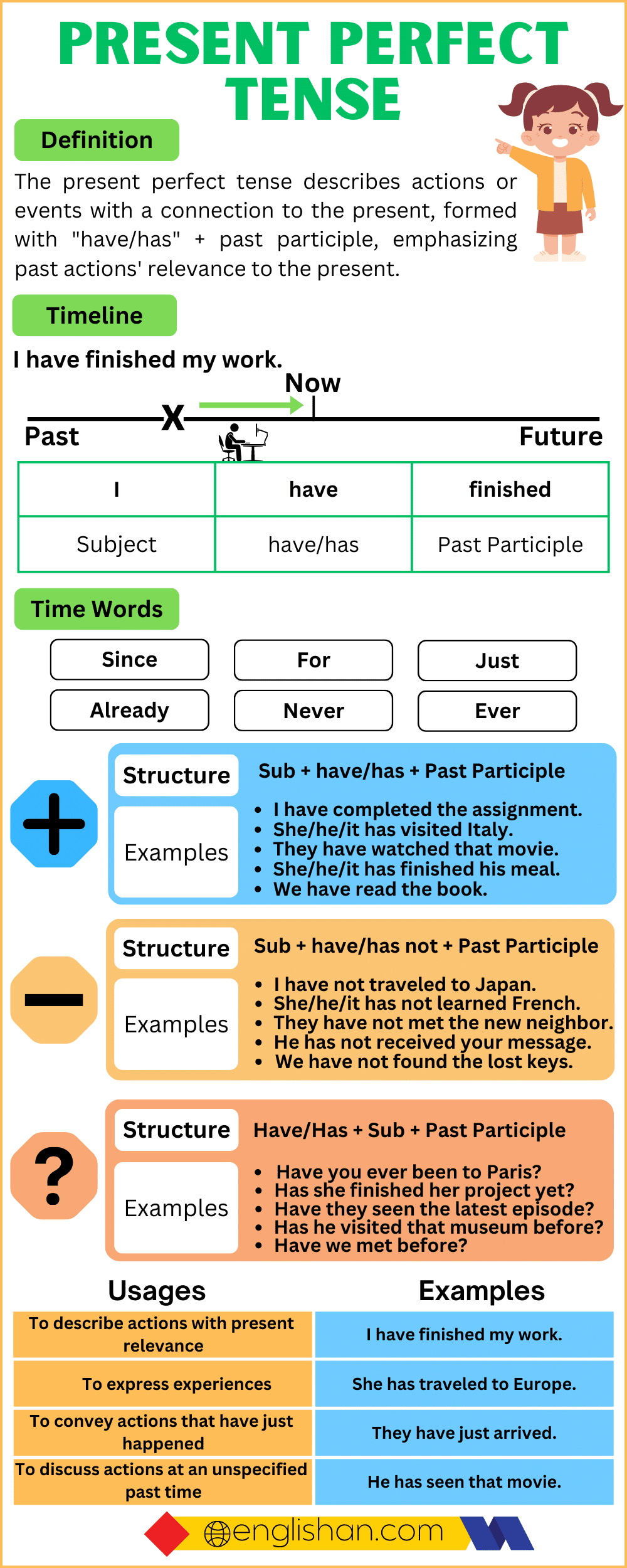
Present Perfect Tense Formulas
We make the Present Perfect Tense using:
has/have + past participle of the main verb.
Affirmative Sentence Structure
Structure: Subject + has/have + past participle + object
Examples:
- Ahmed has completed his assignment.
- We have watched the movie.
Negative Sentence Structure
Structure: Subject + has/have not + past participle + object
Examples:
- She has not visited the new library.
- They have not finished their project.
Interrogative Sentence Structure
Structure: Has/Have + subject + past participle + object?
Examples:
- Has Ali read the book?
- Have they started the meeting?
WH-Questions in Present Perfect Tense
Structure: Wh-word + has/have + subject + past participle + object?
Examples:
- Where has Ahmed gone?
- What have they done to prepare?
Subject-Verb Agreement in Present Perfect Tense
- I/We/You/They → have
- He/She/It → has
- Singular noun → has
- Plural noun → have
Examples: - They have traveled.
- She has completed her work.
- The teacher has explained the lesson.
- The students have learned the topic.
Common Time Expressions
- Since: She has lived here since 2020.
- For: They have studied English for three years.
- Already: He has already eaten dinner.
- Just: I have just finished the task.
- Yet: Have they completed the task yet?
Adverb Placement in Present Perfect
Adverbs are usually placed between “has/have” and the past participle.
Examples:
- She has already submitted the report.
- They have never been to the park.
- Ahmed has just arrived at the station.
Uses of the Present Perfect Tense
- To show experiences:
- She has visited Mecca multiple times.
- For recent events:
- Ahmed has just finished his project.
- To show ongoing actions:
- I have worked here for five years.
- When time is not specific:
- He has seen that movie before.
Present Perfect Tense vs. Simple Past Tense
| Feature | Present Perfect | Simple Past |
|---|---|---|
| Definition | Action completed with present relevance | Action completed at a specific time |
| Helping Verb | Has/Have | None |
| Example | Ahmed has left for the market. | Ahmed left an hour ago. |
| Time Words | Since, for, already, just, yet | Yesterday, last week, at 5 p.m. |
Short Answers in Present Perfect Tense
- Question:Have they completed the project?
- Answer: Yes, they have. / No, they haven’t.
- Question:Has she read the article?
- Answer: Yes, she has. / No, she hasn’t.
Question Tags in Present Perfect Tense
Examples:
- She has finished her homework, hasn’t she?
- They have left already, haven’t they?
- Ahmed has forgotten his keys, hasn’t he?
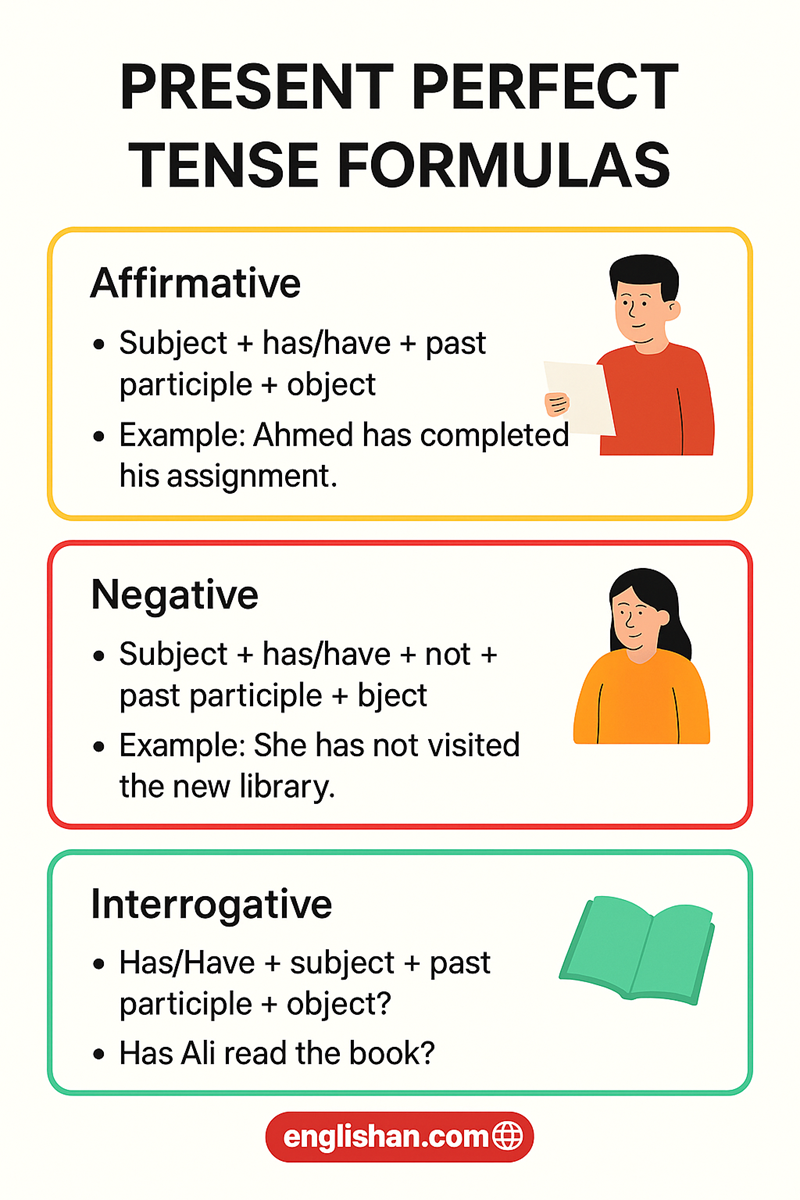
Present Perfect Tense Examples
- Affirmative:
- Ahmed has cleaned his room.
- They have eaten their dinner.
- She has completed her homework.
- Negative:
- She has not gone to the market yet.
- They have not finished their work.
- He has not returned the book.
- Interrogative:
- Have they taken the exam?
- Has she visited Lahore?
- Have you finished reading the book?
Common Mistakes in Present Perfect Tense
- ❌ She has went to the store.
✅ She has gone to the store. - ❌ They have did their homework.
✅ They have done their homework. - ❌ Has he saw the movie?
✅ Has he seen the movie?
FAQs:
The Present Perfect Tense is used to describe actions completed in the past that are relevant to the present. Example: She has completed her homework. It emphasizes the connection between past actions and now.
It is formed using the auxiliary verbs “have” or “has” with the past participle form of the main verb.
Free Grammar and Vocabulary Worksheets Resources
You May Also Like
Present Perfect Tense Quiz
Present Perfect Tense
Complete the sentence.
I ___ my keys and I can't find them anywhere.
Present perfect ties a past action to a result that still matters now: the keys are still missing.
have/has + past participle
I have lost my keys and I can't find them anywhere.
Pick the correct form.
She ___ sushi before; it would be her first time.
Present perfect covers life experience up to now, and 'never' marks the empty experience.
has + never + past participle
She has never eaten sushi before; it would be her first time.
Choose the form that matches 'since 2015'.
We ___ in this town since 2015.
'Since 2015' opens a period that runs up to now, which is exactly what the present perfect marks.
have/has + past participle with since + start point
We have lived in this town since 2015.
Type the correct form of the verb in brackets.
They ___ (finish) the project already.
'Already' points to a completed action that still counts now, so the present perfect fits.
have + past participle
They have finished the project already.
One option breaks a time rule. Choose the correct sentence.
I ___ him yesterday at the market.
'Yesterday' is a finished time, and finished times take the simple past.
finished time (yesterday) requires the simple past
I saw him yesterday at the market.
Complete the pattern.
This is the first time I ___ raw fish.
'This is the first time' triggers the present perfect for an experience measured up to now.
This is the first time + present perfect
This is the first time I have eaten raw fish.
Ask about experience.
___ New York?
'Ever' asks about experience across your life, which the present perfect carries.
ever + present perfect for experience
Have you ever been to New York?
Choose the adverb of recent time.
The train has ___ left; you missed it by a minute.
'Just' marks an action completed a moment ago, which suits the present perfect.
just + present perfect for a recent action
The train has just left.
Choose the word for a question.
Has the delivery arrived ___?
'Yet' asks whether something expected has happened by now.
yet in questions and negatives
Has the delivery arrived yet?
Type the correct form of the verb in brackets.
I ___ (see) that film already.
'Already' marks a completed action that still counts now, so the present perfect fits.
have + past participle
I have seen that film already.
Choose the form for 'for ten years'.
We ___ each other for ten years.
'For ten years' measures a span reaching the present, which the present perfect carries.
have/has + past participle with for + duration
We have known each other for ten years.
Been or gone?
She has ___ to Canada, and she is back home now.
'Have been' means she visited and has returned.
have been = visited and returned; have gone = still away
She has been to Canada, and she is back home now.
Which shows a present result?
I can't get in. I ___ my key.
The loss explains why you can't get in now, so the present perfect fits.
present result now -> present perfect
I have lost my key.
Complete the superlative.
That's the best meal I ___.
A superlative statement about experience up to now takes the present perfect.
superlative + present perfect
That's the best meal I have ever had.
Type the correct form of the verb in brackets.
They ___ (be) friends since college.
'Since college' fixes a start point for a state that continues, which the present perfect carries.
have/has been with since
They have been friends since college.
Complete the negative.
He ___ his homework yet.
'Yet' with an unfinished task takes the present perfect negative.
hasn't + past participle + yet
He hasn't finished his homework yet.
Mind the unfinished time.
I ___ three books this week.
'This week' is not over, so the present perfect counts progress within it.
unfinished time (this week) -> present perfect
I have read three books this week.
True or false?
You can say 'I have finished my work yesterday.'
'Yesterday' is a finished time, so the simple past is required: 'I finished my work yesterday.'
finished time -> simple past
I finished my work yesterday.
Complete the pattern.
This is the second time she ___ late this week.
'This is the [ordinal] time' triggers the present perfect for a running count up to now.
This is the [ordinal] time + present perfect
This is the second time she has been late this week.
For or since?
I've worked here ___ five years.
'For' introduces a length of time, such as five years.
for + duration; since + start point
I've worked here for five years.
Turn on JavaScript for the interactive quiz. The full practice set is shown above.