

An adverb tells how, when, where, or how much. The adverbs that start with A range from ably for manner and always for time to aside for place and almost for degree. Ably means with competence, as in the handover was managed ably, and the words ending in -ly share the alphabetical word list with bare a- words such as ajar.
Choose the first letter:
A · B · C · D · I · K · L · M · N · R · S · T · V
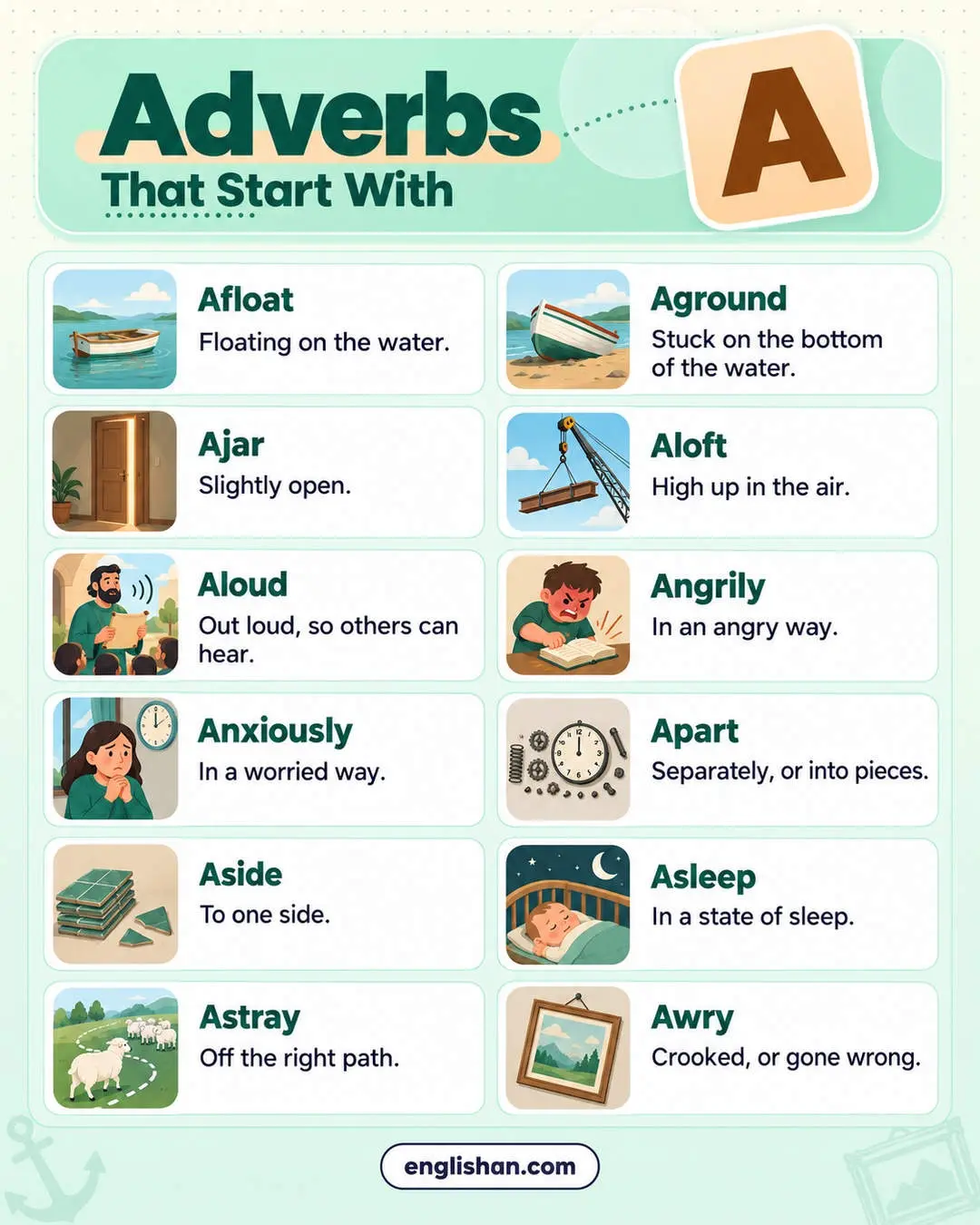
Adverbs That Start With A
The adverbs that start with A run alphabetically from ably to awkwardly, with the meaning beside the word and a sentence showing where the adverb belongs. The letter splits into four parts so that near-neighbours stay close enough to weigh against one another. Most of the judgement words on A come from the ad- and ap- runs.
Adverbs That Start With Ab to Ac
| Adverb | Meaning | In a sentence |
|---|---|---|
| Ably | With competence. | The handover was managed ably. |
| Abnormally | Away from the normal pattern. | The gauge read abnormally high all week. |
| Abruptly | Suddenly, with no warning. | The line ended abruptly at the fence. |
| Absentmindedly | With the mind elsewhere. | He pocketed the receipt absentmindedly. |
| Absurdly | To a ridiculous degree. | The lane is absurdly narrow for a lorry. |
| Academically | In relation to study, or in theory only. | The question is academically interesting and no more. |
| Acceptably | Well enough to pass. | The joint was finished acceptably. |
| Accidentally | By accident. | The file was overwritten accidentally. |
| Accordingly | In line with what went before. | The rent was reduced accordingly. |
| Accurately | Without error in the detail. | The boundary was drawn accurately. |
| Achingly | So as to produce a dull, longing pain. | The strings entered achingly in the slow movement. |
| Actively | By taking part rather than watching. | The tenants were consulted actively. |
| Actually | In fact, whatever was assumed. | The lintel is actually oak. |
Adverbs That Start With Ad to Am
| Adverb | Meaning | In a sentence |
|---|---|---|
| Adamantly | Refusing to be moved. | He adamantly denied the charge. |
| Additionally | On top of what came before. | Additionally, the drains were never adopted. |
| Adequately | Enough for the purpose. | The loft was insulated adequately. |
| Admittedly | As has to be granted. | Admittedly, the render is newer than the wall. |
| Adroitly | With skilful ease. | The objection was turned adroitly. |
| Adventurously | Ready to take a risk. | The roof was spanned adventurously. |
| Adversely | With a harmful effect. | The works affected the spring adversely. |
| Affirmatively | In the form of agreement. | The motion was answered affirmatively. |
| Agonisingly | With prolonged pain or suspense. | The vote was counted agonisingly slowly. |
| Aimlessly | With no purpose or direction. | He walked the towpath aimlessly. |
| Alarmingly | So as to cause alarm. | The crack has widened alarmingly. |
| Alertly | Watchfully and ready. | The keeper scanned the bank alertly. |
| Allegedly | By a claim that is not proved. | The stone came allegedly from the abbey. |
| Alluringly | So as to attract. | The window was dressed alluringly. |
| Altruistically | For the good of others. | The land was given altruistically. |
| Ambiguously | With more than one possible meaning. | The clause is worded ambiguously. |
| Ambitiously | Aiming high. | The second phase was costed ambitiously. |
| Amorously | With romantic desire. | The letters are written amorously. |
| Amusingly | So as to raise a laugh. | The misprint reads amusingly in the second line. |
Adverbs That Start With An to Ar
| Adverb | Meaning | In a sentence |
|---|---|---|
| Analytically | By breaking the matter into parts. | The failure was examined analytically. |
| Anatomically | In relation to the structure of the body. | The pose is anatomically wrong. |
| Anonymously | Without the name given. | The gift was made anonymously. |
| Apparently | On the face of it. | The flue was apparently never lined. |
| Appealingly | So as to attract sympathy or liking. | The puppy whined appealingly. |
| Apprehensively | With fear of what is coming. | She opened the survey apprehensively. |
| Approvingly | With approval shown. | The warden nodded approvingly. |
| Aptly | Suitably, and to the point. | The hamlet was christened aptly. |
| Arbitrarily | By whim rather than by rule. | The boundary was fixed arbitrarily. |
| Ardently | With burning enthusiasm. | The cause was argued ardently. |
| Arduously | With great and sustained effort. | The track was cut arduously through the scree. |
| Arguably | On a point open to argument. | The porch is arguably the oldest part. |
| Aristocratically | In the manner of the nobility. | The hall is proportioned aristocratically. |
| Artfully | With cunning skill. | The join was hidden artfully. |
| Artificially | By artificial means. | The pond is fed artificially. |
| Artistically | With artistic skill. | The panel was lettered artistically. |
| Artlessly | Without guile or technique. | The child told the story artlessly. |
Adverbs That Start With As to Aw
| Adverb | Meaning | In a sentence |
|---|---|---|
| Assertively | Stating a position firmly. | She put the objection assertively. |
| Assiduously | With careful, unflagging attention. | The index was kept assiduously. |
| Astonishingly | To a degree that astonishes. | The glass has survived astonishingly intact. |
| Astutely | Judging sharply in practice. | The site was bought astutely. |
| Athletically | With physical strength and skill. | He cleared the stile athletically. |
| Attentively | With close attention. | The jury listened attentively. |
| Attractively | So as to please the eye. | The garden was planted attractively. |
| Audaciously | With bold daring. | The bid was pitched audaciously. |
| Audibly | Loudly enough to be heard. | He sighed audibly at the figure. |
| Auspiciously | With promising signs. | The season opened auspiciously. |
| Austerely | Plainly, with no ornament. | The chapel is furnished austerely. |
| Authentically | In a way true to the original. | The porch was rebuilt authentically. |
| Authoritatively | With the weight of authority. | The dating was settled authoritatively. |
| Automatically | Without a decision being needed. | The valve closes automatically. |
| Awkwardly | Clumsily, or with embarrassment. | The gate hangs awkwardly on one hinge. |
Positive Adverbs That Start With A
Approval sits in the positive adverbs that start with A, and the letter runs to warmth rather than to standard. Affably, amiably and amicably all report a relaxed manner, which is more than most letters offer in one tone.
| Adverb | Meaning | In a sentence |
|---|---|---|
| Admirably | To a standard worth praising. | The backlog was cleared admirably. |
| Admiringly | With admiration shown. | The crowd watched the lift admiringly. |
| Adorably | So as to charm. | The pups tumbled adorably in the straw. |
| Adoringly | In deep affection. | The dog watched the door adoringly. |
| Affably | With relaxed friendliness. | The landlord greeted them affably. |
| Affectionately | With warm feeling. | The old mare was handled affectionately. |
| Agreeably | Pleasantly, and without friction. | The afternoon passed agreeably. |
| Amazingly | To a degree that surprises. | The plaster has held amazingly well. |
| Amiably | In a good-natured way. | He conceded the point amiably. |
| Amicably | Without quarrel. | The boundary was settled amicably. |
| Angelically | With sweet innocence. | The choir sang angelically. |
| Appreciatively | With gratitude shown. | The crew took the meal appreciatively. |
Amiably and amicably part company among the positive adverbs that start with A, since a person concedes a point amiably and two parties settle a boundary amicably.
Adverbs of Manner That Start With A
Manner accounts for more adverbs that start with A than any other type, and a manner adverb qualifies the verb with how. The standard position is after the verb, or after the object where there is one. Front position is available for stress, and it throws the weight onto the manner rather than the action.
- The objection was turned adroitly.
- He adamantly denied the charge.
- Abruptly, the line ended at the fence.
- The index was kept assiduously.
- The jury listened attentively.
The position to rule out is between the verb and its object, where the adverb separates a pair that belongs together.
- He turned adroitly the objection ❌
- He turned the objection adroitly ✅
The -ly manner adverbs on A take those same two positions, set out under adverbs of manner and across the types of adverbs.
Negative Adverbs That Start With A
Disapproval runs through the negative adverbs that start with A, and the target shifts from word to word. Atrociously and appallingly fault the work, while arrogantly and abusively fault the person behind it.
| Adverb | Meaning | In a sentence |
|---|---|---|
| Abjectly | In a wretched, crushed way. | He apologised abjectly. |
| Abominably | To a detestable standard. | The stock was kept abominably. |
| Abrasively | With a harsh, grating manner. | The question was pressed abrasively. |
| Abusively | By insult or violence. | The notice was answered abusively. |
| Accusingly | With blame in the look or voice. | She held up the receipt accusingly. |
| Acidly | Sourly, and with a sharp edge. | He thanked the committee acidly. |
| Acrimoniously | In bitter ill feeling. | The partnership was dissolved acrimoniously. |
| Aggressively | With forceful attack. | The claim was pursued aggressively. |
| Angrily | With anger. | He slammed the ledger shut angrily. |
| Appallingly | To a shocking degree. | The ward was staffed appallingly. |
| Arrogantly | With overbearing self-importance. | The complaint was answered arrogantly. |
| Atrociously | Dreadfully, and beyond excuse. | The flashing was fitted atrociously. |
| Awfully | To a bad degree, or very. | The flue draws awfully in an east wind. |
Awfully has drifted furthest of the negative adverbs that start with A, since a flue that draws awfully is a complaint while an awfully kind neighbour is praise.
Adverbs That Start With A to Describe a Person
Manner adverbs take the weight when a person heads the sentence, and the adverbs that start with A run to feeling held just under the surface. She answered airily and she answered aloofly report one action and two different people.
| Adverb | Meaning | In a sentence |
|---|---|---|
| Aggrievedly | Feeling wronged. | He returned the form aggrievedly. |
| Agilely | With quick, light movement. | He came down the ladder agilely. |
| Agitatedly | With nervous disturbance. | The witness paced agitatedly. |
| Airily | Lightly, and without serious weight. | She dismissed the overdraft airily. |
| Aloofly | At a distance, with reserve. | He acknowledged the greeting aloofly. |
| Amenably | Ready to agree and go along. | The tenant answered amenably. |
| Anxiously | Worried about the outcome. | The family waited anxiously for the tide. |
| Apologetically | Offering apology as it goes. | He raised the error apologetically. |
| Archly | Knowing, and teasing with it. | He referred archly to the promotion. |
| Ashamedly | Shame showing in the manner. | He returned the tools ashamedly. |
| Avidly | With eager appetite. | He read the minutes avidly. |
| Awedly | With awe showing. | The children looked up awedly at the vault. |
Aggrievedly is the most precise of the person adverbs that start with A, since it reports a sense of being wronged whether or not the person was.
Adverbs of Time and Frequency That Start With A
A holds three of the commonest time and frequency words in English, covering when and how many times. A frequency word such as always or annually belongs in front of the main verb, while afterwards stands at either end of the sentence.
| Adverb | Meaning | In a sentence |
|---|---|---|
| Afresh | Over again from the start. | The ledger was begun afresh. |
| Afterwards | At a later time. | The deeds were registered afterwards. |
| Again | One more time. | Read the clause again before signing. |
| Already | Before now, or sooner than expected. | The frost had already lifted. |
| Always | On every occasion. | The tide reaches the steps always by nine. |
| Anew | Once more, and in a new way. | The roof was leaded anew. |
| Annually | Once a year. | The gutters are cleared annually. |
| Anymore | Any longer. | The mill does not grind anymore. |
| Anytime | At whatever time. | Call the office anytime. |
| Awhile | For a short time. | Wait awhile before you fill the joint. |
Awhile and a while are not the same, since wait awhile takes the adverb and wait for a while takes the noun, as adverbs of time and adverbs of frequency set out.
Adverbs of Place and Direction That Start With A
Place is one of the larger types on this letter, and most of these words open with a bare a- and take no -ly form. A place adverb follows the verb or the object, and it comes after a manner adverb when the two stand together.
| Adverb | Meaning | In a sentence |
|---|---|---|
| Abroad | In or to another country. | The timber was sourced abroad. |
| Afar | From a long way off. | The tower shows afar across the levels. |
| Afield | Away from home ground. | The surveyor went far afield for the match. |
| Aft | Towards the stern of a vessel. | The ballast was shifted aft. |
| Ahead | In front, or further on. | The lane narrows ahead of the ford. |
| Aloft | High up, or up in the rigging. | The crane swung the beam aloft. |
| Along | Onward over a length. | Walk along until the wall turns. |
| Around | On every side, or in a circle. | The scaffold was carried around to the gable. |
| Aside | To one side. | Set the broken tile aside. |
| Astern | Behind a vessel. | The buoy fell astern within a minute. |
| Away | At or to a distance. | The silt was carted away. |
Aft and astern belong to vessels and are not interchangeable, since ballast is shifted aft within a boat and a buoy falls astern behind it, as adverbs of place sets out.
Adverbs of Degree That Start With A
Degree grades how much, and A holds the two that writers choose before any other. Almost and approximately pull a statement down, while absolutely and amply push it up as far as it will go.
| Adverb | Meaning | In a sentence |
|---|---|---|
| Absolutely | Completely, with nothing held back. | The clause is absolutely plain. |
| Abundantly | In great quantity. | The spring runs abundantly after rain. |
| Acutely | Sharply, and to a keen degree. | The shortage was felt acutely in March. |
| Almost | Very nearly. | The lintel is almost two metres long. |
| Altogether | Entirely, or taken as a whole. | The wall was taken down altogether. |
| Amply | More than enough. | The hall is amply lit by the two lanterns. |
| Appreciably | By enough to be noticed. | The damp has dried appreciably. |
| Approximately | Roughly, without exactness. | The barn measures approximately nine metres. |
Altogether and all together divide by meaning, since a wall taken down altogether came down entirely and a crew working all together worked as one, as adverbs of degree sets out.
Adverbs That Start With A Without LY
About twenty-five adverbs that start with A open with a bare a- and take no -ly form, where the a- carries the sense of on, in or to. Afoot held the sense of on foot, aground on the ground, ajar on the turn, and the family has held those senses with no -ly form at all.
| Adverb | Meaning | In a sentence |
|---|---|---|
| Aback | Taken by surprise. | The figure took the auditors aback. |
| Aghast | Struck with horror. | The family stood aghast at the damage. |
| Agape | With the mouth open in wonder. | The children watched the forge agape. |
| Aground | Stuck on the bottom. | The barge went aground under the weir. |
| Ajar | Slightly open. | The vestry door stood ajar. |
| Akimbo | With hands on hips and elbows out. | The foreman waited arms akimbo. |
| Afloat | Floating, or free of debt. | The dinghy was kept afloat by two drums. |
| Afoot | In progress, or on foot. | A scheme was afoot to drain the meadow. |
| Aloud | Out loud, so as to be heard. | The will was read aloud. |
| Amiss | Wrong, or out of order. | Something was amiss with the gauge. |
| Amok | Wildly and out of control. | The press ran amok after the verdict. |
| Apace | At a quick pace. | The works went apace through August. |
| Apart | Separately, or into pieces. | The frame was taken apart on site. |
| Askew | Out of straight. | The sign hangs askew on the gable. |
| Asleep | In a state of sleep. | The baby was fast asleep by seven. |
| Astray | Off the right path. | Two of the plans went astray in transit. |
| Asunder | Into separate parts. | The lintel was split asunder by the frost. |
| Awry | Twisted out of true, or gone wrong. | The whole schedule went awry in April. |
Several of these stand only after a linking verb, so a door stands ajar and a schedule goes awry, and neither word belongs in front of a noun.
Commonly Confused Adverbs That Start With A
Pairs among the adverbs that start with A trade places in print, and in four of them a space is the whole difference. The split turns on whether the phrase is one word or two.
| Pair | What separates them |
|---|---|
| Already / All ready | Already marks time; all ready means fully prepared. |
| Altogether / All together | Altogether means entirely; all together means as one group. |
| Awhile / A while | Awhile is the adverb; a while is a noun after for. |
| Anymore / Any more | Anymore marks time; any more marks quantity. |
| Amiably / Amicably | Amiably belongs to a person; amicably to a settlement. |
| Assertively / Aggressively | Assertively states a position; aggressively attacks one. |
- The frost had already lifted.
- The crew were all ready by six.
- That wall was taken down altogether.
- Wait awhile before you fill the joint.
- Two parties settled the boundary amicably.
Already reports time and all ready reports a state of preparation, so a lifted frost takes one word and a waiting crew takes two.
- The crew were already by six ❌
- The crew were all ready by six ✅
The adverbs that start with A fall into two forms. The -ly half is built from adjectives, and the a- half takes no ending.
Related:
- Adverbs Ending in LY
- Adverbs That Do Not End in LY
- Adverb Examples
- Adverbs of Frequency
- Types of Adverbs
- Relative Adverbs
- Adverbs of Reason
FAQs
About a hundred and fifty qualify in standard English, and 148 adverbs that start with A are gathered here with a meaning and a sentence. About twenty-five of them open with a bare a- and take no -ly ending.
Also and always lead the adverbs that start with A, followed by already, almost and away. None of the five takes an -ly ending.
Admirably, affectionately, agreeably, amiably and appreciatively state open approval, and all five belong in a reference. The letter runs to warmth rather than to standard, which is why so many of the positive adverbs that start with A report a manner rather than a result.
Airily, aloofly, anxiously, archly and ashamedly report how a person acts rather than what they are, so the verb keeps the action and the adverb holds the feeling under it. Aggrievedly is the most precise, since it reports a sense of being wronged whether or not the person was.
Aback, afoot, afloat, aground, ajar, akimbo, agape, aghast, amiss, amok, apace, apart, askew, asleep, astray, asunder, aloud and awry all carry a prefix that once meant on, in or to. None of them has an -ly form, and several follow a linking verb only.
A manner adverb such as adroitly goes after the verb, or after the object where there is one. A frequency word such as always goes in front of the main verb, a place word such as aside follows the verb, and a degree word such as almost goes beside the word it measures.