

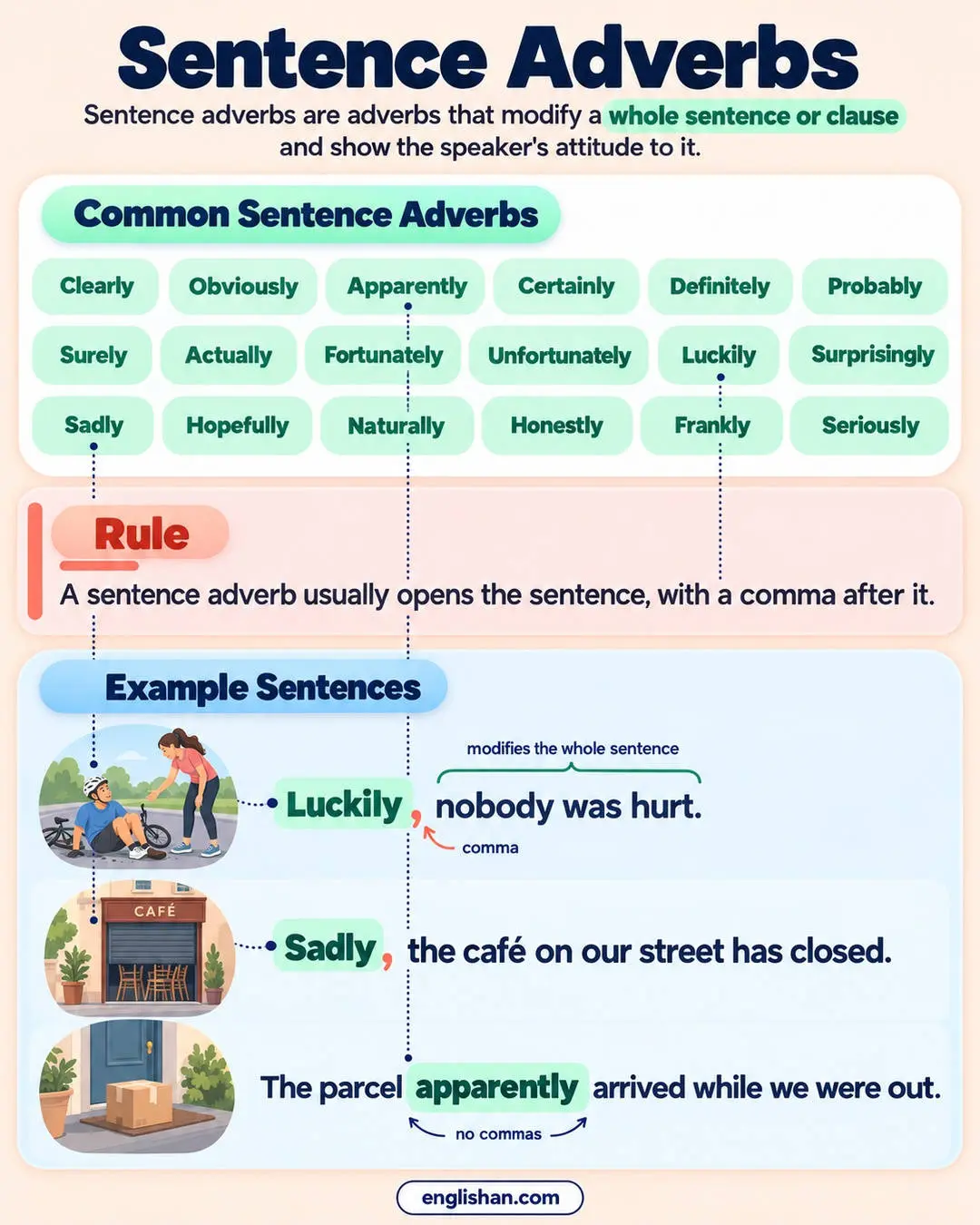
A sentence adverb is an adverb that modifies a whole sentence or clause and shows the speaker’s attitude to what the sentence says. Words such as “fortunately”, “honestly”, “clearly”, and “apparently” are sentence adverbs when they comment on the statement instead of describing the verb.
The usual position of a sentence adverb is the start of the sentence, with a comma after it, as in “Luckily, nobody was hurt”. Some of the same words also act as ordinary adverbs of manner in other positions, so the position and the comma show which job the adverb has in a particular sentence.
Sentence adverbs are adverbs such as “fortunately”, “honestly”, “clearly”, “obviously”, and “hopefully” that comment on a whole sentence. They show how sure the speaker is, how the speaker feels about a fact, or how the speaker is speaking. They usually come at the start with a comma, and they can also go before the main verb or at the end.
What Are Sentence Adverbs?
Sentence adverbs are adverbs that comment on a statement as a whole, so they stand outside the action that the verb describes. An ordinary adverb modifies a verb, an adjective, or another adverb, but a sentence adverb expresses the speaker’s or writer’s comment on the statement. A sentence adverb is also called a comment adverb.
- Obviously, the meeting will start late.
- Sadly, the café on our street has closed.
- Frankly, I don’t have time for another project.
In the first sentence, “obviously” does not describe how the meeting starts. The speaker uses it to say that the late start is easy to see, and the facts of the sentence stay the same with or without the adverb.
A conjunctive adverb such as “however” or “therefore” also comes at the start of a clause, but it links that clause to the one before it. Where the adverb shows a link between two ideas, it is a conjunctive adverb, and where it gives the speaker’s view of one idea, it is a sentence adverb.
Common Sentence Adverbs
Common sentence adverbs show how certain the speaker is, how the speaker feels about a fact, or how the speaker is speaking. Several of them also have a second use as an adverb of manner, so the same word can describe an action in one sentence and comment on a statement in another.
| Sentence adverb | What it shows | Also an adverb of manner? |
|---|---|---|
| Clearly | Certainty | Yes (speak clearly) |
| Obviously | Certainty | No |
| Apparently | What the speaker has heard | No |
| Certainly | Certainty | No |
| Definitely | Certainty | No |
| Probably | Likelihood | No |
| Surely | Expectation that the listener agrees | No |
| Actually | A fact against what someone expects | No |
| Fortunately | Good luck | No |
| Unfortunately | Bad luck | No |
| Luckily | Good luck | No |
| Surprisingly | Surprise | No |
| Sadly | Regret | Yes (smile sadly) |
| Hopefully | Hope | Yes (wait hopefully) |
| Naturally | Something expected | Yes (behave naturally) |
| Honestly | The speaker’s honesty | Yes (answer honestly) |
| Frankly | The speaker’s directness | Yes (speak frankly) |
| Seriously | The speaker is not joking | Yes (take seriously) |
False friends: The adverb “actually” means ‘in fact’ and corrects or adds to what the listener expects. It never means ‘at the moment’, though the Spanish “actualmente”, the French “actuellement”, and the German “aktuell” all have that meaning.
I am actually studying for a master’s degree. (meaning ‘now’) ❌
I am currently studying for a master’s degree. ✅
A sentence about the present time takes “currently” or “at the moment”, because “actually” adds the meaning ‘in fact’.
The adverb “surely” belongs with these false friends too. It expresses that the speaker expects agreement or is surprised, as in “Surely you’ve met her?”, while the French “sûrement” and the Spanish “seguramente” often mean ‘probably’.
Examples Of Sentence Adverbs
Sentence adverbs are frequent in conversation, messages, and workplace email, where a speaker gives news and a comment on it at the same time. Most of them open the sentence, and a few come before the main verb:
- Fortunately, the doctor had a free appointment on Friday.
- Surprisingly, nobody at the meeting asked about the budget.
- The parcel apparently arrived while we were out.
- Honestly, I don’t think the new schedule will work.
- Luckily, my sister had a spare phone charger in her bag.
- Unfortunately, the hotel pool is closed until June.
- Seriously, are you leaving the company?
- Clearly, the instructions were written for experts.
In a sentence with two clauses, a sentence adverb modifies only the clause it belongs to. The comment in the next example is about the second train, not about missing the first one:
- We missed the train, but luckily another one left ten minutes later.
A sentence adverb can also stand alone as a full reply to a question in conversation:
- Are you coming to the party? Definitely.
This one-word answer is normal in written messages and dialogue, but in formal text the adverb stays inside a full sentence.
Position Of Sentence Adverbs
Sentence adverbs can go in three positions: at the start of the sentence, in the middle before the main verb, and at the end. The start is the most frequent position in writing, and the punctuation changes with the position.
Start: A comma usually follows a sentence adverb at the start of a sentence. The comma separates the speaker’s comment from the statement.
- Obviously, we need more chairs.
- Sadly, the bakery doesn’t deliver on Sundays.
- Interestingly, the cheaper laptop was faster.
Middle: In the middle, a sentence adverb takes the same position as adverbs of frequency. It goes before the main verb, after the verb “be”, and after the first auxiliary verb, and it usually has no commas around it. Adverbs of certainty such as “probably”, “certainly”, and “definitely” are especially frequent in this position.
- She obviously forgot about the meeting.
- The manager is clearly unhappy with the results.
- They have probably left already.
A writer can also put a pair of commas around a mid-position sentence adverb to show a pause, as in “The plan, unfortunately, failed.” The commas come as a pair, never as one alone.
The plan, unfortunately failed. ❌
The plan, unfortunately, failed. ✅
A sentence adverb in the middle takes two commas or none, because one comma would separate the subject from its verb.
End: At the end, a comma comes before the sentence adverb. The end position is more frequent in speech than in writing, and in speech a short pause before the adverb replaces the comma.
- He forgot to call, apparently.
- I didn’t enjoy the film, honestly.
- The new manager starts on Monday, hopefully.
Sentence Adverbs Vs Adverbs Of Manner
Sentence adverbs and adverbs of manner can be the same word, such as “honestly”, “clearly”, or “happily”. A sentence adverb comments on the whole statement, and an adverb of manner describes how the action happens.
Honestly, she answered. (the speaker is being honest) ✅
She answered honestly. (her answer was honest) ✅
Clearly, he explained the problem. (it is obvious that he explained it) ✅
He explained the problem clearly. (his explanation was easy to follow) ✅
Happily, the children were safe. (the speaker is glad) ✅
The children played happily. (they were happy as they played) ✅
The position and the comma show the meaning in each pair. At the start with a comma, the adverb is a sentence adverb, and after the verb or the object, it is an adverb of manner.
Before the verb: An adverb with both meanings can be read either way when it comes before the main verb. The sentence “She clearly explained the rules” can mean that her explanation was easy to follow or that it is obvious she explained them. For the manner meaning, put the adverb after the object, and for the comment meaning, put it at the start with a comma.
Clearly, the teacher explained the rules, so everyone understood them. (meaning ‘in a clear way’) ❌
The teacher explained the rules clearly, so everyone understood them. ✅
When “clearly” describes how the teacher explained, it goes after the object, because “clearly” at the start with a comma comments on the whole sentence.
Hopefully As A Sentence Adverb
The adverb “hopefully” can be an adverb of manner or a sentence adverb. As an adverb of manner, it means ‘in a hopeful way’, and as a sentence adverb, it means ‘I hope’ or ‘we hope’.
- The dog looked hopefully at our plates. (adverb of manner)
- Hopefully, the rain will stop before the match. (sentence adverb)
- We’ll hopefully have the results by Monday. (sentence adverb)
Both uses are standard English. As a sentence adverb, “hopefully” is the usual choice in conversation, email, and news writing, and in formal academic or legal writing, “I hope” or “we hope” is more common. At the start of a sentence, “hopefully” does not say who hopes, so where the reader needs to know who hopes, the verb “hope” with its subject names that person: “We hope the board will approve the plan.”
Hopefully that the package arrives tomorrow. ❌
Hopefully, the package will arrive tomorrow. ✅
A sentence adverb is followed directly by the clause it comments on, because “that” follows a verb such as “hope”, not an adverb.
FAQs
Sentence adverbials are words, phrases, or clauses that comment on a whole sentence, so they include sentence adverbs and longer forms such as "to be honest", "in my opinion", and "of course". A sentence adverb is always one word. A sentence adverbial can also be an adverb phrase, such as "in my opinion". It can even be an adverb clause, such as "if I’m honest".
Usually not, since "however" is a conjunctive adverb that links its clause to the clause before and shows a contrast. A sentence adverb gives the speaker’s view of one statement, even though both kinds of adverb often open a sentence with a comma.
Yes, "disjunct" is the technical name for a sentence adverb, and "comment adverb" is a third name for it. All three names mean an adverb such as "frankly" or "luckily" that comments on the whole statement.
No, although most do, because they are formed from adjectives, as "fortunately" is formed from "fortunate". A few common sentence adverbs have no "-ly" ending, such as "indeed", "perhaps", and "maybe".
Only the ones that show the speaker’s way of speaking. Adverbs of certainty and attitude, such as "clearly", "evidently", and "unfortunately", are normal in reports and academic writing. Adverbs such as "honestly", "frankly", and "seriously" belong to speech and informal messages, so formal writing usually leaves them out.
Related:
- Types of Adverbs
- List of Adverbs
- Adverbs Without LY
- Adverbs and Conjunctions
- Adverb Placement in a Sentence
- Discourse Markers