

An adverb states when, where, or to what degree something happens. The adverbs that start with I express time in immediately, instantly and initially, degree in intensely and incredibly, and place in inside. Many of the long ones are positive adverbs with a negative prefix: inaccurately, impatiently, illegally and irregularly come from accurately, patiently, legally and regularly. Pairs that trade places in print are separated near the end.
Choose the first letter:
A · B · C · D · I · K · L · M · N · R · S · T · V
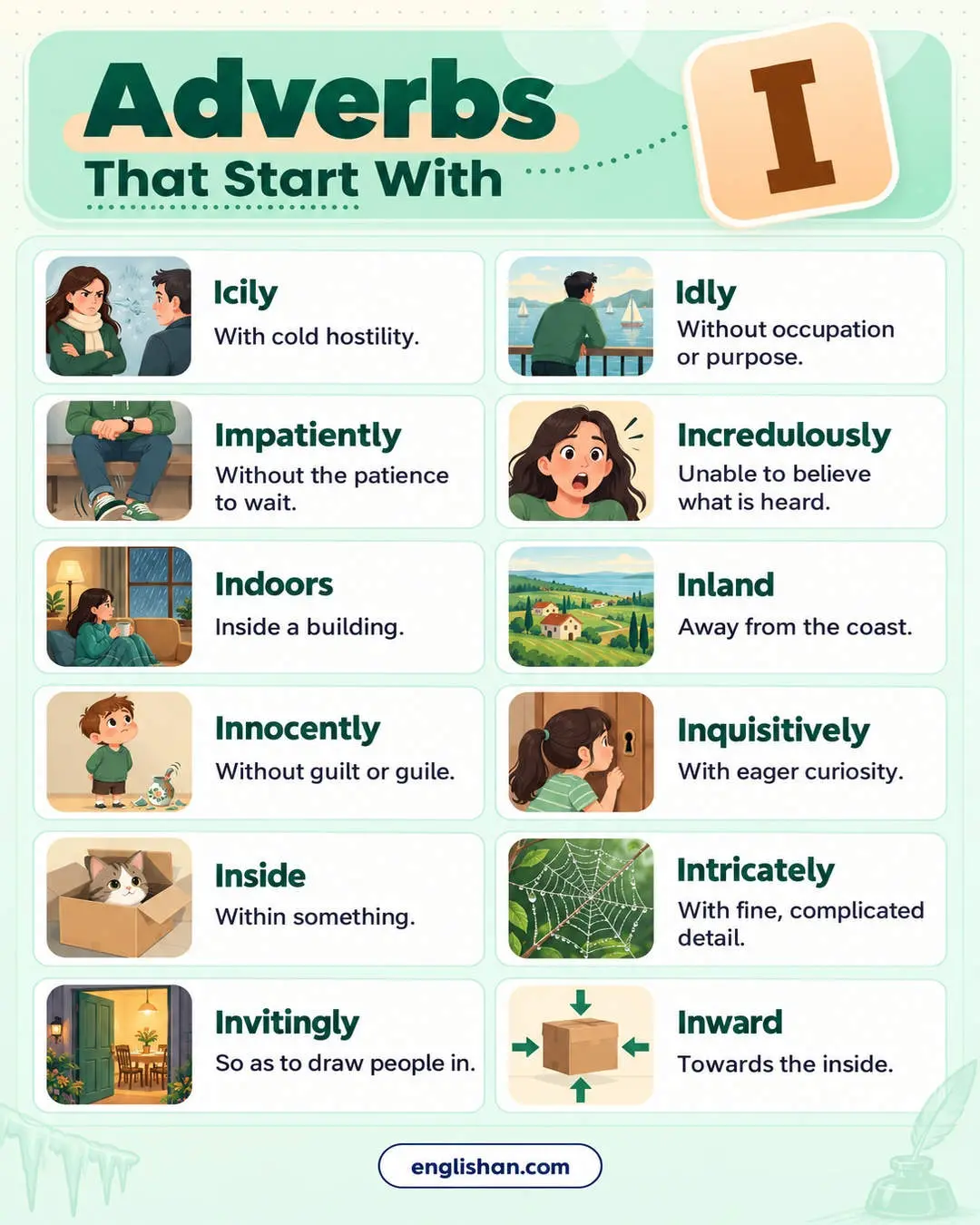
Adverbs That Start With I
The adverbs that start with I run alphabetically from idealistically to irrevocably, with the meaning beside the word and a sentence showing where the adverb belongs. The letter splits into four parts so that near-neighbours stay close enough to weigh against one another. The in- run holds several pairs that look alike and separate by one shade of meaning.
Adverbs That Start With Id to Im
| Adverb | Meaning | In a sentence |
|---|---|---|
| Idealistically | By what ought to be rather than what is. | The scheme was costed idealistically. |
| Identically | Exactly the same in every part. | Both castings were finished identically. |
| Ideologically | By a system of political belief. | The two wings differ ideologically. |
| Idiomatically | In the natural phrasing of the language. | The passage reads idiomatically in French. |
| Idiotically | With foolish lack of thought. | The fuse was bypassed idiotically. |
| Ignorantly | In ignorance of the facts. | The clause was signed ignorantly. |
| Illegally | Against the law. | The gate was moved illegally. |
| Illegibly | So as to be unreadable. | The signature was written illegibly. |
| Illicitly | Outside what is permitted. | The timber was felled illicitly. |
| Illogically | Against reason. | The schedule was drawn illogically. |
| Illuminatingly | So as to throw light on the matter. | The footnote reads illuminatingly on the date. |
| Imitatively | By copying another model. | The porch was built imitatively. |
| Immaterially | Without bearing on the outcome. | The clause was amended immaterially. |
| Immodestly | Without modesty. | He described the sale immodestly. |
| Immovably | So as not to shift. | The bearing is bedded immovably. |
| Impartially | Without favour to either side. | The claim was assessed impartially. |
| Imperceptibly | By too little to be noticed. | The ridge has settled imperceptibly. |
| Imperfectly | With faults remaining. | The seal was formed imperfectly. |
| Impersonally | Without reference to any individual. | The refusal was worded impersonally. |
| Imperturbably | Unruffled, whatever happens. | The chairman held the meeting imperturbably. |
| Implacably | Without any softening. | The objection was pressed implacably. |
| Implausibly | Past the point of belief. | The timeline is set out implausibly. |
| Implicitly | By what is understood rather than stated. | The right of way is accepted implicitly. |
| Impossibly | Past the point of the possible. | The brief was drawn impossibly tight. |
| Improbably | Against the expected course of events. | The outsider led improbably at the turn. |
Adverbs That Start With Ina to Ind
| Adverb | Meaning | In a sentence |
|---|---|---|
| Inadequately | Short of what was needed. | The loft was insulated inadequately. |
| Inadvertently | By accident, with no intention. | The file was deleted inadvertently. |
| Inappropriately | In a way that does not suit the setting. | The notice was worded inappropriately. |
| Incidentally | As a side matter. | Incidentally, the deeds were never registered. |
| Inclusively | Taking everyone or everything in. | The membership was redrawn inclusively. |
| Incoherently | Without connection between the parts. | The account was given incoherently. |
| Inconsistently | Without holding to one standard. | The rule was applied inconsistently. |
| Inconveniently | At an awkward time or place. | The meter sits inconveniently behind the tank. |
| Incorrectly | Wrongly. | The invoice was totalled incorrectly. |
| Incredulously | Unable to believe what is heard. | She read the figure incredulously. |
| Indecisively | Without reaching a choice. | The matter was left indecisively. |
| Independently | On one’s own, free of direction. | The valuation was made independently. |
| Indifferently | Without interest, or to a poor standard. | The roof was patched indifferently. |
| Indirectly | By a route that is not direct. | The grant was awarded indirectly. |
| Indiscriminately | Without selection. | The hedgerow was cut indiscriminately. |
| Individually | One at a time, separately. | The sashes were weighted individually. |
| Industriously | With steady hard work. | The archive was catalogued industriously. |
Adverbs That Start With Ine to Ins
| Adverb | Meaning | In a sentence |
|---|---|---|
| Ineffectively | Without producing the result. | The damp was treated ineffectively. |
| Inefficiently | With effort or resource wasted. | The boiler ran inefficiently all winter. |
| Inelegantly | Without grace. | The extension was joined inelegantly. |
| Ineptly | With plain incompetence. | The repair was attempted ineptly. |
| Inevitably | So that nothing was going to stop it. | The ground floor flooded inevitably. |
| Inexpensively | At low cost. | The glazing was replaced inexpensively. |
| Inexplicably | With no explanation to be found. | The survey omits the gable inexplicably. |
| Infallibly | Without ever failing. | The old lock turns infallibly. |
| Infamously | With a bad reputation attached. | The weir was raised infamously in 1904. |
| Infectiously | Spreading from one person to another. | The laughter ran infectiously round the yard. |
| Inflexibly | Without allowance or give. | The rule was read inflexibly. |
| Informally | Without ceremony or official form. | The agreement was reached informally. |
| Ingeniously | With clever invention. | The water was diverted ingeniously. |
| Innocuously | Without causing harm. | The clause reads innocuously at first. |
| Insecurely | Without being made fast. | The ladder was footed insecurely. |
| Insidiously | Spreading harm by slow, hidden steps. | The rot worked insidiously behind the panel. |
| Insistently | Pressing the point without letting go. | The bell rang insistently. |
| Instinctively | By instinct rather than thought. | He stepped back instinctively. |
Adverbs That Start With Int to Ir
| Adverb | Meaning | In a sentence |
|---|---|---|
| Intelligibly | So as to be understood. | The physics is set out intelligibly. |
| Intensively | Concentrated over a short period. | The site was dug intensively for a fortnight. |
| Intentionally | On purpose. | The lintel was offset intentionally. |
| Interestingly | In a way worth noticing. | Interestingly, the mortar holds lime from two sources. |
| Interrogatively | In the form of a question. | The clause is phrased interrogatively. |
| Intimately | With close personal knowledge. | He knew the valley intimately. |
| Intricately | With fine, complicated detail. | The screen is carved intricately. |
| Intriguingly | So as to arouse curiosity. | The plan omits the stable intriguingly. |
| Introspectively | Looking inward at one’s own thought. | He wrote introspectively in the last volume. |
| Intrusively | Breaking in where not wanted. | The question was put intrusively. |
| Intuitively | By feel rather than by reasoning. | The layout reads intuitively. |
| Invisibly | Without being seen. | The crack runs invisibly under the render. |
| Involuntarily | Without the will choosing it. | He flinched involuntarily. |
| Inwardly | On the inside, out of sight. | He raged inwardly and said nothing. |
| Ironically | With a meaning opposite to the words. | The notice was headed ironically. |
| Irrationally | Against reason. | The stock was valued irrationally. |
| Irreconcilably | So that no agreement is possible. | The two accounts differ irreconcilably. |
| Irrefutably | Beyond any possible denial. | The dating is fixed irrefutably. |
| Irregularly | At uneven intervals. | The gauge was read irregularly. |
| Irrelevantly | Without bearing on the question. | He answered irrelevantly about the drains. |
| Irreparably | Beyond any repair. | The plasterwork was damaged irreparably. |
| Irreplaceably | So that nothing takes its place. | The glass was lost irreplaceably. |
| Irrepressibly | Impossible to hold down. | The spring broke through irrepressibly. |
| Irrevocably | So that it cannot be undone. | The trust was settled irrevocably. |
Positive Adverbs That Start With I
Approval sits in the positive adverbs that start with I, and the letter runs to standard rather than to warmth. Immaculately and impeccably report work without a fault, while imaginatively and inventively report work with an idea behind it.
| Adverb | Meaning | In a sentence |
|---|---|---|
| Illustriously | With great distinction. | He served illustriously for thirty years. |
| Imaginatively | With invention and vision. | The loft was converted imaginatively. |
| Immaculately | In perfect, spotless order. | The engine room was kept immaculately. |
| Impeccably | Without a single fault. | The hedge was cut impeccably. |
| Impressively | To a standard that commands respect. | The arch was turned impressively. |
| Indulgently | With kindly tolerance. | The grandmother watched indulgently. |
| Ingenuously | With open, trusting frankness. | He answered the auditor ingenuously. |
| Innocently | Without guilt or guile. | The boy repeated the remark innocently. |
| Inspiringly | So as to lift others. | The crew worked inspiringly through the night. |
| Intelligently | With understanding applied. | The brief was handled intelligently. |
| Inventively | With original invention. | The budget was handled inventively. |
| Invitingly | So as to draw people in. | The fire was banked invitingly. |
| Irresistibly | So strongly as to overcome resistance. | The smell of baking drifted irresistibly. |
Ingenuously and ingeniously are one letter apart and opposite in use among the positive adverbs that start with I, since the first reports open trust and the second clever invention.
Adverbs of Manner That Start With I
Manner holds more of the adverbs that start with I than time, place and degree together, and manner is the how of an action. The standard position is after the verb, or after the object where there is one. Front position is available for stress, and it throws the weight onto the manner rather than the action.
- The water was diverted ingeniously.
- He instinctively stepped back from the edge.
- Impartially, the assessors read both claims.
- The screen is carved intricately.
- The crack runs invisibly under the render.
The position to rule out is between the verb and its object, where the adverb separates a pair that belongs together.
- They diverted ingeniously the water ❌
- They diverted the water ingeniously ✅
Placement does not change once the negative prefix is added, as set out under adverbs of manner and across the types of adverbs.
Negative Adverbs That Start With I
The whole group holds positive words with the negative prefix thrown, which makes the negative adverbs that start with I the easiest in English to read and the easiest to misjudge. Impatiently reverses patience and irresponsibly reverses responsibility, but invaluably reverses nothing and means the opposite of what the shape suggests.
| Adverb | Meaning | In a sentence |
|---|---|---|
| Impatiently | Without the patience to wait. | He drummed the counter impatiently. |
| Impertinently | With cheek that oversteps. | The clerk answered impertinently. |
| Impolitely | Without courtesy. | The request was refused impolitely. |
| Imprudently | Without proper caution. | The reserve was spent imprudently. |
| Impudently | With brazen disrespect. | The notice was ignored impudently. |
| Immorally | Against moral principle. | The legacy was obtained immorally. |
| Improperly | Against what is correct or allowed. | The grant was claimed improperly. |
| Inconsiderately | Without thought for others. | The van was parked inconsiderately. |
| Indiscreetly | Letting out what should be kept quiet. | The terms were mentioned indiscreetly. |
| Inhumanely | Without humanity. | The stock was transported inhumanely. |
| Inaccurately | With errors in the detail. | The boundary was drawn inaccurately. |
| Insensitively | Without regard for the feelings involved. | The redundancies were announced insensitively. |
| Insincerely | Without meaning what is said. | The apology was offered insincerely. |
| Insolently | With contemptuous rudeness. | The order was queried insolently. |
| Insultingly | So as to give offence. | The sum was offered insultingly. |
| Irresponsibly | Without taking proper care. | The keys were left irresponsibly. |
| Irritably | With short-tempered annoyance. | He corrected the total irritably. |
| Irreverently | Without the respect owed. | The memorial was photographed irreverently. |
Inflammably and inflammatory belong to the same trap, since the in- in both intensifies rather than negates. Their sense gets reversed in print more than that of any other pair on the letter.
Adverbs That Start With I to Describe a Person
Manner adverbs take the weight when a person heads the sentence, and the adverbs that start with I run to temper and impulse. She answered icily and she answered indignantly report one action and two different states.
| Adverb | Meaning | In a sentence |
|---|---|---|
| Icily | With cold hostility. | She thanked him icily. |
| Idly | Without occupation or purpose. | He turned the pages idly. |
| Impassively | Showing no feeling at all. | The witness heard the verdict impassively. |
| Imperiously | With overbearing command. | The visitor rang imperiously at the door. |
| Impetuously | On sudden impulse. | He resigned impetuously. |
| Impulsively | Acting before thinking. | She bought the clock impulsively. |
| Indignantly | With anger at an injustice. | He denied the charge indignantly. |
| Indolently | In settled laziness. | The afternoon was spent indolently. |
| Inquisitively | With eager curiosity. | The terrier watched the hole inquisitively. |
| Insatiably | With a hunger that cannot be filled. | He read insatiably through the winter. |
Impetuously and impulsively are the near twins among the person adverbs that start with I, with the first reporting heat and the second only speed.
Adverbs of Time and Frequency That Start With I
Time covers when and frequency covers how many times, and I holds three words for the same instant. A frequency word such as invariably or infrequently belongs in front of the main verb, while initially stands at either end of the sentence.
| Adverb | Meaning | In a sentence |
|---|---|---|
| Immediately | At once, with no gap. | Shut the valve immediately. |
| Imminently | Very soon, and close at hand. | The licence expires imminently. |
| Incessantly | Without stopping. | The gulls called incessantly over the quay. |
| Indefinitely | For an unlimited period. | The lane is closed indefinitely. |
| Infrequently | On few occasions. | The upper mill is opened infrequently. |
| Initially | At the start. | The crack was narrow initially. |
| Instantly | In the same moment. | The fuse blew instantly. |
| Intermittently | Starting and stopping. | The pump worked intermittently all night. |
| Invariably | On every occasion without exception. | The tide reaches the steps invariably by nine. |
Immediately, instantly and imminently part company here, since the first two report no gap at all while the third reports a gap about to close. They are the three adverbs that start with I that a schedule most needs kept apart, as adverbs of time and adverbs of frequency set out.
Adverbs of Place and Direction That Start With I
Place among the adverbs that start with I is built on one idea, inwardness, and the whole group faces the same way. A place adverb follows the verb or the object, and it comes after a manner adverb when the two stand together.
| Adverb | Meaning | In a sentence |
|---|---|---|
| In | Towards or inside an enclosed place. | Come in and shut the door. |
| Indoors | Inside a building. | The frames were stored indoors. |
| Inland | Away from the coast. | The lane turns inland past the chapel. |
| Inside | Within something. | The deeds were kept inside the strongbox. |
| Internally | Within the thing itself. | The wall is braced internally. |
| Inward | Towards the inside. | The sash opens inward. |
| Inwards | To the interior. | Pull the bolt inwards to free it. |
Inward and inwards are both correct among the place adverbs that start with I, with the -s form standard in British writing, as adverbs of place sets out.
Adverbs of Degree That Start With I
Degree is the type that grades intensity, and the adverbs that start with I grade it both ways. Incompletely and insufficiently pull a statement down, while immeasurably, immensely and inexorably push it up as far as it will go.
| Adverb | Meaning | In a sentence |
|---|---|---|
| Immeasurably | By an amount too great to measure. | The yard is immeasurably quieter since the bypass. |
| Immensely | To a very great degree. | The hall gained immensely from the rewiring. |
| Incompletely | Only in part. | The flue was lined incompletely. |
| Incredibly | To a degree hard to believe. | The lintel is incredibly heavy for its size. |
| Indeed | In truth, and by way of confirmation. | The mortar is indeed older than the render. |
| Indisputably | Beyond argument. | The stone is indisputably older than the porch. |
| Inexorably | Without any possibility of being stopped. | Costs rose inexorably through the build. |
| Infinitely | Without limit. | The second setting is infinitely better. |
| Inordinately | Far beyond what is reasonable. | The hearing took inordinately long. |
| Insufficiently | Not enough. | The mortar had cured insufficiently. |
| Intensely | With great concentration or force. | The fire burned intensely for an hour. |
| Intrinsically | By its own nature. | The design is intrinsically sound. |
Incredibly reads as an intensifier, so a lintel incredibly heavy for its size is very heavy and nobody doubts it, as adverbs of degree sets out.
Adverbs That Start With Im Il or Ir
The negative prefix on this letter changes shape to match the sound after it, which is why four spellings cover one job. Im- goes before p and m, il- before l, ir- before r, and in- before everything else.
| Shape | Goes before | Word |
|---|---|---|
| In- | Most consonants and vowels | Inaccurately |
| Im- | P and m | Impatiently |
| Il- | L | Illegally |
| Ir- | R | Irregularly |
- The boundary was drawn inaccurately.
- He drummed the counter impatiently.
- That gate was moved illegally.
- Our gauge was read irregularly.
- Both claims were assessed impartially.
The shape follows the sound and never the meaning, so a writer who spells inlegally or imregularly has chosen the wrong coat for the same prefix.
- The gate was moved inlegally ❌
- The gate was moved illegally ✅
Commonly Confused Adverbs That Start With I
Pairs among the adverbs that start with I trade places more readily than on most letters, because the prefix hides the difference. The split turns on the word underneath rather than on the prefix itself.
| Pair | What separates them |
|---|---|
| Ingenuously / Ingeniously | Ingenuously means openly trusting; ingeniously means cleverly. |
| Impartially / Impassively | Impartially means without favour; impassively means without feeling. |
| Incredibly / Incredulously | Incredibly marks a degree; incredulously reports disbelief. |
| Indifferently / Indiscriminately | Indifferently means without interest; indiscriminately means without selection. |
| Intensely / Intensively | Intensely marks force; intensively marks concentration over time. |
| Implicitly / Implausibly | Implicitly means understood; implausibly means hard to believe. |
- He answered the auditor ingenuously.
- The water was diverted ingeniously.
- She read the figure incredulously.
- That lintel is incredibly heavy for its size.
- The site was dug intensively for a fortnight.
Intensely measures how strong a thing is and intensively measures how concentrated the effort was, so a fire burns intensely and a site is dug intensively.
- The site was dug intensely for a fortnight ❌
- The site was dug intensively for a fortnight ✅
The adverbs that start with I reward a reader who looks under the prefix. Almost every long word on the letter is a plain word with a switch thrown, and the four spellings of that switch follow the sound rather than the sense.
Related:
- Adverbs Ending in LY
- Adverbs That Do Not End in LY
- Adverb Examples
- Adverbs of Frequency
- Types of Adverbs
- Relative Adverbs
- Adverbs of Reason
FAQs
About a hundred and fifty qualify in standard English, and 153 adverbs that start with I are gathered here with a meaning and a sentence. The negative prefix in its four shapes accounts for over half the total.
Immediately is the most common of the adverbs that start with I in written English, followed by instantly, initially, inside and intensely. Only inside takes no -ly ending, which is unusual for a letter of this size.
Immaculately, impeccably, imaginatively, inventively and impressively state open approval, and all five belong in a reference. Ingenuously looks like praise and is not, since it reports trust rather than skill.
Icily, idly, impassively, indignantly and inquisitively report how a person acts rather than what they are, so the verb keeps the action and the adverb holds the state behind it. Impetuously and impulsively differ only in heat and speed.
The negative prefix changes shape to match the sound that follows it. Im- goes before p and m as in impatiently, il- before l as in illegally, ir- before r as in irregularly, and in- before everything else as in inaccurately.
A manner adverb such as ingeniously goes after the verb, or after the object where there is one. A frequency word such as invariably goes in front of the main verb, and a degree word such as immensely goes beside the word it measures.