

Adverbs modify verbs, adjectives and other adverbs, with or without an -ly ending. The ending is a habit rather than a rule, and the adverbs that do not end in LY include almost all of the ones used most. A reader who treats the ending as proof will class very, too, here and fast as something else, and those four are more common than any -ly word in the language. Most of them are older than the ending itself.
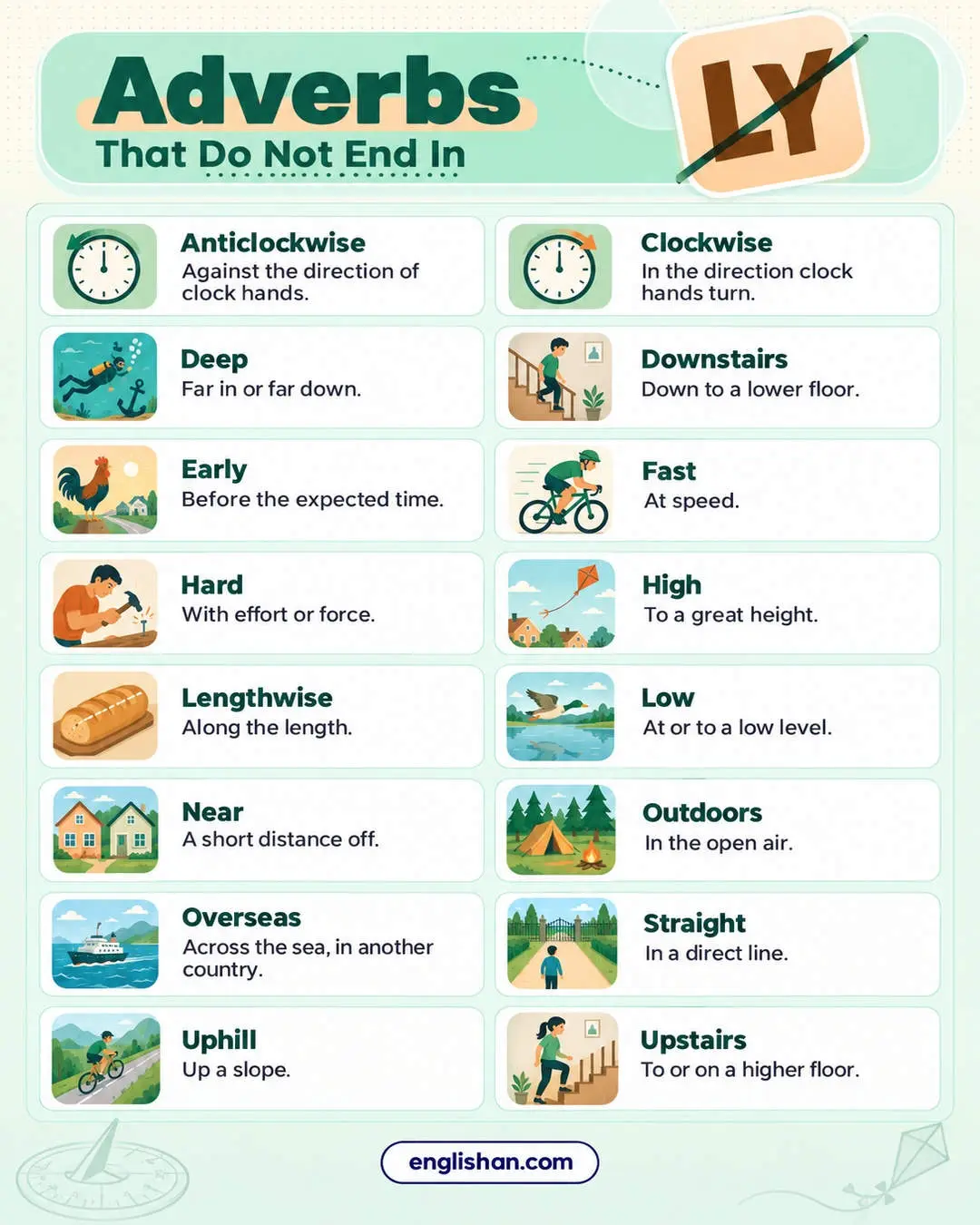
Flat Adverbs That Do Not End in LY
A flat adverb has the same form as its adjective, so a fast car and the car went fast use one word for two jobs. These are the adverbs that do not end in LY a reader is readiest to mark wrong, having learned the ending as a rule, and every one of them is standard.
| Adverb | Meaning | In a sentence |
|---|---|---|
| Fast | At speed. | The red car went fast down the hill. |
| Hard | With effort or force. | The crew worked hard through the frost. |
| Late | After the expected time. | The surveyor arrived late. |
| Early | Before the expected time. | The frost came early that year. |
| Straight | In a direct line. | Walk straight ahead to the chapel. |
| Right | Directly, or correctly. | The nail went right through the batten. |
| Wrong | In the incorrect way. | The valve was fitted wrong and had to come out. |
| Loud | At volume. | Do not talk so loud in the vestry. |
| Slow | At low speed, in instructions and signs. | Go slow past the school. |
| Deep | Far in or far down. | The roots run deep under the path. |
| High | To a great height. | The swallows were flying high. |
| Low | At or to a low level. | The cloud sat low over the levels. |
| Near | A short distance off. | The depot stands near to the sidings. |
| Close | Right up against something. | The hedge grows close to the wall. |
| Clean | Completely, as an intensifier. | The ball went clean through the window. |
| Clear | Out of the way. | Stand clear of the doors. |
| Free | Without payment. | The tickets went free to the tenants. |
| Tight | Firmly, with no slack. | Hold the rope tight while I cut. |
| Quick | At speed, in instructions. | Come quick, the tide is turning. |
| Direct | Without stopping on the way. | The train runs direct to the coast. |
| Cheap | At low cost, in fixed phrases. | They bought the land cheap in 1953. |
| Sharp | Exactly, after a stated time. | The meeting starts at six sharp. |
| Short | Before the expected point. | The car stopped short of the kerb. |
| Sound | Thoroughly, in fixed phrases. | The baby was sound asleep by seven. |
| Fair | Honestly, in fixed phrases. | They played fair all the way through. |
Slow, quick and loud belong to instructions, signs and speech, so go slow is correct on a road sign while he drove slowly is correct in a report. They are the adverbs that do not end in LY most often marked wrong.
Time Adverbs Without an Ending
Time is where the adverbs that do not end in LY are strongest, and almost no time adverb in English takes the ending. Now, then, soon, already and yet are among the commonest words in the language, and none of them has an -ly form at all.
| Adverb | Meaning | In a sentence |
|---|---|---|
| Now | At this present moment. | The surveyor is here now. |
| Then | At that time, or next in order. | Fit the gasket, then tighten the bolts. |
| Today | On this present day. | The scaffold comes down today. |
| Tomorrow | The day after this one. | The crossing is booked for tomorrow. |
| Yesterday | One day back from today. | The beans went in yesterday. |
| Soon | After a short time. | The results will be published soon. |
| Already | Before now, or sooner than expected. | The frost had already lifted. |
| Still | Up to the present moment, with no change. | The kettle is still boiling. |
| Yet | So far, in questions and negatives. | The deeds have not arrived yet. |
| Ever | At any time. | Nothing ever grows on that bank. |
| Never | On no occasion. | The deeds were never registered. |
| Always | On every occasion. | The tide reaches the steps always by nine. |
| Often | Many times. | It often rains in April. |
| Seldom | On few occasions. | The tower is seldom open. |
| Sometimes | Some occasions and not others. | Sometimes the signal drops near the tunnel. |
| Once | A single occasion. | The weir was raised once, in 1904. |
| Twice | Two occasions over. | The gauge was read twice before the shift. |
| Again | One more time. | Read the clause again before signing. |
| Afterwards | At a later time. | The deeds were registered afterwards. |
| Beforehand | In advance of the event. | Book the crossing beforehand. |
| Tonight | On the present evening. | The gates close early tonight. |
Yet stands only in a question or a negative, so the deeds have not arrived yet reads correctly while the deeds have arrived yet does not, as adverbs of time sets out.
Place Adverbs Without an Ending
Place behaves the same way, and the whole class joins the adverbs that do not end in LY. Here, there, inside and away all answer the question where, and none of them is built from an adjective at all.
| Adverb | Meaning | In a sentence |
|---|---|---|
| Here | In this place. | Leave the ledger here on the bench. |
| There | At that place, away from you. | The nest is up there. |
| Everywhere | In all places. | Leaves were everywhere after the storm. |
| Nowhere | No place at all. | The lane leads nowhere beyond the ford. |
| Somewhere | Some place not named. | The deeds are filed somewhere in the attic. |
| Anywhere | Any place at all. | The pass works anywhere on the network. |
| Inside | Within something. | The frames were stored inside. |
| Outside | Not within. | We ate outside at the long table. |
| Indoors | Inside a building. | The pots were brought indoors in October. |
| Outdoors | In the open air. | The kiln is fired outdoors. |
| Upstairs | To or on a higher floor. | The library is upstairs. |
| Downstairs | Down to a lower floor. | The meters are downstairs under the hall. |
| Abroad | In or to another country. | The timber was sourced abroad. |
| Away | At or to a distance. | The silt was carted away. |
| Back | Towards the place of origin. | Put the ledger back on the shelf. |
| Ahead | In front, or further on. | The lane narrows ahead of the ford. |
| Behind | At or towards the rear. | The bucket was left behind. |
| Nearby | A short way off. | A second gate opens nearby. |
| Uphill | Up a slope. | The track climbs uphill past the forge. |
| Downhill | Down a slope. | The lane runs downhill to the ford. |
| Sideways | Towards or from the side. | The cupboard will only go through sideways. |
| Overseas | Across the sea, in another country. | The castings were shipped overseas. |
Uphill, downhill and overseas are compounds rather than flat adverbs, which is why no bare adjective stands behind them. They are adverbs that do not end in LY by construction rather than by history, as adverbs of place sets out.
Degree Adverbs Without an Ending
Degree holds the most used adverb in English, and it sits among the adverbs that do not end in LY. Very, too, so, quite, rather, just and enough measure an adjective or another adverb, and the group also holds the comparison words more, most, less and least.
| Adverb | Meaning | In a sentence |
|---|---|---|
| Very | To a high degree. | The lintel is very much older than the porch. |
| Quite | Considerably, or entirely. | The cellar was quite dry by March. |
| Rather | To a moderate degree. | The hall was rather colder than the kitchen. |
| Too | More than is wanted. | The lane is too narrow for a lorry. |
| So | To that extent. | The hall was so cold that nobody took a coat off. |
| Almost | Very nearly. | The lintel is almost two metres long. |
| Just | By a small margin, or only. | The beam just clears the frame. |
| Enough | To the degree needed. | The mortar had not set enough. |
| Much | A great deal, as a measure. | The second kiln fires much hotter. |
| More | By a greater amount. | The flue draws more in an east wind. |
| Most | To the greatest degree. | The north wall suffers most in winter. |
| Less | By a smaller amount. | The flue draws less in a west wind. |
| Least | To the smallest degree. | The south wall suffers least. |
| Hardly | Almost not at all. | There is hardly room for two chairs. |
| Scarcely | Barely, and only just. | The spring scarcely runs by August. |
| Barely | Only just, with nothing to spare. | The lintel barely clears the frame. |
| Nearly | Almost, but not quite. | The lintel is nearly two metres long. |
| Somewhat | To a moderate extent. | The second batch was somewhat drier. |
Hardly, scarcely, barely and nearly take the ending and belong here anyway, because the adjectives behind them mean something else entirely, as adverbs of degree sets out.
The Wise and Ward Endings
Beyond the -ly one, two other endings build adverbs in English. -wise gives a manner or a direction, as in clockwise and lengthwise, and -ward gives a bearing, as in homeward and northward.
| Adverb | Meaning | In a sentence |
|---|---|---|
| Clockwise | In the direction the hands of a clock turn. | Turn the valve clockwise to shut it. |
| Anticlockwise | Against the direction of clock hands. | Back the nut off anticlockwise. |
| Otherwise | In another way, or in other circumstances. | The render is modern; otherwise the wall is Tudor. |
| Likewise | In the same way. | The second gate was hung likewise. |
| Lengthwise | Along the length. | Split the board lengthwise. |
| Crosswise | Across the width. | Lay the battens crosswise over the joists. |
| Homeward | Towards home. | The fleet turned homeward at dusk. |
| Backward | To the rear. | The cart rolled backward on the slope. |
| Forward | Towards the front, or further on. | Move the marker forward two days. |
| Northward | In the direction of the north. | The geese moved northward in March. |
The -ward words take an optional -s in British writing, so backwards and northwards are equally correct, while the -wise words never do. Both endings produce adverbs that do not end in LY and neither is treated as an exception.
Why Some Adverbs Have No Ending
Several of these words have served as both adjective and adverb for as long as the written record goes back, which is why no ending was ever added to thet of the spelling. The words left behind look identical to their adjectives, which is the whole story behind the adverbs that do not end in LY.
| Period | How an adverb was marked | What survives |
|---|---|---|
| Old English | A final -e on the adjective | Nothing visible today |
| Middle English | The -e falling silent | Fast, hard, late, loud, deep |
| Modern English | The -ly ending taking over | Quickly, softly, loudly |
| Now | Both forms in use together | Go slow on a sign, drove slowly in a report |
- The crew worked hard through the frost.
- A red car went fast down the hill.
- The roots run deep under the path.
- Swallows were flying high over the levels.
- The surveyor arrived late.
Correcting a flat adverb into an -ly form is the error the history produces, and it changes the meaning in several of the pairs.
- The roots run deeply under the path ❌
- The roots run deep under the path ✅
Good or Well
Good has no -ly form, and the adverb belonging to it is well, which looks unrelated and makes the only irregular pair in the language. Of all the adverbs that do not end in LY it is the one most often got wrong in speech.
| Use | Correct form | Why |
|---|---|---|
| After an ordinary verb | He reads well | The verb needs an adverb |
| After a linking verb | The soup tastes good | The linking verb needs an adjective |
| About health | She is well again | Well works as an adjective here |
| In front of a noun | A good reader | Good is the adjective |
- He reads well for his age.
- The lime render has weathered well.
- The soup tastes good after a cold morning.
- She is well again after the winter.
- The second kiln fires well.
Good in an adverb slot is the commonest single error in spoken English, and the repair is always well.
- The second kiln fires good ❌
- The second kiln fires well ✅
Adverbs With and Without LY
Several adjectives give two adverbs, and the bare form and the -ly form differ in sense. These pairs are worth learning, because choosing the wrong one changes the sentence rather than only its register.
| Pair | Bare form means | LY form means |
|---|---|---|
| Hard / Hardly | With effort | Scarcely at all |
| Late / Lately | After the time | Recently |
| Near / Nearly | Close by | Almost |
| High / Highly | At a height | To a great degree |
| Deep / Deeply | Far down | To a great degree |
| Free / Freely | Without payment | Without restriction |
| Right / Rightly | Completely, or correctly | With justice |
| Wrong / Wrongly | Incorrectly | Unjustly |
- The crew worked hard through the frost.
- There is hardly room for two chairs.
- Our surveyor arrived late.
- The lock has been rebuilt lately.
- Tickets went free to the tenants.
Hard and hardly reverse each other, which makes them the pair that does most damage when swapped.
- The crew worked hardly through the frost ❌
- The crew worked hard through the frost ✅
Position of These Adverbs in a Sentence
Position follows the class rather than the ending, so a flat manner adverb behaves exactly like an -ly one. Among the adverbs that do not end in LY, a degree word goes in front of what it measures. A time or place word goes after the verb, or at either end of the clause.
- The crew worked hard through the frost.
- The lane is too narrow for a lorry.
- Leave the ledger here on the bench.
- The deeds have not arrived yet.
- Now the tide is turning.
The position to rule out is between the verb and its object, which holds for the adverbs that do not end in LY just as it does for the rest.
- He worked hard the frost through ❌
- He worked hard through the frost ✅
Position for the whole class is mapped under adverbs of manner and across the types of adverbs.
Adverbs by First Letter
The letter pages mark the adverbs that do not end in LY on their own letter, and B and T hold the largest groups of them.
A · B · C · D · I · K · L · M · N · R · S · T · V
The older half of the class is also the more common one. The ending is a fair signal and a poor proof, since the adverbs that do not end in LY are the words a reader meets first and meets most.
Related:
- Adverbs Ending in LY
- Adverb Examples
- Adverbs of Frequency
- Types of Adverbs
- Relative Adverbs
- Adverbs of Reason
FAQs
No. Very, too, so, now, then, here, there, fast, well, hard, soon and always all qualify. Several of them are more common than any -ly word in English, which makes the ending the usual mark of an adverb rather than the rule.
A flat adverb has the same form as its adjective, which is what most of the adverbs that do not end in LY are. Fast, hard, late, straight, deep, high and loud are adjectives and adverbs alike. A fast car uses the adjective and the car went fast uses the adverb, with no change to the word.
Yes, and it has no -ly form at all. Fastly is not a word in standard English, which puts fast at the head of the adverbs that do not end in LY.
Well. Good has no -ly form, and the pair is the only irregular one in the language. He reads well is correct and he reads good is not, though the soup tastes good is correct because a linking verb takes an adjective.
They reverse each other. Hard means with effort, and hardly means scarcely at all, so a crew that worked hard put the effort in and a crew that hardly worked did almost nothing.
Yes. Slow is one of the adverbs that do not end in LY and belongs to instructions, signs and speech, which is why road signs read go slow. A written report takes drove slowly, and both forms are standard in their own setting.