

An adverb modifies a verb, and an adjective modifies a noun. Food takes adjectives mostly, because a dish is an object rather than an action, so a rich sauce comes more naturally than the sauce tasted richly. That is why the adverbs to describe food worth having are the ones that attach to a verb: cooking, tasting or eating. A recipe uses them constantly, and a menu almost never does.
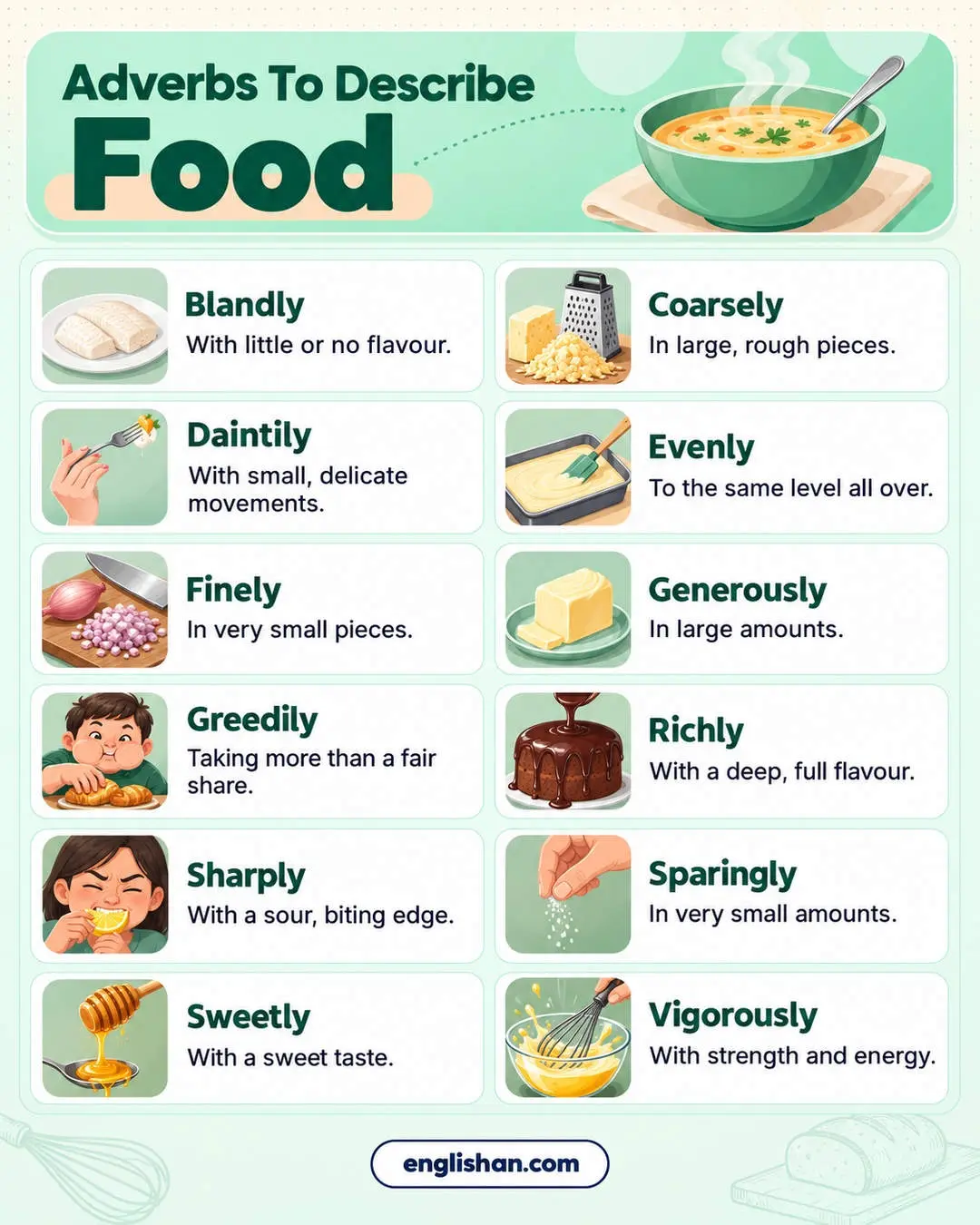
Adverbs to Describe Food by Taste
These adverbs to describe food attach to a tasting verb or to an adjective. Deliciously dry and faintly of lavender both read correctly, and both say something a bare adjective leaves out of the sentence.
| Adverb | Meaning | In a sentence |
|---|---|---|
| Deliciously | So as to taste very good. | The pears poached deliciously in cider. |
| Beautifully | To a standard that pleases the eye or the palate. | The crust came out of the oven beautifully. |
| Richly | With depth and fat in the flavour. | The stock reduced richly over four hours. |
| Sweetly | Sweetness to the front of the flavour. | The windfalls cooked sweetly without any sugar. |
| Sharply | With acid to the front. | The gooseberries cut sharply against the cream. |
| Sourly | With a bitter edge. | The milk had turned sourly in the heat. |
| Blandly | Without flavour of its own. | The farmed fish ate blandly beside the wild. |
| Cloyingly | With sweetness carried past the point of pleasure. | The icing sat cloyingly on the sponge. |
| Sickeningly | To a degree that turns the stomach. | The frying oil smelled sickeningly by closing time. |
| Delicately | With a light, fine flavour. | The broth was seasoned delicately. |
| Intensely | With concentrated force of flavour. | The tomatoes roasted intensely under the grill. |
| Faintly | Only just detectable. | The honey tasted faintly of lavender. |
| Scrumptiously | Deliciously rich on the tongue. | The plums baked scrumptiously under the crumble. |
| Pleasantly | Agreeably, without any fault. | The cider finished pleasantly dry. |
Cloyingly and sickeningly are the two that pass a verdict rather than state a flavour, so both belong in a review and neither belongs on a menu.
Adverbs for How Food Is Cooked
A recipe is built on verbs, which makes this the group that earns its place. Simmer gently, chop finely and fold carefully all tell a cook something the verb alone leaves open.
| Adverb | Meaning | In a sentence |
|---|---|---|
| Gently | Over a low heat, without agitation. | Simmer the stock gently for two hours. |
| Slowly | Under a low heat over a long time. | The shoulder roasted slowly from seven o’clock. |
| Briskly | At a fast rolling heat. | Boil the sugar briskly to the thread stage. |
| Thoroughly | All the way through, with nothing underdone. | Cook the pork thoroughly before resting it. |
| Lightly | With a short, gentle treatment. | Toast the almonds lightly in a dry pan. |
| Evenly | To the same degree all over. | Spread the batter evenly across the tin. |
| Sparingly | In small amounts, with restraint. | Add the salt sparingly and taste again. |
| Generously | In large amounts. | Butter the dish generously before filling it. |
| Carefully | With attention paid to avoiding damage. | Fold the whites in carefully. |
| Finely | Into very small pieces. | Chop the shallot finely. |
| Coarsely | Into large, rough pieces. | Grate the cheese coarsely. |
| Vigorously | With strength and energy. | Whisk the eggs vigorously for a minute. |
| Overnight | Through the whole night. | Soak the beans overnight in cold water. |
| Repeatedly | Many times over. | Baste the bird repeatedly through the hour. |
Gently and slowly are not interchangeable, since gently governs the heat and slowly governs the clock, and a stock wants both.
Adverbs for How Someone Eats
Here the adverb reports the person rather than the plate, which makes this the group a story or a review reaches for. He ate hungrily says nothing about the food and everything about the eater.
| Adverb | Meaning | In a sentence |
|---|---|---|
| Hungrily | With fierce hunger. | The children ate hungrily after the walk. |
| Greedily | Grabbing more than a share. | He took a third helping greedily. |
| Daintily | With delicate neatness. | She set the fork down daintily. |
| Noisily | Making a good deal of noise. | The soup was finished noisily. |
| Politely | With good manners. | He declined the cheese politely. |
| Reluctantly | Unwillingly, and under pressure. | The sprouts went down reluctantly. |
| Appreciatively | Showing gratitude for it. | The crew took the stew appreciatively. |
| Voraciously | With a huge appetite. | The team ate voraciously after the match. |
Greedily and hungrily divide on judgement, since hunger earns sympathy and greed does not.
Why Food Writing Uses Adjectives More Than Adverbs
A dish is a noun, and a noun takes an adjective. That one fact explains why a menu holds almost no adverbs while a recipe holds one in every other line. The recipe is a sequence of instructions, and the menu is a line of dishes.
| Where the words go | What it takes | Sample |
|---|---|---|
| A menu | Adjectives | Slow-roasted shoulder with a rich cider gravy |
| A recipe method | Adverbs | Simmer gently, then reduce slowly for an hour |
| A review of a dish | Both | Richly made, and the pastry baked beautifully |
| A review of a diner | Adverbs | He worked through three courses greedily |
- Simmer the stock gently for two hours.
- Chop the shallot finely before the butter goes in.
- Fold the whites in carefully.
- The pears poached deliciously in cider.
- The children ate hungrily after the walk.
Pushing an adverb into a menu line is the error this produces, and the result reads as a recipe rather than as a dish.
- Shoulder of pork, roasted slowly and richly flavoured ❌
- Slow-roasted shoulder of pork in a rich cider gravy ✅
Adverb Plus Adjective Examples for Food
The strongest construction among the adverbs to describe food puts the adverb in front of an adjective rather than a verb. Deliciously dry and intensely sweet both read better than either word alone, because the adverb measures the adjective.
- The cider finished deliciously dry.
- Those tomatoes turned intensely sweet under the grill.
- A crumb that stayed pleasantly damp.
- The icing sat cloyingly sweet on the sponge.
- By closing time the oil smelled sickeningly stale.
The adverb has to measure the adjective rather than repeat it, which is where the pattern breaks down.
- The cider finished dryly dry ❌
- The cider finished deliciously dry ✅
The destination decides which group to reach for. A recipe needs the cooking adverbs to describe food in almost every line, a review needs the tasting group, and a menu is better off with neither.
Related:
- Adverbs Ending in LY
- Adverb Examples
- Adverbs of Manner
- Adverbs of Time
- Adverbs of Frequency
- Adverbs of Place
- Adverbs of Degree
- Types of Adverbs
- Relative Adverbs
- Adverbs of Reason
FAQs
They are adverbs attached to a verb or an adjective about food, in three groups. Among the adverbs to describe food, deliciously and faintly report how something tastes, gently and finely report how it was cooked, and hungrily and daintily report how a person eats it.
A dish is a noun, and a noun takes an adjective rather than an adverb. That is why a menu reads a rich cider gravy and never richly flavoured gravy, while a recipe method takes an adverb in every other line because it is a sequence of instructions.
Deliciously, richly, sweetly, sharply, delicately, intensely, faintly and pleasantly all report flavour. Blandly, sourly, cloyingly and sickeningly report flavour with the verdict reversed, and they are the adverbs to describe food a review reaches for.
Gently, slowly, briskly, thoroughly, lightly, evenly, sparingly, generously, carefully, finely, coarsely and vigorously carry most of the method writing in English cookery. All twelve answer a question the verb leaves open, which is what makes them the adverbs to describe food a cook actually uses.
Gently governs the heat and slowly governs the clock. A stock simmered gently sits under a rolling boil, a shoulder roasted slowly stays in the oven for hours, and a good stock needs both at once.
Hungrily, greedily, daintily, noisily, politely, reluctantly, appreciatively and voraciously all report the eater rather than the food. The group divides on judgement, since hunger earns sympathy from a reader and greed does not.
