

Adverbs turn up in contracts as readily as in conversation. The adverbs that start with T range from everyday words such as too, then, there and today to intensifiers such as totally, thoroughly and terribly. Tightly and tenderly express manner, and twice gives a count of occasions. The there- compounds, from thereafter and thereby to therewith, are formal wording found in contracts and statutes.
Choose the first letter:
A · B · C · D · I · K · L · M · N · R · S · T · V
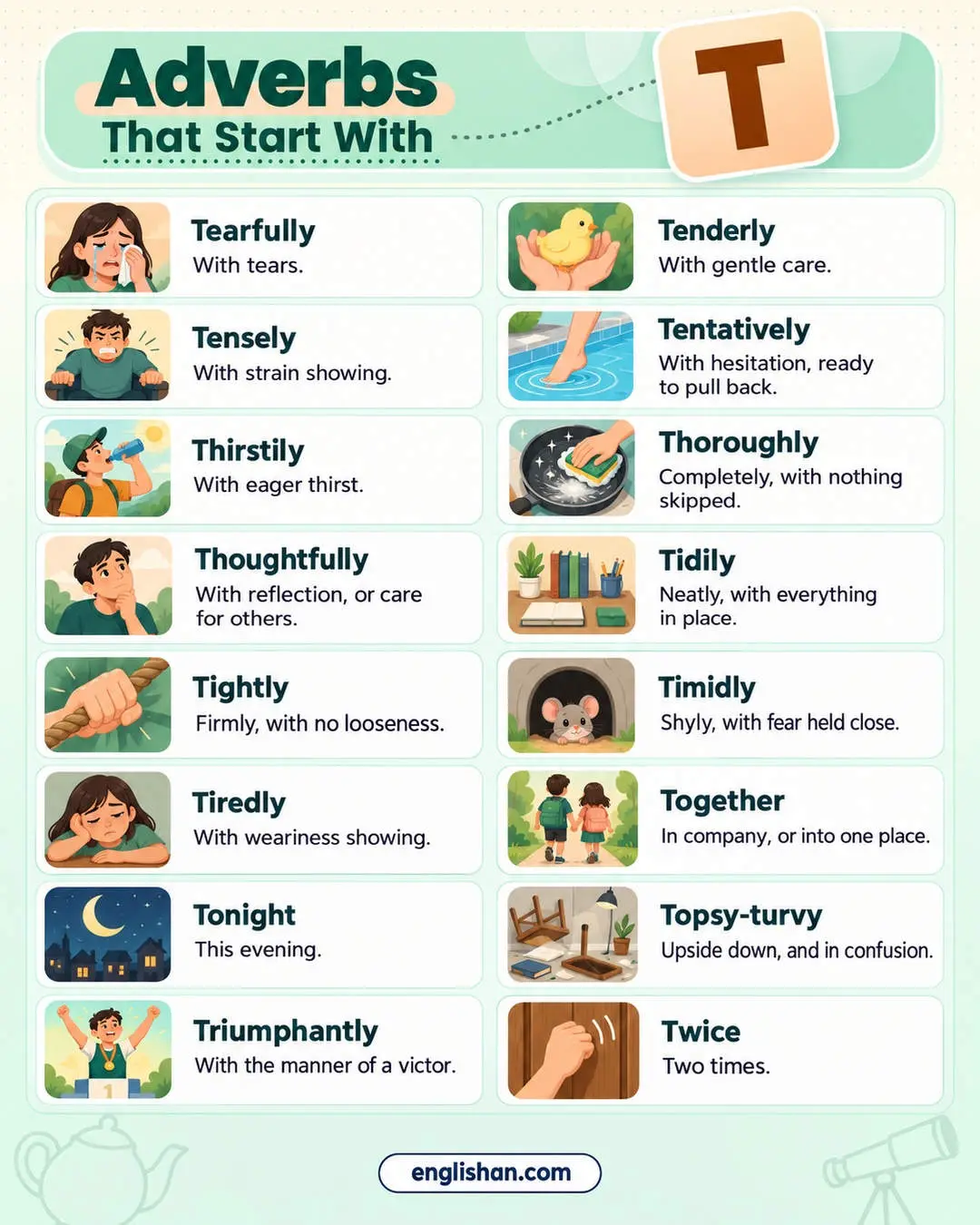
Adverbs That Start With T
The adverbs that start with T run alphabetically from tackily to twitchily, with the meaning beside the word and a sentence showing where the adverb belongs. The letter splits into four parts so that near-neighbours stay close enough to weigh against one another. The tr- and th- runs hold several words that go wrong in writing.
Adverbs That Start With Ta to Te
| Adverb | Meaning | In a sentence |
|---|---|---|
| Tackily | With cheap, tasteless showiness. | The foyer was decorated tackily. |
| Tactically | Aiming at short-term advantage. | The substitution was made tactically. |
| Talkatively | With a steady flow of talk. | The driver filled the drive home talkatively. |
| Tangentially | Touching the matter only at the edge. | The report deals with drainage tangentially. |
| Tantalisingly | So as to tease with something just out of reach. | The gate stood tantalisingly ajar. |
| Tartly | With a sharp, sour edge. | She answered the question tartly. |
| Tautly | Pulled tight, with no slack. | The wire was strung tautly between the posts. |
| Technically | By the strict terms of the rule. | The licence had technically lapsed. |
| Technologically | In relation to the state of technology. | The plant is technologically dated. |
| Tellingly | So as to reveal more than was meant. | The minutes record the vote tellingly. |
| Temperately | With moderation and restraint. | He stated the objection temperately. |
| Temptingly | So as to invite. | The cakes were arranged temptingly. |
| Terrifically | Very well indeed. | The team played terrifically in the second half. |
| Terrifyingly | To a degree that produces terror. | The scaffold swayed terrifyingly in the gust. |
| Territorially | In relation to territory. | The pair of robins behaved territorially. |
| Tersely | In few words, and with no warmth. | The request was refused tersely. |
Adverbs That Start With Th
| Adverb | Meaning | In a sentence |
|---|---|---|
| Theatrically | As though performing for an audience. | He threw up his hands theatrically. |
| Thematically | By theme rather than by date. | The archive is arranged thematically. |
| Theologically | In relation to religious doctrine. | The passage is theologically awkward. |
| Theoretically | By theory, whatever happens in practice. | The valve should theoretically hold. |
| Thermally | In relation to heat. | The loft performs poorly thermally. |
| Thickly | In a dense layer, or with a heavy voice. | The dust lay thickly over the workbench. |
| Thievishly | With the manner of a thief. | He eyed the till thievishly. |
| Thinly | In a sparse layer. | The hedge was planted thinly along the ditch. |
| Thirdly | In the third position in a sequence. | Thirdly, the drains were never adopted. |
| Thirstily | With eager thirst. | The horses drank thirstily at the trough. |
| Threefold | By three times the amount. | Output rose threefold after the rebuild. |
| Thriftily | With careful economy. | The household was run thriftily. |
| Thriftlessly | With money let go to waste. | The legacy was spent thriftlessly. |
| Thumpingly | To an emphatic degree. | The motion passed thumpingly. |
| Thunderously | With a deep, rolling loudness. | The organ answered thunderously. |
Adverbs That Start With Ti to To
| Adverb | Meaning | In a sentence |
|---|---|---|
| Ticklishly | In a way that is awkward to handle. | The boundary question sat ticklishly with both parties. |
| Tidily | Neatly, with everything in place. | The tools were stacked tidily. |
| Tightly | Firmly, with no looseness. | The lid was screwed tightly onto the drum. |
| Timelessly | Without showing the age of the style. | The hall was furnished timelessly. |
| Timorously | With nervous fearfulness. | The clerk raised the error timorously. |
| Tinnily | With a thin metallic sound. | The radio played tinnily in the corner. |
| Tonally | In relation to tone or pitch. | The two recordings differ tonally. |
| Tonelessly | With no change of pitch or feeling. | He read the statement tonelessly. |
| Topically | In relation to the news of the day. | The sermon was framed topically. |
| Topographically | By the shape of the land. | The two valleys differ topographically. |
| Torpidly | Sluggishly, with no energy. | The carp moved torpidly under the ice. |
| Tortuously | By a long, winding route. | The lane climbs tortuously to the ridge. |
| Torturously | So as to cause prolonged pain. | The appeal dragged on torturously for four years. |
| Touchily | Quick to take offence. | He answered the audit touchily. |
| Toughly | With hard resilience. | The claim was contested toughly. |
| Toweringly | To an overwhelming height or degree. | The oak stands toweringly over the lane. |
Adverbs That Start With Tr to Tw
| Adverb | Meaning | In a sentence |
|---|---|---|
| Traditionally | By long-established practice. | The roof is traditionally pegged rather than nailed. |
| Tragically | With a disastrous outcome. | The crossing ended tragically. |
| Tranquilly | In untroubled calm. | The pond lay tranquilly under the willows. |
| Transiently | For a short while only. | The symptom appeared transiently. |
| Transitively | Taking a direct object, in grammar. | The verb works transitively here. |
| Translucently | So that light passes without a sharp image. | The alabaster glows translucently. |
| Transparently | So as to be seen through, or with nothing hidden. | The accounts were kept transparently. |
| Transversely | Across, from side to side. | The beam runs transversely over the aisle. |
| Treasonably | In a way amounting to treason. | The letters were read treasonably at the trial. |
| Tremblingly | With a shaking movement. | She held out the telegram tremblingly. |
| Tremulously | Quavering with fear or emotion. | He gave his name tremulously. |
| Trenchantly | Forcefully and to the point. | The dissent was argued trenchantly. |
| Trickily | In a way that is awkward to manage. | The flashing sits trickily behind the chimney. |
| Trimly | Neatly, with a tight finish. | The hedge was cut trimly. |
| Triply | In three parts or three times over. | The seal is triply bonded. |
| Trippingly | Lightly and easily off the tongue. | The lines came trippingly in rehearsal. |
| Troublingly | So as to cause unease. | The survey reads troublingly on the east wall. |
| Tumultuously | With uproar and disorder. | The result was greeted tumultuously. |
| Tunelessly | Out of tune. | He whistled tunelessly along the corridor. |
| Turgidly | In swollen, overblown language. | The preface is written turgidly. |
| Twitchily | With nervous, jerky movement. | The cat watched the hallway twitchily. |
Positive Adverbs That Start With T
Approval sits in the positive adverbs that start with T, and the letter divides between care and completeness. Tactfully and tenderly report care, while thoroughly and tirelessly report effort seen through.
| Adverb | Meaning | In a sentence |
|---|---|---|
| Tactfully | With care not to give offence. | The redundancy was raised tactfully. |
| Tastefully | With good judgement in style. | The cottage was extended tastefully. |
| Tenaciously | Holding on without letting go. | The claim was pursued tenaciously. |
| Tenderly | With gentle care. | He lifted the chick tenderly. |
| Thankfully | With gratitude, or to the reader’s relief. | The frost lifted thankfully before the planting. |
| Thoroughly | Completely, with nothing skipped. | The flue was swept thoroughly. |
| Thoughtfully | With consideration for others, or with reflection. | She answered the complaint thoughtfully. |
| Thrillingly | So as to excite. | The last lap was run thrillingly. |
| Tirelessly | Without flagging. | The volunteers worked tirelessly through the flood. |
| Tolerantly | With patience towards difference. | The dispute was handled tolerantly. |
| Touchingly | So as to move the feelings. | The letter closed touchingly. |
| Triumphantly | With the manner of a victor. | He held up the deeds triumphantly. |
| Truthfully | Without departing from the facts. | The timesheet was completed truthfully. |
| Tunefully | With a pleasant melody. | The bells rang tunefully across the fields. |
Thankfully splits two ways among the positive adverbs that start with T, since a person acts with gratitude and a writer reports relief at an outcome with the same word.
Adverbs of Manner That Start With T
Most of the ordinary T adverbs qualify manner, which is the how of an action. The standard position is after the verb, or after the object where there is one. Front position is available for stress, and it throws the weight onto the manner rather than the action.
- The request was refused tersely.
- He tactfully raised the redundancy.
- Thickly, the dust lay over the workbench.
- The lid was screwed tightly onto the drum.
- The dissent was argued trenchantly.
The position to rule out is between the verb and its object, where the adverb separates a pair that belongs together.
- He refused tersely the request ❌
- He refused the request tersely ✅
The ordinary -ly adverbs on T place the same way, treated under adverbs of manner and across the types of adverbs.
Negative Adverbs That Start With T
Disapproval runs through the negative adverbs that start with T, and the target shifts from word to word. Tactlessly and thoughtlessly fault the judgement, while truculently and tyrannically fault the temper behind it.
| Adverb | Meaning | In a sentence |
|---|---|---|
| Tactlessly | Without care for the offence given. | The question was put tactlessly. |
| Tastelessly | With poor judgement in style. | The memorial was lettered tastelessly. |
| Tauntingly | With mockery meant to provoke. | The crowd chanted tauntingly. |
| Tediously | At wearisome length. | The minutes record the debate tediously. |
| Testily | With short-tempered irritation. | He corrected the figure testily. |
| Tetchily | Peevishly, and quick to snap. | The porter answered tetchily. |
| Thanklessly | With no recognition given. | The ditch was cleared thanklessly every autumn. |
| Thoughtlessly | Without thinking of the consequence. | The gate was left open thoughtlessly. |
| Threateningly | With menace shown. | The dog stood over the gate threateningly. |
| Tiresomely | So as to wear the patience. | The point was repeated tiresomely. |
| Treacherously | With betrayal, or with hidden danger. | The slope ices treacherously after dusk. |
| Truculently | Aggressively, and spoiling for a fight. | The tenant answered the notice truculently. |
| Turbulently | With violent disorder. | The meeting ended turbulently. |
| Tyrannically | With oppressive, absolute control. | The yard was run tyrannically for a decade. |
Treacherously applies to a surface as well as to a person, which no other of the negative adverbs that start with T manages, so a slope ices treacherously and a colleague acts treacherously.
Adverbs That Start With T to Describe a Person
Manner adverbs take the weight when a person heads the sentence, and the adverbs that start with T hold several matched pairs. She answered tensely and she answered tartly report one action and two different people.
| Adverb | Meaning | In a sentence |
|---|---|---|
| Tacitly | Without being said aloud. | The arrangement was accepted tacitly. |
| Tamely | Without spirit or resistance. | The appeal was dropped tamely. |
| Tearfully | With tears. | She gave her evidence tearfully. |
| Teasingly | With light provocation. | He mentioned the bet teasingly. |
| Temperamentally | By disposition rather than by choice. | He is temperamentally unsuited to the role. |
| Tensely | With strain showing. | The pair waited tensely for the result. |
| Tentatively | Without commitment, and ready to withdraw. | The date was offered tentatively. |
| Throatily | With a deep, husky voice. | She laughed throatily at the story. |
| Timidly | Shyly, with fear held close. | The boy knocked timidly at the office door. |
| Tiredly | With weariness showing. | He folded the chart tiredly. |
| Trustingly | Without suspicion. | The puppy followed trustingly. |
| Truly | In a way that holds to the truth. | He answered the charge truly. |
Tacitly is the one with no outward sign at all among the person adverbs that start with T, since an arrangement accepted tacitly was never spoken about.
Adverbs of Time and Frequency That Start With T
T holds three of the plainest time words in English and two of the plainest frequency words, and none of the five takes an ending. A frequency word such as twice belongs in front of the main verb, while today and tonight take either end of the sentence.
| Adverb | Meaning | In a sentence |
|---|---|---|
| Tardily | Later than it should have been. | The payment arrived tardily. |
| Temporarily | For a limited time. | The lane is closed temporarily. |
| Then | At that time, or next in order. | Fit the gasket, then tighten the bolts. |
| Thenceforth | From that point onward. | The toll was dropped thenceforth. |
| Thereafter | After that point. | The mill ran on steam thereafter. |
| Thrice | Three times. | The bell was struck thrice. |
| Today | On this present day. | The surveyor calls today. |
| Tomorrow | The day after today. | The scaffold comes down tomorrow. |
| Tonight | This evening. | The gates close early tonight. |
| Twice | Two times. | The gauge was read twice before the shift. |
Thenceforth and thereafter belong to formal writing and mean the same thing, as adverbs of time sets out alongside adverbs of frequency.
Adverbs of Place and Direction That Start With T
Place is a small group among the adverbs that start with T, and there is almost the whole of it. A place adverb follows the verb or the object, and it comes after a manner adverb when the two stand together.
| Adverb | Meaning | In a sentence |
|---|---|---|
| There | In or at that place. | Leave the ledger there on the bench. |
| Through | From one side to the other. | The nail went through into the joist. |
| Throughout | In all parts, or for the whole time. | The leak spread throughout the cellar. |
| Together | In company, or into one place. | The parts were fitted together on site. |
| Topsy-turvy | Upside down, and in confusion. | The office was left topsy-turvy by the move. |
There also opens a sentence as a dummy opener, as in there are two gates, which differs from the place adverb, as adverbs of place sets out.
Adverbs of Degree That Start With T
Too is the commonest word for how much in English. Tepidly, trivially and tolerably pull a statement down, while terribly, totally and tremendously push it up into opinion.
| Adverb | Meaning | In a sentence |
|---|---|---|
| Tangibly | Enough to be felt or measured. | The damp has worsened tangibly since March. |
| Tenuously | By the slightest connection. | The two cases are linked tenuously. |
| Tepidly | With little warmth or enthusiasm. | The scheme was received tepidly. |
| Terribly | To a great degree. | The lintel is terribly out of true. |
| Tolerably | Well enough to be accepted. | The engine ran tolerably after the service. |
| Too | More than is wanted, or also. | The lane is too narrow for a lorry. |
| Totally | In full, with nothing excepted. | The ledger was totally rewritten. |
| Tremendously | To an enormous degree. | Costs rose tremendously after the delay. |
| Trivially | To a degree too small to matter much. | The two drafts differ trivially. |
| Twofold | By two times the amount. | The yield increased twofold. |
Terribly reads as an intensifier, so a lintel terribly out of true is badly out of true and nothing about it inspires terror, as adverbs of degree sets out.
Adverbs That Start With T Without LY
The endingless adverbs that start with T are there, then, today, tomorrow, tonight, too, twice, thrice, thus, together, through, throughout, twofold, threefold, tight and true. A pair of the adverbs that start with T in that run take an -ly form as well, and the two forms differ in meaning.
- Hold the rope tight while I cut.
- The gauge was read twice before the shift.
- The nail went through into the joist.
- Fit the gasket, then tighten the bolts.
- His story rang true to the inspector.
Tight and tightly both exist, and the bare form belongs to the instruction while the -ly form belongs to the description of a finished job.
- Hold the rope tightly while I cut ❌
- Hold the rope tight while I cut ✅
True and truly divide the same way, since a story rings true and a witness answers truly.
- His story rang truly to the inspector ❌
- His story rang true to the inspector ✅
Adverbs That Start With There
A family of adverbs that start with T is built from there plus a preposition, and the whole family belongs to formal drafting rather than to speech. They point back to something already named, which earns them a place in a deed and makes them awkward anywhere else.
| Adverb | Meaning | In a sentence |
|---|---|---|
| Thereabouts | Near that place or that number. | The cottage dates from 1780 or thereabouts. |
| Thereby | By that means. | The weir was raised, thereby flooding the meadow. |
| Therefore | For that reason. | The deeds were never registered and the claim therefore failed. |
| Therein | In that place or document. | The covenant and the conditions set out therein still bind. |
| Thereof | Of that thing. | The lease and any extension thereof pass to the heir. |
| Thereon | On that thing. | The platform and the rails laid thereon were removed. |
| Thereto | To that thing. | The schedule and the plan annexed thereto are part of the deed. |
| Thereupon | Immediately after that. | The notice expired, and thereupon the tenancy ended. |
| Therewith | With that thing. | The press and the type supplied therewith were sold together. |
Therein and thereof are the pair that goes wrong most, since therein belongs inside a place or a document while thereof attaches to a thing.
Commonly Confused Adverbs That Start With T
Pairs among the adverbs that start with T trade places in print, and in several of them a single letter is the whole difference. The split turns on what the word measures rather than on how strongly it reads.
| Pair | What separates them |
|---|---|
| Tortuously / Torturously | Tortuously means winding; torturously means painful. |
| Thriftily / Thriftlessly | Thriftily saves money; thriftlessly wastes it. |
| Tastefully / Tastelessly | Tastefully shows judgement; tastelessly shows none. |
| Tacitly / Tactfully | Tacitly means unspoken; tactfully means without offence. |
| Temperately / Temporarily | Temperately means with restraint; temporarily means for a while. |
| Tangibly / Tenuously | Tangibly means measurably; tenuously means barely at all. |
- The lane climbs tortuously to the ridge.
- His appeal dragged on torturously for four years.
- The household was run thriftily.
- A legacy of nine thousand was spent thriftlessly.
- The arrangement was accepted tacitly.
Tortuously applies to a shape and torturously to pain, so a winding lane climbs tortuously and a long appeal drags on torturously.
- The lane climbs torturously to the ridge ❌
- The lane climbs tortuously to the ridge ✅
The adverbs that start with T divide along register, with the there- compounds on the formal side. Too and twice belong to speech and the there- compounds belong to a deed. A sentence that mixes the two reads wrong before a reader sees why.
Related:
- Adverbs Ending in LY
- Adverbs That Do Not End in LY
- Adverb Examples
- Adverbs of Frequency
- Types of Adverbs
- Relative Adverbs
- Adverbs of Reason
- Conjunctive Adverbs
FAQs
Around a hundred and forty qualify in standard English, and 142 adverbs that start with T are gathered here with a meaning and a sentence. The there- compounds account for nine, and a further sixteen take no -ly ending at all.
Too is the most common of the adverbs that start with T by a wide margin, followed by then, there, today and twice. None of the five takes an -ly ending, which is why they turn up in speech far more than the long manner words.
Tactfully, tenderly, thoroughly, tirelessly and truthfully state open approval, and all five belong in a reference. Tenaciously makes a point about persistence that no other T word makes as plainly.
Tartly, tensely, timidly, tacitly and trustingly report how a person acts rather than what they are, so the verb keeps the action and the adverb holds the character. Temperamentally is the exception, since it reports a disposition rather than one occasion.
Thereafter, thereby, therefore, therein, thereof, thereon, thereto, thereupon and therewith are formal adverbs built from there plus a preposition. They point back to something already named in the document, which is why deeds, leases and statutes use them and ordinary writing does not.
A manner adverb such as tersely goes after the verb, or after the object where there is one. A frequency word such as twice goes in front of the main verb, a degree word such as too goes beside the word it measures, and a place word such as there follows the verb.