

A verb is a word that expresses an action or a state, and an adverb is a word that modifies a verb, an adjective, or another adverb. In any adverb vs verb question, the answer depends on form: a verb changes for tense and agrees with its subject, while an adverb keeps one form in every tense.
The two words often appear side by side, because the most common job of an adverb is to modify a verb, as in “Mia sings softly“. Put that sentence in the past and only the verb changes, so “sings” becomes “sang” and “softly” stays as it is. Both words are parts of speech with separate jobs, and the verb is the one a sentence cannot leave out.
A verb expresses an action or a state, such as “run”, “know”, or “be”, and it changes for tense and agrees with its subject. An adverb modifies the verb and tells us how, when, where, how often, or how much, as in “quickly” or “often”. An adverb never changes for tense, and it usually comes before a main verb, after “be”, or after the object.
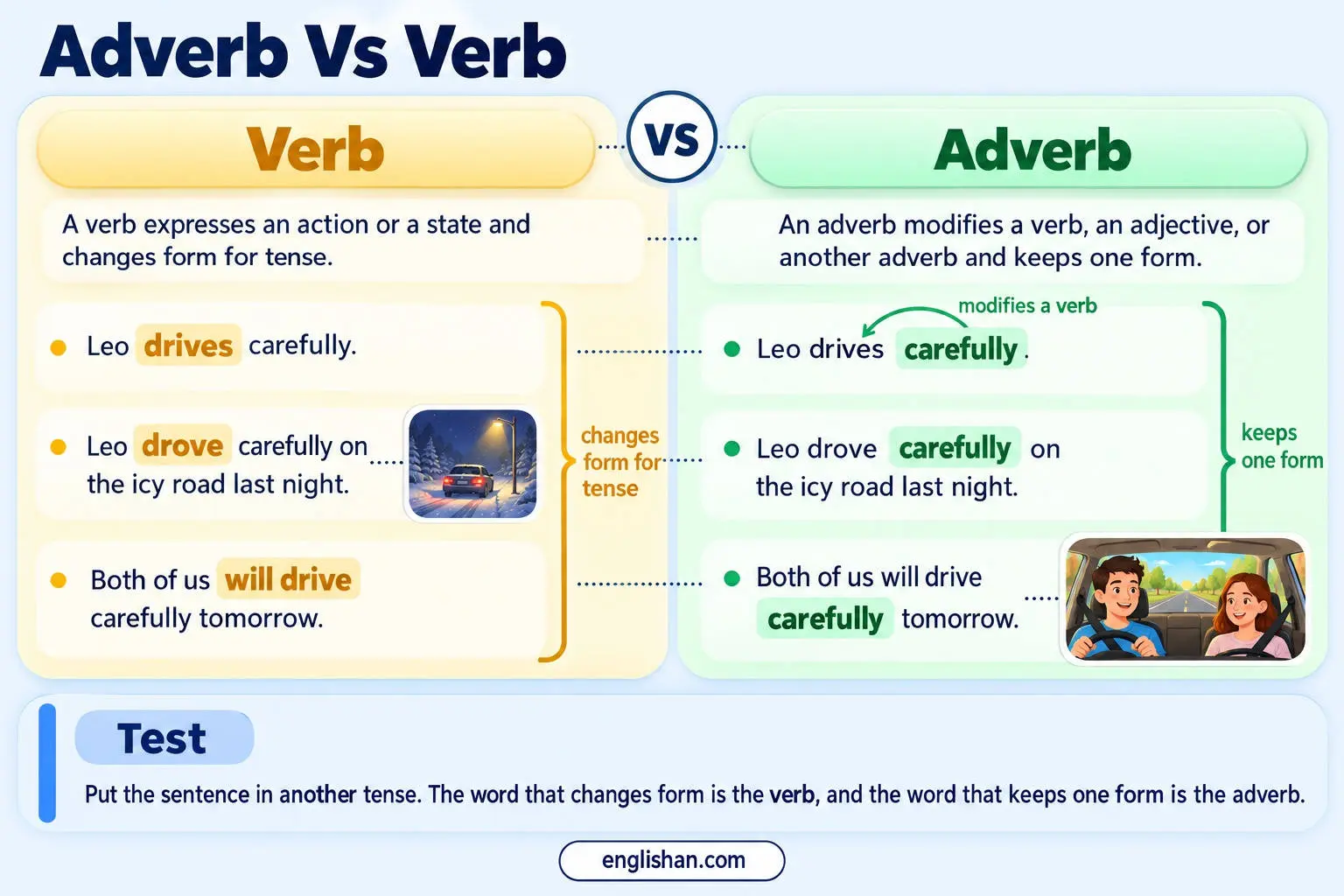
What Is A Verb And An Adverb?
A verb is a word that expresses an action, such as “run” and “write”, or a state, as with “be”, “know”, and “belong”. A complete sentence contains at least one verb, and that verb agrees with the subject, the person or thing the sentence is about. The verb also shows tense, so “work” becomes “worked” in the past simple and takes “-s” after “he”, “she”, or “it”.
An adverb is a word that modifies a verb, an adjective, or another adverb. With a verb, it tells us how, when, where, how often, or how much the action happens. An adverb has no tense and no agreement, so “carefully” keeps the same form whether the subject is “I” or “they” and whether the action is past or future:
- Leo drives carefully.
- Leo drove carefully on the icy road last night.
- Both of us will drive carefully tomorrow.
The verb moves from “drives” to “drove” to “will drive”, and the adverb “carefully” does not change at all. An adverb can change for comparison, as in “more carefully” and “faster”, but comparison is a change of degree, not of tense.
Verbs Vs Adverbs
Verbs and adverbs both belong to the part of the sentence that tells us about the action or state of the subject, which is why the two so often appear together. The adverb vs verb differences are in form, in job, and in whether the sentence can stand without them:
| Property | Verb | Adverb |
|---|---|---|
| Job | Expresses an action or a state | Modifies a verb, an adjective, or another adverb |
| Question it answers | What does the subject do, or what is it? | How, when, where, how often, or how much? |
| Tense | Changes: walk, walked, will walk | None: quickly in every tense |
| Agreement | Agrees with the subject: she walks | None: she walks quickly, they walk quickly |
| In a sentence | Required, at least one | Usually optional |
| Common endings | -ize, -ify, -en, -ate (organize, simplify, widen, create) | -ly (slowly, rarely), though many have no ending (soon, here, very) |
| Comparison | None | More slowly, most slowly, faster |
| Examples | Run, think, become, have, seem | Quickly, never, here, today, very |
Most adverbs are optional, so the sentence stays complete when the adverb is removed. A few verbs, “put” and “live” among them, take a required word of place, and with them the adverb cannot be dropped:
- The bus left early.
- The bus left.
- Nadia put her keys there.
- My grandparents live nearby.
Without “there”, the sentence about Nadia is incomplete, and “My grandparents live” changes the meaning of “live” to ‘are alive’. Where the class of a word is unclear, put the sentence in another tense. The word that changes form is the verb, and the word that keeps one form while answering how, when, or where is the adverb.
Examples Of Verbs And Adverbs
An adverb that modifies a verb tells us how, when, where, how often, or how much the action happens. There are five main types of adverbs by meaning: manner, time, place, frequency, and degree, and each of them answers one of those questions about the verb it modifies:
- The nurse spoke gently to the patient. (manner)
- Our flight leaves tomorrow at noon. (time)
- The kids ran outside after lunch. (place)
- We rarely eat out on weekdays. (frequency)
- I almost missed the last train home. (degree)
- Did you sleep well last night? (manner, question)
An adverb modifies the verb in its own clause, so the same adverb can change the meaning when it moves to a different clause. In the first sentence, “quickly” modifies “agreed”; in the second, it modifies “call”:
- Ben quickly agreed that he would call.
- Ben agreed that he would call quickly.
After a linking verb: The linking verbs “be”, “seem”, “look”, “feel”, and “smell” are followed by an adjective, not an adverb. The word after the linking verb describes the subject, not the action, so the form without “-ly” is correct.
The soup smells deliciously. ❌
The soup smells delicious. ✅
The word “delicious” describes the soup, so it is an adjective, and the full contrast between the two forms belongs to adverb vs adjective.
Adverb Before Or After The Verb
An adverb can come before or after the verb, and its position depends on the type of adverb and on the verb in the sentence. Adverbs of frequency, degree, and certainty, such as “always”, “almost”, and “definitely”, usually take mid position: before a main verb, after “be”, and after the first auxiliary. Adverbs of manner, place, and time usually come after the verb, or after the object when the verb has one.
For adverb vs verb order, the question of verb before adverb or after therefore has four answers, one for each kind of verb and object in the sentence.
Adverb Before The Main Verb
A mid-position adverb comes directly before a main verb when the sentence has no auxiliary. The subject comes first, then the adverb, then the verb:
- My brother always forgets his umbrella.
- We usually take the early train.
- The printer often jams on cold mornings.
- I really enjoyed the concert on Saturday.
- Our neighbors never park in front of the gate.
Adverbs of frequency follow this order with every main verb except “be”, including “have” when it is the main verb: “She often has lunch at her desk.”
I go always to the gym after work. ❌
I always go to the gym after work. ✅
An adverb of frequency comes before a main verb, not after it.
Adverb After The Verb Be
When “be” is the main verb, a mid-position adverb comes after it. The forms “am”, “is”, “are”, “was”, and “were” all follow this order:
- The office is usually quiet before nine.
- My parents are never home on Sundays.
- The tickets were already gone by noon.
- Are you still at the station?
She always is late for meetings. ❌
She is always late for meetings. ✅
With “be” as the main verb, the adverb comes after the verb, not before it.
In a short answer or when “be” is stressed, the adverb comes before it instead, as in “Is Tom late again?” “He always is.” This order is used in speech and short replies, not in a full statement.
Adverb Between The Auxiliary And Main Verb
When a verb has an auxiliary, the mid-position adverb comes after the first auxiliary and before the main verb. With two or more auxiliaries, the adverb still follows the first one:
- I have never seen snow.
- The package has already arrived.
- You can easily walk there from the hotel.
- We will definitely call you tonight.
- The road has always been closed in winter.
In a question, the subject comes between the auxiliary and the adverb, as in “Have you ever tried sushi?” and “Can we still change the date?”
I have been never to Paris. ❌
I have never been to Paris. ✅
The adverb goes after the first auxiliary, “have”, not after “been”.
Adverb Of Manner After The Object
An adverb of manner usually comes straight after the verb when the verb has no object. A transitive verb, a verb that takes an object, keeps its object next to it, so the adverb of manner moves to the position after the object:
- The baby slept peacefully.
- Jonas fixed the tap quickly.
- Please read the contract carefully.
- The manager explained the new plan very clearly.
She speaks very well English. ❌
She speaks English very well. ✅
The object “English” follows “speaks” directly, and the adverb “very well” comes after the object. The wrong order follows French and Spanish, where the adverb normally comes straight after the verb, as in the French “Elle parle très bien anglais”.
When the object is long, the adverb of manner can come before the verb instead: “She carefully read every page of the contract.” The adverb still does not come between the verb and its object.
Auxiliary Verb Vs Adverb
An auxiliary verb, also called a helping verb, is a verb that comes before a main verb to form a tense, a question, a negative, or the passive. The auxiliary verbs are “be”, “have”, and “do”, and the modal verbs belong with them. An auxiliary is still a verb, so it changes for tense and agrees with the subject, as “has” changes to “had” and “is” changes to “are”:
- The meeting has already started.
- The meeting had already started when we arrived.
- Our kids are still sleeping.
- Do you usually work on Fridays?
Across these sentences, the bold auxiliary changes with the tense or the subject, while “already”, “still”, and “usually” stay the same, which shows that they are adverbs. The adverb vs verb confusion comes up most often with auxiliaries, because the auxiliary and the adverb stand next to each other before the main verb.
Modal verbs: Like “be”, “have”, and “do”, the modals “will”, “can”, “must”, and “should” are auxiliary verbs, not adverbs. A modal takes no “-s” after “he” or “she” and is followed by the base form of the main verb, and an adverb in the same sentence comes after the modal: “We can always change the date.”
The adverb “not”: With a main verb in the present simple or past simple, “not” takes the auxiliary “do”, while “never” comes directly before the main verb with no auxiliary. Both words are negative adverbs, not verbs.
She not smokes. ❌
She does not smoke. ✅
Without another auxiliary, “not” follows “do”, “does”, or “did”, and the main verb returns to its base form.
Words That Are Verbs And Adverbs
A word can be a verb in one sentence and an adverb in another when the same spelling belongs to both word classes. These shared spellings are the hardest adverb vs verb cases, and the job in the sentence shows the class. As a verb, the word takes a subject and changes for tense, and as an adverb, it modifies a verb and keeps one form.
- The driver backed the van into the garage. (verb)
- Please step back from the door. (adverb)
- The shop upped its prices in June. (verb, informal)
- Prices went up in June. (adverb)
- He downed his coffee and ran for the bus. (verb, informal)
- The sun went down behind the hills. (adverb)
- As the deadline nears, the office stays open late. (verb)
- My cousins live quite near. (adverb)
Some pairs only look alike. The adverb “fast” means ‘quickly’, as in “She drives fast“, and it has no verb form with that meaning. The verb “fast” is a separate word meaning ‘eat no food’, as in “He fasted before the blood test”, so the two share a spelling and nothing else.
In a phrasal verb such as “give up” or “sit down”, the adverb particle follows the verb, and the two words together have one meaning. The verb, not the particle, takes the tense ending, as in “She gave up sugar”, and the particle stays one of the prepositional adverbs in every tense.
FAQs
The word "will" is a verb, a modal auxiliary that comes before the base form of a main verb to talk about the future, as in "I will call you." Its past form is "would". An adverb in the same sentence comes after it, as in "I will always remember this trip." The noun "will", meaning a wish or a legal document, is a different word.
The word "not" is an adverb, and it negates a verb, an adjective, or another adverb. With a main verb, it takes "do", as in "They did not reply." In "isn’t" and "can’t", the verbs are "is" and "can", and "-n’t" is the short form of the adverb "not".
Both are verbs: "is" and "are" are present forms of "be". The form "is" agrees with "he", "she", and "it", and "are" agrees with "you", "we", and "they". They function as main verbs in "She is a nurse" and as auxiliaries in "They are waiting", and neither is ever an adverb.
Look at the job of each word in the sentence. The verb has a subject and changes for tense, as "plays" changes to "played". The adverb answers how, when, where, how often, or how much about that verb, as "well" does in "She plays well." Most adverbs can also be left out, and the verb cannot.
Not as part of the verb itself. A verb phrase is the main verb with its auxiliaries, as in "has been waiting". An adverb can come inside it, as in "has always been waiting", but the adverb keeps its own word class and never changes for tense.
Related:
- Adverbs of Degree
- Adverbs Without LY
- Comparative and Superlative Adverbs
- Adverb vs Preposition
- Adverb Placement in a Sentence
- Types of Verbs
- Transitive and Intransitive Verbs
- Do-Support
- Separable and Inseparable Phrasal Verbs
