

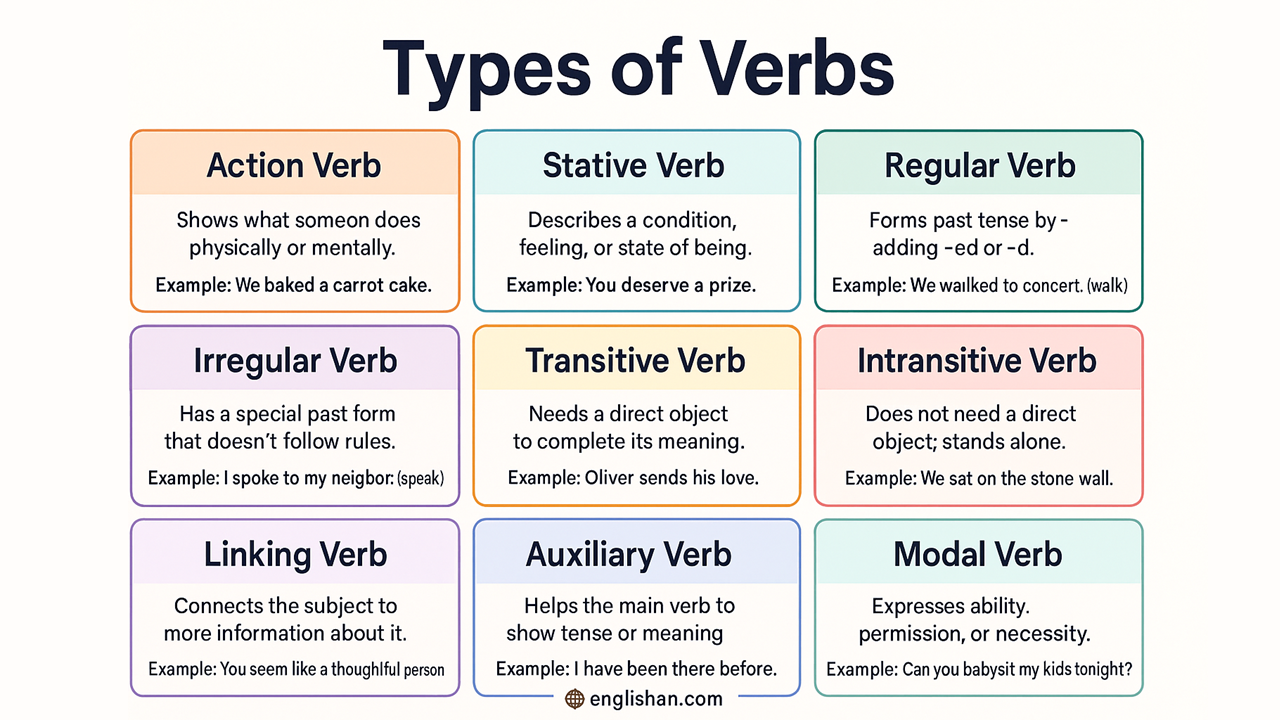
English has twenty types of verbs, and one verb can be several of them at the same time. In She wrote the letter, wrote is a main verb, an action verb, a transitive verb, an irregular verb, and a finite verb.
Which ones a verb takes depends on its meaning, on what it needs after it, and on how it inflects.
Every type below has a definition, the sentences that show it, the mistake it causes, and a test you can run on any verb.
What Is A Verb
A verb is the word that predicates: it states what the subject does, what happens to it, or what state it is in. Every complete sentence requires a finite verb, and that requirement is what separates a sentence from a fragment.
- The engineer replaced the valve.
- The valve failed overnight.
- The pressure is stable now.
Replaced names an action, failed names an event, and is names a state. Action, event, and state are the three situation types behind all twenty.
20 Types Of Verbs In English
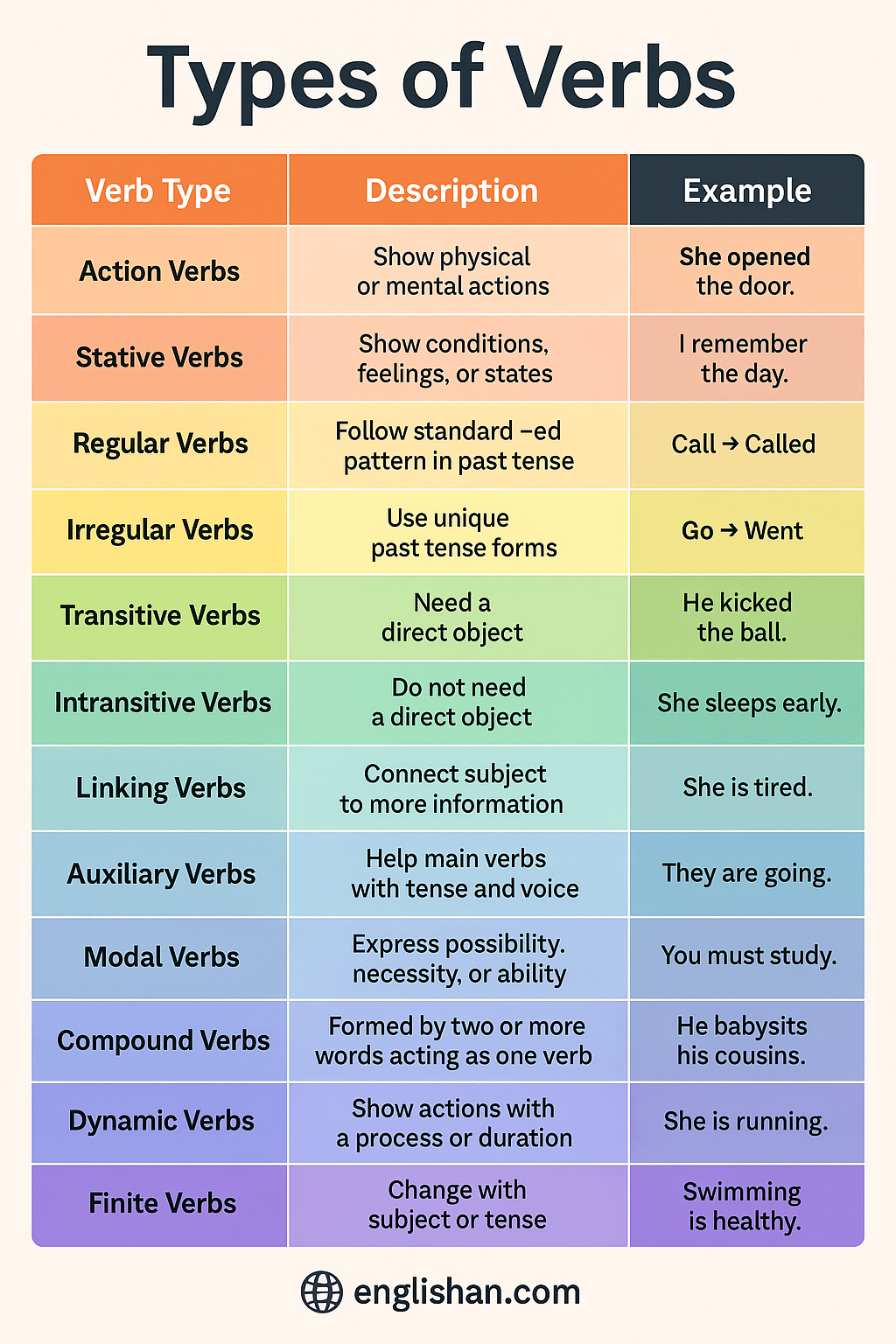
English has twenty named types of verb, and the seven properties below account for all of them.
- Lexical content: Main, auxiliary, modal, and light verbs
- Situation type: Action and stative verbs
- Complementation: Transitive, intransitive, ditransitive, and linking verbs
- Construction: Causative, reflexive, ergative, and catenative verbs
- Past tense inflection: Regular and irregular verbs
- Finiteness: Finite and non-finite verbs
- Single or multi-word: Phrasal and prepositional verbs
A verb does not answer to one line and stop. It answers to every line, which is why the same verb is listed under several types of verbs. Each type is taken in turn below, starting with the verb that expresses the meaning of the clause on its own.
Main Verbs
A main verb, also called a lexical verb, names the action or state and heads the predicate on its own. Every clause requires exactly one, and any verb beside it is grammatical rather than lexical.
Examples: run, write, believe, arrive, decide, build, sing, forget.
- She repaired the engine.
- She has been repairing the engine since Monday.
- The committee rejected the proposal.
- The proposal had been rejected twice before.
Each sentence contains one main verb, whatever the number of verb forms around it. In the second and fourth, has, been, and had mark tense and aspect, while repairing and rejected express the meaning.
Has been repairing contains two verb forms beside the main verb. Those two are auxiliaries.
Auxiliary Verbs
An auxiliary verb, also called a helping verb, combines with a lexical verb to build the verb phrase, marking tense, aspect, voice, and question or negative form. English has three primary auxiliaries: be, do, and have.
Examples: is, am, are, was, were, being, been, do, does, did, have, has, had.
- She has finished the report.
- Did she call you?
Has forms the present perfect and did forms the question, while finished and call express the meaning.
| Same word | Auxiliary | Main verb |
|---|---|---|
| Have | She has finished | She has two brothers |
| Do | Did they call? | They did the paperwork |
| Be | She is working | She is an engineer |
Be, do, and have mark when an action happened. Ten more verbs mark how certain or how necessary it is.
Modal Verbs
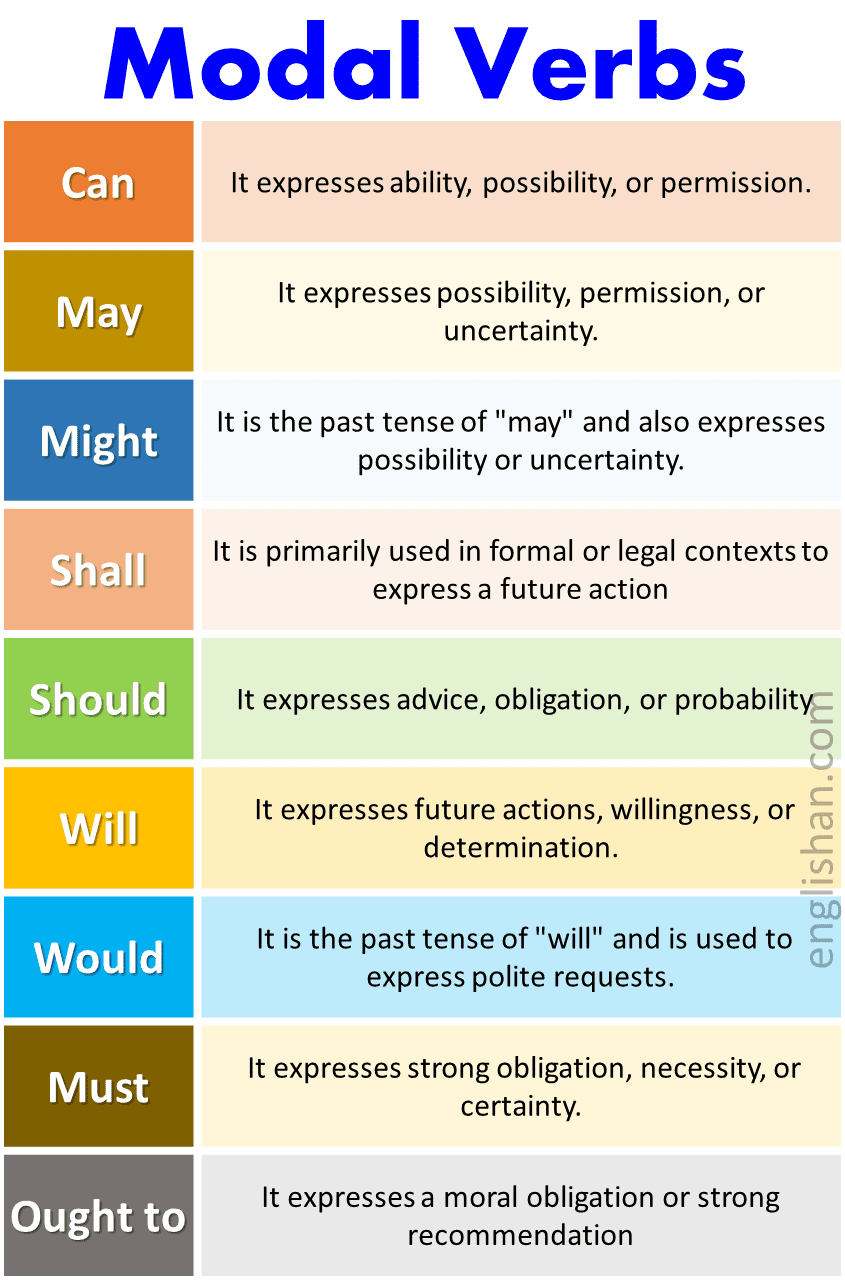
A modal verb expresses modality, the speaker’s judgement of how possible, how necessary, or how permitted something is, and it names no action of its own. Modals are a closed class of ten, with one form for every subject and a bare infinitive after them.
Examples: can, could, may, might, must, shall, should, will, would, ought to.
- You must submit the form by Friday.
- She can read three languages.
Must states an obligation and can states an ability.
| Wrong ❌ | Right ✅ | Why |
|---|---|---|
| She cans swim | She can swim | A modal never takes -s |
| She must to leave | She must leave | A modal never governs to |
| She will can drive | She will be able to drive | A clause takes one modal |
One modal covers several meanings, since must states obligation in one sentence and near-certainty in another. Modal verbs separates those meanings verb by verb.
A modal adds meaning without naming an action. One more type does the reverse and transfers its meaning to a noun beside it.
Light Verbs
A light verb, also called a delexical verb, has almost no lexical content of its own, and the noun after it expresses the meaning. Make a decision is the delexical equivalent of decide, with make marking tense and agreement alone.
Examples: take a look, have a rest, make a decision, give a talk, do the washing, take a walk.
- She made a decision.
- She made a difficult and unpopular decision.
The second sentence has no one-word equivalent, because adjectives attach to nouns and decide has no place for them. That is why English keeps the longer form.
| Wrong ❌ | Right ✅ |
|---|---|
| Do a mistake | Make a mistake |
| Make homework | Do homework |
| Take a decision quickly | Make a decision quickly |
Those four types differ in lexical content. The next property is situation type: what kind of event or state the verb denotes.
Action Verbs
An action verb, also called a dynamic verb, denotes an event that unfolds over time, physically or mentally. Because the event has internal stages, a dynamic verb takes the progressive freely.
Examples: jump, throw, consider, calculate, write, listen, build, decide.
- The technician calibrated the sensor.
- The technician was calibrating the sensor when the alarm sounded.
The second sentence is grammatical because calibration has internal stages, and was calibrating is the form English uses to describe an event from inside it.
The mental verbs are where readers hesitate, since consider, calculate, and decide involve nothing visible. Put the verb into is -ing rather than judging by meaning, since She is considering the offer is grammatical and settles the case. Action verbs in English grammar takes the type further by meaning.
Other verbs are ungrammatical in the progressive, and they form the second half of this property.
Stative Verbs
A stative verb denotes a state rather than an event: a condition, a possession, a relation, an emotion, or an act of perception. A state has no internal stages, so stative verbs resist the progressive, and that single fact accounts for every restriction on the type.
Examples: know, believe, own, belong, seem, prefer, contain, resemble.
- She owns three properties.
She is owning three properties is ungrammatical, because ownership has no internal stages.
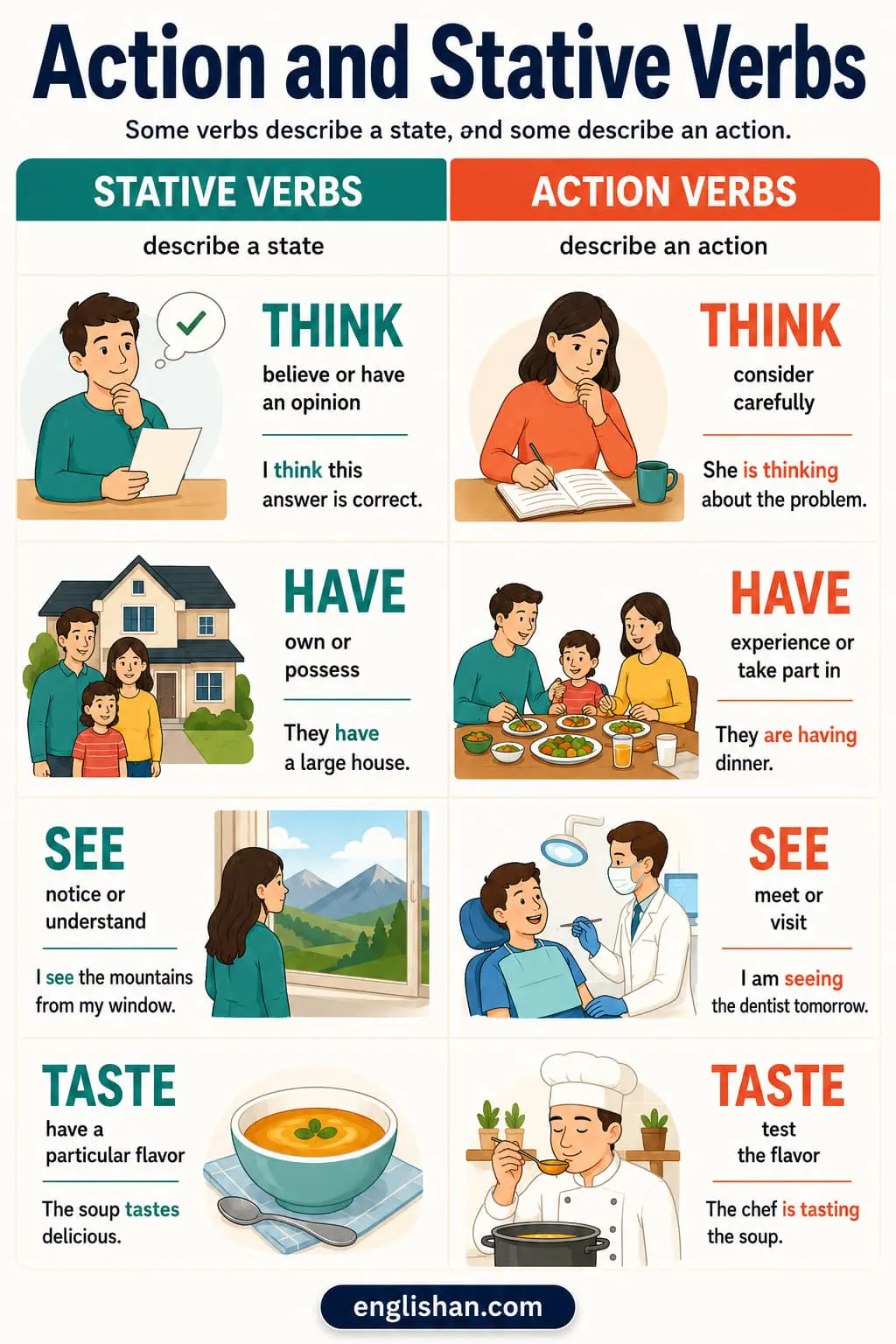
Dozens of verbs take both readings, and the intended meaning identifies which one applies. Stative and dynamic verbs pairs the two meanings for each verb that takes both.
| Verb | Stative meaning | Action meaning |
|---|---|---|
| Think | I think you are right | I am thinking about the offer |
| Have | She has a car | She is having lunch |
| See | I see the problem | I am seeing the dentist |
| Taste | The soup tastes salty | She is tasting the soup |
Situation type divides verbs into dynamic and stative. The next property is complementation: what the verb requires after it.
Transitive Verbs
A transitive verb takes a direct object as its complement, and the object completes the verb’s meaning. Transitivity is a property of the verb rather than of one sentence, since break implies something broken whether you name it or not.
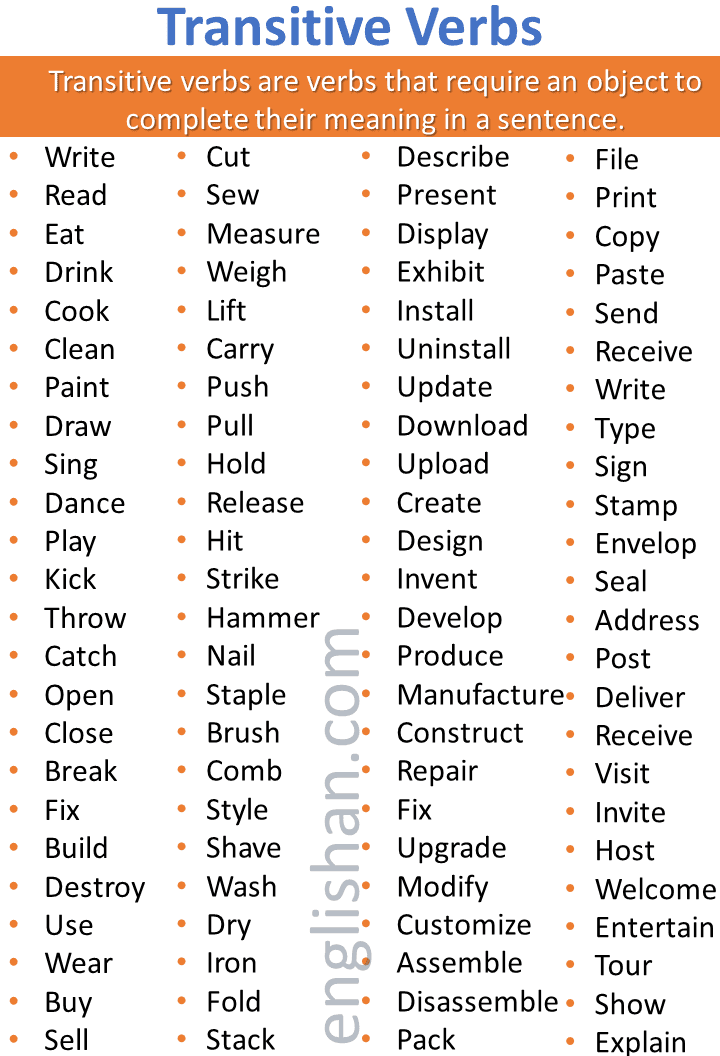
Examples: buy, send, break, need, describe, carry, produce, mention.
- He broke the window.
He broke is incomplete, because broke requires an answer to what? The noun that answers what? or whom? straight after the verb is the direct object. Transitive and intransitive verbs treats the verbs whose object requirements differ between English and other languages.
| Wrong ❌ | Right ✅ | Why |
|---|---|---|
| Discuss about the plan | Discuss the plan | Discuss takes a direct object |
| Explain me the rule | Explain the rule to me | Explain takes to before the person |
A transitive verb needs an object. The next type takes none.
Intransitive Verbs
An intransitive verb takes no object, because the event involves one participant only. Whatever follows it is an adjunct, normally an adverbial of time, place, or manner, rather than a complement.
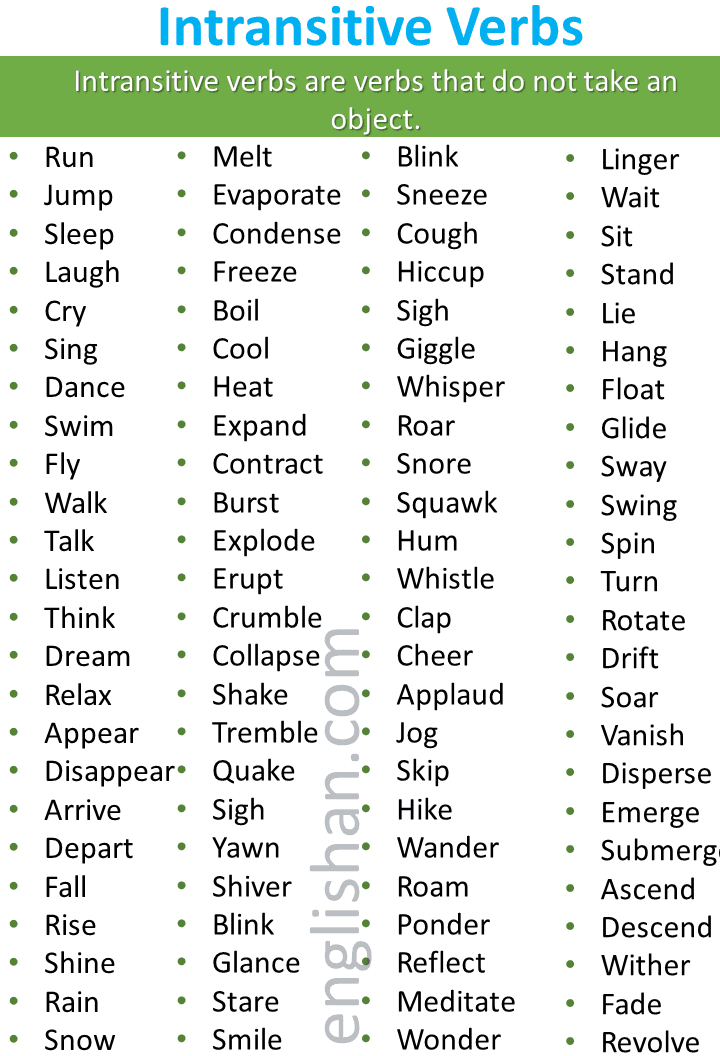
Examples: arrive, sleep, laugh, fall, exist, wait, disappear, rise.
- The train arrived late.
Late answers when and not what, which identifies it as an adverbial. Verbs of motion in many languages take a destination directly, so the missing preposition is the error to expect.
He arrived the station at six. ❌
He arrived at the station at six. ✅
One object or none covers most English verbs. About a dozen take two.
Ditransitive Verbs
A ditransitive verb takes two objects: an indirect object naming the recipient and a direct object naming what is transferred. Verbs of transfer allow the dative alternation, so both object orders are available.
Examples: give, send, offer, tell, lend, show, teach, promise.
- The bank sent the client a statement.
- The bank sent a statement to the client.
Both orders state one event, and a verb that takes both is ditransitive. Not every verb of transfer takes both, and explain, describe, and suggest require to.
Explain me the rule. ❌
Explain the rule to me. ✅
Every object so far names a second participant. The last type on this property takes a subject complement instead.
Linking Verbs
A linking verb, also called a copular verb, links the subject to a subject complement: an adjective that describes it or a noun that renames it. A subject complement refers back to the subject, and an object never does.
Examples: be, seem, appear, become, feel, look, sound, taste, smell, remain.
- The soup tastes delicious.
- She tasted the soup.
Delicious describes the soup and receives no action, so tastes is linking in the first sentence. The second names a real action, so the same verb is transitive there. Put is in place of the verb and the difference is immediate: The soup is delicious is grammatical, and She is the soup is not. The substitution applies to all ten, and linking verbs tests each one.
| Wrong ❌ | Right ✅ | Why |
|---|---|---|
| She feels badly about it | She feels bad about it | A complement takes an adjective |
| The music sounds loudly | The music sounds loud | Sounds describes the music |
| He remained silently | He remained silent | Remained renames the subject |
Four types turn on complementation. Four more turn on the construction a verb imposes on the clause, beginning with causatives.
Causative Verbs
A causative verb expresses that the subject causes another participant to act. English has no causative affix, so a small set of verbs expresses causation, and each one governs a fixed complement after its object: a bare infinitive or a to infinitive.
Examples: make, have, let, get, help, cause, force, allow.
- The editor had the writer revise the draft.
The editor revised nothing; the writer did, and had names only the person who caused it. Causative verbs takes each verb in the set with more sentences.
| Causative verb | Verb form after the object | Example |
|---|---|---|
| Make, have, let | Bare infinitive | She let him borrow it |
| Get, force, allow | To infinitive | She got him to borrow it |
| Help | Either | She helped him borrow it |
The manager got the team revise the plan. ❌
The manager got the team to revise the plan. ✅
A causative verb assigns the action to somebody other than the subject. The next type returns it to the subject.
Reflexive Verbs
A reflexive verb takes a reflexive pronoun as its object, and that pronoun refers back to the subject, so the action returns to whoever performed it. English marks reflexivity on the pronoun with -self, never on the verb.
Examples: hurt oneself, enjoy oneself, blame oneself, teach oneself, help oneself, pride oneself.
- She taught herself Arabic.
Herself names the same person as she, and that identity is the whole definition. French, Spanish, and Italian mark washing, dressing, and shaving as reflexive, so speakers of those languages add pronouns English drops.
I washed myself and dressed myself. ❌
I washed and dressed. ✅
Reflexive verbs keep the subject and the object the same. The next type lets the object become the subject.
Ergative Verbs
An ergative verb alternates between transitive and intransitive use with no change of form. The direct object of the transitive use becomes the subject of the intransitive use, since the verb names a change of state that English expresses with or without its cause.
Examples: break, open, close, boil, melt, start, increase, sink.
- The engineer opened the valve.
- The valve opened.
- The heat melted the seal.
- The seal melted.
- The technician started the pump.
- The pump started.
In every pair the object of the first sentence is the subject of the second, and the verb is identical in both. English uses the shorter form whenever no cause is named, where many languages require a passive or a reflexive.
An ergative verb changes which noun becomes the subject. The last construction changes what follows the verb.
Catenative Verbs
A catenative verb takes a non-finite verb as its complement, either a to infinitive or an -ing form, with no conjunction between them. Catenatives chain without limit, and She seems to want to keep trying to finish places five verbs in a row.
Examples: want, hope, avoid, manage, keep, decide, promise, refuse, enjoy, seem.
- She decided to resign.
- He avoided answering.
No rule predicts which verb takes which form, so each verb is learned together with the form after it, as a noun is learned together with its preposition. Hope, plan, and promise take the infinitive; avoid, finish, and deny take the -ing form, and gerund and infinitive rules lists which verbs take which.
| Wrong ❌ | Right ✅ | Why |
|---|---|---|
| She decided resigning | She decided to resign | Forward in time takes the infinitive |
| He avoided to answer | He avoided answering | Already started takes the -ing form |
| They managed finishing | They managed to finish | Forward in time takes the infinitive |
Those four turn on construction. The next property is inflection: how a verb forms its past tense.
Regular Verbs
A regular verb forms its past simple and past participle with the -ed inflection on the base form. -Ed is the productive suffix in English, which is why googled, texted, and streamed were regular from the day they were coined.
Examples: walk, play, finish, decide, open, watch, cover, arrive.
- They finished the audit yesterday.
Finish becomes finished in both past forms, as almost every English verb does. The errors here are spelling errors rather than grammar errors.
| Spelling rule | Base form | Past form |
|---|---|---|
| Double the final consonant after a short stressed vowel | Stop | Stopped |
| Change y to i after a consonant | Study | Studied |
| Add -d only after a silent e | Hope | Hoped |
The -ed ending has three pronunciations, and the spelling never changes with them. Regular verbs treats each adjustment with more examples.
- Walked, stopped, and watched end in a t sound
- Played, covered, and arrived end in a d sound
- Wanted, decided, and needed add a syllable, id
Most English verbs take -ed. The few hundred that do not are the verbs you use every day.
Irregular Verbs
An irregular verb forms its past simple or its past participle without -ed, in most cases by a vowel change inside the base. About two hundred are in daily use, and each one is learned in its three principal parts.
Examples: go, went, gone. See, saw, seen. Write, wrote, written. Cut, cut, cut.
- She wrote the specification last month.
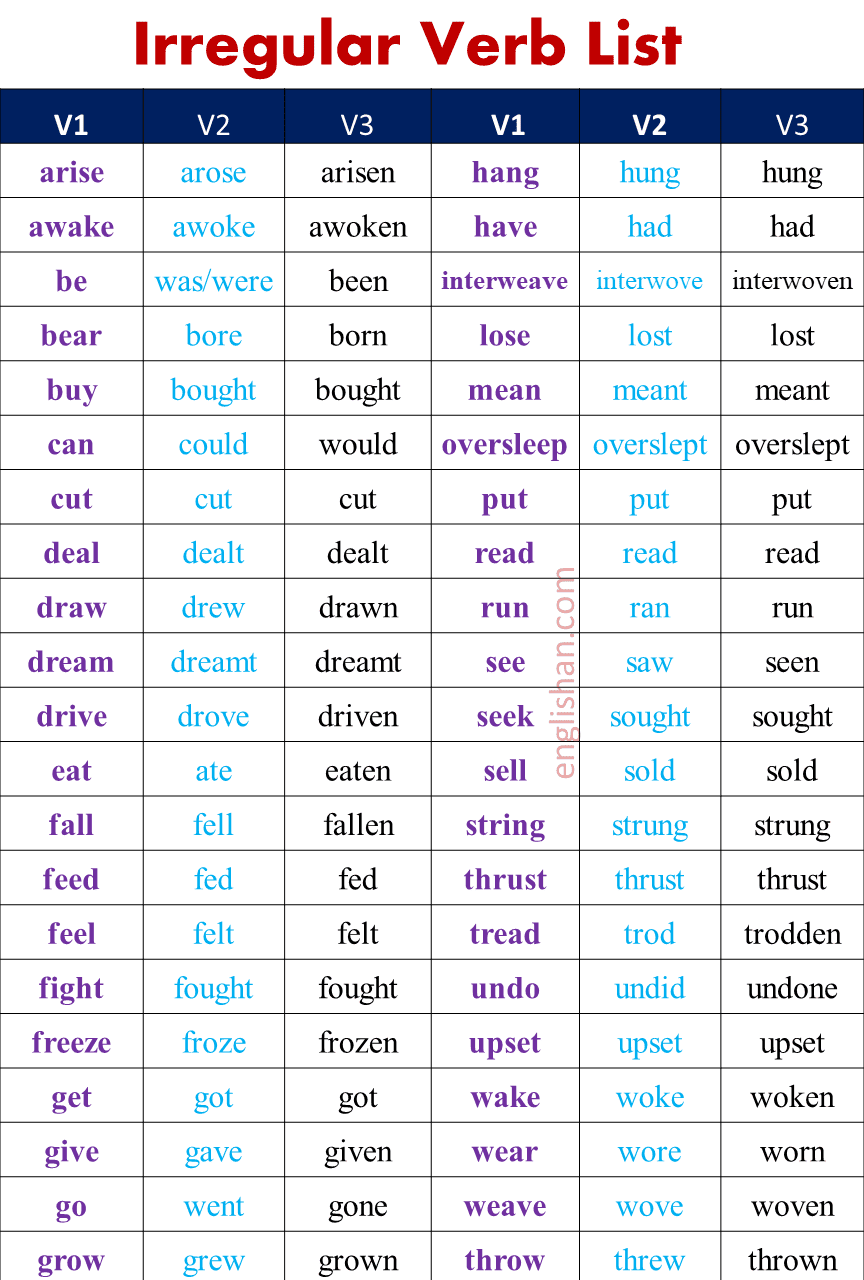
Learn them in families rather than one at a time, because the vowel change repeats across whole groups.
| Family | Base | Past simple | Past participle |
|---|---|---|---|
| i, a, u | Sing, ring, drink | Sang, rang, drank | Sung, rung, drunk |
| i, o, i + en | Write, drive, ride | Wrote, drove, rode | Written, driven, ridden |
| No change | Cut, put, let | Cut, put, let | Cut, put, let |
The participle is where the errors appear, since knowing wrote does nothing for the third form. After has, have, had, or a passive, the third form is the one required, and irregular verbs sets out the common two hundred in all three columns.
She has wrote it. ❌
She has written it. ✅
Both types here answer how a verb inflects for the past. The next property is finiteness: whether the verb is marked for tense at all.
Finite Verbs
A finite verb is marked for tense and agrees with its subject in person and number. Every independent clause requires one, since tense and agreement are what allow a clause to assert something you can call true or false.
Examples: writes, wrote, is, was, has, had, goes, went.
- She writes for two journals.
Writes shows present tense and agrees with the singular she. This property explains the fragment, the error readers detect without naming.
The engineer working on the valve. ❌
The engineer was working on the valve. ✅
Working shows no tense and agrees with no subject, so the first string names a person and describes her without asserting anything. Change the subject to they and a finite verb changes with it. Verb conjugation shows the same agreement across every tense.
A finite verb shows tense. Three verb forms show none, and you use all three constantly.
Non-Finite Verbs
A non-finite verb is unmarked for tense and takes no subject agreement. English has three non-finite forms: the infinitive, the -ing participle or gerund, and the -ed participle. Because they are unmarked for tense, one event can be embedded in another without restating when it happened.
Examples: to write, writing, written, to go, going, gone.
- She hopes to publish next year.
- Running improves circulation.
The finite verbs hopes and improves mark the tense of each sentence, while to publish and running change for no subject.
Reviewing the data, the conclusion changed. ❌
Reviewing the data, the analyst changed her conclusion. ✅
A participle names no subject of its own, so a reader attaches it to the subject of the main clause. The first sentence therefore states that the conclusion did the reviewing. Read every opening participle against the noun after the comma, and rewrite the sentence if that noun performed no action. Finite and non-finite verbs takes the three forms one at a time.
Finiteness accounts for two types. The last property is whether the verb is a single word or a multi-word verb.
Phrasal Verbs
A phrasal verb combines a verb with an adverb particle to form one lexical unit, and its meaning is idiomatic rather than literal. The particle is not a preposition, which is why give up means stop trying and has no connection to give.
Examples: give up, look after, put off, run into, take over, break down, call off, bring up.
- The committee called off the meeting.
Called off means cancelled, a sense neither call nor off conveys. The meaning of a phrasal verb cannot be derived from its parts, so each one is learned as a unit. Separable and inseparable phrasal verbs shows which verbs allow the split.
| Object | Order allowed |
|---|---|
| Full noun | Called off the meeting, or called the meeting off |
| Pronoun | Called it off only |
She called off it. ❌
She called it off. ✅
A particle changes what the verb means. A preposition leaves the meaning alone.
Prepositional Verbs
A prepositional verb combines a verb with a dependent preposition, and the verb keeps its literal meaning. The preposition is governed by the verb rather than chosen by the sense of the sentence, which is why the pairing has to be memorised.
Examples: depend on, listen to, believe in, apply for, refer to, consist of, rely on, insist on.
- The result depends on the sample size.
Depends on means what depend means, with on fixed by convention. The wrong preposition is the error, and it arrives from a first language.
| Wrong ❌ | Right ✅ | Source of the error |
|---|---|---|
| Depend of the result | Depend on the result | French dépendre de |
| Listen the radio | Listen to the radio | English requires the preposition |
| Discuss about the plan | Discuss the plan | English requires none |
All twenty types of verbs are now covered. A single verb, though, rarely answers to only one of them.
How Verb Types Overlap
A verb is not assigned one type. It is tested against every property, and each test returns a type that is true at the same time as the rest.
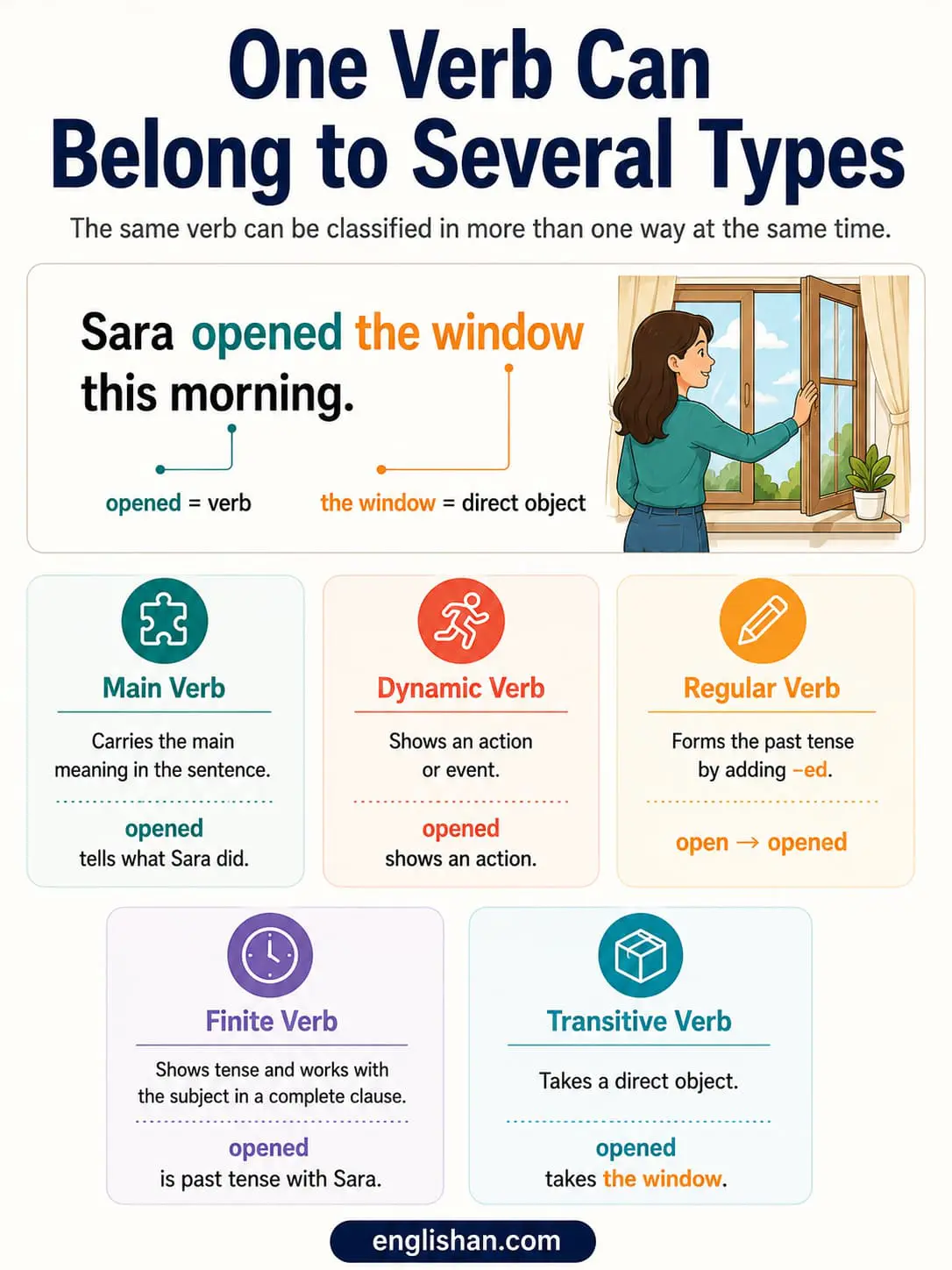
Take gave in The manager gave the team new targets. It expresses the full lexical meaning of the clause, so it is a main verb. It names something the manager did, so it is an action verb. It takes the team and new targets, so it is ditransitive. Its past is gave and not gived, so it is irregular, and it shows past tense, so it is finite.
Five types apply to one word in one sentence, and none competes with the others. Move the same verb into Giving is quick and two of them change, since giving shows no tense and takes no object.
Identification therefore requires testing every property in turn.
How To Identify Verb Types In Sentences
Test the seven properties in order and each one returns a type. The result is seven answers rather than one name.
Step 1, lexical content: is the verb the only one the clause requires? A main verb is. An auxiliary and a modal are not, and a light verb transfers its meaning to the noun beside it.
Step 2, situation type: put the verb into is -ing. A natural result returns an action verb, and an impossible one returns a stative verb.
Step 3, complementation: count what comes after. Nothing means intransitive, one object means transitive, two objects mean ditransitive, and a word describing the subject means linking.
Step 4, construction: does the verb require a particular form after it? Somebody else acting means causative, an object naming the subject means reflexive, an object that also occurs as the subject means ergative, and a second verb straight after means catenative.
Step 5, past tense inflection: form the past. An -ed ending means regular.
Step 6, finiteness: change the subject. A verb that changes with it is finite.
Step 7, single or multi-word: count the words. A particle that changes the meaning means phrasal, and a fixed preposition means prepositional.
Apply all seven to this sentence:
- The supervisor let the trainee finish the shift.
| Step | Answer | Reason |
|---|---|---|
| 1. Lexical content | Main | Let is the only verb the clause requires |
| 2. Situation type | Action | Was letting is natural |
| 3. Complementation | Transitive | The trainee is the object |
| 4. Construction | Causative | The supervisor finished nothing |
| 5. Past tense inflection | Irregular | The past of let is let |
| 6. Finiteness | Finite | They let changes from he lets |
| 7. Single or multi-word | Single | No particle, no preposition |
Some pairs remain confusable even after seven answers. Set side by side, the difference is immediate.
Types Of Verbs Compared
Action Verbs Or Linking Verbs
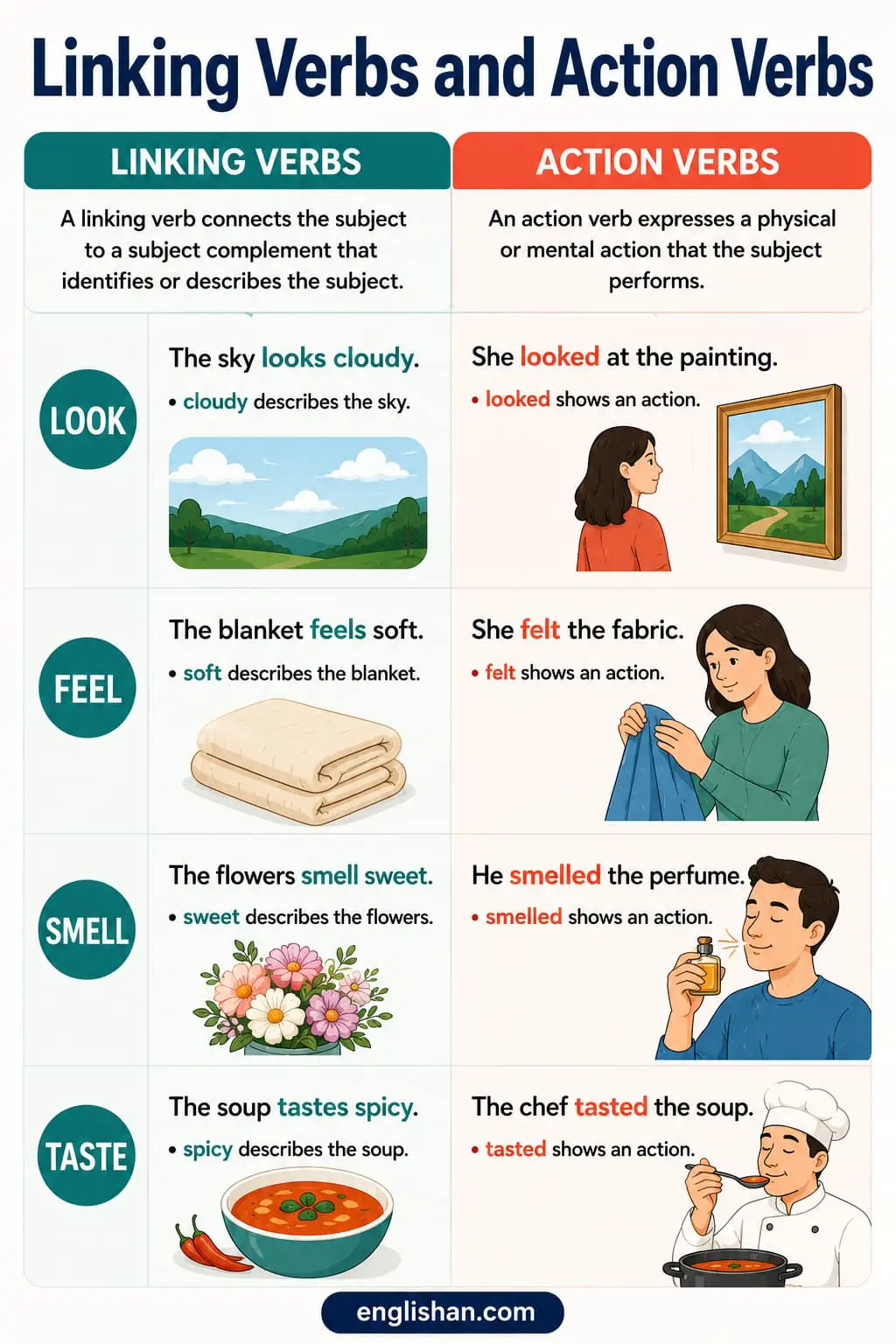
Several verbs occur as either, and the word after them identifies which.
| Action verb | Linking verb | |
|---|---|---|
| What follows | An object or nothing | A word describing the subject |
| The is swap | Fails | Works |
| Example | She tasted the soup. | The soup tasted salty. |
Phrasal Verbs Or Prepositional Verbs
Both pair a verb with a small word, and only one changes the meaning.
| Phrasal verb | Prepositional verb | |
|---|---|---|
| Second word | Particle | Preposition |
| Meaning | Changes | Stays literal |
| Object placement | Between the two parts is allowed | Never between |
| Example | She called off the meeting. | She relies on her notes. |
Auxiliary Verbs Or Main Verbs
Be, do, and have occur as both, and a second verb beside them identifies which.
| Auxiliary | Main verb | |
|---|---|---|
| Another verb present | Yes | No |
| Expresses the meaning | No | Yes |
| Example | She has finished. | She has two brothers. |
Finite Verbs Or Non-Finite Verbs
The subject test separates these two in a second.
| Finite | Non-finite | |
|---|---|---|
| Shows tense | Yes | No |
| Changes with the subject | Yes | No |
| Occurs alone in a clause | Yes | No |
| Example | He writes daily. | He hopes to write daily. |
Those four pairs account for most of the confusion between types of verbs. Three further errors cut across every type.
Common Mistakes With Verb Types
Agreeing the verb with the nearest noun: a finite verb agrees with the head of the subject, not with a noun inside the phrase that follows it. Drill the rule with these subject verb agreement worksheets.
The list of approved suppliers are attached. ❌
The list of approved suppliers is attached. ✅
Marking the past twice: did already marks the past, so the verb after it returns to the base form.
She didn’t went to the meeting. ❌
She didn’t go to the meeting. ✅
Shifting tense inside one sentence: two finite verbs describing one event remain in the same tense.
He walked in and sits down. ❌
He walked in and sat down. ✅
Twenty types, seven properties, and one test each cover the whole of English. That total needs one more word, because you will meet lower figures.
How Many Types Of Verbs Are There
English has twenty named types of verb. A count of three, eight, or eleven describes the same verbs and stops at an earlier property, so the lower figures leave types out rather than contradicting the higher ones.
Three is the count you meet first: action verbs, linking verbs, and helping verbs. Those three parse an ordinary sentence, which is why most classroom teaching stops there. Counting lexical content raises the figure to four, since modal and light verbs join main and auxiliary. Action and stative make six. Complementation makes ten, and the four constructions make fourteen. Past tense inflection, finiteness, and multi-word status account for the last six.
No figure below twenty is wrong, and each one stops earlier. The chart below lists all twenty.
Types Of Verbs Chart
| Type | Property | What defines it | Example |
|---|---|---|---|
| Main | Lexical content | The only verb the clause requires | She wrote it. |
| Auxiliary | Lexical content | Marks tense with a main verb | She has written. |
| Modal | Lexical content | States certainty or necessity | She must write. |
| Light | Lexical content | Transfers the meaning to a noun | She made a decision. |
| Action | Situation type | Names something done | She jumped. |
| Stative | Situation type | Names a condition | She knows it. |
| Transitive | Complementation | Takes one object | She broke it. |
| Intransitive | Complementation | Takes no object | She arrived. |
| Ditransitive | Complementation | Takes two objects | She gave him it. |
| Linking | Complementation | Takes a complement | She seems tired. |
| Causative | Construction | Somebody else acts | She had him wait. |
| Reflexive | Construction | Object names the subject | She hurt herself. |
| Ergative | Construction | Object becomes the subject | The door opened. |
| Catenative | Construction | Takes a second verb | She hopes to go. |
| Regular | Past tense inflection | Past takes -ed | She walked. |
| Irregular | Past tense inflection | Past takes another route | She went. |
| Finite | Finiteness | Shows tense | She writes. |
| Non-finite | Finiteness | Shows no tense | Writing helps. |
| Phrasal | Multi-word | Particle changes the meaning | She gave up. |
| Prepositional | Multi-word | Preposition stays literal | She relies on it. |
Read the middle columns rather than the names, since complementation identifies a verb faster than its meaning does.
Types Of Verbs Exercises
Name which of the types of verbs each bolded verb takes, on the property given in brackets. More practice is in these verbs worksheets and verb patterns exercises.
- The kettle boiled dry. (construction)
- She believes every word. (situation type)
- They sent the office a parcel. (complementation)
- He had the mechanic check the brakes. (construction)
- The audience laughed. (complementation)
Answers: ergative, stative, ditransitive, causative, intransitive.
Decide whether the bolded verb is an auxiliary or a main verb.
- She has two degrees.
- She has completed the course.
- They did the paperwork.
- Did they call?
- He is an engineer.
Answers: main, auxiliary, main, auxiliary, main.
Decide whether each pair is a phrasal verb or a prepositional verb.
- put off
- depend on
- look after
- consist of
- call off
Answers: phrasal, prepositional, phrasal, prepositional, phrasal.
Correct each sentence.
- The train arrived the platform late.
- She let him to borrow the manual.
- He is knowing the answer.
- They relied their supplier on completely.
- She avoided to answer the question.
Answers: arrived at the platform. Let him borrow. He knows the answer. Relied on their supplier. Avoided answering.
FAQs
Common verb types include main verbs, action and stative verbs, linking verbs, auxiliary and modal verbs, transitive and intransitive verbs, regular and irregular verbs, finite and non-finite forms, and phrasal verbs. These groups overlap because they classify verbs from different grammatical angles.
English does not have one universally fixed number of verb types. Some lessons count three or four broad functional groups, while others count more than ten categories based on meaning, form, objects, and structure.
Yes. In “She wrote a letter,” wrote is a main, dynamic, irregular, finite, and transitive verb. Each label describes a different feature of the same verb.
A common beginner model uses action verbs, linking verbs, helping verbs, and modal verbs. This model is useful for sentence function, but it does not include other classifications such as transitivity, regularity, or finite form.
A main verb carries the central meaning, while a helping verb supports it by forming tense, aspect, voice, questions, negatives, or modality. In “She has arrived,” arrived is the main verb and has is the helping verb.
Look for a direct object that answers “what?” or “whom?” after the verb. In “They repaired the road,” the road is the direct object, so repaired is transitive.
Be can perform either function. It is linking in “The room is quiet,” where quiet describes the subject. It is auxiliary in “The team is working,” where it helps form the progressive verb phrase.
A finite verb carries tense and can anchor a clause. A non-finite form does not show tense, person, or number by itself. Infinitives, -ing forms, and past participles are common non-finite forms.
Phrasal verbs are best treated as multiword verbs made from a verb and one or more particles. The label compound verb is used inconsistently, so it should not be used as the main parent category for all verb phrases and phrasal verbs.
The most reliable way to identify verb types is to examine meaning, function, objects, and form together. A correct classification explains how the verb works in that sentence instead of assigning a permanent label to the word.
You May Also Like
- 200 Action Verbs in English
- 100 Stative Verb Example Sentences
- Passive Voice with Modal Verbs: Rules and Examples