


A regular verb is a verb that forms its past tense and past participle by adding -ed or -d to the base form. Walk becomes walked. Love becomes loved. Study becomes studied. The suffix stays the same across every regular verb in English, which makes the class the most predictable in the language.
What Is a Regular Verb?
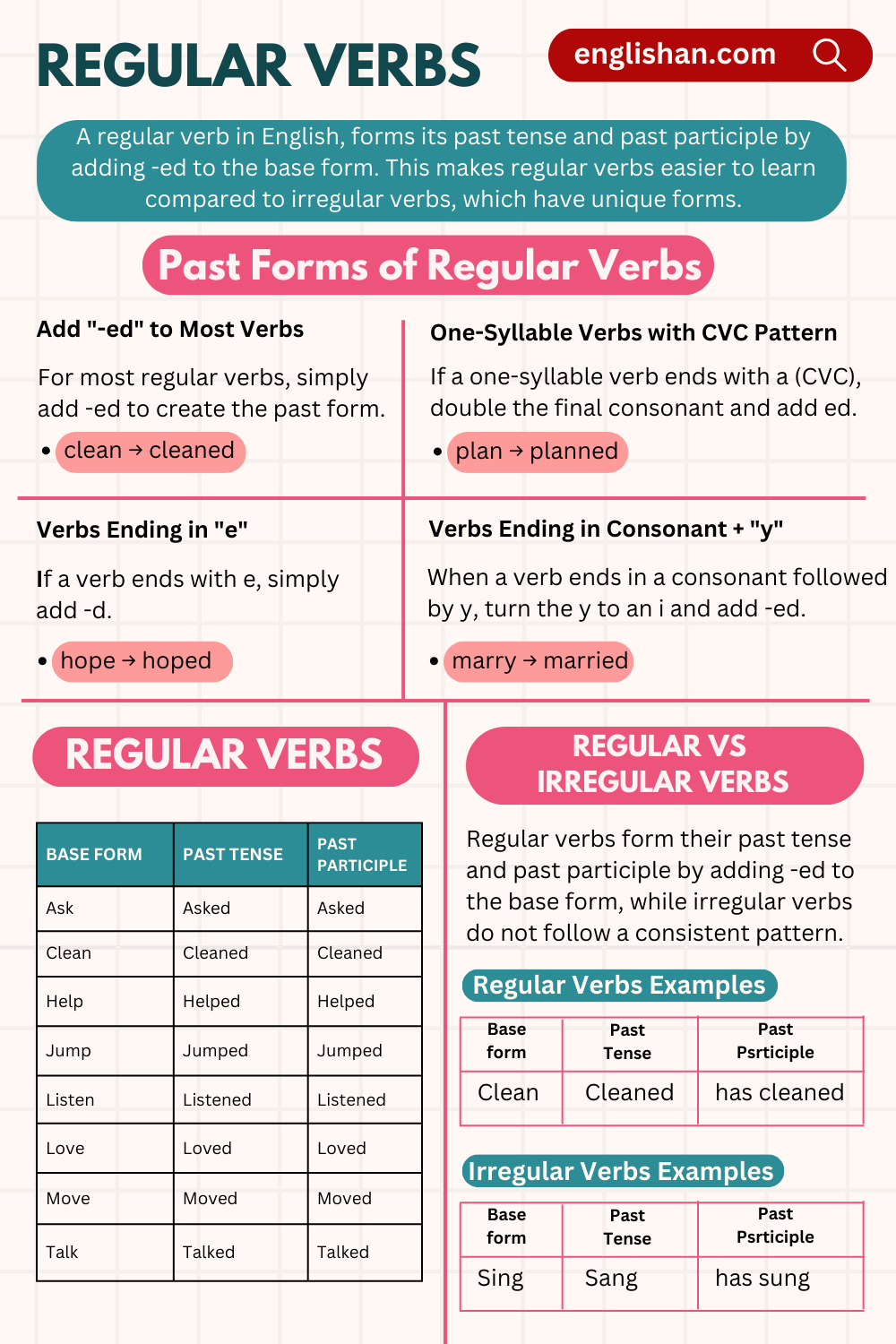
A regular verb takes the standard past-tense marker of English: -ed for consonant-ending verbs and -d for verbs already ending in -e. The suffix does two jobs at once. It marks the simple past tense (She walked home yesterday) and the past participle (She has walked home before). The two forms are identical for every regular verb.
Every regular verb has five forms in total.
- Base form: walk, love, study, plan.
- -s form (third-person singular present): walks, loves, studies, plans.
- Past tense: walked, loved, studied, planned.
- -ing form (present participle): walking, loving, studying, planning.
- Past participle: walked, loved, studied, planned.
The past tense and the past participle are always the same in a regular verb. That single fact is the defining rule of the class.
Some verbs accept both a regular and an irregular past form, and the choice depends on dialect. Burned and burnt, learned and learnt, dreamed and dreamt, spilled and spilt all appear in edited prose. American English favours the regular form (burned, learned, dreamed). British English preserves the irregular form (burnt, learnt, dreamt) for many of these verbs. Both are correct.
Spelling Rules for Adding -ed
Seven rules cover every regular verb. The right rule depends on the final letters of the base form.
Rule 1: Add -ed to Most Verbs
Most regular verbs take -ed with no other change: ask → asked, walk → walked, watch → watched, jump → jumped, play → played.
Rule 2: One-Syllable CVC Verbs Double the Final Consonant
When a one-syllable verb ends in a consonant-vowel-consonant sequence, double the final consonant before adding -ed: stop → stopped, plan → planned, beg → begged, hop → hopped, chat → chatted.
Rule 3: Verbs Ending in w, x, or y Do Not Double
The consonants w, x, and y are the exceptions to Rule 2. They never double, even in a one-syllable CVC verb: fix → fixed, snow → snowed, play → played.
Rule 4: Stressed Last Syllable in Longer CVC Verbs Doubles
When a two-syllable verb ends in CVC and the stress falls on the last syllable, double the final consonant: prefer → preferred, admit → admitted, permit → permitted, occur → occurred.
Rule 5: Unstressed Last Syllable Does Not Double
When the stress does not fall on the final syllable, do not double: open → opened, offer → offered, listen → listened, happen → happened.
Rule 6: Verbs Ending in -e Take Only -d
If the base form already ends in -e, add only -d: love → loved, hope → hoped, arrive → arrived, live → lived, decide → decided.
Rule 7: Consonant + y Changes to i + -ed
When a verb ends in a consonant plus y, change the y to i before adding -ed: study → studied, try → tried, carry → carried, worry → worried, apply → applied. The rule does not apply when the y follows a vowel: play → played, enjoy → enjoyed, stay → stayed. Vowel + y verbs follow Rule 1.
Summary Reference
| Rule | Ending of the base verb | Action | Sample |
|---|---|---|---|
| 1 | Most verbs | Add -ed | Walk → walked |
| 2 | One-syllable CVC | Double the final consonant + -ed | Stop → stopped |
| 3 | Ends in w, x, y | Add -ed with no doubling | Play → played |
| 4 | CVC with stressed last syllable | Double the final consonant + -ed | Prefer → preferred |
| 5 | CVC with unstressed last syllable | Add -ed with no doubling | Open → opened |
| 6 | Ends in -e | Add only -d | Love → loved |
| 7 | Consonant + y | Change y to i + -ed | Study → studied |
How to Pronounce -ed: Three Sounds
The written -ed suffix is a single spelling, but English pronounces it in three distinct ways. The right sound depends on the last sound of the base verb, not the last letter. Pronunciation of -ed depends on the sound at the end of the base verb, not the spelling.
/ɪd/ (sounds like “id”)
Use /ɪd/ when the base verb ends in t or d. The suffix becomes an extra syllable: want → wanted (wan-tid), need → needed (nee-did), start → started (star-tid), decide → decided (deci-did).
/t/ (sounds like “t”)
Use /t/ when the base verb ends in a voiceless consonant (p, k, f, s, sh, ch, x). The suffix does not add a syllable: walk → walked (walkt), hope → hoped (hopt), laugh → laughed (lafft), wish → wished (wisht), watch → watched (wotcht).
Voiceless consonants are made with no vibration in the vocal cords. Place two fingers on your throat, say sss, and feel the silence. That is voiceless.
/d/ (sounds like “d”)
Use /d/ when the base verb ends in a voiced consonant (b, g, l, m, n, r, v, z) or a vowel sound: play → played (playd), love → loved (lovd), open → opened (oh-pnd), study → studied (stu-deed), agree → agreed (a-greed).
Voiced consonants and vowels use the vocal cords. Place two fingers on your throat, say zzz, and feel the buzz.
The three-way split applies to every regular verb in English.
Regular Verbs vs Irregular Verbs
Regular verbs form the past by adding -ed or -d. Irregular verbs form the past through some other mechanism: a vowel shift (sing → sang), a full stem change (go → went), a dental ending with vowel change (feel → felt), or no change at all (cut → cut).
| Feature | Regular verb | Irregular verb |
|---|---|---|
| Past-tense marker | -ed or -d suffix | Vowel change, full stem change, dental + vowel change, or no change |
| Past participle | Same as past tense | Distinct past participle for verbs like drive → drove → driven |
| Predictability | Fully predictable | Must be memorised one by one |
| Modern share | Vast majority | Roughly 200 verbs |
| Direction of drift | Growing class | Shrinking class |
| Weak-verb equivalent | Every regular verb is weak | Some irregular verbs are weak (feel, keep); some are strong (sing, drink) |
Three paired sentences show the split.
She walked home yesterday. (regular; -ed suffix) She sang the aria last night. (irregular; vowel change) She has driven the car home before. (irregular; -en past participle)
Some verbs accept both a regular and an irregular form, and the choice depends on dialect: burned/burnt, learned/learnt, dreamed/dreamt, spilled/spilt, spoiled/spoilt. American English favours the regular form. British English preserves the irregular for many of these verbs. Both readings are correct.
Regular Verbs Are Weak Verbs
In the traditional Germanic classification of English verbs, regular verbs are called weak verbs. The term comes from nineteenth-century linguistics, where verbs that formed the past by adding a dental suffix (-ed, -d, -t) were named weak and verbs that changed the stem vowel were named strong. The labels were coined by the German philologist Jakob Grimm in the 1810s.
Every regular verb is a weak verb; the two labels describe the same class from two angles. The reverse does not hold. Some weak verbs are irregular. Verbs like feel → felt, keep → kept, and bring → brought take a dental ending (which makes them weak) but change the stem vowel (which makes them irregular). For a full treatment of the weak class, see the weak verbs reference.
Common Regular Verbs
A working set of 40+ regular verbs organised by spelling class.
Rule 1 (plain -ed): ask, call, cook, count, jump, learn, look, need, open, play, rain, start, talk, want, watch, work.
Rules 2 and 4 (doubled final consonant): ban, beg, chat, hop, pat, plan, prefer, refer, stop, admit, permit, occur, control.
Rule 6 (only -d because the base ends in -e): agree, arrive, bake, close, dance, decide, hope, live, love, move, note, save, share, smile, use.
Rule 7 (consonant + y → i + -ed): apply, carry, cry, deny, marry, reply, study, try, worry.
Verbs with dual regular / irregular forms: burn (burned/burnt), dream (dreamed/dreamt), lean (leaned/leant), learn (learned/learnt), smell (smelled/smelt), spell (spelled/spelt), spill (spilled/spilt), spoil (spoiled/spoilt).
Common Mistakes With Regular Verbs
Five errors show up repeatedly in learner writing. Each has a fast fix.
1. Doubling a final consonant that should not double.
- She travled to Paris last year. ❌
- She traveled to Paris last year. ✅ (American English; single -l because travel is unstressed on the last syllable)
- She travelled to Paris last year. ✅ (British English; double -l is the British convention)
2. Missing the y-to-i change.
- He tryed to answer the question. ❌
- He tried to answer the question. ✅
3. Adding an extra e when the base verb already ends in -e.
- She hopeed to arrive early. ❌
- She hoped to arrive early. ✅
4. Doubling w, x, or y.
- He fixxed the leak yesterday. ❌
- He fixed the leak yesterday. ✅
5. Pronouncing -ed as a full syllable where it should fuse with the previous sound. The suffix is pronounced as an extra syllable (wan-tid) only after t or d. After other endings, it fuses with the last sound (walkt, hopt, playd).
- walked pronounced as walk-ed (two syllables) ❌
- walked pronounced as walkt (one syllable) ✅
Quick Reference
- A regular verb forms its past tense and past participle by adding -ed or -d.
- Most English verbs are regular. Only around 200 irregular verbs remain in modern use.
- Seven spelling rules cover the class: plain -ed, doubled consonant, w/x/y no-doubling, stressed CVC doubling, unstressed CVC no-doubling, only -d after -e, y-to-i after a consonant.
- Three -ed pronunciations: /ɪd/ after t or d, /t/ after voiceless consonants, /d/ after voiced consonants and vowels.
- Every regular verb is a weak verb.
- Some verbs (burn, learn, dream, spell) accept both regular and irregular past forms depending on dialect.
FAQs
A regular verb forms its past tense and past participle by adding -ed to the base form, or only -d when the base already ends in -e. Walk becomes walked. Love becomes loved. The past tense and past participle are always the same for a regular verb.
Regular verbs mark the past tense with a -ed or -d suffix. Irregular verbs form the past through some other mechanism: a vowel change (sing → sang), a full stem change (go → went), a dental ending with vowel change (feel → felt), or no change (cut → cut). Regular verbs are predictable; irregular verbs must be memorised one by one.
The suffix takes three distinct pronunciations. After t or d, it becomes /ɪd/ and adds a syllable (wanted, needed). After voiceless consonants (p, k, f, s, sh, ch, x), it becomes /t/ with no extra syllable (walked, hoped). After voiced consonants (b, g, l, m, n, r, v, z) and vowels, it becomes /d/ with no extra syllable (played, loved, studied).
In Germanic linguistics, verbs that form the past by adding a dental suffix (-ed, -d, -t) are called weak verbs, and verbs that change the stem vowel are called strong verbs. The labels were coined by the German philologist Jakob Grimm in the 1810s. Every regular verb is a weak verb; the two labels describe the same class.
Yes. Verbs like burn, learn, dream, spell, spill, spoil, and lean accept both a regular past form (burned, learned, dreamed) and an irregular past form (burnt, learnt, dreamt). American English favours the regular form. British English preserves the irregular for many of these verbs. Both are correct.
Most English verbs are regular. Estimates run to several thousand in active use, with common learner lists teaching between 130 and 600 of the most frequently seen. Only around 200 irregular verbs remain in modern English, so any new verb entering the language (Google, tweet, download, unfriend) joins the regular class by default.
You May Also Like
Regular Verbs Quiz
Regular Verbs
Choose the past form.
The past of 'walk' is ___.
Regular verbs add -ed for the past.
regular verbs add -ed for the past
They walked home.
Which is a regular verb?
'Play' forms its past as 'played'.
regular verbs form the past with -ed
played, not 'goed'
Choose the correct past.
The past of 'study' is ___.
A consonant plus 'y' changes to -ied.
consonant + y -> -ied
She studied all night.
Choose the correct past.
The past of 'stop' is ___.
A short vowel plus single consonant doubles before -ed.
short vowel + single consonant doubles before -ed
The car stopped suddenly.
Which verb is NOT regular?
'Keep' is irregular: keep -> kept.
irregular verbs don't take -ed
keep -> kept
Complete the statement.
For regular verbs, the past and past participle are ___.
Both forms share the same -ed ending, as in walked / have walked.
regular verbs share one -ed form for past and participle
walked (past) / have walked (participle)
Choose the past form.
Yesterday we ___ to the shop.
'Walk' is regular, so its past adds -ed.
regular verbs add -ed in the past
Yesterday we walked to the shop.
Which verb is regular?
Pick the regular verb.
'Play' forms its past with -ed, so it is regular.
regular verbs keep the base and add -ed
She played the piano.
Type the past form of the verb in brackets.
He ___ (study) all weekend.
A verb ending in consonant + y changes the y to i before -ed.
consonant + y -> -ied
He studied all weekend.
True or false?
The past of 'stop' doubles the final consonant: 'stopped'.
A short verb ending in one vowel and one consonant doubles that consonant before -ed.
double the final consonant after a single stressed vowel
The bus stopped at the corner.
Choose the past form.
The porter ___ the heavy bags upstairs.
'Carry' ends in consonant + y, so the y becomes i before -ed.
consonant + y -> -ied
The porter carried the heavy bags upstairs.
Which past form is regular?
Pick the -ed past form.
'Jump' adds -ed, marking it as regular.
regular verbs form the past with -ed
The cat jumped onto the sill.
Choose the past form.
They ___ the kitchen after dinner.
'Clean' is regular, so its past adds -ed.
regular verbs add -ed
They cleaned the kitchen after dinner.
Which verb is regular?
Pick the regular verb.
'Cook' adds -ed, so it is regular.
regular verbs add -ed
She cooked a fine meal.
Type the past form of the verb in brackets.
We ___ (plan) the trip for months.
A short verb ending in one vowel and one consonant doubles that consonant before -ed.
double the final consonant after a single stressed vowel
We planned the trip for months.
Choose the past form.
The child ___ when the balloon burst.
'Cry' ends in consonant + y, so the y becomes i before -ed.
consonant + y -> -ied
The child cried when the balloon burst.
True or false?
'Painted' is a regular past form.
'Paint' adds -ed, so 'painted' is a regular past form.
regular verbs form the past with -ed
She painted the fence white.
Choose the past form.
He ___ for a better result.
A verb ending in a silent -e drops the e before adding -ed.
drop silent -e before -ed
He hoped for a better result.
Which verb is NOT regular?
Find the strong verb.
'Swim' changes its vowel to 'swam', so it is strong, not regular.
strong verbs change the root vowel
She swam across the lake.
Type the past form of the verb in brackets.
He ___ (worry) about the exam all week.
A verb ending in consonant + y changes the y to i before -ed.
consonant + y -> -ied
He worried about the exam all week.
Turn on JavaScript for the interactive quiz. The full practice set is shown above.