

An adverb chart is a table that sorts adverbs by their meaning, their job in the sentence, or their form, with examples in every row. Most adverb charts begin with meaning, because the question an adverb answers is the quickest way to identify its type: how, when, where, how often, how much, or why.
The other charts are lookups: the “-ly” spelling of adverbs formed from adjectives, the comparative and superlative forms, and the time adverbs used with each tense. There are six main types of adverbs by meaning: manner, time, place, frequency, degree, and reason.
An adverb chart lists adverbs by type with the question each type answers: manner (how), time (when), place (where), frequency (how often), degree (how much), and reason (why). Function charts add interrogative, relative, conjunctive, and sentence adverbs. Form charts show the “-ly” spelling (“quick”, “quickly”), comparison (“fast”, “faster”, “fastest”), and the time adverbs used with each tense.
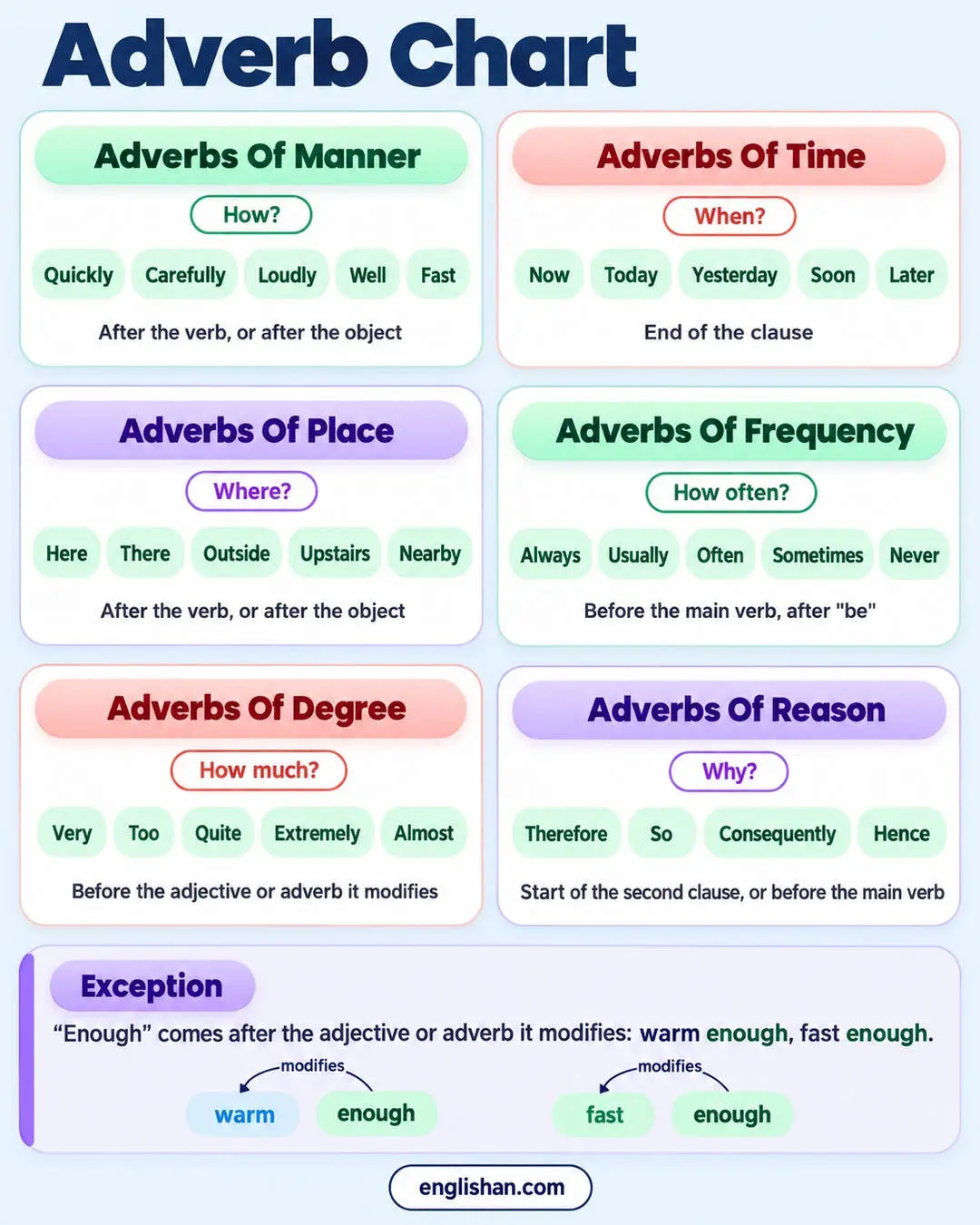
Adverb Chart By Meaning
The meaning of an adverb is the question it answers about the action: how, when, where, how often, how much, or why. The position column gives the usual place in a statement, and adverbs of time and place can also come at the start of the sentence for emphasis.
| Type | Question | Examples | Usual position |
|---|---|---|---|
| Adverbs of manner | How? | Quickly, carefully, loudly, well, fast | After the verb, or after the object |
| Adverbs of time | When? | Now, today, yesterday, soon, later | End of the clause |
| Adverbs of place | Where? | Here, there, outside, upstairs, nearby | After the verb, or after the object |
| Adverbs of frequency | How often? | Always, usually, often, sometimes, never | Before the main verb, after “be” |
| Adverbs of degree | How much? | Very, too, quite, extremely, almost | Before the adjective or adverb it modifies |
| Adverbs of reason | Why? | Therefore, so, consequently, hence | Start of the second clause, or before the main verb |
- The nurse lifted the patient gently. (manner)
- We are flying to Lisbon tomorrow. (time)
- Leave your muddy boots outside. (place)
- My manager rarely replies after six. (frequency)
- This soup is too salty for the children. (degree)
- The roads were icy, and the school therefore closed early. (reason)
The degree row has one exception to its position: “enough” comes after the adjective or adverb it modifies, as in “warm enough” and “fast enough“. The frequency row has the position rule with the most common error: an adverb of frequency goes before the main verb, not after it.
I go always to the gym after work. ❌
I always go to the gym after work. ✅
With the verb “be”, the order reverses, and the adverb of frequency follows the verb: “She is always on time.”
Adverb Chart By Function
An adverb chart by function groups adverbs by the job they do in the sentence rather than by their meaning. An adverb by function begins a question, introduces a clause, links two clauses, or comments on the whole sentence, and its usual position follows from that job.
| Type | Job in the sentence | Examples | Usual position |
|---|---|---|---|
| Interrogative adverbs | Begins a question | How, when, where, why | Start of the question |
| Relative adverbs | Introduces a clause about a noun | Where, when, why | Directly after the noun |
| Conjunctive adverbs | Links the ideas in two clauses | However, therefore, meanwhile, otherwise, instead | After a semicolon or at the start of a sentence |
| Sentence adverbs | Comments on the whole sentence | Fortunately, clearly, honestly, surprisingly | Start of the sentence, followed by a comma |
- Where did you park the car?
- This is the café where we first met.
- The flight was delayed; however, we made the meeting.
- Fortunately, nobody was hurt.
The same word can appear in two rows of an adverb chart. The adverb “where” is an interrogative adverb at the start of a question and a relative adverb after a noun, as in “the town where I grew up”. The meaning chart and the function chart also overlap, since “therefore” is an adverb of reason by meaning and a conjunctive adverb by function.
The flight was delayed, however we made the meeting. ❌
The flight was delayed; however, we made the meeting. ✅
A conjunctive adverb between two complete clauses takes a semicolon before it and a comma after it.
Tense Adverb Chart
A tense adverb chart lists the time adverbs and time phrases that usually appear with each tense. Some entries are phrases rather than single words, such as “last week” and “at the moment”, but they answer the same question as an adverb of time: when? The clearest pairings follow one condition, because a finished time in the past takes the past simple, while a time that continues up to now takes a perfect tense.
| Tense | Time adverbs and phrases |
|---|---|
| Present simple | Every day, usually, often, on Mondays, never |
| Present continuous | Now, right now, at the moment, currently, these days |
| Present perfect | Already, yet, just, ever, never, so far, recently, since 2019, for a week |
| Present perfect continuous | For two hours, since this morning, all day, lately |
| Past simple | Yesterday, ago, last week, in 2020, the other day |
| Past continuous | At that moment, at eight last night, all evening, this time last week |
| Past perfect | Already, just, by then, by that time, never before |
| Past perfect continuous | For an hour, since dawn, all morning, by then |
| Future simple and “going to” | Tomorrow, next week, soon, later, tonight, in an hour |
| Future continuous | This time tomorrow, at noon tomorrow, all day tomorrow |
| Future perfect | By tomorrow, by Friday, by next year, by then |
| Future perfect continuous | For ten years by next June, by the end of the year |
- I have already sent the invoice.
- The courier came two days ago.
- Has the plumber called yet?
- Dad is working from home at the moment.
- By the time we arrived, the guests had already left.
- They have lived in Leeds since 2019.
- We will check in tomorrow afternoon.
Finished time: Adverbs of finished time, such as “yesterday”, “ago”, “last week”, and a past date, describe a time that is over, so they take the past simple and never the present perfect. Adverbs of the current period, such as “today” and “this morning”, take either tense, depending on whether that period is still running when you speak.
I have seen her yesterday. ❌
I saw her yesterday. ✅
The error copies the compound past of French, German, and Italian, which is formed like the present perfect but is used for finished time.
For and since: A time phrase with “since” starts from a point in time, as in “since Monday”, and it takes a perfect tense. A phrase with “for” gives a length of time, as in “for two hours”, and it is used with any tense, so the past simple sentence “I lived in Rome for two years” is correct.
American English: In American English, the past simple with “already”, “just”, and “yet” is common in speech, as in “Did you eat yet?” In British English, the same question takes the present perfect: “Have you eaten yet?”
Adjective And Adverb Chart
Most adverbs of manner are formed by adding “-ly” to an adjective, and the spelling of the adjective sometimes changes before the ending. The spelling change depends on the last letters of the adjective, so the adjective and adverb chart sorts the adjectives by how they end.
| Adjective ending | Spelling rule | Adjectives | Adverbs |
|---|---|---|---|
| Most endings | Add “-ly” | Quick, careful, sad | Quickly, carefully, sadly |
| Consonant + “y” | Change “y” to “i” and add “-ly” | Happy, easy, angry | Happily, easily, angrily |
| Consonant + “le” | Drop the “e” and add “y” | Gentle, simple, terrible | Gently, simply, terribly |
| “-ic” | Add “-ally” | Basic, tragic, automatic | Basically, tragically, automatically |
| “-ue” | Drop the “e” and add “-ly” | True, due | Truly, duly |
| “-ll” | Add “y” | Full, dull | Fully, dully |
The “-ic” row has one common exception, “public”, which becomes “publicly”. The adjective “good” has the irregular adverb “well”, so a good singer sings well.
Some adverbs have the same form as their adjective: “fast”, “hard”, “late”, “early”, “straight”, and “daily”. The position in the sentence shows which word class the form belongs to.
- She is a fast driver. (adjective)
- She drives fast. (adverb)
- The meeting started late. (adverb)
- Our train was late. (adjective)
The hard case among same-form adverbs is the “-ly” form that looks like the adverb but has a different meaning. The word “hardly” means ‘almost not’, and “lately” means ‘recently’, so neither word is the adverb of “hard” or “late”.
He works very hardly. ❌
He works very hard. ✅
The adverb of “hard” is “hard”, and adding “-ly” changes the meaning to ‘almost not’.
Adjectives ending in -ly: Some adjectives already end in “-ly”, such as “friendly”, “lovely”, and “silly”, and they have no adverb form, so the adverb meaning is expressed with a phrase: “She smiled in a friendly way.”
Adverb Comparison Chart
Adverbs that can be graded have three degrees of comparison: positive, comparative, and superlative. The comparative and superlative adverbs in the chart follow three spelling rules: one-syllable adverbs add “-er” and “-est”, adverbs ending in “-ly” take “more” and “most”, and a short list of adverbs is irregular.
| Positive | Comparative | Superlative |
|---|---|---|
| Fast | Faster | Fastest |
| Hard | Harder | Hardest |
| Late | Later | Latest |
| Soon | Sooner | Soonest |
| Early | Earlier | Earliest |
| Quickly | More quickly | Most quickly |
| Carefully | More carefully | Most carefully |
| Often | More often | Most often |
| Well | Better | Best |
| Badly | Worse | Worst |
| Much | More | Most |
| Little | Less | Least |
| Far | Farther, further | Farthest, furthest |
The adverb “early” has two syllables but adds “-er” and “-est”, because its “-ly” is part of the word and not an adverb ending. The degrees of comparison differ from adverbs of degree such as “very” and “too”, which make an adjective or adverb stronger or weaker, and neither word has a comparative form.
She types more faster than I do. ❌
She types faster than I do. ✅
A comparative adverb takes “-er” or “more”, never both.
Noun Verb Adjective Adverb Chart
A word family is a group of words formed from the same root, and many word families include a noun, a verb, an adjective, and an adverb. The adverb usually adds “-ly” to the adjective, while the noun and the verb take their own endings: “-ion”, “-ity”, “-en”, and “-ify”.
| Noun | Verb | Adjective | Adverb |
|---|---|---|---|
| Success | Succeed | Successful | Successfully |
| Decision | Decide | Decisive | Decisively |
| Creation | Create | Creative | Creatively |
| Strength | Strengthen | Strong | Strongly |
| Simplicity | Simplify | Simple | Simply |
| Clarity | Clarify | Clear | Clearly |
| Danger | Endanger | Dangerous | Dangerously |
| Care | Care | Careful | Carefully |
- The product launch was a success.
- Small teams often succeed with fewer meetings.
- It was a successful launch.
- The team launched the product successfully.
The word “care” belongs in two columns, because the same form is a noun (“take care”) and a verb (“I care about it”). A word that describes the verb takes the form in the adverb column.
He finished the course successful. ❌
He finished the course successfully. ✅
The adverb “successfully” describes the verb “finished”, so the adjective form is wrong after it.
FAQs
An adverb of manner tells how an action happens, as in "She sang softly." Most adverbs of manner end in "-ly", but "fast", "hard", and "well" answer the question how as well.
Only in the form "how many times", which adverbs of frequency such as "once" and "twice" answer. A plain "how many" before a noun is answered by a number or a quantity word, such as "three" or "several", and those words are not adverbs.
Sentence adverbs and conjunctive adverbs usually come at the beginning, followed by a comma, as in "Luckily, the shop was still open." Adverbs of time and place can also move to the start for emphasis, and interrogative adverbs open a question.
An adverb anchor chart is a classroom poster version of an adverb chart. It usually shows each type of adverb with its question and a few common words, which matches the chart by meaning.
Related:
- Adverbs Without LY
- Adverbs of Movement
- Negative Adverbs
- Prepositional Adverbs
- Adverb Phrases
- Adverb Clauses
- List of Adverbs
- Adverb vs Adjective
- How to Form Adverbs from Adjectives
- What Questions Do Adverbs Answer
- Tense Chart
- Present Perfect vs Past Simple
